
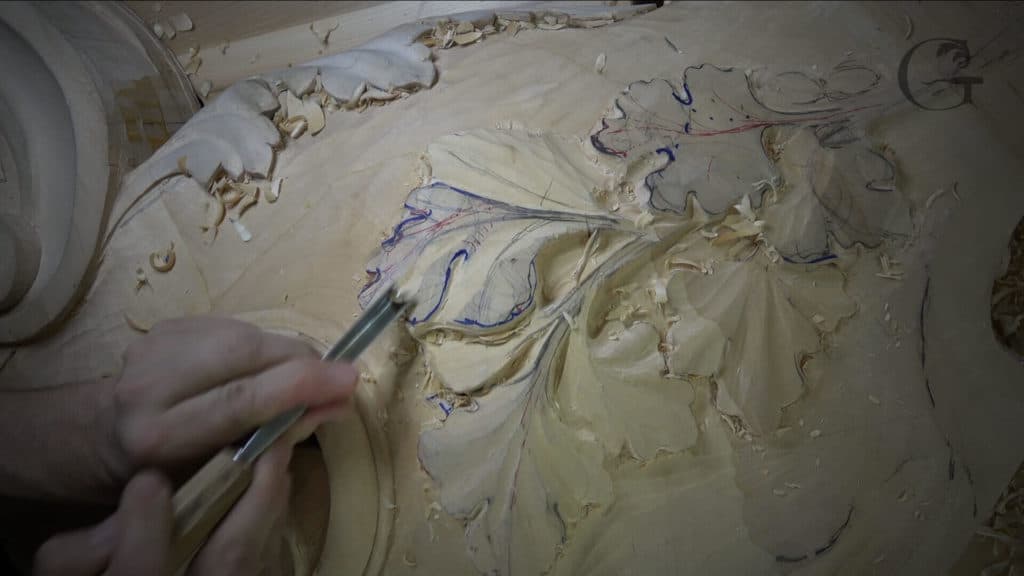
Alexander Grabovetskiy, woodcarver, School of Woodcarving · Published 2021
What does a wood carver mean by "just fine"?
Quick answer: In the sixth video of workshop 98, a number seven on a leaf earns the words "just fine." Lessons from other courses carry the same verdict after a try, with the tool, the size and the next step named. Each one is read with its nearby lines.
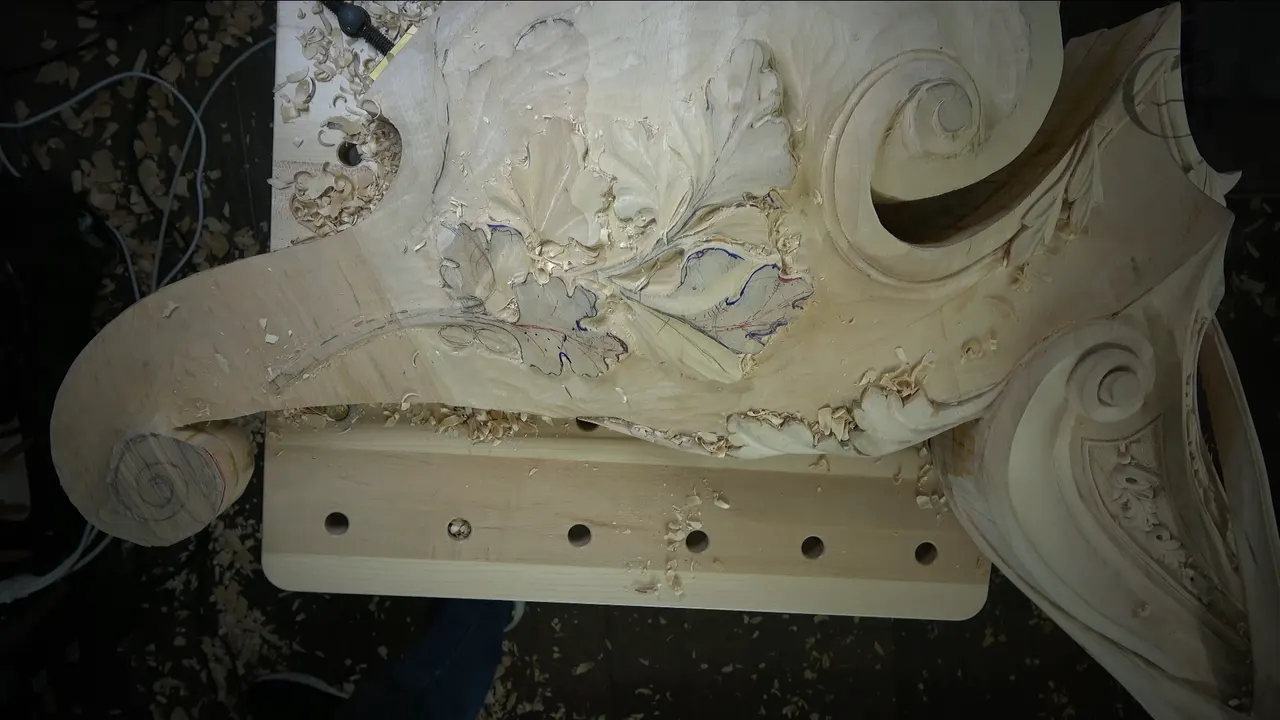

In the sixth video of workshop 98, I turn a number seven over on a leaf and give my verdict in two plain words, "just fine." Many other lessons carry the same two words, each with its own tool, its own size and its own next step. I read every one of them with the lines around it, so you can see what I mean.
Ever picked a tool, tried it, and wondered if it was good enough? I do that on camera in these lessons. This page follows the answer I give myself, lesson after lesson. Sizes come in millimeters and inches, with my figure first and the conversion after it.
How does part 6 of workshop 98 lead to the words?
The part opens with a decision. "So let me think what's next I want to do," I say, and then "There is nothing to think." A leaf is next, "this leaf right here." One middle line runs "this direction," another runs "that direction" and a third area is "much smaller," which "is okay, which is fine."

My plan for the convex is spoken in advance: "let me start by establishing my convex and I'll see how it looks." I warn myself too. "I don't want to do too uniform, okay?" A shape that is too even is "going to be looking fake."
Blending comes next. My pick is "I'll use number three upside down" then "Half an inch" (12.7 mm), and "And blend it from both sides."

My question's tool comes next: "Let me try number seven upside down." A little later I say "And it works just fine." The next job is in the same spot: "Let me also clean up a little slightly in this section."

Soon after I say "And again, previous tool." I tell you "So I'm somewhat happy with the movement" and I add a reminder: "Yes, I still have to work on outlining and so on."

Now to the left side of that development. "Same idea, right in the middle there's going to be a convex." The need is "And I need to attack that from an opposite direction." The last cue is "On another side too."
Does "just fine" come after a try?
Across the cases I read for this page, a tool is tried first and judged second. A try with no verdict yet is in workshop 98, part 7: "number 7, 14 millimeters again" (about 9/16 in), for "a little better outline to that section."
Part 10 of workshop 41 follows the same order. My try is "I'm going to try number 11 and 10 millimeters" (about 3/8 in). "And looks like it works just fine," I say. A leftover spot follows right after.

A round shape is the goal over in workshop 13, part 5. My choice is a seven upside down. "It's going to give me really good roundness" is the hope. The pass gets "just fine." What it is not comes next: "Yeah, it's not the final form, but it gives me exactly what I want."
A first try is planned in workshop 60, part 7. "Number 5 I'll try first, and if it's not going to fit..." I leave that sentence open. Some lines later I am "after this shape" and I call that number 5 "just fine," while the angle I plan is "a little in right away."

Volutes are a different job. For workshop 157, part 2, I say "let me get number six or number five, but I'll try number six first, and I'll try to create my volute." The tool that stays is a number six at 10 millimeters (0.39 in), and I call it "just fine" with a limit I take up in the next section. Then comes "the point of my acanthus" and I say I do not want to lose it.

Workshop 33, part 6, puts a number five under test, and the verdict is "just fine." What it leaves is "beautiful preliminary shape" to me. My plan reads: "I could leave it actually like that, without extra separations and so on, but I will do extra separations."

What is left to watch afterward?
A second tool can be waiting. Back in workshop 41 I say "Except I still have a little region I have to get with the smaller one, with the seven." The size is spoken too: "Seven millimeters, that's what I'm saying, okay?" So 7 mm (0.28 in), "Little bigger than a quarter inch."
Care comes next in workshop 37, part 10. I come at an area from the side with a number seven, and I judge that pass "just fine," though a warning follows, "But I still have to be really careful." Another thought crosses my mind, "Maybe I should use a smaller number seven."

A mallet is in workshop 23, part 10. "Okay, number 11. And I can probably try with 10 millimeters first" (0.39 in). "And with the help of the mallet" then the pass is judged "just fine," yet depth is my worry after that: "But I also have to keep an eye that I'm not going all the way through."

Fiber is what I watch in workshop 6, part 10. I could take a V tool and "create preliminary cuts like that with the V tool attacking from the sides," I say. In this case I stay with a number one, and the verdict is again "just fine," although fiber is the watch: I do not want to "overstress my fibers."
Part 12 of workshop 6 brings a seven in among the small bits. I add "At least in this case, works just absolutely fine." Hurry is the risk. "Again, I can't rush it because it would be a big mistake."
Back in workshop 13, I plan "Now I can probably just clean everything and develop more."
Does "just fine" cover the whole job, or one spot?
Sometimes I tell you how far it reaches. Over in workshop 83, part 4, I say it of "Number 7, 14 millimeters" (0.55 in), and add "in this case." Just before, I admit "I've got too many tools on my workbench now, so it's time to clean up because I'm losing track of my tools." After it I say I am going to need "a spoon gouge because this area, that's the only way I can attack."

Time sets the limit in workshop 3, part 12. A heavy piece sits on a rubber, and I say "I actually did not clamp anything." The rubber helps: "it's a rubber, it prevents that from slipping." Fastening comes later: "I probably have to fasten it, and I'm going to fasten it from the backside." Then comes the verdict, "So, but as of now" with a time limit built in.

My own taste is the limit in lesson 4, part 1, of the Lily Box course. The subject is my setup. "I know it's not as stable as if you would use, let's say, just a normal workbench" and the verdict ends with "for me." Wobble gets a word too: "So this wobbling is not distracting for me, okay?"
The scroll saw part of Lily Box 1 has a limit of its own. I went back and forth like a zigzag and made "a bigger opening right in this area" so my blade could turn. Its verdict, "just fine" comes with "sometimes" and "a smaller area like this."
Shadow is the problem in Lily Box 12, part 4. I say I dislike "really sharp shadow on this side" and that I could "take number three and carefully blend." My verdict on that number three is "just fine" with an "I think" in front of it. A second option is making the movement "downhill right here also using my tool upside down" and I say I kind of like it.

Is it only a numbered gouge?
No. In workshop 39, part 9, a spoon opens the video, and "just fine" is the first thing I say about it. A V tool is the subject in lesson 43, part 6, of the Hashemi Flowers course: "I'm using just a V tool right now" and for "some spots" the verdict is the same. My reminder is "I should not forget about those ones" and the final excavation there will be "kind of deep."
A flatter gouge gets the verdict in lesson 18, part 12, of the Furniture Panel course. The plan is to "take out that hill" and "And use flatter tool, or flatter gouge, I should say, and clean it." My line is "Just a flatter gouge, like number three and a 1/4 inch will work just fine" (6.4 mm). The size comes twice, once as a quarter inch and once as "6 millimeters" (0.24 in).

In Flower Rosette 1, part 4, the tool is a knife. "I could use just the number 12 knife," I say, and "I'll just connect those spots." It ends with "And that should be just fine for the main outline." A number six of "about half an inch" (12.7 mm) is next, and no deeper than "eighth of an inch" (3.2 mm) for now.
Return passes are the job in Flower Rosette 2, part 4: "Now, I'll use my background tool again to make return cuts." That tool earns "just fine" then I add "So any number three will do."

Roman Acanthus 11, part 4, holds a choice. A five is "what I've done before," but "looks like number one" is my pick, with the same verdict. Tools are not the topic of Roman Acanthus 6, part 4. "And you can see I'm actually locked, like I told you before, my hand" and the verdict is "just fine." Long passes follow: "And I can do long and continuous cuts."

Another size is in part 14 of Lily Box 10: "I'm using number five and 10 millimeters" (3/8 in, as I say there). That pass earns "just fine." Then my next line is "All right, so now I need to attack this area."
Tiny sizes get the verdict too. Grape Onlay 10, part 3, has "here you go, two millimeters" then the same verdict, and then a limit, "but I need to get half a millimeter now." That is 2 mm (0.08 in), then 0.5 mm (0.02 in).

Does a result get the same verdict?
A result gets it too. I stop to check in workshop 25, part 1: "Let me double-check if I've got anything else to do." Then I see "And it looks just fine and clean." Another option follows, "Yes, I could attack little bit the side" and a big tool or a skew crosses my mind.
Seen from above, a carve gets the same words in workshop 35, part 4: "Let me see how it looks from above" and then "And from above, it looks just fine." A twist is on my mind, though: "I'm not sure if I should or not."
Twice in one part: Furniture Panel 17, part 8. "And this area, I'll use number five, and that one is 7/8 of an inch" (22.2 mm). Only "a corner of it" is used, and the result is "just fine." Next I check "if it's going to match rest of the profile."

Later in that part I need a bigger tool and think a number seven over. "It looks like this is just fine," I say, and "Number seven and one inch is what I used" (25.4 mm).
Looking ahead is in workshop 12, part 9. "Right now it's a straight line." A line like that is not wanted, and what I want is "a really nice flow movement." My pick is "number five, I would say" and the forecast uses the same two words. A few hits are planned, "maybe a little inward slightly."
Lesson by lesson
| Lesson and part (course named when it is not Venice Room) | What goes with my just fine |
|---|---|
| 98.6 | A seven on a leaf, then a nearby spot to tidy |
| 41.10 | Small region left for a seven, 7 mm (a little bigger than a quarter inch) |
| 13.5 | Clean everything, then develop more |
| 60.7 | Preliminary undercut |
| 33.6 | Beautiful preliminary shape, with extra separations still planned |
| 157.2 | Volute work, with the point of the acanthus to keep |
| 23.10 | Mallet in hand, and an eye on not going all the way through |
| 37.10 | More care |
| 6.10 | Number one, and fibers not to overstress |
| 6.12 | Seven between small bits |
| 83.4 | Crowded workbench, a 14 mm (0.55 in) seven, a spoon gouge to come |
| Lily Box 12.4 | Number three to soften a sharp shadow |
| Lily Box 10.14 | Number five at 10 mm (0.4 in), then the next area |
| Hashemi 43.6 | V tool in some spots, and the ones to remember |
| Furniture Panel 18.12 | Flatter gouge, number three, to take out a hill |
| Furniture Panel 17.8 | Corner of a number five, then a profile check |
| Flower Rosette 2.4 | Return passes with a background tool |
| Roman Acanthus 6.4 | My hand locked, and long continuous passes |
| Grape Onlay 10.3 | Two millimeters (0.08 in) now, half a millimeter (0.02 in) wanted next |
| Venice Room 3.12 | Heavy piece, not clamped yet |
Which tool on your own bench earns that verdict, and what would you check next? Every lesson here sits inside one tuition plan. More Venice Room videos wait on the Part 9 course page, and other wood carving courses wait too, with a gouge, a mallet, a chisel and chips on every bench. Venice itself is there, and so is the grain, and the shadow on each leaf.
How it's done
- Find the try in part 6. The try comes first, and "just fine" a little later.
- Read on. Another pass in that section comes next.
- Compare a second try. Workshop 41, part 10, tries a number 11 first, then names a leftover spot for a smaller seven.
- Look for the limit. Workshop 83 adds "in this case," and workshop 3 adds "as of now."
- Check what is left. Workshop 37 still says "really careful," with a smaller seven in mind.
Frequently asked questions
Which tool does workshop 98 try just before the verdict in part 6?
A number seven turned over. Earlier I plan to blend from both sides with number three upside down.
What follows the verdict in that part?
Another pass nearby, in that same section. Later I say I am "somewhat happy with the movement," and that outlining still waits.
Is the verdict ever given before a tool is used?
Workshop 12, part 9, forecasts a number five as "going to work just fine." Workshop 60, part 7, plans a number 5 as a first try instead.
Does it mean the job is finished?
What to carve next