
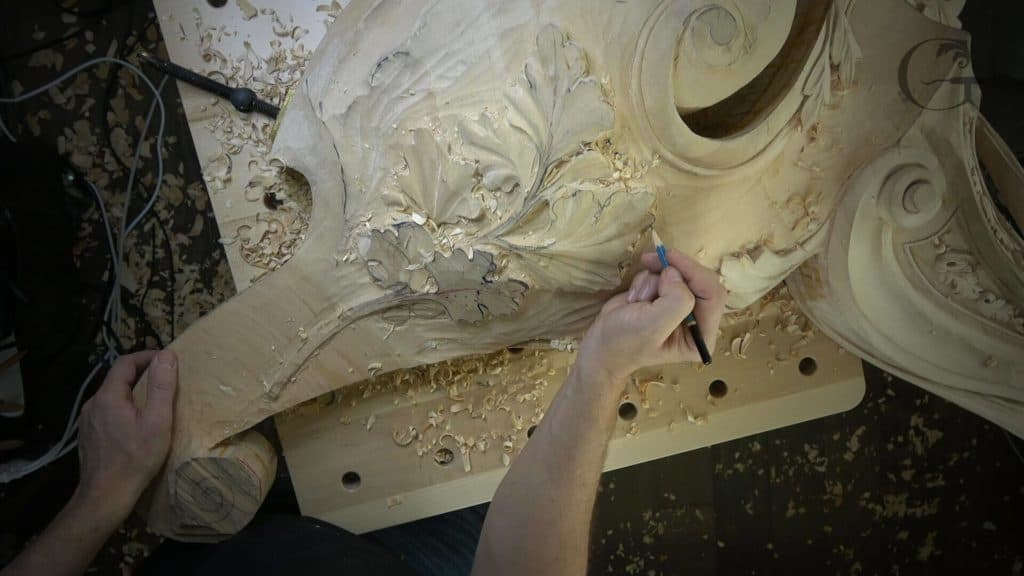
Alexander Grabovetskiy, woodcarver, School of Woodcarving · Published 2021
What does a wood carver mean by "let me know"?
Quick answer: Part 7 of workshop 98 has me sketching waves, then asking whether the sketch makes sense to you. My next line named a number 11 at 10 mm (0.39 in) for notches. Other lessons ask about seeing, liking and what to teach next.
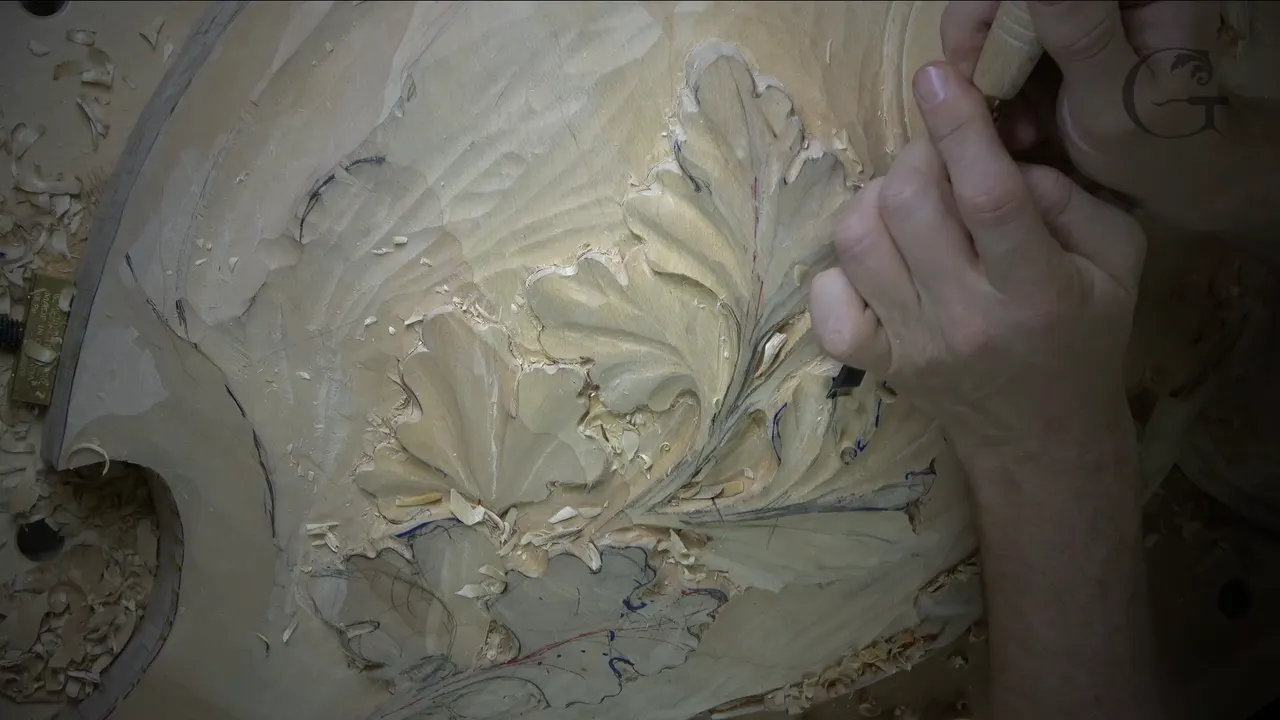

In the seventh video of workshop 98, I sketch a few waves and then invite you to tell me whether the sketch makes sense. That invitation turns up in lessons across my courses and in my livestreams. Each one carries a different question, so I read the lines around it and set them side by side.
Ever watched a carving video and wished you could talk back? You can. Your answer might be about the picture on your screen, or about the carving itself, or about a course you want next. Sizes below come in millimeters and inches, my figure first and the conversion after it.
What happens in part 7 of workshop 98?
The part opens in the middle of a blend: "And let me blend that middle part." I also plan to "clean right away this edge" and I say "let me clean this side also."

Then a sentence breaks off. "And I'm ready to work on the" is as far as I get. "Well, actually, I'm not ready to work on the thing because I see a lot of messy areas," I say, and I follow it with "That's okay. I'll fix it a little later." The plan for now is "let me establish the outline first, and I'll clean everything."

Drawing begins with "Okay, let me draw." The first line gets a name, "the main triple movement." Then come "movement going this direction," "a secondary wave" and "a little wave on this side right here." For another spot I plan "exactly the same right here."

One wave gives me trouble: "This one doesn't make too much sense, but I'll try to make sense of it." I count it out, "one, two, three" and give my verdict: "I think that is enough." The invitation arrives right after "Something like that." In my words: "So let me know if it makes sense."

Next on my mind are notches: "Going to establish those whatever notches. The number 11 and 10 millimeters" (0.39 in). A mixed verdict follows: "Some areas it's okay, and some areas it's a little too big."

Later I tell you "Getting closer to what I want to see." My next plan: "I'm going to use number 7, 14 millimeters again" (0.55 in), to "Give a little better outline to that section." The next video in the lesson opens with "let me use a smaller number 11."

The part runs on plans for blending and cleaning, a drawing, and notches to come. Elsewhere the invitation returns with other questions, and I sort those by what I hope you will tell me.

Can you see my work clearly?
A marker is on my mind in workshop 52, part 8. "I need to probably use a marker or something like that for you to see much better. So that would be my middle line." I check "if you see that okay" and my own plan follows: "I want to get my middle line really fluent and going all the way down."

Over in workshop 56, part 5, I offer a closer view. "Maybe I can show you closer." I wonder if you like "those close-up shots" and I add "If it's better for you." There is a reminder too: "you see much bigger picture than I see." For the wood itself I need "to attack from three sides until I have plenty of space for the full rotation motion."

Sound is the problem in A Simple Tip for Back Cutting. After saying hello, I ask about "if you can hear me, if you can see me, and the quality of picture is good." My audio is acting up "this morning." I tell you I "had to connect four times, four times, just to be able to get that short video."
During a livestream from April 2020 about creating shadows, I think about moving my camera. "Maybe I'm going to just reposition little bit my camera so you can see a little better that excavation." I check "if the shot is okay." Later I plan "to bring it a little closer to you" and the same check comes back with "if it's good."
In How to Sharpen Micro Tools, I check whether I have "a different angle for you can see my sharpening system." Next comes a plan: "turn the lights on for you can see that better." I ask whether you see it, since the sharpening system is the subject of that video.
Does it make sense?
Workshop 54, part 12, states a goal: "now the goal is just to create a really nice concave, convex, concave." I will "continue my concave all the way this way," I say, "later on." I add "Hope it makes sense" and I ask for a reply if it does not. I plan to "blend this ridge with the back bend," though "any flat tool will work in this area."

Someone asks me a question in workshop 55, part 4, and I say "if I did not understand correctly the question," I need to hear about it. The answer: "another approach would be just like mine." "I did over all main movements" and "I did not develop the movements details inside until I carve it."
A livestream from that month covers wood movement and buying wood. "Either quarter sawn or rift cut." A request for your answer "in the chat, please" follows "Hope it makes sense." Nearby are "Do you understand what I'm trying to explain" and "I'm actually looking for a rift cut."
In Furniture Panel 28, part 1, I say "I call it like molding. I'm not sure if it's correct." A request for a reply follows, and then an offer: "I can exaggerate a little deeper right here."
In Furniture Panel 32, part 3, I look back at "what we worked on today" and "that's how it looks in the world." I tell you "Hope it helped" and ask for a reply "if it's helped."
Do you like it, or does it bug you?
Workshop 62, part 4, has a section I call "ready, I believe," or "preliminary." "I'm still going to keep it," I say, with a wish to "get an idea where it's going to be my boundary." "Can you see the development" is my question, and so is whether you like "this project." "If it even helps you," I add, "you can take a small section and use it somewhere else."

Part 12 of workshop 72 asks for your view "in the comments," specifically on "the design overall and the Venetian style." A humble line follows: "that is just one of the styles, pretty much. Just one of many."

A tool gets a note in workshop 64, part 1: "this tool needs to be sharpened a little better." Then I say "that is good, I think" and I ask for "what you think." A deeper pass is the plan, "a little deeper excavation right here."
In the Vase with Grape Leaves course, I invite you to "please comment" about the project, and I add "The idea of it." I also say "this is going to be more on coloring wood and so on" and "I think it should be really good."

Music is the subject in workshop 2, part 10. My question comes with "I wanted to ask, when I put the music on the background, does that help or not?" I try "to be as low volume as possible," yet "when it's too quiet in the background, it's just boring." I say I will "listen to multiple feedbacks, not just from one guy." "That would help a lot to improve."

Noise is the worry in workshop 35, part 12. "I didn't use it before because of the noise," I say, and "it's not much noise at all." A line with "if it bugs you" follows, and after that a plan: "let me undercut underneath of this division."

I cannot show you everything in Chamomile and Bow Rosette 2, part 2: "it's impossible for me to show you exactly what I see, but I'll show you later." Next come "if it helps" then "if it bugs you" and a plea: "Just don't be mean."
What should I teach next?
A new course is the idea in Furniture Panel 36. I describe a style I prefer to scrolling, though "don't get me wrong, it's just different." Feedback matters here: "I really appreciate your feedback." The ask is simple. If you really think "I should do a course," tell me.

In Greek Acroterion 5, part 3, I call "complicated acanthus leaf design" my big interest. School projects are on my mind too, and I ask what you hope to find me carving at school, "for just the school projects, how you can apply that."

Grape Onlay 12, part 3, carries plans: "I am planning to do some other projects for the school, for the courses." My question is which project I should carve for the school, and your answer "would be really helpful."
Drawing is the topic in workshop 93, part 1. Drawing for carving, I say, is not the same as working in the "2D world." "It's absolutely different." What you think of that idea is my question, and I admit "I can overcomplicate stuff."
A one-on-one lesson is the idea in workshop 55, part 1: "maybe it's a good idea to give a lesson one-on-one," for "some area you're struggling." "Again, one-on-one over internet." A no is fine: "If you don't, that's okay."

The idea gets a condition in workshop 53, part 4: "I'm not going to do that for free." It "has to be paid because it's my work, it's my bread." My picture is "half-an-hour sessions or 40-minute sessions," to "attack specific problems, specific subject." Are you "interested in that"? I want to know.
Talking is the question in workshop 83, part 10: "I would like to ask some of the permission." "Since this project is big and for me, it's kind of hard to film and talk all the time." My offer is "if it's okay, sometimes I'll just be quiet and keep carving." Some of you wrote me an email: "They want to see a real life more."

A mallet livestream from April 2020 touches the price of work. "It's a really, really tricky subject," I tell you, and I ask if you want "a little more in depth how to price your work."
In October 2020, a livestream widens the circle. I ask "what would you like to hear from me in the livestreams." A limit follows: "Please don't expect me to talk what I'm talking only on a school site because like I said, it would be really unfair to the people of my school."
Where does each invitation sit?
| Topic and where I say it (Venice Room unless a course is named) | What comes with my ask |
|---|---|
| Drawn waves (98.7) | Then notches with a number 11, after an invitation to say whether the waves make sense |
| Marker line (52.8) | A marker so you can see the middle line much better |
| Close-ups (56.5) | Close-up shots, and a much bigger picture on your side of the screen |
| Sound check (back cutting tip) | Hearing me, seeing me, and the quality of the picture |
| Camera move | Creating shadows livestream, with a camera move planned to show an excavation |
| Lights (sharpening micro tools 1) | A different angle on the sharpening system |
| Concave, convex, concave (54.12) | A planned blend with a back bend, though any flat tool will work there |
| Possible misreading (55.4) | An answer: main movements first, details inside only when I carve it |
| Buying wood (livestream on wood movement) | Quarter sawn or rift cut, and whether you follow |
| Day's work (Furniture Panel 32.3) | Whether the day of work helped |
| Preliminary section (62.4) | A boundary to see, and a project you might like or not |
| Venetian style (72.12) | The design overall, one style of many |
| Sharper tool (64.1) | A tool to sharpen a little better, then a planned deeper excavation |
| Noise (35.12) | Whether a noise bugs you, then a planned undercut |
| Hidden view (Chamomile and Bow Rosette 2.2) | What I see, what you cannot, and a plea not to be mean |
| Scrolling (Furniture Panel 36.1) | A style I like better, and a possible course |
| Next project (Grape Onlay 12.3) | Which project to carve next for the school and the courses |
| One-on-one (53.4) | Sessions of half an hour or 40 minutes, for specific problems |
| Quiet carving (83.10) | Permission to stay quiet and keep carving, since some of you want real life |
| Price of work (livestream on mallets) | A tricky subject, with a question on how to price your work and whether you want more |
| Livestream topics (Oct 15) | Topics for the livestreams |
Which of these would you answer first, and in what words? Every lesson here sits inside one tuition plan. More Venice Room videos wait on the Part 9 course page, and workshop 98 holds the part I started with. Other wood carving courses wait too, and your feedback is welcome at every workbench.
How it's done
- Find the sketch. The seventh video of workshop 98 shows a main movement and a few waves.
- Read the invitation. My ask comes right after I count the waves.
- Check the plan. Notches with a number 11 come next in my words.
- Compare other lessons. One lesson asks about a marker line, and another asks about the whole project.
- Tell me. My lessons welcome a comment, a chat message or an email, so tell me what you see.
Frequently asked questions
Which waves come just before the invitation?
A secondary wave and a little wave on the side, after a movement I name. I count "one, two, three" and say "I think that is enough."
What comes right after the invitation?
A plan for notches: "Going to establish those whatever notches."
Is the invitation only about a drawing?
Workshop 52 is about a marker line, workshop 62 about a project, workshop 55 about a lesson idea and workshop 83 about my talking.
Does it cover sound and noise?
What to carve next