
Alexander Grabovetskiy, woodcarver, School of Woodcarving · Published 2021
What does a wood carver mean by "even smaller"?
Quick answer: Part 8 of workshop 98 has me step down to 2 mm (0.08 in) and plan 1 mm (0.04 in) for later. Other lessons attach a size to those two words, and some give the reason too, like a curly grain, a fragile section or a spot seen from below.
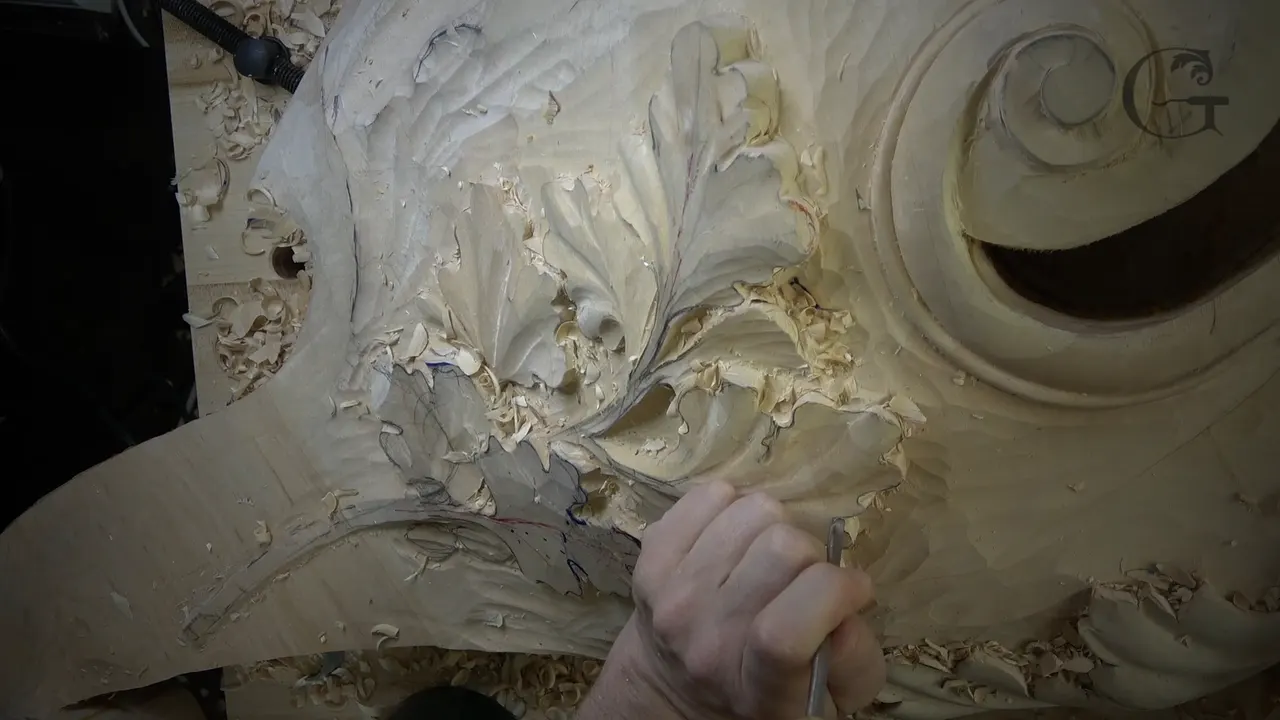

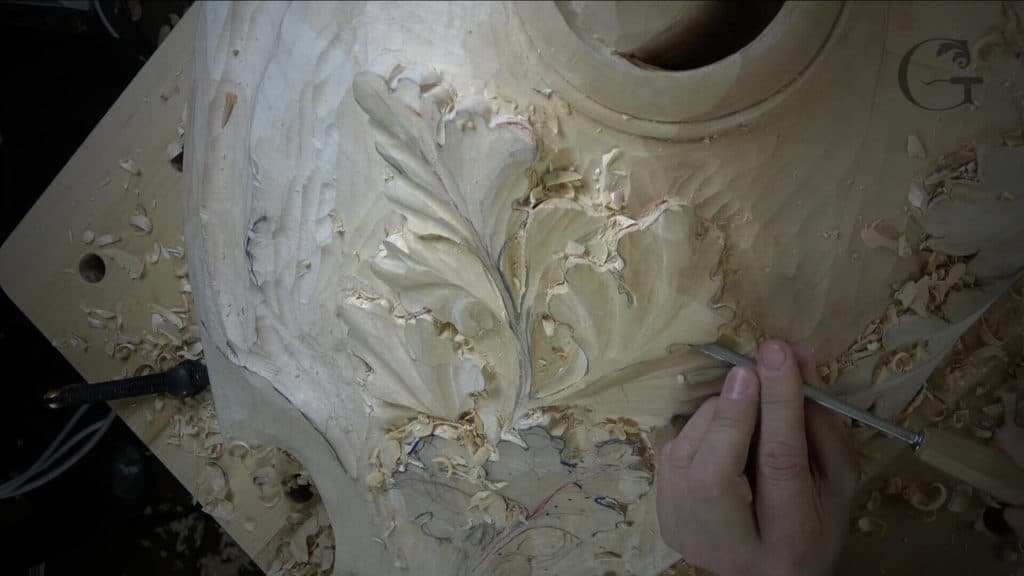
In the eighth video of workshop 98 I name a smaller 11, then a 3 mm one (0.12 in), and then I step down again to 2 millimeters (0.08 in). A plan for 1 mm (0.04 in) comes next. Other lessons of mine carry the same two words, some with a size and some with a reason.
Ever set a gouge into a tight corner and felt it was a hair too wide? That small moment is the whole subject here. Sizes come in millimeters and inches, my figure first and the conversion after it, for the wood carving I show.
What happens in part 8 of workshop 98?
The video opens on a plan: "Okay, let me use a smaller number 11." My next words are "those areas" and then "And I can go around this little thing, number five."

Another plan comes: "And let me clean with the same number seven." The size I name next is "Number 11, smaller one, 3 millimeters" (0.12 inch), with a note that I can probably clean from this section also.

My number 5 gets a remark of its own. I call it a quarter inch (6.35 mm), then correct myself: "Actually, a little less than a quarter." I finish with "It's supposed to be a quarter, but it's not."
Notches are next. I plan to take a number 11 in 10 mm (0.39 in) again "and establish a little nicer notch or whatever you call it." After that, "I'm going to use a smaller one to get this little thing."

The line this page is named for arrives next: "I guess I need to use even smaller, like 2 millimeters" (0.08 inch). Behind it sits one more plan. "And later on, I'll use just 1 millimeter" (0.04 inch), I say, "to get right there."

A clean-up of the whole piece is next. "Let me take number three and clean everything," I say, to "get rid of all the pencil marks and create clean canvas where I can see what is going on and what needs to be taken care of."

Next I say I am "ready to reestablish my middle line and make it more logical." I say 10 millimeters again, with the number 11, then "I get a little closer to the final line" and "from this side too."

One more plan sits near the end: "maybe 5 millimeters number 11" (0.20 in), "and get underneath of here." The part closes on "Okay. That is good."

Other videos of mine use those words too, and I read them next to this one.
When does a number 11 get too big?
The step comes with numbers in workshop 71, part 2. I could "probably just use even smaller right away, like 3 millimeters or so" (about 1/8 in), even "right at the beginning of an eye." After that, 2 millimeters (just over 1/16 in) "or even 1 millimeter" (a bit under 1/16 in) "I could do." Then "let me do 2 millimeters" in a number 11, and "I can excavate a little deeper."

A piece of the eye sets the limit in workshop 63, part 6. "I'm limited by this part of eye," I say, and my plan is to take out material "little by little." For the size, I say "probably even smaller, like one and a half millimeters" (0.06 in), to "excavate somehow that way."
Next: "I really don't have to." In my words, "It's still going to look beautiful." "I want to, okay? And it makes a big difference for me."

A hole is the topic of workshop 51, part 5: "I know it sounds bad, but what it is, it's just a hole." The tool I had was a number 11, "four millimeters" (0.16 in). Then I say I can use three (about 1/8 in) "and get even deeper." A reason follows: "this area is going to be visible from the bottom," so a smaller tool is what I "really need." The plan is two millimeters (5/64 in), then "probably to one millimeter" (0.039 in) "or maybe even a half a millimeter" (0.02 in). Later in that part I say "Two millimeters too big."

For an eye in workshop 35, part 7, I "usually like to do number eight." The next tool is a "smaller one, like one-eighth of an inch" (3.2 mm) "or even smaller, maybe two millimeters" (about 5/64 in), "like 3/32 of an inch." Next: "two millimeters is a little too big, and I have to go with the one millimeter" (1/25 in). It is "just one millimeter, number 11," to "get deeper."

The challenge in workshop 66, part 5, is "this raised that's on the way." Then comes "Maybe I need to switch to even smaller one, like seven millimeters" (0.28 in), "Number 11" and "go in." Cleaning follows with "the number seven and half an inch," or "about 14 millimeters or so" (0.55 in).

Does fragile or curly wood ask for a smaller tool?
My reason in Lily Box 4, part 2, is "I'm using even smaller quarter inch right now" (about 6 mm), because I think it will be better. It is olive wood. A little later come the words "I hope you understand why I'm using that smaller tool right now. Because it's so curly. With the bigger tool, I am catching grain."

Part 1 of that lesson sets the first tool, a number 9 at "20 millimeters or three-quarter of an inch" (0.79 in). "It doesn't have to be that," I say, and it "could be smaller." Then: "It could be even smaller if you feel more comfortable." A quarter inch number 9 (about 6 mm) is the tool I name next.
A section of a leaf is fragile in Lily Box 2, part 7. For now the aim is to "just get the main idea," though "I could take right away pretty much even smaller, maybe one millimeter" (0.04 inch). The warning is plain: "be careful not to push too hard because this section is fragile."

Not forcing is the point in Furniture Panel 21, part 8. "I'm not forcing," I say, and "I don't want to destroy my edges." The fix is to "turn to another tool," one "like 1 millimeter" (1/25 in), and then, in a number 11, 0.5 mm (1/50 in).

Work from the backside, in Chamomile and Bow Rosette 4, part 3, the plan is "a small tool without pressing," held "almost like a pencil, if you wish." "Sometimes it's a good idea" to take smaller tools still, I say, and my reason is short: "those small tools, safer."
A mistake on the backside can break the piece, even "after hours of work." So: "Don't press it, okay?"

In part 2 of that lesson, "maybe I can" go smaller, "and create even deeper shadow" in a number 11. Another line says "maybe even a half a millimeter" (1/50 in), and later "Again, it's going to give me a beautiful shadow."

Greek Acroterion 5, part 1, goes looking for a fit along the lines. "Let me check the smaller one, also number 7." Then just "Even smaller" and "it looks like it's a perfect fit."
On the other side: "No, I need smaller." After it comes "Even smaller, number 7, and that would be too scary to use, but it fits perfectly right here." Further on: "Even smaller. Oh, even smaller than that" and "I'm still doing my same number 7 right here."

What makes me step down?
The table sorts the lessons above by the reason in my words, or by what the spot in front of me asks.
| What makes me step to a smaller tool | Where I say it |
|---|---|
| A spot seen from below | Workshop 51, part 5, where I say the area is going to be visible from the bottom |
| Curly grain | Lesson 4 of the olive wood Lily Box course, second video, where a bigger tool is catching grain |
| A fragile section | Lily Box 2, part 7, with a warning not to push too hard |
| An edge I do not want to destroy | Furniture Panel 21, part 8, with a plain "I'm not forcing" |
| Work from the backside | Chamomile and Bow Rosette 4, part 3, where small tools are safer |
| Work on an eye | Workshops 63, 71 and 35, each with its own size and its own plan for the next step |
| More shadow and depth | Roman Acanthus 15, part 3, and workshop 108, part 2, both in a number 11 |
| A fit to the line | Greek Acroterion 5, part 1, in a number 7, with a perfect fit |
| Tool changes that can wait | Workshop 99, part 12, and part 4 of that same lesson, with a line on why |
How small does the next tool get?
Furniture Panel 16, part 1, tells a longer story. "Now I need to get even smaller," I say, and the tool I plan is "just a grounding tool, 1/16 of an inch" (1.6 mm). There are tools smaller still: "I have actually even smaller tools if I need to get something like that in." One is a "long bent number one," "pretty much one millimeter" (under 0.05 in).
Of that tool I say it is "actually 1.5 millimeter" (0.06 in) and "just feels almost like just 1 mil." Then: "Maybe I reshaped that. Yeah, that's exactly what I did, actually. I reshaped that. I made that smaller."

Hashemi Flowers 47, part 1, is about going deeper. The gouge in hand is "about five millimeters" (0.20 in), and I want "a small concave cut on inside right here." For that, the plan is "an even smaller gouge. About eighth of an inch" (about 3 mm), "and make my cut even deeper."
Roman Acanthus 15, part 3, goes for more shadow. "Now I'm going to need even smaller number 11," I say, and the size is "5 millimeters" (about 3/16 in), to "create even more shadow."

After a shadow I call really beautiful, workshop 108, part 2, goes smaller yet. "I can actually get even smaller," I say. The tool is "2 millimeters, number 11, of course" (0.079 in), "and get even deeper right here." My reason is "I know I'm not going to do too many details to that part anyway."

Can the smaller tool wait?
A few lessons end on the other answer. In workshop 99, part 12, I say "I need to switch to a smaller tool" and the pick is "number eight and about 10 millimeters" (0.39 in). My judgment comes right behind it: "I could go actually even smaller than that, but it should be okay."
The Lily Box course, lesson 2, part 4, has the other answer too. A one-eighth inch number 2 (roughly 3 mm) is "a little too big, even one-eighth of an inch big." I have smaller tools "for areas like that," but "I don't need them now. It's too early."
A small blade shows up in Acanthus over Moldings 2, part 2, "maybe no more than" an eighth of an inch (3.2 mm). "Even smaller blade probably," I say, "most likely to get inside of this cavity right here."

Plate with Butterflies 11, part 3, offers a step I decide against. The step is "even smaller cuts with the smaller gouge," perhaps 1/8 inch (roughly 3 mm). Then: "But I'm not going to do it, probably."
In Greek Acanthus Leaf 14, part 1, a tiny tool goes under a pipe. I have smaller ones "of course, too." Still, "for this, it looks good." The sweep is hard to name: "it looks like it's number eight. It could be number nine. It's hard to tell because it's so tiny."
Is smaller about gouges alone?
The words reach past tools. The design principles course shows them on arcs, in lesson 4, part 4: "that arc, that curvature, that movement is a long one. This one is a smaller one. That one, even smaller one." Rhythm there is "repetition of the detail, but it's not supposed to be the same size."
The Golden Ratio shows up in that part with "40%" and "60%." A repeat, I say, "but on a different scale."
A volute is the example in Furniture Panel 14, part 4. "A small volute. I can make it even smaller and stick number eight." The Fibonacci sequence follows, "one, two, three, five, eight" and "I am trying to be pretty close to those Fibonacci numbers."
Punches carry the idea in Bubbly Background. Next is a "smaller diameter punch," "3/8 or a little less than 3/8, actually" (9.5 mm). Then: "I have even smaller ones to get in smaller areas like that area right here."
Who is part 8 for?
Anyone who has picked a gouge, set it on the wood and felt it was a size too big. Twelve videos make up workshop 98, and this one sits inside the Part 9 course of Venetian style wood carving.
Which size would you reach for first on your own bench? Would a number beside every step help? Tuition opens the whole school, and each lesson above sits inside it.
How it's done
- Watch the eighth video. It names a smaller 11, a 3 mm gouge (0.12 in), a smaller one and a 2 mm gouge (0.079 in).
- Hear the plan. Right after that line comes a plan for a smaller tool, later on.
- Compare the sizes. Workshop 71 gives two sizes in a row, and the olive wood lesson gives a reason.
- Read my reasons. They are curly wood, a fragile section, an area that shows from below and a backside.
- Tell me. Pick a lesson in the table, listen for the size I name, and tell me what you notice.
Frequently asked questions
Which sizes come up in the eighth video of workshop 98?
A smaller 11 opens it, and a 3 mm tool (0.118 in) comes before my remark that a number 5 is a quarter inch (6.35 mm). The 2 mm one (0.08 inch) follows, and I plan 1 millimeter (0.039 in) for later.
What comes right after the line about going even smaller?
A plan for a smaller tool still, later on, "to get right there." A number three follows, for the pencil marks.
What reason do I give on olive wood?
The wood is "so curly," and a bigger tool is catching grain. It comes in lesson 4, part 2.
Do I step down when a leaf is weak?
What to carve next