
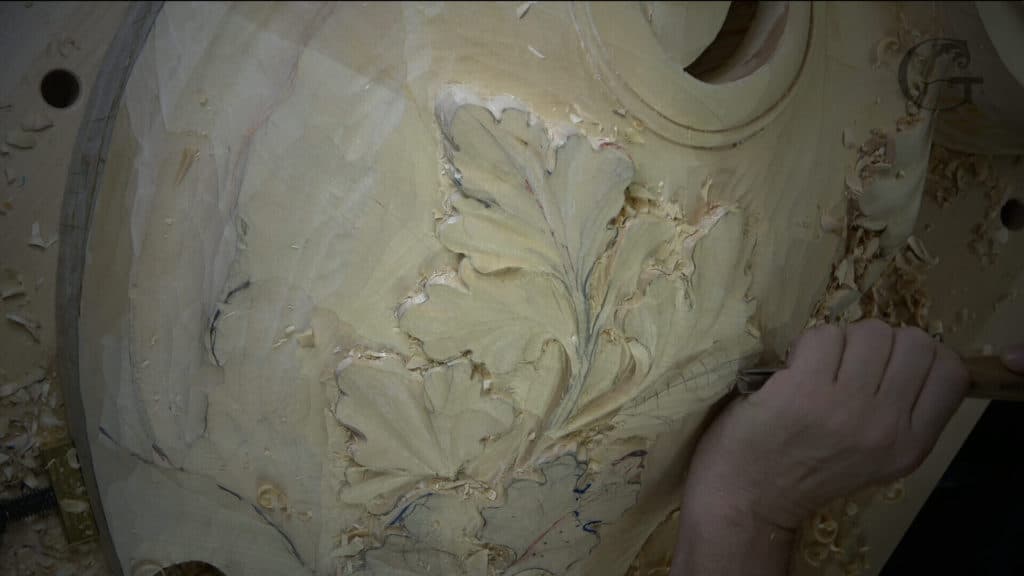
Alexander Grabovetskiy, woodcarver, School of Woodcarving · Published 2021
What does a wood carver do when he says concave and means convex?
Quick answer: Workshop 98, ninth video: I plan "create concave," then catch it with an apology and a convex, and name the same tool, a number 11 at 10 mm (0.39 in). Other lessons carry the swap both ways, with a blue pencil, a tool plan or a molding beside it.
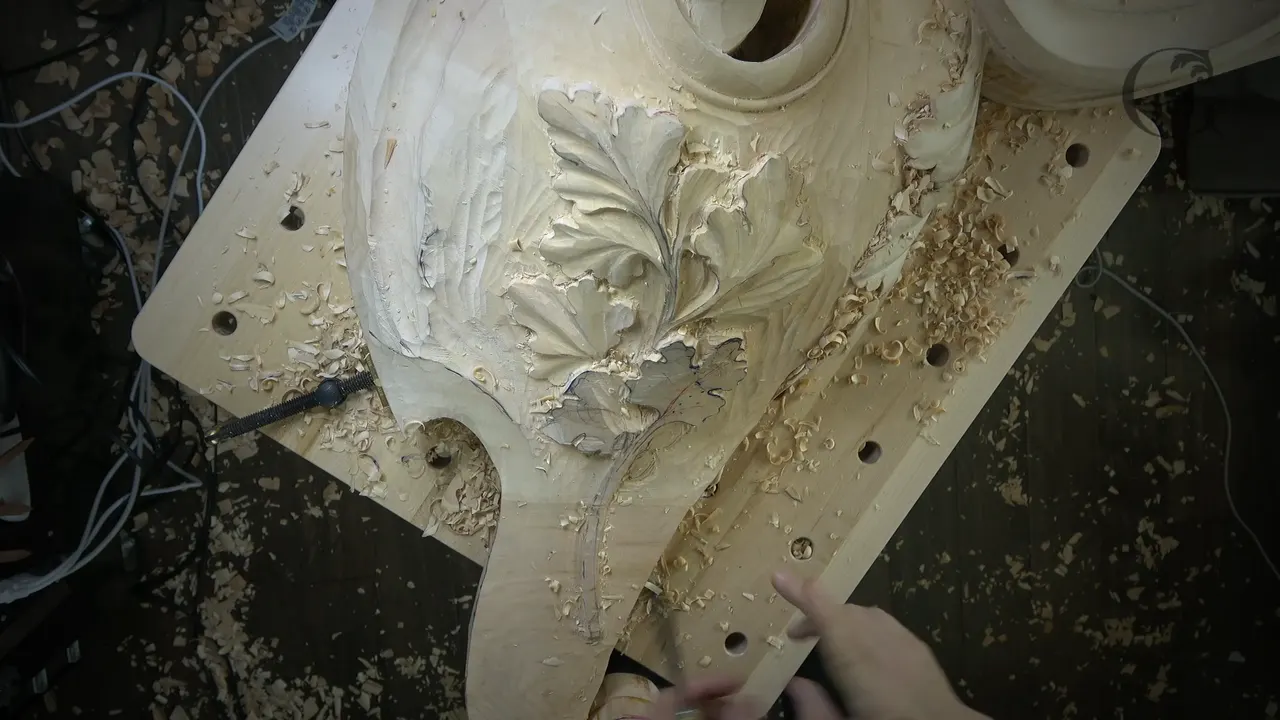

In the ninth video of workshop 98 I plan to "raise up the middle part, create concave" then the sentence turns: "Oh, I'm sorry, convex, this part." A #11 at 10 mm (0.39 in) is the tool I name right after. Other lessons of mine carry the same swap, some with a pencil color beside it.
Ever said left and meant right with a gouge in your hand? That small slip is the whole subject here, and speech errors have an article of their own. Sizes come in millimeters and inches, my figure first and the conversion after it, for the wood carving I show.
What happens in part 9 of workshop 98?
The video opens on the shell. "Like I said, later on I will undercut once we're going to do a shell," I say, and "a big shell going on right here" plus "I'll bring everything to the edge." What you will see is "more or less final look of it."

For now a few sections come first: "I want to take care of" them, "like right here and then right here." A number seven comes first, "I'll just lower down with the number seven," followed by "You will see what I mean in just a second."
"So take number seven and I need to attack that from the right position," I say, and "I'm going to create a concave like this." Concave is the word there. The lines after it are about the leaf: "It still feels like it's a part of a leaf, but it just rolls all the way this way."

A remark on the connection follows, "that makes more sense how it's connected" and "Going to do on another side the same thing, just like that." Roundness waits: "at some point, I will have to give roundness to that stem" and the tool is "probably" a back bend. Of it I say "This one is number eight, by the way, back bend, and six millimeters quarter inch" (6 mm is 0.24 in, and a quarter inch is 6.35 mm).

"And let me also work on this one," I say. The middle line is there, with "one of the divisions going to go all the way this way" and "another one going to go underneath right here." My names for it are "the main movement" with "secondary movements" still ahead. For the notches: "probably take number 11 and 10 millimeters and just pre-establish."

The line this page is named for comes next. "Okay, so let me raise up the middle part, create concave," I say, and the sentence breaks. "Oh, I'm sorry, convex, this part." The tool stays: "And same tool, 10 millimeters number 11. And I'll start."
Blending comes after: "And I'm going to blend it. I'll take just number three." Near the end a movement gets a direction: "We do have another movement going this direction" and "I will now give also convex this way. I'll use the same tool."

What do concave and convex mean in my lessons?
Raised is convex. A valley is concave. Both words describe curvature, and optics uses them for a lens too. Workshop 49, part 8, has both: of a pipe I say "if it's raised like that, it's a convex." The valley follows: "if it's a valley going downhill, going like this, it's a concave." An apology sits between the two definitions, and "Convex, yes" comes after it.
Later in that part I plan "a three millimeters number 11" (about 1/8 in), "really small, one-eighth of an inch, pretty much."
Other courses name the parts. The Byzantine Acanthus course, lesson 4, has me say "Middle is a convex, and a pipe is a convex." Corinthian Acanthus 3 has a line too, "What I mean concave, that means the sections between."
A rule for the pair sits in workshop 75, and I say it plainly: "whenever I have a convex, I have to create concaves." The concaves come first in workshop 100, part 3: "I'll create my concave cuts right on the sides for my future convex."
Where else does concave turn into convex?
Part 4 of this same workshop has one. The plan is "my convex is supposed to go like that" with the #11 again, 10 millimeters (about 0.4 in), one side "and other side." Then "I need to blend it and make it really looking like a concave. Convex, I'm sorry." A #7 turned over is the next plan: "Let me try to use my number seven upside down." Notches follow, and then "A wave. I don't know, you tell me what's the right word." Then: "It's like a pipe, but it's not really pipe. Not in the oak leaves."

The eleventh video of workshop 37 opens with "Now we can develop a convex." I call it "really big convex on inside," a "Preliminary convex, I should say." "I'm not afraid of losing the sides," I say. What I want is "really good concave" then the word turns to convex with an apology in front of a second "convex." After that the look gets a remark: "Oh, it looks messy. But it's okay. It's supposed to look messy at this stage." And "that convex beautifully developed."

In workshop 140, part 2, a back bend is the plan, and the grain sets the side: "I have to just attack that from the opposite direction because of the grain direction." Later: "And I do have a concave now." The next words, after an apology, are "not concave, but convex right in the middle." A cleaning plan follows, the #11 with "7 millimeters," or "Little bigger than quarter of an inch" (7 mm is 0.28 in), then "maybe about even 4 millimeters" (0.16 in).
"And I like it. I like it so far," I say, and "I don't see any reason to do the final clean cut yet, so until I just establish everything." After that comes "a straight down cut, 90 degrees from above." I plan "a number 2 in this case," "a big one, like 30 millimeters" (1.18 in).

In workshop 161, part 3, the swap sits beside a limit. "And logically, I cannot go lower than this concave," I say, and a convex takes its place. A question follows: "Where is the molding going to be?" A change of mind follows: "I thought I was going to keep that part higher, but then I had a second thought." The new plan is to "lower that down and also drop a little bit that section of a canvas," so "from down, up, and down again."
Tool plan: "just a big gouge," "probably" a number seven, "three inches" (76 mm), then "carefully" and "start shaving." One spot will be "the highest spot" with "approximately maybe half an inch to work with" (13 mm) "to make it a really smooth transition."

Furniture Panel 19, part 8, deals with a surface. "I want to hold it really low and kind of clean it," I say. Then "I really want to see my concave," followed by the apology and "convex on this side." Next is "maybe number seven" with "clean a little bit this part, but not much." Last, the result "in overall composition" and "I kind of like it."

Furniture Panel 29, part 2, holds a double fix: "I still gonna feel like it's a concave, I mean convex, I'm so sorry, convex." Before that comes a limit, "it's not gonna be really deep cut, reason why I do have that molding, which is going right underneath of those petals" and "I don't wanna dig deeper than that molding." Later: "we still have to do concave, I mean convex" then "the center convex right here" and "couple concaves on the side."
Between those lines I think I can get "little deeper concave," for "real nice movement because it's away from a molding." For depth, a hedged "I don't know, maybe about" and then "No more than that. About millimeter and a half" (0.06 in).

Byzantine Acanthus 4, part 2, comes with a measure just before. "We still have some space," I say, "about five millimeters left, maybe four millimeters left" (0.20 in, 0.16 in). Then "exactly the same" and the word breaks: "Concave," an apology, then "Concave, convex, concave. Each leaf." Right after, three names: "That part called pipe, that part called middle, and that thing called an eye."
Next comes advice on a tool: "you can take number seven and 14 millimeters" (0.55 in), "and in some of the spots, turn that upside down and get rid of the extra edges." The result I name is "even better convex right in the middle."

Modern Acanthus 4, part 2, adds one more. "Let me communicate one more time what I'm after," I say. "What I'm after I want to see concave convex" and then an apology and the single word "convex." On the pipe: "pipe is always convex." A promise follows, "I'll explain that on a Blackboard."

In Lily Box 4, part 4, the words are "I going to create my concave, not concave, a convex cut." Then "just like a fillet with a bigger radius this way." Before it comes a tool plan, a number 11 with 3 millimeters (0.12 inch), and after it a flatter one, "maybe like number two and 12 millimeters" (0.47 in). Then "I'm not going to force this section" with the same 11 "and remove that waste." About an edge: "I don't want to touch my edge. I don't want to lose it."

When does convex turn into concave?
The swap runs the other way in workshop 75, part 6. A shape check comes first. "Right now, it just looks like almost Rectangle, which is no good," I say, so I "kind of have to create more tapered look." Pencils come next: "I promise I'm not going to use marker right now. I'll use just a blue pencil." Next: "number one convex and number two convex" then an apology, then "concave. The blue would be concave."
Next, a code to write down: "So let me write that down. Blue would be concave and red will be convex" and of the red, "that would be the high spot."

Workshop 26, part 8, has a shallow concave before the swap. I call it "a more shallow concave" then "I don't really need that deep concave right there." Then: "Again, the idea is the same. Convex... I'm sorry, concave, convex, concave." And a line on how far to take it: "it doesn't have to be on all of the movements like that." Next comes "another concave on the side of the pipe on this side," not "a too deep" one. My plan is "Maybe number six and maybe 10 millimeters" (0.39 inch).

A color comes first too in workshop 94, part 6: "let me use a different color, just the use, like blue color." The pipes come next: "One of the pipes," I say, "Like this." A fix comes: "Not the pipes, concaves. I'm sorry." After it: "Here, I have to be careful" and "also a gradual movement."

Which other words get a quick fix?
A bevel gets the same fix in workshop 30, part 3: "I need to fix, right now, bevel inside. Not the bevel, I'm sorry" and then "concave on inside of this movement." Then a plan: "carefully, I'll just attack with the number five and clean it a little bit." Later in that part: "I need to carry that movement this way" and "a little more."

A tool size gets it too, near the start of that workshop 100 video: "I'm sorry, not number three, but the three millimeters" (0.118 in). A size change follows: "Maybe actually, I need to get a little bigger, like five millimeters" (0.20 in).
What does each lesson start and end on?
The table gives the lesson and what my words look like, read from the lines above.
| Lesson | What the swap looks like in my words |
|---|---|
| Ninth video, workshop 98 | A plan to raise the middle part starts on concave and the word changes |
| Fourth video, same workshop | A blend meant to look like a concave turns into the other word |
| Eleventh video, workshop 37 | A wish for really good concave lands elsewhere |
| Second video, workshop 140 | The concave I have now is corrected in the middle |
| Third video, workshop 161 | The limit I name with one word is named again with the other |
| Sixth video, workshop 75 | Two convexes become concaves, and a blue pencil marks them |
| Eighth video, Furniture Panel 19 | My hollow word becomes a raised one on a single side |
| Sixth video, workshop 94 | One line starts with the pipes and ends on concaves |
Who is part 9 for?
Anyone who has caught a wrong word halfway through a sentence at the bench. Twelve videos make up workshop 98, and this one sits inside the Part 9 course of Venetian style wood carving.
Which word do you say first when a ridge rises beside a hollow? Would a pencil color on the wood settle it for you? Tuition opens the whole school, and every lesson above, in the Venice Room and the Lily Box alike, sits inside it.
How it's done
- Hear the plan. The first word for the middle part in the ninth video is concave.
- Catch the fix. An apology and a convex follow, with the same tool named again.
- Read the rule. Workshop 49 gives convex to a raised pipe and concave to a valley going downhill.
- Compare the lessons. The table lists the places where I start with one word and end on the other.
- Tell me. Pick a row, find the lesson and tell me which word you hear first.
Frequently asked questions
Which tool comes right after the swap?
The same one as before, a number 11, 10 millimeters (about 0.4 in). Blending comes later, with number three. The last movement of the part gets a convex too, and I plan the same tool for it. The middle part is the one I want raised.
What is raised, and what is a valley?
A pipe that is raised is a convex, in workshop 49, part 8. A valley that runs downhill is a concave. Between those two lines I stop to apologize and say the word convex again. The same lesson talks about an eye and a pipe going to the center.
Do I say convex and mean concave too?
Workshop 75, part 6, has it. Number one and number two convex become concave, and I give blue to the concaves and red to the convexes. Workshop 26, part 8, gives a run of three words after the apology, and the same video plans a number six.
What to carve next