
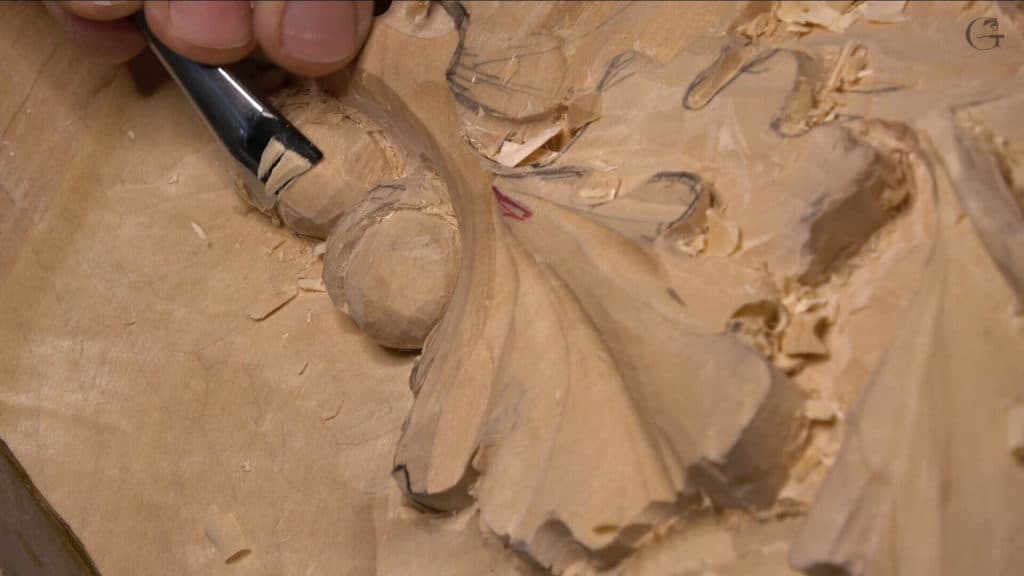
Alexander Grabovetskiy, woodcarver, School of Woodcarving · Published 2021
What does a wood carver mean by "overall composition"?
Quick answer: In Venice Room 99, part 10, I said "I think it looks good proportionally" and, a few words before it, "in overall composition." Other lessons of mine put the same words after a view of a whole piece from above, and beside a drawing with a main point and a second one.
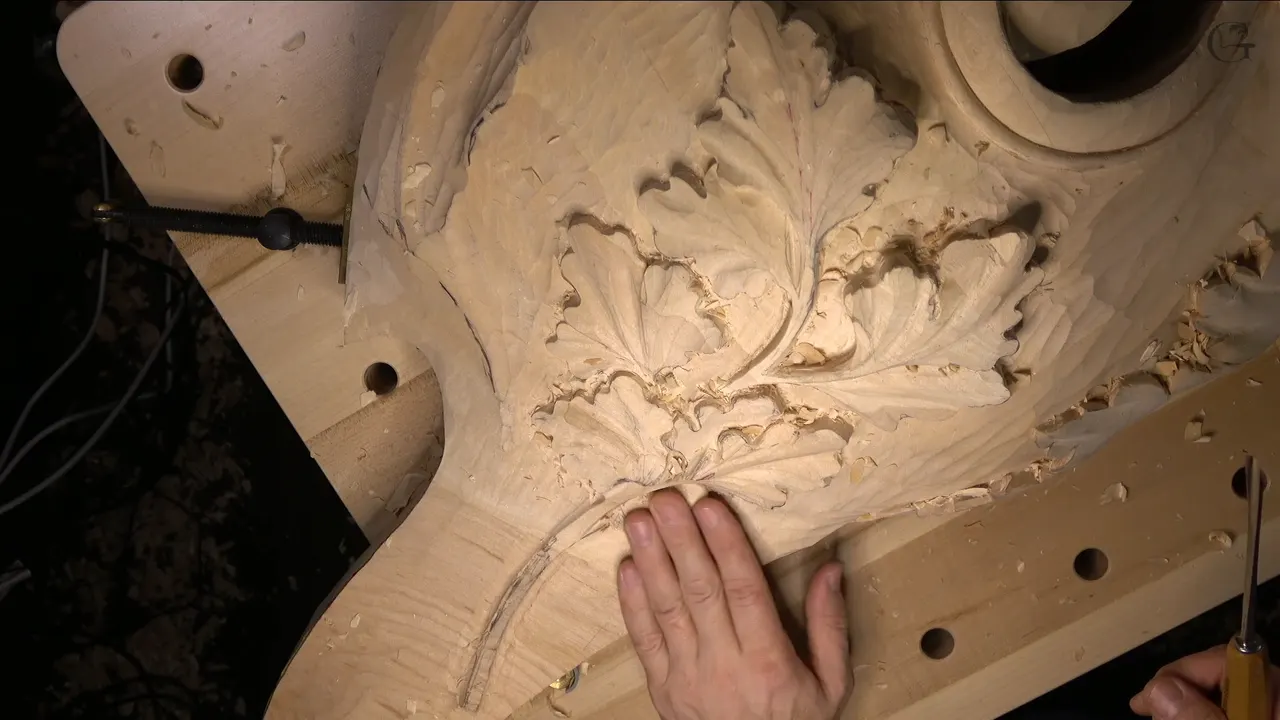

In part 10 of workshop 99 I said "But in overall composition, so how it's supposed to look, I think it looks good proportionally and so on." The same words come up in other lessons, and each place is below. A lesson with a link is open to everyone. A name like 54.3 means part 3 of lesson 54.
Ever stepped back from your board to see the whole piece and wondered what you were supposed to see? Here is each place I said it, in my own lines.
What did I say in part 10 of workshop 99?
Part 10 starts with "Now I also need to work on this one." About the acorn I say "This one is actually good," and then "It does look like acorn. If you look from above." I add "Otherwise, I don't know if it looks even like oak leaves without those acorns." Then comes "At least give some idea."

Further on I say "And I can give somewhat like undercut, not really undercut yet because, like I said, we still have to do a shell." Then "But preliminary idea." Another line is "And now I need to hook this stuff out." One tool is named: "I'm still using the same tool. Number seven and 14 millimeters" (0.55 in).

Then comes "I am sorry that I'm covering it, but so you should get an idea how it's supposed to take shape." A plan comes after it: "Maybe off camera, I'm going to refine a little bit the overall shape, and we're going to work on hat, the upper part of acorn together."

The line from the top of this page comes right after that plan. It ends with "proportionally and so on." Then I say "Yes, of course, I still have to refine the stems". About them: "this one is going to go low, really low, and that one is going to be going like that." Near the end I say "And I need to fix it. I mean, fix the overall movement."

Which lines in part 8 and part 11 sit nearby?
In part 8 comes a reason for waiting. "I'm not going to do a final form because like I said, there's going to be a shell below, and that's going to give me a chance to undercut and just to create the final form." Next, "So this is like I'm after 60% done."
Part 11 begins "I am ready to work on a shell." About the shell I say "same what you saw on our main piece," and my tool is "just probably number seven and about three-quarter of an inch." I plan to "leave approximately 10 millimeters to the edge" (0.39 in). Later I say "about the three quarters of an inch, about 19 millimeters, I'd say" (0.75 in).
That part also has "Really, you have to attack that with the grain direction, but I do have that oak piece on my way, and that's almost impossible." Then "So the only solution would be to have really sharp tools." Near its end I say "It's okay as of now to use that bigger three-quarter of an inch. But I'll switch to a lot smaller one pretty soon."
When do I step back and show the whole piece?
In Panel Design 6.1 comes a line about stepping away from the piece. "It is a good practice once in a while just to step away and look at your composition from just a little distance and see how overall development develops."
In Lily Box 2.1 these are my words: "It does look like I missed a small detail right here." Then "It's okay. We'll see how it's going to look in overall composition." Next I plan "Let me rotate and work on an opposite side."
Next, Lily Box 11.13 has "Let me try to show you from a look above." Then "All right, here you go. That is how it's going to look in a overall composition." Also "And personally, I really, really like it." And "you can see overall movement, even the low relief, it just blends everything together."


For Venice Room 35.1 the line is "But I really like how it blends together with the overall composition."
At Venice Room 46.7 I say "In overall composition, it looks really good." A plan follows: "I'm going to just establish some kind of acanthus movement this way."

Over in Venice Room 54.3, before I develop the main idea of the element, I say "how it looks in the composition." Then "See those two deep spots?" The reason follows: "if I wouldn't excavate too deep in those two areas, it would look different. It wouldn't look developed. It would look off."

Next is Venice Room 74.4, with "I've got to the point when I've done those flowers already," and then "in our overall composition". Right after, "Okay, so I don't want to do anything else except probably just the cleaning."
In Venice Room 74.9 I say "And that's how it looks in our overall composition. So now I have to just create more divisions." I use "number 11 and 5 millimeters" (0.2 in), and before it come "Two big pipes, really thick and pronounced pipes."

Furniture Panel 19.8 has "in overall composition." The next lines are "And here you go" and "I kind of like it."

At 38.3 of the Furniture Panel course I say "Pardon my mess." and "right now in overall composition." Then "I could probably remove that paper."
In Chamomile 1.3 the words "in overall composition" come before "Now what I can do, I can start working on my sides." From Chamomile 4.3: "in a overall composition. Hope you like it."

Then Rosette 3.2: "from above in overall composition." Next comes the tool, "some kind of flatter tool, like number three," and I say "In my case, it's a quarter inch, like six millimeters or so" (0.25 in). At Rosette 5.2 come "That is the flower" and "in overall composition." The undercut and the clean-up of that flower wait for "Off-camera."

Floral and Molding 1.1 turns to the top view with "And that is just a part of the composition," and later in that part I say "Unfortunately, I cannot show you the complete look of it."

What do I call the composition of a design?
Here the words are about a drawing. In Furniture Panel 1.3 I name a simple way, "the rule of thirds," for a board divided in "three equal sections this way and three equal sections that way." Then come "the intersections of those threes" and "four focal points of the composition." After them I say "my goal is to create a beautiful piece of art."
In Furniture Panel 1.2 I say "Doesn't matter if you design composition of a photo, or a fine art, or carving especially." Then "In wood carving, there's a three-dimensional world."
At Panel Design 3.3 I talk about "my opposite focal point." After that I say "it has to be six parts out of 10. And right here is my six."
From Panel Design 5.1: "when you read a composition, and that applies to actually not just the composition like artistic composition, it applies also when you read a book." Then "If you are Western, if you do have a Western mindset, you always start from a left side and you're moving down like this." Further on: "when you look at the composition, what I'm doing right now, I'm trying to unite two worlds."

Over in Panel Design 5.2 there is also "So that means the real center, which the eye is going to focus, it's right here." Two points get names: "we've got the main hero, master of the composition point" and "the second minor of the composition". A story about my youngest daughter and her teacher comes later: "we thought the teacher going to teach all the composition rules, all the color palettes and so on. But no, it didn't happen."
Panel Design 7.1 brings in numbers: "I told you about the golden ratio and the focal points of the composition and so on, but you should also understand about the rectangles." Then "But I still want to be somewhat relative to the overall composition, overall dimensions, and I have to find the inner panel."
Look at Panel Design 8.3 has "everyone who's trying to do some composition in wood carving. In wood carving, you don't use too much colors. You're using just the lights and shadow".
From Furniture Panel 25.1 comes "if you remember in overall composition when we develop that cluster in design, that was a main hero if you wish of the design." Over at Furniture Panel 32.1 comes "but outline first" and then "overall composition I should say."

Chamomile 4.1 says "the main part of this composition. That flower, whatever flower you're going to call it, but that is the main idea of overall composition."
In Rosette 4.1 the words are "that's it on the composition. Now, I know I did not explain how I worked on those three flowers, but I think I showed you enough." Then "So my goal is to show you the technique and development of those flowers."
From Hashemi Flowers 8.1: "with the overall composition, if you wish." Then "You don't have to repeat exactly the movements I do." The next line is "The idea is actually to learn how to do it on your own, to make your own designs."
Hashemi Flowers 5.5 says you can't explain "those laws of movements and rhythm" to everyone, "but it's really important in the composition." And in Hashemi Flowers 24.1, about photographers, I say "who do understand the composition, all the laws of composition".
Do the words go with shadow and tool marks?
Hashemi Flowers 49.1 has "I really like the chisel marks or tool marks and the overall composition with all those facets, with all those side cuts and so on, gouge cuts." Then "They're going to create the shadow." After it comes "Even tiniest shadow casting will do a big difference."
At Venice Room 56.4 I say "So shadow's really important." After it come the words "And especially this huge composition," and later "It wouldn't look good."
In Gibbons Maine 13.1 I say "I've got Shadow right there. I've got Shadow right underneath". Then "it looks really good in overall composition, you know, at least those two."

Tray 1.2 is next. It has "an overall composition and that I can't help you with that. You have to feel it" and "make sure you don't dig too deep at the edges."
In Tray 8.3: "I am looking on overall composition. Try not to make those small varies." For grapes I say "maybe seven eighths to three quarters of an inch" (22 to 19 mm).

Rosette 2.3 has "In the overall composition, even if those flowers are almost the same, but they are not." Then "Even if it's a stylized composition".
Which lessons say it?
The table lists the lesson, what the work was, and a few of my words from each. Each row is a lesson you can watch.
| Lesson | What the work was about | My words |
|---|---|---|
| Lily Box 2-1 | One side finished, then a turn planned | we'll see |
| Lily Box 11-13 | The lily panel seen from the top | really like |
| Venice Room 35-1 | A shell still waiting for its details | blends together |
| Venice Room 54-3 | Two deep spots seen in one wider look | look off |
| Furniture Panel 19-8 | A look before moving to another spot | something else |
| Chamomile 4-3 | A picture of how it will look | like it |
| Rosette 5-2 | One finished flower, then the clean-up | Off-camera |
| Floral 1-1 | The piece seen from above | the composition |
| Design 5-2 | A drawing with a main point | second minor |
| Design 7-1 | A golden ratio and the inner panel | overall dimensions |
| Hashemi 49-1 | Tool marks and facets left in | the shadow |
| Gibbons 13-1 | Shadow above, under and beside | those two |
| Tray 8-3 | Grapes that have to connect | small varies |
Where can you watch the lessons I name here?
The video for this page belongs to Venice Room 99, one of the twelve workshops, 98 through 109, in the Part 9 course. Workshop 98 is in the same course, and its page is open to everyone.
Panels fill the Furniture Panel course and the Furniture Panel Design course, and flowers are in the Hashemi Flowers course, the Floral and Molding course, the Venetian Flowers Rosette course and the Chamomile and Bow Rosette course. A lily lives in the Lily Box course, and a tray in the Tray of Blessing course. Carving by Grinling Gibbons is the subject of the Gibbons class in Maine.
Plain definitions of a few words here are one click away: wood carving, carving, woodworking, gouge, mallet, chisel, grain, oak, acorns, shadow, pencil, lighting, Venice, volute, millimeters and inch.
Want to hear all of this in my own voice? Start here.
How it's done
- Check the acorn. Part 10 has "If you look from above."
- Name the tool. I say "I'm still using the same tool." The size is 14 millimeters (0.55 in).
- Keep the undercut preliminary. Part 10 says "not really undercut yet," and a shell is still to come, as part 11 shows.
- End on the stems. Part 10 ends on "fix the overall movement."
Frequently asked questions
What is the plan for the hat in part 10?
"we're going to work on hat, the upper part of acorn together." The plan opens with "Maybe off camera." Next to it stands another: "refine a little bit the overall shape."
Where does the shell go in part 11?
"That is actually going to go all the way to the volute you don't see." I say "same what you saw on our main piece" about the shell itself.
Do I say it about drawings as well?
Panel Design 7.1 says "overall composition, overall dimensions". Then Panel Design 3.3 has "my opposite focal point" and "six parts out of 10."
Which words come before the piece in Furniture Panel 19?
What to carve next