

Alexander Grabovetskiy, woodcarver, School of Woodcarving · Published 2021
Why draw a carving pattern on clear plastic instead of paper?
Quick answer: A pattern on clear plastic is a pattern you can flip. Paper has an absolutely clean back, I said in a livestream, so a flipped sheet means redrawing everything. In Byzantine Acanthus Leaf 1, I said you can flip the plastic again and again.
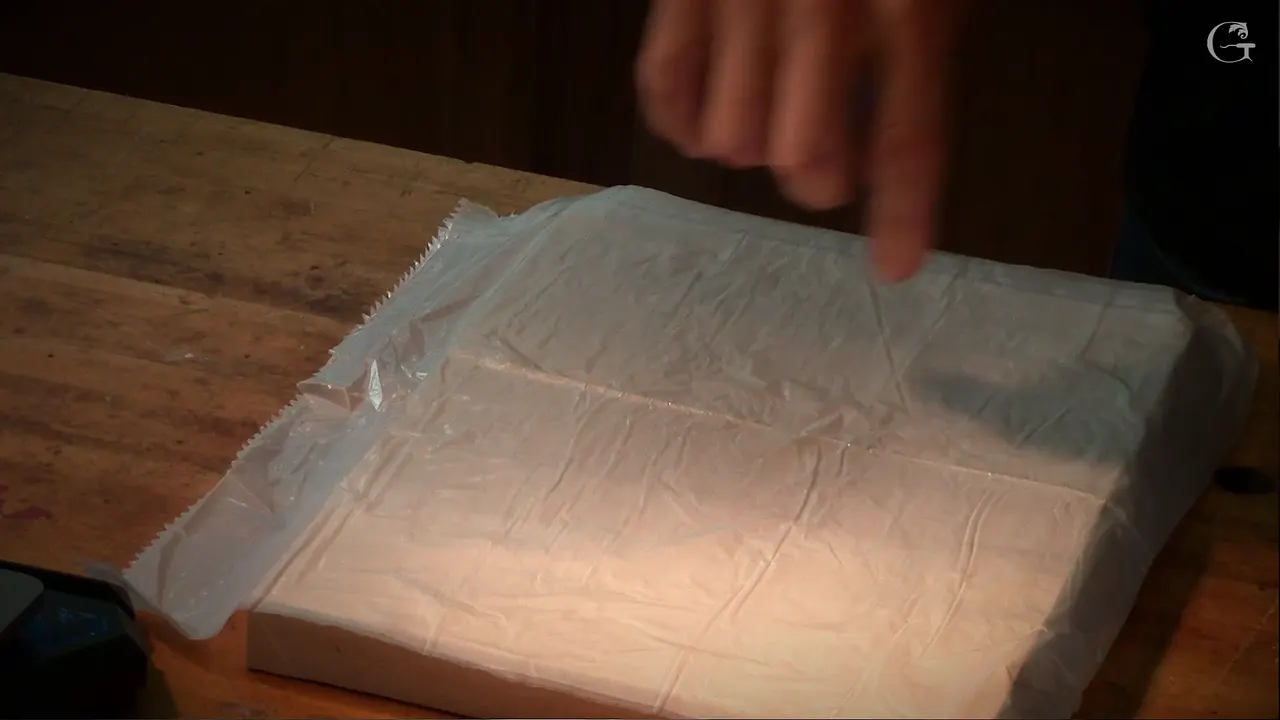

A pattern drawn on clear plastic is a pattern you can flip. Paper has a back that stays blank, so turning it over means a new drawing. Plastic lets you look through it. In video 1 of Byzantine acanthus Leaf 1, I told the class that plastic was what we would use.
Ever drawn one half of a leaf and needed the other half to run the opposite way? Ever wished the first drawing would simply turn over and work again? Plastic does that. Below you get what I did with it in this video, the plastic I use, what I draw with, and a run of other videos where I reach for it.
What did the plastic do in the first Byzantine video?
"You don't have to draw," I said. "If you wanted to, that's okay, but you can actually take that pattern from me and reapply it." What we were going to use for that was plastic.
Two pieces, cut approximately that size, was my request. Someone asked if I wanted drop cloth, and I said "The drop cloth, yes." The drop cloth was "super cheap stuff" and "it's what we need."
"Cheap man technique" is what I called it. When I asked if the room knew what I meant, someone said no. I told them I was talking about "the smartest way to create the carving."

Two patterns were coming. I was going to draw right on the board, take a plastic piece and "the magic tool, which I call marker," draw that, and then you take it to your piece. I had some carbon paper for that.
Go that direction, I said, then the next movement, and the next one. "All you do, flip it, flip it, flip it, and you can do the cover of the whole church if you wish to." The carvers I had named earlier worked without the plastic. They had the pattern on plain wood, and they would cut around it, flip it over and trace it around.
"Easy, right? Super easy," I said. Someone told me I had made a template, and I answered "Template, yes."

The first movement came next, my first swirl. It is "still a leaf, just a normal leaf. It just twists." In this case, I said, it will twist, go that direction, then up, up, up, up, up, and backwards, so it will be "full 3D."
Before the second layer, I said, we have to create the first layer. "But they didn't glue on, they used tacks," I said, and you can pop the piece "really quickly with no problem." Toothpicks or screws from the backside would do too. Screws came later: "not in Byzantine, of course, they didn't have screws, but later on, Orthodox Churches, they used screws from the backside."

"Really simple form," I said, with three divisions: division number one, division number two, and the main movement. "Make sense?" It probably doesn't make sense 100% yet, I told them, "But it will."
"Okay, take a look what I've done," I said. I counted one, two, three, four, five, six, seven, "and the main goes back, eight." Those are Fibonacci movements on this side, on the first layer.

Which plastic do I use for my patterns?
A roll of it, and it has to be clear. In my April 2020 livestream about plastic I showed "a roll of a plastic" and said you can get it at a hardware store, from the garden section as garden plastic or from the paint department as a drop cloth. "Just to check if it's clear enough," I said, and "that is really important that plastic is clear."


In Grinling Gibbons class 2 in Maine, video 2, I said "don't be cheap on that, don't buy really thin one." Get the true garden plastic, I told them, a big roll that is going to last me a lifetime.
Thickness came up in Leaf 1, video 2. "Make sure you don't tear that, okay? It's kind of fragile. So I use a little thicker for just that case, but it's going to work, so it's perfect." For Venice Room 79, video 4, I used "normal garden plastic" and said painter's plastic will work also. "That's really good," I said, and "it's not really thick."
What do I draw on the plastic with, and how fast does it dry?
Colored permanent markers and a ball pen. The markers, I said, "dry really quick, and they're permanent." A normal ball pen did the job too, "really cheap one" and "you don't have to get expensive stuff." That pen is "also wood carving tool."

"Well, this is little smooshing," I said, and "it's not dry yet." A little later, "here it's dry." Permanent markers stay without smooshing, which I called "actually better." Once I put my hand down too early and said "Oops, I just painted myself."
For the trace, I said, you could take a different color from the black I developed with, and you'll know "that would be accurate."

Blue and red had jobs in Maine class 1, video 1: blue for the lower level and red for the upper one, one color on each plastic piece, "You're not gonna mix it." I wrote upper and lower on the pieces too, because I saw people sometimes place one upside down by mistake.
How do I cut the plastic and pin it down?
In the livestream I said "I don't need to unfold all of it." "I just can cut approximately what I need, whatever, just a section of my plastic." Scissors do it, and "you can use a knife."


Push pins held it, I said, "whatever, how big, how small you need." The plastic "just creates the shape what I need to fill." With a drawn piece going back onto the work, I told them it is "really important not to damage the area with the push pins" and to look for the right position.
Venice Room 79, video 4, had a full-scale drawing. My wish was that it "stays in place" and I said "I'm going to need some push pins. Couple of push pins, three, four."

Why can I flip a drawing on plastic, and not on paper?
You see through plastic, and paper has another side that is absolutely clean. Design is supposed to have a law of repetition, I said, so one detail repeats in more than one spot, maybe at a different scale. But what if it must point the opposite direction? "If it would be just a piece of paper like this, it's almost impossible to flip it. You have to redraw everything." With the plastic, I said, you flip it over and "here you go. You see through, and there is other direction."
That is really good for family crests, I said, and for any design, "like for the mantels, for hoods, and so on," when one side repeats the other. "That actually saves you a half of the time." Another example: I can do only one side, trace it, and then fold that, "and that's going to be two sides."

The first Maine class says it in plain words. Draw on one side, and when the second side has to be exactly the same, turn the plastic over and the direction is opposite. "So that is why I like that."
In Venice Room 39, video 3, I drew a detail with a marker on plastic. If I want to reuse the detail on the same design in a different position, I said, "I can just always flip and do that."
A plan to repeat a movement from the opposite side sits in the ninth video of workshop 50. "Just because I used that trick with just the plastic, I have that detail," I said, and "now I'm going to flip it and I can trace it on another side." Then: "So that is much easier for me to do the work." All I need now, I said, is carbon paper, plus a couple of push pins.
"Just because I'm using my plastic, so it's not that complicated to flip it both directions," I said in the fourth video of workshop 79. "So it's really easy."
One side got traced in Venice Room 51, video 7, with the same pattern and the same plastic as the other. It was "about the same what we see on another side, but it's not." "It's similar, but it's still unique," I said.
How do the lines get from the plastic onto the wood?
Through carbon paper and a pen. For the livestream transfer I said "again, just the old carbon paper." You place it, "and again, you just use just a normal ball pen, really cheap one" and you transfer it to the piece of wood. Before that I put the plastic where it belonged, with the same push pins. "I have to match my curvature," I said.

A viewer asked me about carbon paper in my April 5 livestream. There are two ways to use it, I said. One is a normal drawing on paper. The other is for a big piece: "I'm actually drawing the idea on plastic, just normal plastic, like a garden plastic" and the plastic, not the paper, lets you "see from both sides." From there I can turn the detail over and "transfer opposite direction on another end of the design." How often do I use carbon paper? "Not too much."

Leaf 1, video 2, is where I brought one sheet of carbon paper and said "We're going to use just the one for everyone." It lasts for years. A ballpoint pen was my next ask, and I said "Not gel. I don't like gel."
A loose transfer is fine, I said in Maine class 2, video 3. "It's absolutely fine." Getting the line exactly in a position is not the point. We can "move it around with the gouges and so on."
In Byzantine Leaf 6, video 1, I said I would take my plastic and lay it, and my goal was "to trace whatever the black lines I placed." It was "really important for me to get as close as possible to those lines." Video 2 adds "we don't need to trace anymore through the plastic. We can just actually trace the existing piece."
Where did the plastic show up once the carving was under way?
"I need to keep that plastic closer to myself because the movement itself is not exactly the same," I said of workshop 50, video 9. Venice Room 53, video 2, has me saying "I do have that at the front of me for I can see. I mean that plastic."
Calipers came out first in workshop 148, video 3, and then I said "it's not a big deal. I can always use plastic." "Before too late, let me get the plastic and I'll just draw on it. That way it's going to be much easier to find the right position." I was going to keep that piece for reference later. A marker there was "supposed to be permanent marker" and I said "That looks like this one is not too good."

Plastic and marker came up as a plan in Venice Room 149, video 3. "Maybe it's a good idea for me to use, again, plastic and marker and just preliminary draw that section before I wouldn't forget the lines because all that is going to go down." Drawing it on the spot was another way, and I said so: "I could probably draw that right in place with no problem whatsoever. But why not? It takes only a couple seconds."
With two corbels like that, I said in workshop 79, video 7, "I can save that plastic for another corbel." I called it "a really, really good method."
Why do I call plastic a carving tool?
There is a story behind plastic as a tool, I said. By the time of college we used just plastic bags "to carry all of our college stuff." We used plastic wraps for the notebooks too, and for me it was "like a heaven, like a paradise," because I could use a normal pen and just draw. I would listen to the professor and draw on my plastic bags, "just to develop some ideas." "I actually developed the artistic skill."
Of the plastic I said "I know it's really simple, but a lot of people didn't think about it." And "it's one of the probably most useful tool in wood carving."
What if the surface is curved, or the design is in a book?
For some of you, I said, it is "one of the huge, big challenges, how you transfer on a curved surface," or on curves inside, "like a concave, but what about the convex?" The measurement will be different, and not everyone is able to draw right on a piece of wood. Plastic was a solution, I said, though "I shouldn't say it's only solution." You can use it "on concave movements like this, or even convex" and for Queen Anne legs: "You just use plastic again."

An old book of ornamental design prints, "authentic," was my next example, and you can find "beautiful movements and ideas right there." Put the plastic over it, "and again, you can use a fine marker and just trace it." For scale, take a picture, send it to yourself, enlarge it, and use another piece of plastic. You can even place the plastic on an enlarged screen, though "I wouldn't use a ball pen in this case."
Where did each plastic piece come in?
| Where | What the plastic did |
|---|---|
| First Byzantine video | Two pieces of drop cloth, and a plan to flip the pattern |
| Second Byzantine video | A thicker sheet, because plastic is kind of fragile |
| April 2020 livestream | Scissors, push pins, markers, carbon paper, a flip |
| Maine class 1 | One piece for the lower layer and one for the upper layer |
| Class 2 in Maine | A big roll of the true garden plastic |
| Venice 39 | One detail reused in a different position |
| Workshop 50 | I planned to flip a movement and trace the other side |
| Venice 79 | Garden plastic, push pins, a flip in both directions |
| Workshop 148 | I would draw on clear plastic to find the position |
| Leaf 6, video 1 | My plan was to lay plastic on top and trace the black lines |
Which drawing on your bench would you flip? The whole course sits inside one tuition plan. The Byzantine acanthus course page lists every lesson, and Leaf 1 holds the three videos, this one first.
How it's done
- Pick clear plastic. Clear garden plastic from a hardware store, or a clear drop cloth, is what I named.
- Cut a section. Approximately what I needed, with scissors. A knife works too, I said.
- Pin it down. Pins held the plastic where I put it, and I said not to damage the area under them.
- Draw the movement. A marker or a ball pen. Permanent markers stay without smooshing once the ink is dry.
- Turn it over. The other direction is right there, because the sheet is see-through.
- Transfer the lines. Carbon paper under the plastic and a ball pen carried the lines to the wood.
Frequently asked questions
What kind of plastic works for a carving pattern?
A clear one, I said in a livestream, and a hardware store has it as garden plastic or as a drop cloth. In class 2 of the Maine course I said you should not buy a really thin one.
What do I draw on plastic with?
Colored permanent markers, or a ball pen, I said. A fresh line smooshes a little while it is wet, and once I said "Oops, I just painted myself" after placing my hand too early.
What keeps the plastic from sliding?
A few push pins. A cut piece sat in place with them in the livestream, and I said the area under them should not be damaged. For a full-scale drawing I asked for three or four.
What to carve next