

Alexander Grabovetskiy, woodcarver, School of Woodcarving · Published 2021
What does a wood carver mean by "understand why"?
Quick answer: Byzantine Acanthus 1-3 has my question "Do you understand why?" beside a border that no tool may touch, and the answer is gluing surface. Other lessons put the same words next to a cleanup I skip, a smaller tool, a thicker first pass or an area I leave alone.
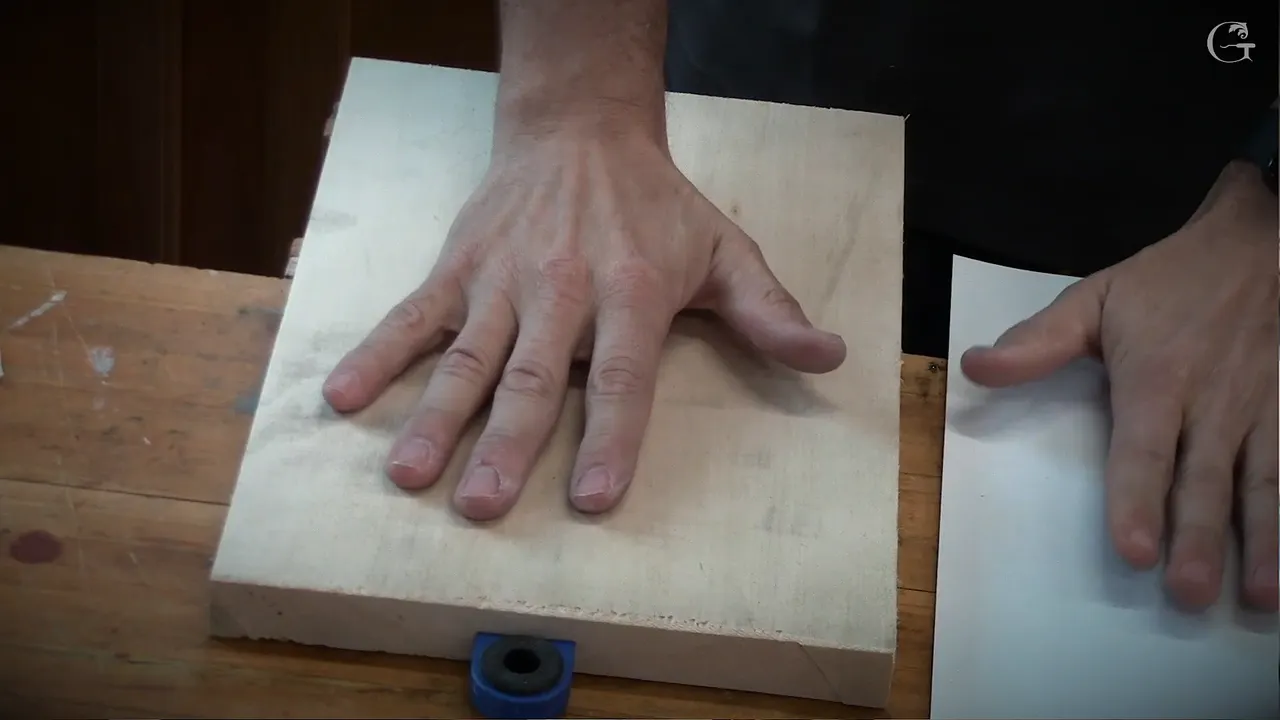

In Byzantine Acanthus 1-3 I ask "Do you understand why" about a border, and the reason I give is gluing surface. Other lessons of mine use the same two words near a cleanup I skip, a tool I change or a spot I leave alone.
Ever carved right up to a line and wondered who put it there? Do you want the reason along with the rule? First comes the line on this Byzantine leaf. Each passage after it names its lesson, so you can open that video and hear me say it.
Five lines on the border and its reason
- Spray the board and the paper, wait until your finger does not stick, then place the piece.
- Three-quarters of an inch (19 mm) is what I want near the corner.
- No gouge and no other tool touches it.
- The answer to my question is gluing surface.
- A bee or a signature goes inside before the top piece goes on.

How do you put a blank down with spray and paper?
The part opens on the spray glue sandwich. You take the surface you will glue on, and you "spray two surfaces": that surface and one side of the paper. Then you wait a minute, and I say "Don't stick it right away."
Your finger is the test. "It has to be dry enough when you put your finger, it's not sticking." If it sticks or looks too wet, "it's not the time yet." Next you take the piece you are going to work on and "make sure you're working on the back side." "Don't glue it the wrong way," I say. Two surfaces again, another wait, and then "glue it, just like that." Last comes "And that's going to hold."

Somebody asks if you need to clamp. I say there are no clamps, just the paper, and the paper does the job. After I spray the second side and place it, I say "And then you start working."
I tell you "it's not going to be as easy as it looks." The sandwich method is "one of the best methods" and I want you to "make sure you understand that and just use it." Micro carving works with it. So do huge carvings.
What do the colors on the board mean?
I pick different markers. Blue is a concave, "deep like an ocean." Orange is convex. Black is "just to give you a picture" and you do not have to use it. On your own board I tell you to use a pencil.
The markers are "just to show you the idea" and it is "a lot easier to see on the screen also as well." The first layer is a "really important layer." On it I want "a concave on inside, like a bowl almost, but still leave some surface to glue on the second layer."

Why does the border stay untouched?
The orange line marks where the second piece goes. "Make sure you've got that border right," I say, and I trace it again so you can see the spot. The step I ask for is approximately three-quarters of an inch (19 mm), closer to the corner. The other figure I name is five-eighths of an inch (16 mm), "but three-quarters is going to be giving you better gluing surface."

The step tapers. "Keep about three-quarters all the way consistent," I say. The rule follows, and nothing gets a hit "by gouge, by any tool." "Don't touch it. So that is your border." The carving happens beside it and inside it, and all of that gets carved.
My question is whether it makes sense, and I say "Please make sure just to do what I've done." Then I ask if you understand why, and the next words are "Because we need gluing surface." The place is "gluing surface right here for the second piece."

For the top piece I list three ways. "You could use just the pegs, like a few pegs." Or "screws." Or "you could just glue." I say they were able to replace that upper piece in Byzantine work if somebody knocked it or broke it. In my case, "I'm just going to glue it, okay?"
Why not follow along at 15 miles an hour?
Next I say "I told you yesterday, I would like you to understand why we do what we do," not just to follow along "like 15 miles an hour and then switch the gear." The sentence ends with "Just because we need to glue."
Maine 1-3, a video of the Grinling Gibbons class, puts the idea with a car. I show "only two steps at a time" and ask you to "really try to understand the logic." Do not be like a person teaching you to drive, who calls out push, stop, turn right. "You have to understand why you're pushing that stop and why you turning right?" The traffic goes that direction, I say.

That video names an area to leave alone too. I keep "maybe about one inch or so or 7/8" (25 mm, or about 22 mm) for the line around. The lower part stays off limits for now, and I say "Okay, just don't even think about it."
What reasons came with the other steps of Leaf 1?
Part 1-1 starts with the background. The background waits, and you do not touch it yet, "maybe not even texturing." The piece I call the first layer is "the first layer of a canvas itself." You do not have to draw. If you want, you can "take that pattern from me and reapply it." Of the swirl I say "it's still a leaf, just a normal leaf. It just twists."
Part 1-2 has more. About the pen I say "Not gel. I don't like gel." One sheet of carbon paper serves everybody. "We don't have 16 people in the class," I say, "so really don't want to waste it. It lasts for years." The plastic is "kind of fragile," so "I use a little thicker for just that case." The second layer gets sawn on the scroll saw. About that saw I say "don't be dumb." Keep the cutoffs, too, because we might be able to use them. I also say "Don't worry about being perfect" and then "don't drift away like an inch" (25 mm).
What else did I ask you to decide in that part?
You can put something inside "if you wish." "Make the decision if you want to do it or not now." The place for a bee, "or whatever you want to do, or put your signature," is "before we're going to apply the second piece." People "wouldn't even know" how it was done, because it is going to look solid, "like it's done from one piece."

Hazelnuts 4-3 has a part that I call a big mess. Later in that video I say "now it's probably you understand why" those blocks are glued, and it "looks like from a solid piece."

Where else did I tell you to stay off a line?
Venice Room 5.4 starts the concaving, and I say "I can start probably with the number nine." Next comes "I'm not going to touch beyond that line. And you will understand why later on." And "on inside, we're going to create some beautiful movements."

Byzantine Acanthus 3-3 has the idea of "convex going uphill but not going backward." Maybe I excavate "much deeper concave on that side." I take the same tool. It is "also not going all the way, of course. I still have to have some space. You will understand why, okay?" I really want a raised part, and then "it's going to look more organic movement." My line about the blend is "So we are blending it, but without going back."

Why hold off on cleaning the eye and the pipes?
Roman Acanthus 13.1 gives a size for a bigger one, "three-quarter of an inch, 20 millimeters." "Probably by now you do understand why I don't clean right away my pipes and my eyes on the design," I say. I give a reason too, "once I'm going to establish the minor, the smallest details, I still have to be cleaning that, and I don't have to do double work."
Venice Room 64.8 has "probably now you understand why" and right after it comes "I did not clean everything in this area when I was working on that eye, because I didn't need to yet." I still have "other movements of the same detail" to carve.

Furniture Panel 19.2 has "Flip it and go that direction," I say, and "probably by now, you understand why" my sides and middle stayed alone, "for I can just travel easily and just take care of those small sections."
Why were the first passes thicker?
Workshop 23, video 8, has the line. "That is the reason you probably should understand why" preliminary cuts stayed much thicker. "Because now we are establishing final form, which I don't want to go back and redo." My next tool is "number seven, 14 millimeters" (0.55 in).

Why did I switch to a smaller tool?
Lily Box 4.2 has curly wood, and I use "even smaller quarter inch" (about 6 mm). Then comes "I hope you understand why I'm using that smaller tool right now. Because it's so curly. With the bigger tool, I am catching grain."

"When I'm saying catching grain, I know it doesn't make sense until you try." In the curly spots "the grain changes" and "that's almost impossible." "Can you hear that sound?" And "I got to carefully attack that spot."
Hashemi Flowers 12.7 tries number 3, "actually 12 millimeters" (0.47 in). "I hope you understand why I do that," I say. I am "trying different tools" to "find which tool easier to use in this area."
What did I leave for you to find out later?
Lily Box 11.5 names a separation line. I have to "remove that material and also cut inward just like that." "You'll understand why. Because it's actually going to go on inner part and it has to be semi-flat at the top."

I take that piece to the scroll saw and say "I'll be right back." When I return I say "I just scrolled this out." It stays connected to a point, "but still going to have semi-flat look."
What if you do not follow yet?
Workshop 57, video 3, uses a "12 millimeters, about half an inch" (0.47 in) number 11 veiner, leaned toward the left side. "The reason why, because I really want to raise the right-hand side ridge," I say. Not following yet? "Please watch all of those videos about this particular carving, okay?" The question is "Why is that important" and the answer is "Because I said maybe hundreds of times."

Video 4 of workshop 57 has a space between two points that I do not like. "It's almost equal everywhere, and it should not be that." I think I will slightly move it to the right. Again I mention "the reason behind."
Roman Acanthus 8.4 turns the phrase around. "I think the extreme undercutting creates the beauty," I say. Some wood carvers do not approve it, "and I absolutely do understand why. Because it becomes fragile." It breaks easily, I say, though "you can break anything." My example is the crystal: "it's really fragile," yet it does not mean "you can't create some beautiful things."

Why is why the big question?
Principles of Design 4.2 has "In every little detail, it's really important." "Important to understand and answer WHY," I say. I call it "the big question." Then "Now at least you know part of it."
Maine class 12 begins "I'll make some changes again." My reasons follow. "First of all, I'm not restricted anymore on time." Later "when I look at that piece, I want to make sure it looks really nice."
Where did I say it, and what came next?
| Lesson | What came next |
|---|---|
| Byzantine 1-3 | Gluing surface for the second piece |
| Maine 1-3 | Another area to leave alone for now |
| Venice 5.4 | Some beautiful movements to create on the inside |
| Byzantine 3-3 | A raised part and a blend that goes uphill |
| Roman 13.1 | Small details that still need cleaning, so no double work |
| Venice 64.8 | Other movements of the same detail still to carve |
| Panel 19.2 | Easy travel and small sections taken care of |
| Hazelnuts 4-3 | Glued blocks that look like a solid piece |
| Lily 4.2 | Curly wood, where a bigger tool catches grain |
| Roman 8.4 | Extreme undercutting turns fragile and breaks easily |
Which line on your own panel is waiting for a reason? Everything above sits inside one tuition plan, with the whole Byzantine course. Leaf 1 holds the sandwich, the border and the bee, and Leaf 2 comes next. More wood carving waits in each.
How it's done
- Spray both faces. Spray the surface and the paper, then wait a minute. Your finger should not stick when you touch it.
- Set the piece down. Turn the piece over, spray its back and the other face of the paper, wait again and place it.
- Mark your layers. Blue marks the concave and orange marks the convex. A pencil goes on your board.
- Draw the border. Keep a step of about 19 mm closer to that corner, and keep it consistent.
- Keep tools off it. No gouge touches that strip, because the second piece will be glued on it.
Frequently asked questions
How wide is the border that no tool may touch?
I ask for approximately 19 mm, which is three-quarter inch. Five-eighths (16 mm) is also on the table, but three-quarters gives a better gluing surface, and the strip stays consistent along its whole length.
Why did I mark the board in blue and orange?
The concave is blue and goes deep like an ocean. Orange is the convex. I used markers to show the idea, and the screen shows it more easily. Black only gives a picture, and on your board I say to use a pencil.
Can paper hold the second piece with no clamps?
In this part I spray the board and the paper, wait until a finger does not stick, and place the piece. When somebody asks about clamps I say there are none, just the paper. The second side gets sprayed and placed the same way.
What to carve next