

Alexander Grabovetskiy, woodcarver, School of Woodcarving · Published 2021
What does a wood carver mean by "bring everything"?
Quick answer: Bring everything is my plain way of saying take every surface out to its limit. In lesson 10 of Byzantine Acanthus it is the last operation on a leaf, done by a number 2 or a knife. My other lessons aim the same words at a hole, a cut and a line.
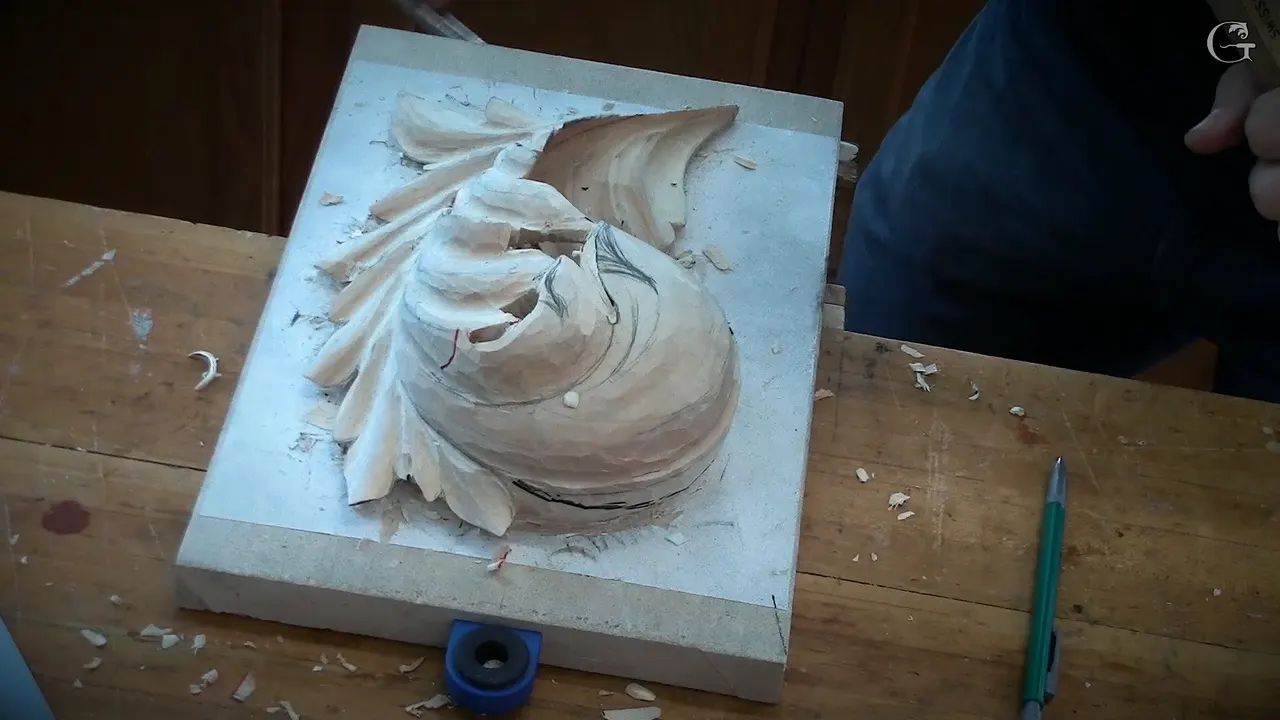

In Byzantine Acanthus 10, video 2, I say "Every edge, whatever you see, you just bring everything to the edge." Near the end of the video I call the job "the last operation." Other lessons of mine aim the same words at an edge or a hole, and at a line or a final depth.
Ever held a carved leaf up to the light and felt one more pass could still thin it? The place to start is the second video of lesson 10, a Byzantine acanthus leaf. Then come the lessons where the same words show up.
What does bring everything mean on the leaf in video 2?
The tool comes first: "just take pretty much the flatter tool, and I'll take number two." The job follows: "you start working toward the edge undercutting and just really, really, really make it sharp."

One more line: "Or close to the edge as you can." For me it is "time to get that separation out," meaning "that ridge out." A warning comes with it. "And careful, please. Don't place your hand on it." My reason is that the leaf is "fragile now, okay?" The part I repeat is "More you remove, more fragile."

Where does the wall come in?
"But anywhere where you see the wall, so you really have to undercut," I say, and that wall goes to its edge too. A knife helps there: "If you do have a knife, like a number 12 knife, it actually makes it a lot easier."
"So you can just pretty much do that operation with the knife." Next comes how the leaf looks, and I put it as "really, really light. See?" The leaf "looks paper thin, but it's solid."

The close of the video is a list of jobs. "So that's the last operation." I "clean up everything and bring" the last of it to the edge, and "refine all the movements." My next words: "No sharp corners." The leaf should have "movements flowing and so on." The last line is "And clean, clean, clean, and clean."
What did an undercut under an overlap have to do with the edge work?
Earlier in video 2 the edge work starts at an overlap. I use "one millimeter 11," which is 1 mm (0.04 in), and place the flute at "3:00." Then comes "undercut it." For the depth, "you go as deep as you wish."

The result, I say, is that "that area going to be really solid pretty much." It is "connected on the bottom" and it is "still going to look like it's separated, but it's not." My rule for each overlap: "Every time when you see overlapping leaf, you just clean that little deeper."
What did the first minutes of video 2 do to the leaf?
The video opens on shallow work. "Don't get too deep cuts," I say, because "we don't want to lose overall shape." On the ridge: "I want to make sure that ridge is rised up." Before a new separation: "to relieve it, it's really important."

I show the leaf to the camera: "Every concave makes big difference." After the undercut I say "I'm going to change slightly the line" then "The line is going to go now right underneath."
Which tool takes a surface out to the edge of a leaf?
Byzantine Acanthus 5, video 3, uses a number nine. "And in this case, I've got the big." The size has a reason: "Remember, you could use smaller one, but the bigger you have, it's better, okay?" Of the edge itself I say "just bring it to the edge."

A warning comes along. "Keep an eye how far you cut." And "be careful when you just get to the edge not to overdo it, okay?" The point, I say, is to "make it look like it's light and almost airy."
That lesson says where the wood should come from. "Don't take too much material in the middle of the leaf." The sides are the place: "better to get more material on the sides of the leaf, but not in the middle."
Another tool shows up in Floral and Molding for the Panel 12, video 2: "It could be done with the knife, but I'll use a number one chisel, a double bevel." I call it "Really, really small one." Before it I say "It's already undercut, but not to the edge." The chisel is the tool.

In my Grinling Gibbons class, lesson 18, video 3, the tool is a spoon gouge. "I'll blend it slightly," I say, and I want "just to take out some of the sharp ridges." About the facets: "I don't want to see them." Before that, "any tool will do."
When is the knife the better choice?
Venice Room 61, video 9, puts it as a method: "By the way, one of the methods how to bring everything to the edge, you can use just a knife." Pretty much any carving knife will work, I say. My favorite is "number 12 as of now, at least."

With it, I say "See, I can bring everything" and after that "I create beautiful transition."
Hashemi Flowers 47, video 8, has "Different ways we can do that." One way is "I can use a knife" and the other is "I can use a gouge." Earlier in that video comes "same idea, just go as deep as you can" and then "now I do have a wall right here." My plan for the wall: "attack that from inside and remove that completely" and then the edge.
What is a wall, in my words?
Video 8 of Hashemi 47 gives me a spot to explain it: "I'll try to explain again what I mean by wall." The next line is "This section right here, I call it a wall." The plan for the edge follows. "I need to bring everything" there, and "I like how it looks on the outside."

In video 10-2 the same wall comes with an undercut: "anywhere where you see the wall." Over in Hashemi 47-8, I attack the wall from the inside, remove it completely and take it to the edge.
Modern Acanthus 8, video 1, brings it up again. I put it this way: "you still bring everything." Later in that video, "if you see a wall you have to bring everything."
What comes right before the edge pass?
In Hashemi Flowers 47, video 7, a blend comes first. "I like that movement a lot, actually." Then "I just make a blending cut." After the edge comes "Okay, now I need to undercut this."
Floral and Molding for the Panel 9, video 1, has a transition first. "And let me create a little nicer transition." Next "maybe add curvature." After that: "And also attack that from the backside." The cue that follows names "the point."

In Venice Room 78, video 5, a separation comes first. "And create that separation cut." That pass is a later step, "now from this side." Over in Venice Room 64, video 11, a shape comes first: "And now I can just create the shape." It reaches "final shape" in my words "how I want to see it."
Is the edge the only place it goes?
Down at Hashemi Flowers 45, video 7, I aim it at a hole. "The idea is the same. Take small gouge." The line is "Just bring everything", so "that hole" is the target. I also say "you don't have to do those holes everywhere because if you do, it's not going to look as nice."
Workshop 52, video 11, is on Venice Room 52. That would be "number nine and the three millimeters," which is 3 mm (0.12 in). My words: "I can just continue my cut deeper, till almost to the point you can't see." Next, "But rest of the cuts" go to "that hole." "Doesn't matter what kind of tool you're going to use," I say.
A little later in that video: "And bring everything", with "that same hole" as the target. My eye goes to the shadow: "But see how deep a shadow it casts?" Then "It's just perfect."

Back in Venice Room 64, video 7, there is an order. "excavate underneath and bring everything" toward the hole. I add "Although I could create another hole, actually, in this area."
Hashemi Flowers 48 comes next, and video 6 has the hole after a second cut. "exactly the same right next to the first cut." Then "and now bring everything" toward "the same hole what I just created." What follows is "cleaning, cleaning, cleaning, and cleaning." Same list as the end of video 10-2.

What about a cut, a line or a depth, a target besides the edge?
Back at Venice Room 61, video 7, the aim is a cut. "And now I can bring everything", and the target is "that cut, all the way." Next: "All of those cuts to the center and flow them together." Last: "get even more shadow somewhere."
In workshop 82, video 3, I take a number nine plus "the quarter inch gouge," which is 6.35 mm. The lesson is Venice Room 82. Here I say "I can't go too deep because I can damage this side." Close behind: "And I can actually bring everything." The cut is the target.
In Plate with Butterflies 2, video 3, a cut line is the target. I use the same number seven as before, and I say "14 millimeters a half an inch" with 14 mm being 0.55 in. My cue is "I have to bring everything" then "that outline." Of that line: "don't destroy that line."
Furniture Panel 28, video 1, makes the move a line, and it sits at lesson 28 of that course. "which means I have to lower down slightly." Then "bring everything underneath of this line."
A final depth is the plan in Furniture Panel 15, video 2: "probably" my "final depth for this region." After it, "I can take my router plane if I need to." Without one, "it's still possible to do it with just the gouges."

Can it point up?
Byzantine Acanthus 8, video 3, answers with a ridge. My words: "So I've got really deep cuts" and "Maybe it's not even deep enough yet." Then I "bring everything up," until "those two ridges, become high spots."

My tool there is "flatter tool, like number 2." What it makes: "just blend that and create convex." Next, a "big convex." So the words can point down, into a hole, or up, to a high spot.
When did I leave it for the end?
Workshop 98, video 9, sits in Venice Room 98 and waits on a shell. "later on I will undercut" and "a shell." Then "I'll bring everything." Its target is the edge, and "you'll be able to see more or less final look of it."
Over at Venice Room 145, video 1, it becomes a list for the end. "all it's going to take for me, just to refine everything, undercut everything, bring it to the edge." The line ends on a "sharp edge." And "But the main excavation has to be happening right here."
The second video of that lesson says "all I'm going to do is just clean it and bring everything." Edge work again. Next: "I need 2 millimeters or 1 millimeter even," which is 0.08 in or 0.04 in. Then "1 millimeter and attack that until everything is clean."
Acanthus over Moldings 7, video 3, has the same finish: "And yet a little nicer shape gonna bring everything." Edge again. I add "Make it more smooth." And "Maybe gonna introduce some curliness."
In my Grinling Gibbons lesson 16, video 3, I say "Okay, and I can just remove and bring everything" with "edge you can see" after it. Then "expose the first layer even more."
In which videos did I say it? One table has them.
| Where | What went out to its limit |
|---|---|
| Byzantine 10-2 | Every edge, by a flatter number 2 |
| Same video | A wall, with a knife to help |
| Lesson 5, video 3 | The edge, with a big number nine |
| Lesson 8, video 3 | Two ridges, raised into high spots |
| Hashemi 47-8 | A wall, with a knife or a gouge |
| Hashemi 48-6 | A small knife, then the same hole |
| Room 52-11 | The rest of my cuts, down to that hole |
| Venice 61-9 | Edges, with my favorite knife |
| Venice 145-1 | Everything, down to a sharp edge |
| Floral Panel 12 | An undercut, with a small chisel |
| Furniture 15 | A final depth, with my router plane |
| Panel 28 | A little lower, under a line |
| Butterflies 2 | Everything left, to my outline |
Which line would you try first on a leaf of your own? Every video of this wood carving lesson sits inside one tuition plan. The Byzantine Acanthus course page holds all ten lessons, with lesson 10 on the edge work. My sizes come with my own figure first and an inch figure beside it, for relief and for the millimeters too.
How it's done
- Take a flatter tool. I take pretty much the flatter tool and say I'll take number two.
- Work toward the edge. I undercut my way to the edge, and I want it really, really, really sharp.
- Go to the edge or close to it. Every edge I see goes to the edge, or as near as I can get.
- Keep a hand off. I ask the class not to place a hand on the leaf, since it's going to be fragile now.
- Try the knife at a wall. Where I see a wall I undercut it, and I say a knife helps a lot.
- Refine the movements. I clean up everything and refine all the movements, with no sharp corners.
Frequently asked questions
How do I choose a tool for the edge?
In lesson 10 I take a flatter number 2, and I say a knife is a lot easier. Other lessons name a number nine, a small chisel or a spoon gouge. In Gibbons 18 I say any tool will do.
What happens at a wall?
I undercut it, and the wall goes to its edge. Hashemi 47-8 has me call a section a wall, and I attack it from the inside. I name a knife or a gouge there, and Modern Acanthus 8 uses the same word.
Will the leaf be weaker?
It gets fragile, I say, and the more I remove, the more fragile it becomes. So I ask the class not to place a hand on it. Still, I say the leaf looks paper thin but it's solid, and I say "careful, please."
What to carve next