

Alexander Grabovetskiy, woodcarver, School of Woodcarving · Published 2021
What does a wood carver mean by "on the wall"?
Quick answer: In the third video of Byzantine Acanthus 10, I say a separate leaf would look good on a wall, so it gets a background and a texture. In other lessons I say a piece on the wall can go extreme, and a piece for daily use cannot.
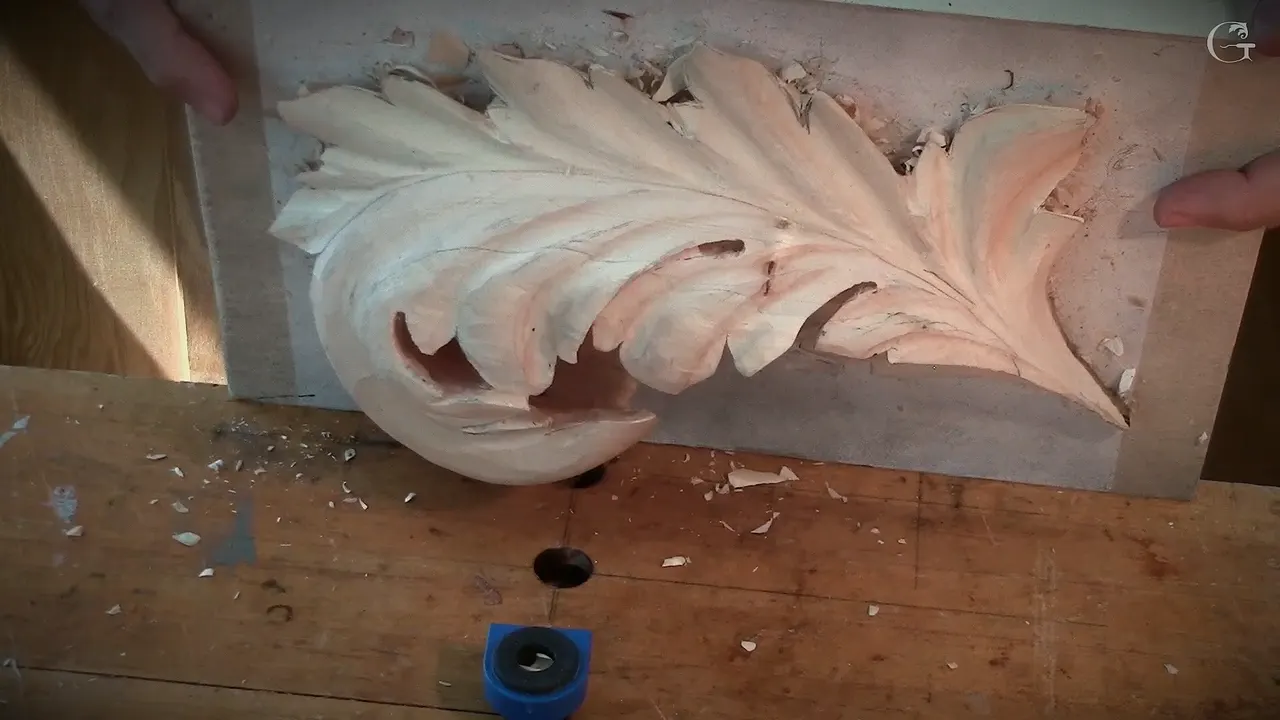

In Byzantine Acanthus 10, video 3, I say about a separate leaf, "it would be looking good on the wall somewhere, right?" A garage is the other place I name for it. Other lessons of mine use the same words on a piece that hangs, and they come with a choice of depth.
Ever carved a leaf and wondered where it goes when the carving is done? Lesson 10, a Byzantine acanthus leaf, comes first. The lessons where I say the same thing about a wall come after it.
Why does a separate leaf need a background?
The video opens on a plan. I skip "the details" for now, and I would "probably work on it a little later." The leaf, I say, is how "it's supposed to look."
My next line is "But I would like to use a background." The leaf is "just a separate piece." On a wall it "would be looking good," I say, and otherwise it would end up "in a garage."
Next comes a plan to "do something with the background." Taking it out: "Let me, without trying to break it, take it out."
What do I do to the back of the leaf before the glue?
Before the glue, I say, turn the leaf upside down and "clean, okay, from that side." A knife works, or "the gouge" and the job is to "bring that also to the edge, wherever we had that curvature."

One spot on my leaf needs an undercut, and "that's the time to do that." The best way, I say, is "a small knife or small gouge, the flatter one," just to get in the corners. My warning is short: "Just don't break it." Then "That would be big mistake."
Which board does the leaf sit on, once it is out?
The board is the one used for the gluing, and I plan to "do something with that." The paper comes off, and I ask "See how dark it became besides the paper?"

Pencil marks are gone from the board: "All the pencil erased." For the layout I say to "position your piece on that board" and "find the best movement, what you want to see."
Where on the board does the leaf sit?
My plan is to bring the leaf "a little closer to this edge," because I want "the bulk of it coming closer to the golden ratio."

Next I pencil around it. "Just pencil it around," I say, and the texture will run "all the way to those marks."
How much of the board stays flat?
One spot holds the glue, and I say I know where. I plan to "step inside a little bit, about maybe an inch or so inside," that is about 1 in (25 mm).

The middle is the only part I will not touch with the tool. It stays flat, I say, "and that's where I'm going to put the glue." The rest, I say, will get a texture.
Which gouge gives a background its texture?
Number nine does it, "either a small one or bigger one, it's up to you." Number seven works as well, and gives "the same idea." I want to "run across some stripes, some cuts."

Near the end of the video a question asks which tool I am using. My answer is "Number nine." The nine, the seven or the eight all work, I say.
Which way should the tool attack the edge?
The tool goes from the edge toward the inside. Otherwise, I say, it will "catch the edge, the grain" and the board will not look as nice. After that I rotate the board and attack from the opposite side.

Against the grain is my advice for the stripes. It gives "a nicer texture," I say, and I tell you to "stay just perpendicular to the grain." The dirt marks go too: "I'm going to get rid of all of those dirt marks."
What happens once the board has stripes?
The texture will "cast some shadow," I say, and I call the result "a really beautiful effect."

Another technique is a different wood for the background. A "darker wood, like oak or cherry," I say, would do it. Alongside that I name Grinling Gibbons, who "used oak backgrounds all the time for his carving."


Does hanging a piece change how deep I undercut?
In Lily Box 6, video 9, I say "I really like extreme undercutting" and "that is just my personal taste." An everyday item is "not too practical" for it, because "more material you're taking out, more fragile you make it."
Art on the wall is another case. People do not "touch it all the time" and it will "hang right there." My words are "you can undercut as extremely as you wish."
Over in Greek Acanthus 15, video 4, I put it the same way. "I did extreme undercutting on this one," I say, "but for furniture, it would not be good idea." Fragile is the word, "too fragile." A frame and the wall change it: "if you want to frame it and place it on the wall, it's absolutely fine."

In its first video, Roman Acanthus 10 tells the same story. "I don't really worry about to make it fragile," I say, since the piece is "more decorative, ornamental" and "I do have a background in it." Framing it and placing it on the wall is open to me, and so is a stain "with all the shades and make it look antique."
If a piece is "more artistic" and "not practical like for furniture, I can go to the extreme."
What changes when the piece is for daily use?
For Tray of Blessing 6, video 3, the contrast is stated. One case is a "piece of decoration, which is gonna be on the wall." "Not in this case" is the other, because the piece is a "practical use thing."
In its sixth video, Lily Box 12 has me stop myself. "I have a tendency to make it paper thin," I say, but it is an "everyday use piece" and "I can't make it too fragile." A wall decoration differs: "I could make it paper thin. I have no problem with that."
Take the tenth video of Lily Box 8. A wall decoration gets a what-if: "I could definitely separate it and make it absolutely just above completely without connection downhill." The piece in that video is different. "It's a practical thing," I say, and it will be used. I also want to "make sure it's not that easy to break."
Is a fragile piece a problem once it hangs?
Hashemi Flowers 15 shows a piece that "becomes really fragile" and I say "I can easily break it." Hanging "in the air" is "absolutely fine." Once it is on the wall, I say, "it's going to be stable and there is not going to be any problem with that."
Carving, "especially heavy excavation," has a problem like this, I say. My words: "I left that on purpose. I didn't do any mistakes."
For carving such a piece I name "one of the solutions." One way is to glue it "to a piece of plywood" and "sandwich it with a piece of paper between the plywood and this piece." Another way is to apply it to my MDF board "with the 20-millimeter holes," holes of 20 mm (about 0.8 in), and "clamp this piece" there.
The view in Tray 3, video 3, is the same. "It depends how you're gonna use it," I say, and on a wall "it's not gonna be broken like glass."


In Grinling Gibbons Maine 14 comes a warning: "If you don't feel comfortable of doing it, then don't do it, okay." Not as furniture, I say: "I'm not planning to use it as a piece of furniture." Then "It's gonna be on the wall." A little later: "I am all the way through and I can just refine that."
How does the wall change the light?
In Hashemi Flowers 7, video 1, I say "You probably would ask me why I do that," about a backside, most of which you will never see, especially on a wall. As the background you can use "just a bare wall."

The depth is "no more than maybe 16th of an inch deep," which is 1/16 in (about 1.6 mm). My answer is "It's all about lights and the shadows."
A small thing counts, I say: even a small amount of light that travels behind will "create a shadow." It is a "tiny detail, but really important." Overall, I say, it "makes this piece much, much lighter."
In Modern Acanthus 6, video 3, I say "I know there's a lot of light," I say, but on "a wall somewhere, where's not too much light, you're gonna see that shadow." A half millimeter tool, 0.5 mm (0.02 in), "can create even deeper undercut" and the undercut will "look even better."
In Tray 2, video 1, I say "we are painting with the shadows and the light." I add "It depends how the light gonna hit." When a piece will not hang on the wall, the light comes "from the window," maybe "in your dining room." To create the shadow, I say, "I have to excavate somewhat deeper." In this case "I gotta do extreme excavation." Put it on the wall, with "the light source above" and "you can just get by with a shallower cut." You still "cast the shadow."
Roman Acanthus 11, video 4, adds a frame and the right light. "On a wall with the right lighting hitting this thing," I say, the piece will "create beautiful effect." Even "without the finish on it, just the bare wood is still going to look really nice."
Venetian Flowers Rosette 2, third video: I tell you to keep in mind where a piece is "positioned on the wall or whatever to the eye level" and how the shadow is cast. My light source goes "from above."
What about the back and the finish?
The Butterflies plate final assessment shows how the plate will look "on the wall, and I think it's really good." On the back, "of course, you can protect that" with shellac or wax. A plain back is fine too: "you can leave it like that" and "not going to bug anyone."
Over in Plate with Butterflies 13, I probably will not do anything on the backside. If it's "just a decor just on the wall somewhere" then "it should not be a problem if I leave it like that." A real plate would be easy "because we did the excavation on the inside."
Lesson 6 of the Lily Box course, video 9, has more on the finish. For "a lacquer or maybe with the shellac," I say you can "dilute a shellac as much as possible by using spirit and penetrate multiple times." That way it will "bind all those fibers on inside" and it will "hold really long."
Where else does a piece for the wall go?
Venetian Flowers Rosette 5, third video, says "I think it's good for any home" and "You can just hang that on the wall as a piece of art." I plan to show how it sits "on the wall, so you would understand exactly what I mean."

Grape Onlay 3 lists places in its third video: "the mantels, the kitchen hood, about the doors" and then "a piece of art, just on the wall." Of the grapes I say "It's still gonna look nice."

The fourth video of lesson 10 says "you can actually frame it later on" and "Just put inside of the frame, and that's going to look really nice."
In which videos did I say it? One table has them.
| Where | What I say about the wall |
|---|---|
| Byzantine 10-3 | A separate leaf, with a background behind it |
| Hashemi 7-1 | The backside, mostly out of sight |
| Hashemi 15-1 | Fragile work, stable on the wall |
| Modern Acanthus 6-3 | Shadow you see where light is low |
| Tray 2-1 | Shallower cuts, with light from above |
| Tray 3-3 | Thin work, not broken like glass |
| Tray of Blessing 6-3 | Decoration for the wall, not a practical thing |
| Roman 10-1 | Framed pieces, taken to the extreme |
| Roman 11-4 | A frame, with the right lighting |
| Lily Box 6-9 | Art that hangs, undercut as I wish |
| Lily 8-10 | Separated parts, with no connection downhill |
| Lily Box 12-6 | Paper thin work, if I like |
| Greek 15-4 | Extreme undercutting, when it is framed |
| Venetian Rosette 2-3 | Composition, as set at eye level |
| Venetian Rosette 5-3 | Good for any home, as art |
| Gibbons Maine 14-3 | An opening, taken right through the piece |
| Grape Onlay 3-3 | Anywhere, even as art on a wall |
| Butterflies final | The back can stay as it is |
| Butterflies 13-3 | Decor, with no worry about the back |
Which line would you try first on a leaf of your own? Every video of this wood carving lesson sits inside one tuition plan. The Byzantine Acanthus course page holds all ten lessons, with lesson 10 on the background. My sizes come with my own figure first and the other system beside it, in inches and millimeters.
How it's done
- Turn the leaf over. Ahead of gluing, I say to turn it upside down and clean it from that side.
- Pencil around the leaf. Position the piece on the board, find the best movement, and put a pencil mark all around it.
- Leave the middle flat. I step inside about an inch (25 mm), and the middle stays untouched, where the glue goes.
- Take a number nine. Number nine, small or bigger, or even a seven, runs some stripes and cuts across the board.
- Start at the rim. Work from the edge toward the inside, then rotate the board, and the opposite side gets the same.
- Stay perpendicular. Stay perpendicular to the grain, and the stripes cast some shadow.
Frequently asked questions
How deep can I undercut a piece that hangs?
In Lily Box 6 I say you can undercut as extremely as you wish on art that will hang on the wall. Greek Acanthus 15 calls extreme undercutting absolutely fine when you frame it and place it on the wall. For furniture, I say people touching it makes it too fragile.
Which gouge makes the texture on a background?
In lesson 10, number nine does it, a small one or a bigger one, and number seven gives the same idea. At the end of the video I name the nine, the seven and the eight. I run some stripes and cuts across it.
Which way should the stripes run?
Against the grain, I say, and perpendicular to it, which gives a nicer texture. I start at the rim and work inward, since otherwise the tool will "catch the edge, the grain." After that I turn the board and come in from the opposite side.
What to carve next