

Alexander Grabovetskiy, woodcarver, School of Woodcarving · Published 2021
What does a wood carver mean by "nowadays"?
Quick answer: The word nowadays comes in the cue after a question about glue, in Byzantine Acanthus 10, video 4. Other lessons of mine put it beside gold leaf, a tiny tool, a back bent gouge, a V tool, wood and design.
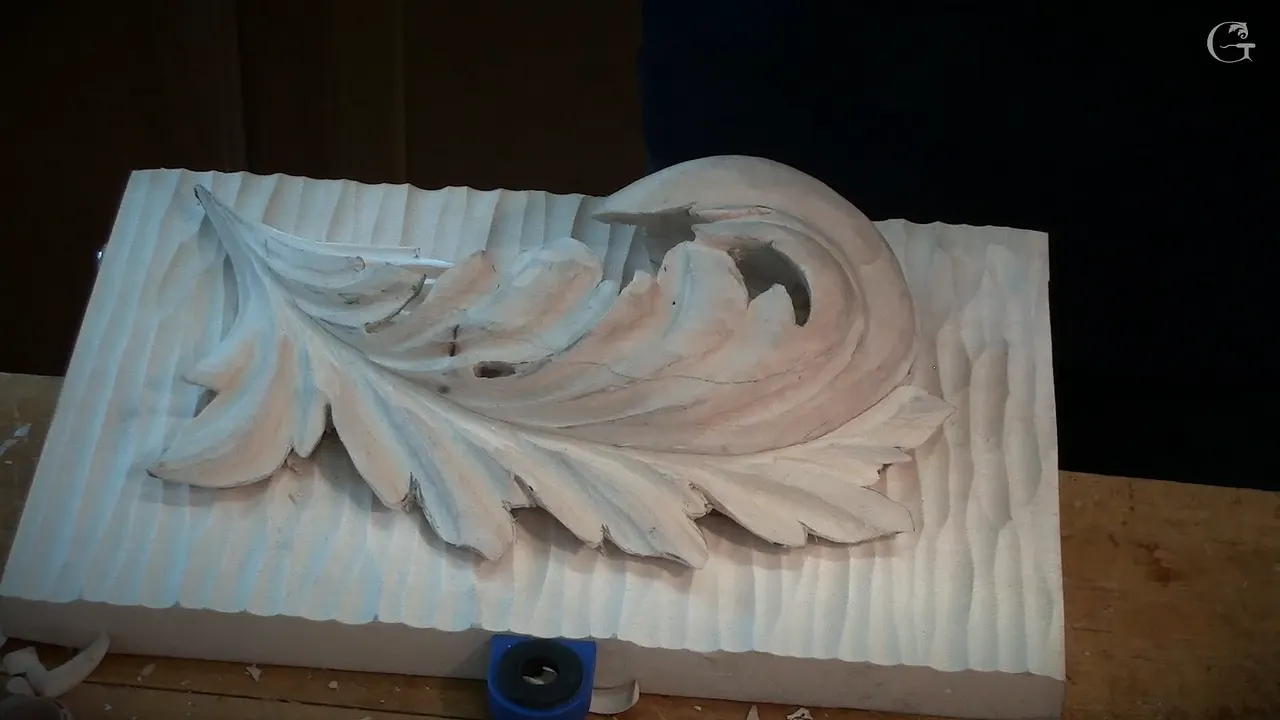

In Byzantine Acanthus 10, video 4, a question about glue gets an answer that ends on "one of the best glues nowadays." Other lessons of mine put the same word beside gold leaf, a tiny tool, a back bent gouge and a V tool.
Ever glued a carved leaf onto a board and wondered if one thin layer of glue would hold it? Ever hunted for a tool that is hard to buy? The place to start is the fourth video of lesson 10, a Byzantine acanthus leaf. After it come the lessons where the word shows up again.
What came right before the word?
The first cue in the file is "So, you can actually frame it later on." The next is "Just put inside of the frame, and that's going to look really nice." Texture follows. "I'm talking about the really strong texture," I say, and "Take a look, the effect." Then comes the question: "It looks really nice, right?"

I give two choices. "So, you can leave it like this, or you can actually give a little smoother finish on it." The smoother one needs "just to get the flatter gouge, like maybe number three." For the ridges: "And you can take those ridges out, some of them at least." My pick is the first choice: "But personally, I like to keep it like that, and just glue it, okay?" After the glue, "you're still going to be able to refine the form of acanthus."
Which glue was in the question?
The question is "What glue is that?" The cue after it ends on "one of the best glues nowadays." A few cues later comes "This is just the original." My own taste follows: "I really like" the version I name there, "personally."
My plan for the glue-up is short. "And I'm not even going to clamp it." The rest is "to just to rub slightly and leave it for about half an hour."

Why did rasps and sandpaper come up?
The big question, I say, is how to leave the surface smoother, "not smooth like a sandpaper, which I don't really like." Still, "if you like to use a sandpaper, I'm absolutely okay with that." A story about rasps follows: "Last year, I spent $1,000 just to buy rasps, just to try out."
"I saw other carvers, they use it, and they have no problem with that." My feeling? "I always felt like it's something bad, not allowed." Still, I "bought $1,000 in rasps." Asked how I feel about them now, I answer "I still don't use them."

My reason is blunt: "it's not saving me time." Worse, it "actually creates even more problems, so I have to actually make it a lot smoother after the rasps." The sum, in my words: "it's actually twice as long for me. But that's okay."
One case takes a rough surface. Paint is that case: "With the paint, great, I'm going to just brush on." But "I still love out of the chisel finish. Okay? So without any sandpaper or anything."
How does a flatter gouge take the facets off?
"You take a flatter gouge. In my case, I'm going to take number three." There is a second choice: "You can use number three or you can use number two." Someone asks if I have a 12 mm (0.47 in) number two, and I say "maybe I should use a number two or number three. We'll see."

Before the pass I say "just let me strop it for a second." Then I point at the leaf: "Really strong facets." The section I choose gets "You pretty much attack that at an angle." The stroke itself is "just like almost shaving."
I keep going "until I just get rid of all of those facets, if I need to take all of them out." The line I give you is "See how it just disappears?" Next I add "Disappears completely." One more tip is "just to check what direction it doesn't fight back."

Can the same wood burnish the leaf?
The same wood does the job. "Let me get the burnisher from the same piece of wood." Next: "you're actually pushing down on the fibers." The surface, I say, "that's going to become really shiny, almost like you applied some finish on it."
"Some of the facet is going to disappear on its own," I say, and then "Not in this case, it's a big one." Back to the gouge. One slip follows: "I just caught the grain." So I "just attack from different sides." The last line is "if you spend another month, it can look like sanded."

Which tool goes inside a hollow?
"And let's say if I've got a concave, and what you do in concave, I like to use number 11." Next comes "But the idea is still the same." My reason is "you can use just the side of it." The bottom works as well, "if you wish."

How did video 4 end?
Video 4 closes on "the last step, just to get rid of the facets." I add "If you can. If you wish." My verdict on the leaf: "almost 100% done." What I could do is "spend a lot longer cleaning and cleaning." For a one-week class, I say, "that is an excellent project."
One leaf gets more. "I added extra micro-separations at the end of it." Because of that, "so I have to do it everywhere." A warning goes with it: "be careful not to break it" and "Now it becomes more fragile." The gain is "extra layer of detail."

Where else does nowadays go with glue?
Grinling Gibbons Maine 6 is where it fits best, since its third video holds a glue-up much like this one. I name a screw for the back, and then say "honestly, I never had any problem with just the glue." Straight after comes "the glue nowadays really excellent."
That glue-up matches video 4. "So I'm not gonna clamp it, but see what I'm gonna do. I'm gonna wiggle it couple times." I add that it will "create a vacuum effect." After that, "I'm gonna leave it for like about half an hour or so. And it should be okay."

Which old methods did I set against today's?
Byzantine Acanthus 5, video 2, is about gold leaf, and the Byzantine leaf there "was always gold leaf." As for now, I say "you can gold leaf anything because the gold leaf nowadays is just, you barely apply it." Back then "It was little thicker."
In video 2 of Roman Acanthus 16 the subject is the base layer. "They would cover all the carving with the red clay." Then "Nowadays, we're using just gesso." My tip for the clay: "get with your finger."
Which tools were hard to get?
Floral and Molding 11, video 1, starts on the smallest one. My words are "get the 1 millimeter again," which is 1 mm (0.04 in), and "Really, really, really a tiny, small one." Next: "one of my new toys." And "Nobody's actually making it nowadays."

In Floral Panel 1, video 2, I work out how to measure and adjust, and the cue says "probably the best position to extend that rod." Then comes "that is one of my favorite tools nowadays."
Blades are the subject in the third video of Grinling Gibbons Maine 2: "how tiny blade can you get nowadays?" "It's only half a millimeter blade," I say, which is 0.5 mm (0.02 in).
Back bends come up in Venice Room 12, video 11. "I remember the time when in United States, you almost couldn't get any back bends." I ordered them from Europe and paid extra. "Nowadays, you can get some of them here, too, in USA." Still, "You're still limited." Yet "for everyday carving, you really can get by without them."

On a scroll saw, in Venice Room 76, video 9, I say "Mine was made in Canada." About the maker I say "Nowadays, they making the same models pretty much just in China." My own is "a little older model."
Floral Panel 10, in video 3, holds my words on the tool I reached for. "It's just nowadays my preference." Then "Even in my case, I change sometimes my preferences." Plain talk follows: "I do carve every day, and yeah, I also get tired of using the same tools."
Acanthus over Moldings 3, video 3, has a leather strop in it: "Especially nowadays you can get some leather even for free." The place is "some kind of leather shop leather craft shop."

Handles are the topic of a livestream from April 2020, where "I know a lot more people, wood carvers, prefer octagonal," I say. Then "And nowadays, actually," a maker in the UK is "actually switching."
Where does the V tool fit?
Back in that same lesson, my V tool line comes in video 2. "They never used any V tools back then." And "even today, wood carvers don't use a V tool at all." "So the V tool was invented later." Still "I really like the V tool" and "it's not necessarily you have to have it."
Furniture Panel 19 has the word in the middle of a sentence, in video 3. "They did not have parting tools until later." Then "And by the way, even nowadays, not all wood carvers in the world even know about the existence of V tool." Over in the V-tool problem lesson, I say "It wasn't common actually until, let's say 19th century in Europe." Then "some of wood carvers, they never use it even nowadays."

Furniture Panel 27 agrees, in its third video. "The V tool. Even nowadays, not every carver uses that."
What changed for wood and for the people who carve it?
walnut comes up in Furniture Panel 16, video 11. "People who used to build furniture in 19th century, they were not as picky." By contrast: "Nowadays, if there's a little sap, people cut this out and throw away, but it wasn't the case back then."
Roman Acanthus 2 has me talking about the leaf. Today, I say, you can find "lots of furniture makers who are still using symmetrical acanthus leaf just to decorate furniture."
The sandpaper question has a line on wood. It is "really kind of hard to find nowadays" in "a stabilized wood, like air dry."
People come in, in Venice Room 28, video 8: "It's really hard to find people nowadays who really, honestly do understand the structure, anatomy of acanthus leaf."
The first video of Corinthian Acanthus 1 tells of an architect "always looking for new ideas and new designs." I compare him to "probably nowadays so many architects do the same thing."
Lily Box 12, video 2, is about Grinling Gibbons. "But nowadays, people making photos or pictures." After that: "Even if it's above, you can zoom in and you can still see."
Does nowadays reach design, sharpening and speed?
The Maine sharpening class, video 1, keeps it short: "So sharpening, really important, and nowadays, even more important than design." For design: "you can go online, you can print, you can glue on."
Another livestream day has me on old pictures. "If it's not possible to go, just go online," I say, and "you can find all of the ancient pictures."
Carving with the Grain brings it home. "Nowadays, even nowadays, when my wife asks me to sharpen knives again, okay, I keep sandpaper in the kitchen." The method: "I just put it on a countertop, and that's it."
An April 2020 question hour has "Yes, you are able to skip design nowadays."
Customers show up in Venice Room 50, video 12. "Customers, they really nowadays want to get it done yesterday." And "That's new invention. It wasn't like that before."
The cost sits in Venice Room 3, video 12. "The idea of deadline nowadays probably is everywhere in every country, but it wasn't like that a few years ago." The cost: "you are losing quality."

In which videos did I say it? One table has them.
| Where | What I tied to nowadays |
|---|---|
| Byzantine 10-4 | A glue, in a question about it |
| Maine 6-3 | The glue, with no clamp |
| Byzantine 5-2 | Gold leaf, which you barely apply |
| Roman 16-2 | Gesso, where they used red clay |
| Maine 2-3 | A tiny blade, half a millimeter |
| Floral Panel 11 | A 1 mm tool nobody is making |
| Venice 12-11 | Back bends, some sold here |
| Furniture 19-3 | The V tool, unknown to some carvers |
| Room 28-8 | People who understand the leaf's anatomy |
| Sharpening 1-1 | Sharpening, more important than design |
| Workshop 50-12 | Customers who want it yesterday |
Which line would you try first on a leaf of your own? Every video of this wood carving lesson sits inside one tuition plan. The Byzantine Acanthus course page holds all ten lessons, with lesson 10 on the finish. My sizes come with my own figure first and an inch figure beside it, for the millimeter too.
How it's done
- Look at the texture. I show the strong texture and say it can stay like this.
- Pick a flatter gouge. My plan was number three, and number two works too.
- Strop it. Just let me strop it for a second, I say.
- Take the facets off. I go at the facets almost like shaving, until they are gone, if I need to take all of them out.
- Burnish what is left. A burnisher made from the same wood pushes down on the fibers, and the surface turns shiny.
- Switch to number 11 in a hollow. A concave gets number 11, and the idea is still the same.
Frequently asked questions
Which glue did the class ask about in video 4?
The question is "What glue is that?" and the cue after it holds the word nowadays. I call it the original, and I like the version I name there, personally. I also say I'm not even going to clamp it.
Do I use rasps?
In video 4 I say "I still don't use them." I spent $1,000 on rasps to try them out, and I say I have to make the surface a lot smoother after, so it is twice as long for me. If you like sandpaper, I'm absolutely okay with that.
How do I take facets off a leaf without sandpaper?
Video 4 uses a flatter gouge: number three in my plan, or number two. I strop it first. Working the facets off is, in my words, almost shaving. Burnishing with a bit of the same wood is the other tool.
What to carve next