

Alexander Grabovetskiy, woodcarver, School of Woodcarving · Published 2021
Why does a wood carver stop for a picture in the middle of a carving?
Quick answer: In Byzantine Acanthus 3-1 I pause while marking the high spots and hollows of a leaf, and I want the picture for online. In other lessons I say a picture will show what the camera does not, or get me the pattern.
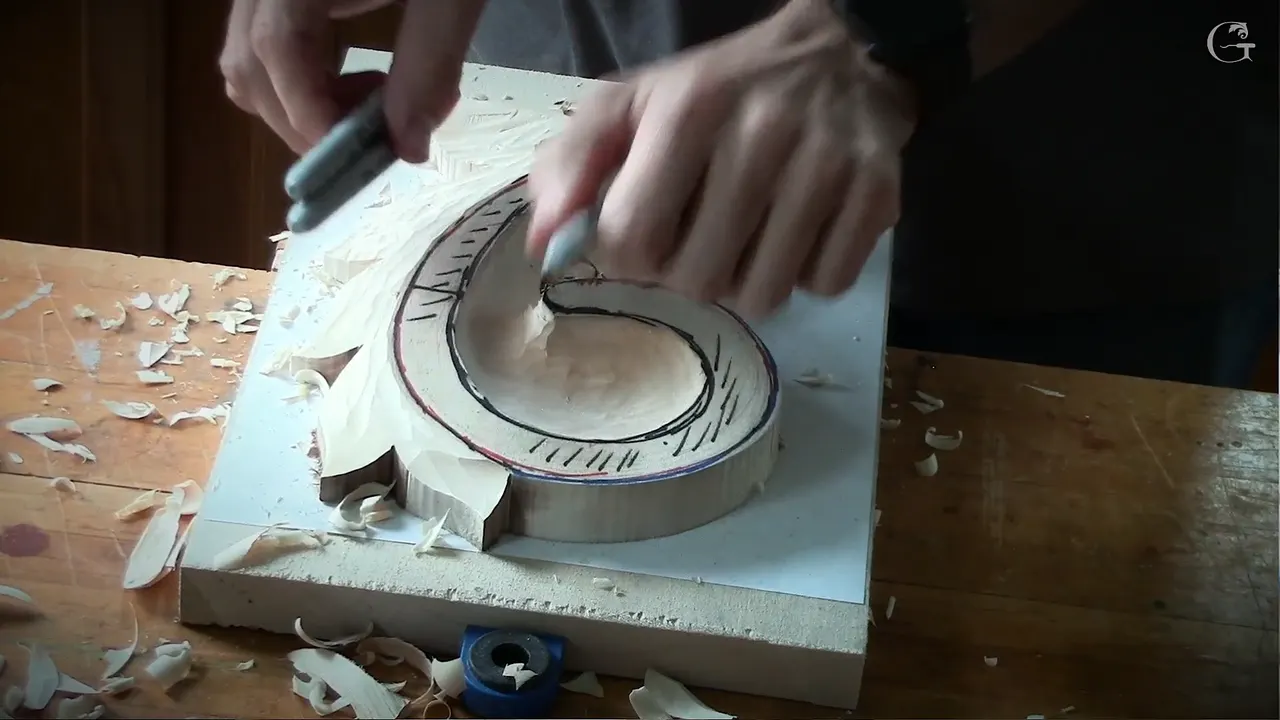

In Byzantine Acanthus 3-1 I stop in the middle of marking a leaf to get a picture, and I say "I want to keep that picture also for online." The same stop shows up in other lessons of mine. Each one is named below, with what I was doing and what I said the picture would show.
Can you hold a phone over your bench? And can you tell a high spot from a hollow by its color? Then you can follow these videos, because I say where the picture goes and what it is for.
What was I marking when I stopped for a picture?
I ask "Can you see on the screen" and say "Okay, that's good." Stage number one is done, and stage number two is next, which I say is "almost going to look like finished on this layer." My tools are multi-color permanent markers, and I remind the class of the code. Blue is down. The sunshine color is up.
The first job is to "establish the main concave and convex movements." Everything is supposed to be connected, I say, to "an invisible center line, right in the middle somewhere." The points of those leaves connect to that line. I bring back the warning about "no T-stops" and "in wood carving, you really have to be flowing." I ask "Better now? Better now" and say "For me, it's okay because I've got lights all over, so I'm fine."
Then comes the 40-60 rule, "40%, 60%. 60%, 40%." On the inner part of the two leaves, "we're going to flip it, so my 60 becomes this part." The line is "only partial on this part," I say, and I will develop it more later.
Why does that line matter? It is going to be "the high spot," I say, and "always convex." Next I say "Let me put orange, the sunshine color" and "I'm also going to make a picture." After that I add "It's still going to connect to the same line."

A book on old masters of the 16th, 17th century comes up next. In nature, I say, "not everything connects to the same line" and then "I hope it makes sense." Next come "Let me make a picture" and "I want to keep that picture also for online."

The eye comes next, where two leaves meet. It "most of the time looks like water drop" and mine is "maybe about, I would say, five millimeters the most," about 3/16 of an inch. I want you to put one "in every place where those leaves meeting," "whatever form." "Just like a human eye," I say, so it is called an eye. "Sometimes we're going to do on an upper piece, you'll see what I'm talking about," I say. Another high spot comes next, and "we call between transitions a pipe." "Just like a real pipe is going to be convex," I say, and it is "going to go all the way to the center line."
"Everywhere," I say, and then "Well, actually, this one is a little off." Then comes "So that is convexes" and "Let me make another picture."

Blue is next. "To create that convex, we need to create concaves right on the sides." Between the orange or red marks I say the blue marks will be "concave cuts." They must run straight, I say. The warning is "Don't do it this way. That would be a mistake."

Where they end, it is "about somewhat 40/60, but it's not that critical." Every space between the red lines gets a concave cut, and the plan is to do all of those at once. The last line says the concave cuts will be "almost parallel."

Did I stop for pictures in other Byzantine videos?
Byzantine Acanthus 4-3 has the phone line: "Once I draw that, you are welcome to come right here and take a picture on your phone if you have a phone with you, and place it close by." "Sometimes it's a really good idea to do that," I add. Later in the same video I ask "Any questions about those triangles and separations" and say it is "a really good idea" to get one. The same words sit in Byzantine Acanthus 5-1.
First "we just take out the whole thing," I say in Byzantine Acanthus 7-1, and then "just round it or fillet it." That's a good word, I say: "Filleting." Right there a picture follows. A little later come "we're not going to touch it" and a picture again, "really quickly for the reference."

Plastic is the other choice in Byzantine Acanthus 8-1, next to a picture: "you could probably just get the plastic. But what I would like you to do, do it yourself." In video 2, "before I create my cut," I say I am going to let the class get pictures, and one for me too, also for the archive. Next comes "I'm going to put the marker." In video 3 I ask whether I made one, and I say "I did, okay, good. Thank you."

Over in Byzantine Acanthus 9-2, I say "See, I already made a mistake" and "I would use probably smaller tool next time." After that comes "You take a picture also." Lesson 10 has it as well, in Byzantine Acanthus 10-4, where I say "now just because I've done it" and I will add it "everywhere." The line about the picture closes with "If you want to do that."

What does a picture show that the camera does not?
Pictures come later, I say in Venice Room 85-3, where a movement goes from the side to the front and "it has to flow together." "I really have to stand from the position of the camera because of the grain," I add. Venice Room 84-1 has a part "wrapping around going this direction." The camera is a little away, so "you don't see" what it is supposed to look like. Later comes the picture, and "you'll see it."

"I established just a big, huge eye on this section," I say in Venice Room 63-8, and the picture waits until later, so "you'll see it." In Venice Room 53-4, I say "I don't want to stop the camera because you don't see. My apologies." "You'll be able to see that later," I add, and "I'll create multiple pictures."

A smaller tool comes up in Venice Room 82-4. I need to switch to a smaller one, "maybe 2 millimeters or even 1.5 millimeters" (0.08 in or 0.06 in). "Unfortunately, you really don't see what is going on," I say, "but I'll try to make a good picture later on."

Venice Room 93-12 has "that is the look I'm after" and then "I'll make pictures, okay? And you'll be able to see."
The Lily Box has the same wish. "Not sure if you're going to catch it or not," I say in Lily Box 5-3, and "Let me turn the lights off" then "Let me do different direction." Then a picture follows, and I say "that way you'll see exactly what I mean." Video 11 of that lesson has "I hope you can catch that on a camera what I'm doing" then "you'll see the result." In it I say I also need to give a small concave, "exactly the same 1/16 of an inch concave" (about 1.6 mm).

The next video has "it does have a nice movement" and "you'll see what I'm talking about." Lily Box 3-11 has "That is the result of the first layer" and "the next step, I have to glue my second layer." A first-layer picture comes too, I say. In Lily Box 8-10, I say "you can't see what I can see" and "I'll try to make pictures, and you'll see exactly what is going on."

Hashemi Flowers 41-1 has "As deep as possible" and "I know it's impossible to see on the camera." The picture comes, I say, and then "you'll see how deep all the excavations I've done."
How does a picture turn into a pattern?
Grape Onlay says it most. I do change things "on the fly, how it's gonna look," I say in Grape Onlay 1-2, and once the carving is out a picture of it comes, then "line works." In the third video a picture comes "even in rough spot" and later the "finalized look" and the line work. "I highly encourage you to design your own," I add.
"Some of you really want to see how it looks," I say in Grape Onlay 2-2, and "Please be patient." The third video has "Once I'm gonna rough in everything" then a picture, and then you can carve it.
In Grape Onlay 3-1, a picture will get "the pattern," I say, because "multiple people probably didn't watch all the way through." They emailed me, I say, "what about the pattern?" And in Grape Onlay 9-1, I say I changed the design of the leaves, and "if you look at the original, you not gonna see this part."
Grape Onlay 12 has "the last session of this project" before a picture and "do some drawings for you." "I would like to see the result, what you're gonna come up with," I add, and in the third video "it's better to develop your own."
Two other courses stop at a drawing. "I will provide some drawings," I say in Chamomile and Bow Rosette 1-1, and I am going to "scan it, and provide the sizes, and you can work on that yourself." For the grape leaves vase, video 7, a picture is for anyone who wants "to repeat exactly what I've done" and I say "I can probably just wrap that with the plastic."
Can a phone picture help while I carve?
Floral and Molding 3-2 has a trick. I want a leaf to replicate the previous piece, and "One of the tricks you can use if you are flipping opposite direction" is "just your phone." "I can just go to that picture and flip it," I say, and "Boom, and that's done." Then "And now I know exactly how it's going to look."

"I think it's a good tip," I say. "I know they didn't use back then those phones, but we do have them." At least I know I'll be "pretty close," I say, and "it's fast."
The April 2020 livestream on plastic gives another use. "Nowadays, it's so easy," I say there, and I name the phone for the picture, and you can "Email it to yourself" and "enlarge your screen and place your plastic right on the screen if you wish."

Who gets the picture, the class or me?
"Feel free people," I say in Grinling Gibbons Maine 3-3, and "if you got lost nothing wrong with that." Maine 6-1 has "you can always come to my piece" and Maine 7-3 has "I'll come to you and I'll explain you, you know on a personal level." The Tray of Blessing 4-3 has "let me just clean it for you" and I say you can get one, with the details added later.
Pictures can come back to me too. Flower Rosette 7 has "make pictures of your progress, of your work" and "Upload those pictures, and I can take a look." Floral and Molding 13-3 has "You don't have to upload 20 pictures. All I need is just the one picture." Make the file smaller first, I ask, because a full size picture "slows down my server."
Where did each picture come up?
| Lesson and video | What I said about the picture in each video |
|---|---|
| Marking the leaf in Byzantine 3-1 | Kept for online |
| Phone pictures in Byzantine 4 and Byzantine 5 | Placed close by on your phone |
| Rounding, Byzantine 7 | Taken really quickly, I say, for the reference |
| Plastic, Byzantine 8 | Let the class get pictures, plus one kept in an archive |
| Camera view, Venice Room 53, 63, 82, 84, 85 | Later, so you see it |
| The Lily Box, lessons 3, 5, 8 | So that you see what I mean, and a first layer |
| Patterns, Grape Onlay 1, 2, 3, 9, 12 | Getting me the pattern and the line work |
| Flipping with a phone | Flipped on the phone to see the opposite direction |
| Scale, April 2020 | Emailed to yourself, then enlarged on the screen |
| Getting lost, Maine 3, 6, 7 | Come and get one, I say, if you got lost |
| Progress, Flower Rosette 7 | Uploaded for me to look at |
Which stage of your own leaf would you want a picture of? Every video named here sits inside one tuition plan. The Byzantine Acanthus course page lists all ten lessons, and lesson 3 holds this video and the two next to it. More wood carving and acanthus work waits there.
How it's done
- Mark orange for up. The sunshine color is up and blue is down in Byzantine 3-1, and the orange high spots all go to one center line.
- Get a picture. After the lines run to the center line, the picture is for online, I say.
- Place a phone picture close by. Byzantine 4-3 has me say a picture on your phone can sit close by.
- Flip it for the opposite side. Molding lesson 3, video 2, has me flip a phone picture with the edit button to see the opposite direction.
Frequently asked questions
When did I stop for a picture in Byzantine 3-1?
While I marked the leaf. I said I was also going to get one after the orange lines, wanted one for online after the book story, and said I would get another once the eyes and pipes were marked, ahead of the blue lines.
Does a phone picture flip to show the opposite side?
Lesson 3, video 2, of the molding course has me going to the picture and flipping it with the edit button. Then I know exactly how a leaf looks the other way round. I say it is a good tip, and fast.
How many pictures did I ask for in the last molding lesson?
Just one, I say. You don't have to upload 20 pictures. A smaller file is what I ask for, because I have many students and a full size picture slows down my server, and not all of you have great internet.
What to carve next