

Alexander Grabovetskiy, woodcarver, School of Woodcarving · Published 2021
What does a wood carver mean by "in person"?
Quick answer: In video 3 of Byzantine Acanthus lesson 4, I ask the class to come closer and look at my separations, and the video says it will probably look much better in person. Other lessons use my words for classes: mistakes I see, how long a class lasts, and projects for a week.
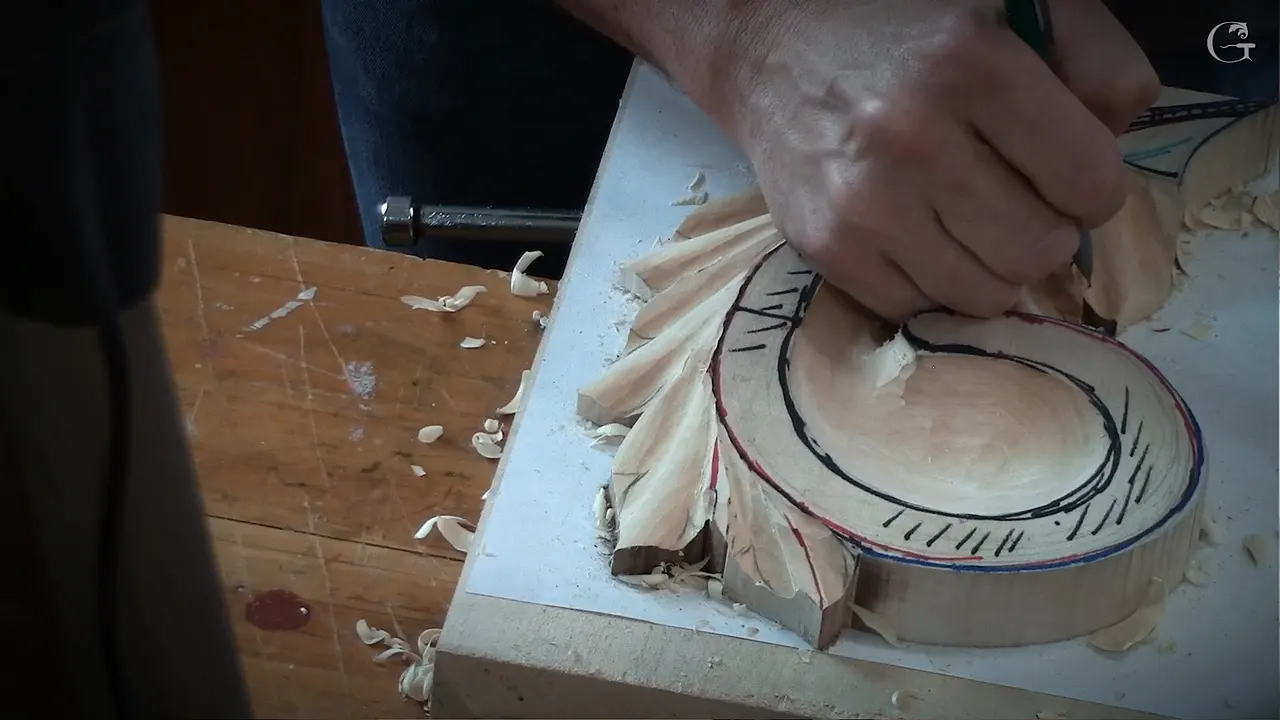

In Byzantine Acanthus 4, video 3, I ask the class to come closer and look at my separations, and the video has the line "In person, it's going to look probably much better, right?" Other lessons carry my words "in person" for the classes I teach, and this page follows them there.
Ever watched a carving on a screen and wished you could step up to it? Ever missed what a tool did because the view came from the wrong side? The first stop is video 3 of Byzantine Acanthus lesson 4, and the lessons where I said it come after.
What did I invite people to do in this video?
"Can you see what I'm doing" is the first question. Then comes an invitation: "once I draw that, you are welcome to come right here and take a picture on your phone if you have a phone with you, and place it close by." Next, "Sometimes it's a really good idea to do that. It just works really good, okay?"

Triangles come up. "So those triangles, we're going to take out." One step comes before that, and I name it: "We have to make a relief cut first." For the tool the plan is "number 11 in 3 millimeters" (about 0.12 in), and the job is to "create that relief cut."
My explanation starts with "what I mean by relief cut, whatever the triangle you see." Then the line stops: "The camera is off. Hold on just a second."
How do I stab a relief cut into a triangle?
"You're going to just stab it down, just like that," I say, and then "A few stabs in every triangle area." Someone asks "Including the eyes?" My reply is "No, not the eyes." Next, "It's close to the eyes, but not the eyes." Last, "Only we've got the separation."

Then I send them closer: "it's probably a good idea if you would come right here closer and take a look where I got those separations and see exactly what I'm doing." The in-person line from the top of this page follows it, with "When you come and see." Another voice says "I don't see."
Divisions are next. "Every one of those become like three pieces inside, okay?" And "So I made the divisions, and those triangles, really important to relieve it." Lesson 5, video 1, carries the same words too.
Why does the relief cut come first?
"Why" is my next question, and the reply is "If you're going to start logically, some people take a gouge and start cutting like this." The result is "just because of the grain, you break the points." My verdict: "So that's no good. So relief cut is really, really important."

A bigger tool is an option, and a mallet too: "In this case, I can actually take a bigger one, and even mallet." A request follows: "Can I grab one of the mallets?" I add "Or even a bigger tool" and with it "I can relieve it even more." Then "And now I can get the smaller one."
Limits on the mallet come too. "We don't need to use a mallet if it's not big tool." For every triangle it is "try to use the same tool all around." The reminder is "don't concentrate just on one leaf, okay?" The ending: "Just go around" and then "Work on everywhere else."
What comes after the relief cuts?
In my words: "So just to make those relief cuts, and only then after step number one, we take now number two, whatever you got, 12 millimeters" (roughly 0.47 in) "or 10 millimeters" (or 0.39 in), "and we start establishing those cuts little by little." The caution is "Don't go all the way right away, okay?" The plan ends with "We're going to remove those triangles."

A look check follows. "But we want to make sure it looks beautiful." And "Even just how I drew that, it already changes everything, right?"
Could a V tool start the cut?
A voice asks "What about using a V tool for the initial cut?" My answer is "You could do a V tool, yes, absolutely." And "A V tool is also good. If you have V tool, yeah, go ahead, use it." Then, on the old work: "But on the other hand, authentic Byzantine carving, they didn't have V tools."
Why do I dig downhill in this board?
I ask "See what happened right here" and say "I didn't relieve it enough, so I should relieve it more." Also "it's better just to relieve it more." Then "See, I'm just going downhill. So now you understand why we're using that board, because I'm digging in the board."

About the wood: "if it would be different species, it would work" and "just either plywood or basswood, whatever."
What did I tell them about taking time?
With that tool, "we're just going to work a miracle." A warning comes with it: "But carefully. Don't think that you stab once and it's going to create a beautiful shape. Take your time, okay? And walk around."

About a space "like a S, letter S," I say "you can take number 7 and 14 millimeters" (near 0.55 in) "and create the S curvature." Then "if you need to reestablish it, so number 7 would be the tool." And "again, blend it nicely."
Looking ahead: "have to undercut later on." I ask "Any questions about those triangles and the separations?" The last lines are "Make a picture. It's a really good idea. At least you make vertical because we'll undercut that later."

What do I see in a class that I do not see online?
In Grape Onlay 1 I tell what I see "time after time, every class" when I teach in person. Among the biggest problems, I say, are "people concentrating on details at the beginning." Online, I don't see it, "because you working on your own." My own piece looks rough at that stage. That is "absolutely fine because it's a roughing stage."

Floral and Molding 1 has a question: "Why am I saying what I'm saying?" My reply starts "When I'm teaching in person, I see that would be the biggest mistake what lots of people do." The mistake is "They just push just like that, and that's no good." Along with it come "lots of resistance" and "a lot quicker tired." So "it's always better just to slice it."

In Grape Onlay 14 I speak to those who took my class: "it just bugs me when people just pushing the whole thing in without creating that rotation motion, without the slicing." Also "Slicing is the key." In this lesson, video 2 has "Just like a rotation" and "movement in overall."

Hashemi Flowers 8 has "The idea is actually to learn how to do it on your own, to make your own designs." Next, "that's the whole point, okay? Like I'm saying all the time," about classes where I teach in person. And "the main idea of wood carving is to learn how to design for the chisel."

Live classes get a line in Venice Room 83: "if you've ever been in one of my live classes, in person, you know how I'm really big about the shadows when I have to explain about the levels of shadows and so on." Then "There's multiple levels of shadows, and we want to use them."
Which class story goes with a relief cut?
Venice Room 3 has this, workshop 3: "Got to be careful in corners like that, so let me make a relief cut." Also "I always like to make the relief cuts." For them I plan "in this case, 16 millimeters, number nine," that is "5/8 of an inch" and "just make a rotation cut." Then comes "I know some people don't get it."

It begins with "I was teaching a class in Tampa, a class in person." Then "So we had a really good time, really nice people." One guy hears my idea: "I tried to explain about that idea, but one of the guys, he said" "Well, I'm carving for a long time already, so I never done it. I never had any problem." And he "just messed up. He decided not to do that way, and he messed up his carving."
Next, "it's not like it's unfixable. It is fixable. But still, why would you fix something if you can avoid that in the beginning?" Right after that, "Okay, I've got multiple spots like that. So those triangles."
Is an in-person class different from a video?
Furniture Panel 21 tells of a class: "I had a class I was teaching, wood carving in person." It adds "I think I love it even more right now than I used to." Words about the difference follow: "little different experience," "it's a big difference" and "connecting with me on more personal level, I would say."

At some woodworking schools I have several students at once. Lily Box 3 has "when you walk in a room, you don't hear anybody talks." Then "Everybody just concentrated and working" and "all you hear is just everybody's blowing."
What does a class teach about bows and clay?
Chamomile and Bow Rosette 2 has "after teaching for a while, even in person classes, I found some people they do have a problem with those bows because it's a 3D." "You can use clay," I say, and mine is a plastilina. Then "you can really quickly replicate with the clay."

"You don't have to be making a perfect shape, but at least it can show you a twist." A livestream of April 2020 adds two class lines: "day number one, I'm trying to be easy with people." And "When I start on Monday, by Tuesday evening, everybody's so tired." Both sit in the April 2020 livestream lesson.
How long does an in-person class last?
A viewer asked, and in the April 8 livestream I answer "In person, it lasts pretty much five days, like the whole week, and that's from 8:00 to 5:00." The hours: "Let's say something like that, eight, nine hours, 10 hours and so on. It depends on the school, of course."
The questions and answers course describes who comes: "I do have some 30s, 40s people, sometimes even 18 years old in person." And "let's say in Florida when I'm teaching, it's over 50s." Then, in the livestream question and answer lesson, I list "All the mathematics, all the golden ratio, Fibonacci numbers, sequence, and all the movements, all the armature, law of space, law of rhythm and so on." And "I'm teaching actually in person. It takes the whole week when I'm explaining the whole process of development."
Which projects did I carve in person?
In the Butterflies final assessment I say I have some carving in the back side, which is "like the board I brought from school when I was teaching in person." And "I didn't want to waste that board, so I decided to make something on that side."

Acanthus over Moldings 2 has "excellent project for in person" and "For one week project." My tools course has "what we did in my lessons in person, that project, it's a Byzantine acanthus leaf." Grape Onlay 4 adds "in-person classes I was teaching a few years ago" and "we established preliminary movements at the class." Venice Room 1 has a tool roll that I sometimes bring to a school: workshop 1 says "sometimes I use that when I'm taking tools."
Can someone who never carved take a class?
In Grinling Gibbons Maine 17 I say "some of the people actually who took that class in person, they pretty much never carved and they also pulled really good results."

Where did I say it, in one table?
| Where | What I said about in person |
|---|---|
| Acanthus 4-3 | A carving that looks better when you come |
| Onlay 1 | A problem when people start on the details |
| Floral 1 | The biggest mistake, which is to push |
| Onlay 14 | A push without a rotation motion bugs me |
| Hashemi 8 | Design for the chisel is the main idea |
| Workshop 83 | Shadows I explain in a live class |
| Workshop 3 | A man who skipped my idea and messed up |
| Chamomile 2 | Bows are hard for some because they are 3D |
| Lily Box 3 | A room where all you hear is blowing |
| Livestream April 8 | A class that lasts the whole week |
| Butterflies final | A board from school that I did not want to waste |
| Moldings 2 | An excellent project for one week |
| Maine 17 | Good results from some who took it |
Which part of your own piece would you like to stand next to? Every video of this lesson sits inside one tuition plan. The Byzantine Acanthus course page holds all ten lessons, lesson 4 here and lesson 5 next. Wood carving and relief wait in that course, and my sizes come with my own figure first and an inch figure beside it.
How it's done
- Relieve the triangles first. I plan a number 11 and a few stabs in each triangle, and the eyes stay out of it.
- Go bigger when it helps. A bigger tool can relieve more, with a mallet if the tool is big, and a smaller one comes after.
- Take the next tool. The next step uses a tool of 12 or 10 mm (about 1/2 in or 3/8 in), and the cuts come little by little.
- Relieve again. Where I did not do enough, I say I should do more. I say plywood or basswood is better for a board I dig into downhill.
- Shape the S. A space like the letter S can take number 7 in 14 mm (0.55 in), and I blend it nicely.
- Take a picture. My last lines are "Make a picture" and "At least you make vertical," because we will undercut that later.
Frequently asked questions
Why did I want people at the piece?
A good idea, I say, is to come closer to the spot where I got the separations. Phone pictures get an invitation too, and I say it "works really good."
Which tool makes the relief cut here?
My plan is a number 11 of 3 mm (0.12 in). Each triangle gets a few stabs, and the eyes stay out of it. The next step takes a tool of 12 or 10 mm (about 1/2 in or 3/8 in), with the cuts coming a bit at a time.
What mistakes do I see in a class?
One is people starting on the details early. Another is pushing the tool, and I tell them to slice. Online I don't see the first one, "because you working on your own."
What to carve next