

Alexander Grabovetskiy, woodcarver, School of Woodcarving · Published 2021
What does a wood carver mean by a "stabbing cut"?
Quick answer: Byzantine Acanthus 5 shows me taking a 3 millimeter number 11 (about 0.12 in) and stabbing it straight down a few times in each triangle, as a relief cut. Other lessons use my words stabbing cut for a straight push, and a few say what I think of it.
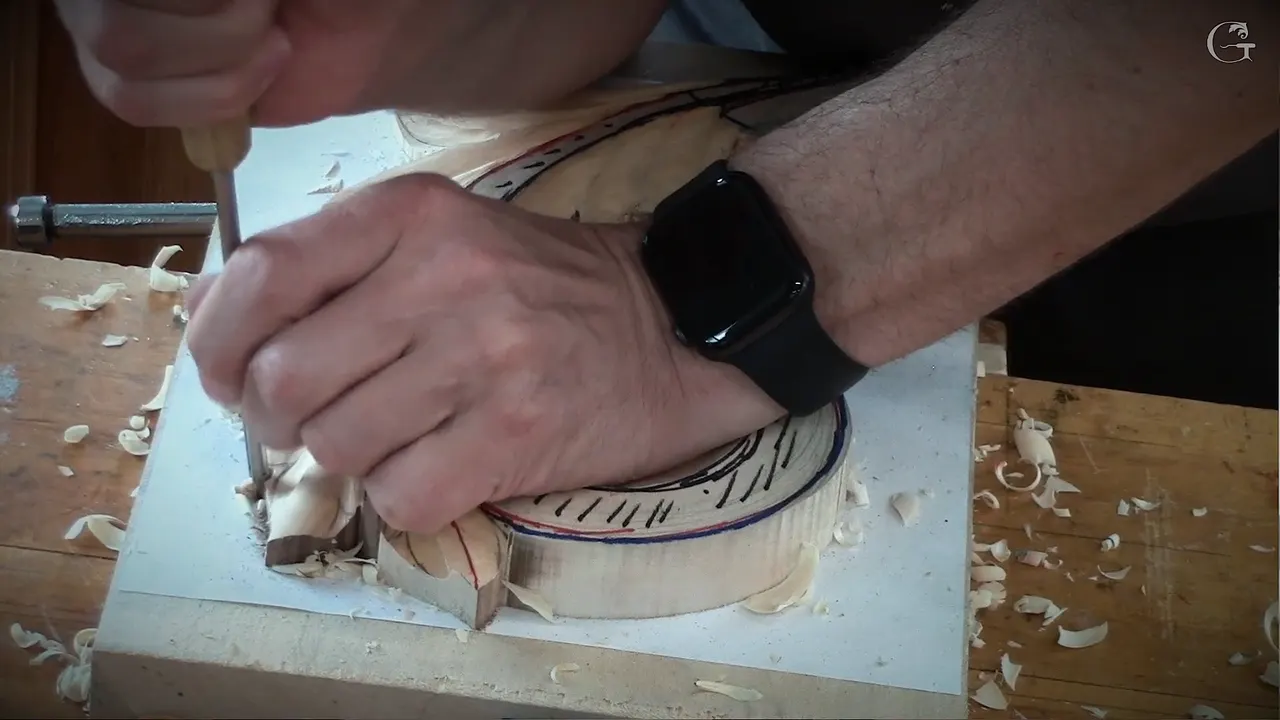

In Byzantine Acanthus 5, video 1, I take a number 11 of 3 millimeters (about 0.12 in) and tell the class "you're going to just stab it down, just like that." Few stabs in every triangle area. Other lessons of mine call a straight push a stabbing cut. In a few of them I say it is not my preference. This page follows my words through each.
Ever seen a gouge slip along the grain and take a point off a leaf? Ever wondered which tool goes in before all the others? Start with Byzantine Acanthus lesson 5. Then come the other lessons, each one linked where I mention it.
What do I say before the first stab?
Video 1 opens with "Can you see what I'm doing" and an invitation. Once I draw, you are "welcome to come right here and take a picture on your phone." Sometimes, I say, "it's a really good idea to do that."
The order comes next: "So those triangles, we're going to take out." Then "We have to make a relief cut first." My tool is "number 11 and 3 millimeters" (0.118 in). I stop mid-explanation. "The camera is off." And then comes "Hold on just a second."

Back on track, I ask "Which one is going to be better to show? This one. Right here, okay?" The amount comes with the move, and I give it in two short words: "Few stabs."
Where do the stabs go, and where do they not?
A voice in the room asks "Including the eyes?" My reply: "No, not the eyes. It's close to the eyes, but not the eyes." I also say "Only we've got the separation."
Then the triangles. "Every one of those become three pieces inside, okay? So I made the divisions, and those triangles, really important to relieve it." It will probably look much better in person, I say, when you come and see.

Why do I stab before I carve a triangle?
The reason arrives as a question. "Why? If you're going to start logically, some people take a gouge and start cutting like this. And what happens, just because of the grain, you break the points." My verdict: "So that's no good. So relief cut is really, really important."
The end of lesson 4, video 3, carries the same demonstration, down to "a few stabs in every" triangle and the same line about the points.

Which tools come after the stabs?
A bigger tool is next. "In this case, I can actually take a bigger one, and even mallet." I ask for one of the mallets and say "Or even a bigger tool." With that one, I say, "I can relieve it even more" and then "now I can get the smaller one."
A mallet is not always needed. "We don't need to use a mallet if it's not big tool," I say, "but every triangle, and try to use the same tool all around." I also warn against staying on one leaf: "Just go around. Work on everywhere else."

Only after the relief cuts does the next step start. "After step number one, we take now number two, whatever you got, 12 millimeters or 10 millimeters" (roughly 0.47 in or 0.4 in), "and we start establishing those cuts little by little. Don't go all the way right away, okay?" The plan is to remove those triangles.
A voice in the room asks "What about using a V tool for initial cut?" My answer is "You could do a V tool, yes, absolutely." And "If you have V tool, yeah, go ahead, use it." And I add: "But on the other hand, authentic Byzantine carving, they didn't have V tools."

What happens when a stab is not enough?
One spot shows it. "I didn't relieve it enough, so I should relieve it more." And "it's better just to relieve it more," I add, followed by "See, I'm just going downhill."
That is where the board matters. "So now you understand why we're using that board, because I'm digging in the board." On other woods, "if it would be different species, it would work, but it's better to just get, I guess, just either plywood or basswood, whatever."

Next comes "And now, with that tool, we're just going to work a miracle." A warning follows: "But carefully. Don't think that you stab once and it's going to create a beautiful shape. Take your time, okay? And walk around."
How do I shape the S curve after the stabs?
"A space like this, like a S, letter S, you can take number 7 and 14 millimeters" (0.55 in) "and create the S curvature." About one spot I say "right there, it's already established. But anyway, if you need to reestablish it, so number seven would be the tool. And again, blend it nicely."

A look ahead ends the video. "And we're going to have to undercut later on." Then "Any questions about those triangles and separations" and "Make a picture. It's a really good idea." The last line is "These should stay vertical because we'll undercut them later."
Where else does stabbing cut come up?
The words travel. Below, I use the words for a gouge set straight down, and I say what I think of that. My views go from a plain "acceptable" to a flat "don't."
Is a stabbing cut good for the wood?
In the first video of Furniture Panel 24, step one is an outline. "So the step number one would be outline the flower itself, and then just cut with a different tool underneath of it." One approach, I say, is "like we've done before, like number 11, and just go around." Another is "you can actually just do a stabbing cut. So you can pretty much just stab with some kind of gouge."
For that one, I say "Let me take probably number five and three millimeters" (about 1/8 in), and "I'm going to just place it straight down, just like that." After that, "Just stab down and then follow the outline."

Now my view. "Which is acceptable way of carving, but that's not my preference because you're creating too much stress. You're actually spreading those fibers both directions. It's actually not too good for the wood."
My advice comes right after, and it is "it's always better to just outline first." Yet speed has a place. "If you want to do much quicker, that would be acceptable, I would say. Why not?"

Another side shows in Grape Onlay lesson 7, video 1. "I could just do like a stabbing cut, which I'm not the biggest fan." A flat gouge makes it "doable." My reason is "you're just spreading the fibers to the sides" and so "I prefer to use number 11, but sometimes it's all right to use it."
Over in Furniture Panel 38, the second video plans a cut "with the knife, not so deep." My line there is "I usually don't like that stabbing cut," because of the fibers, and in most cases it would be a no-no. In that spot there is "not much material I have to remove."
When is a stab safe?
Furniture Panel 39, video 2, has the same order as Byzantine 5. A stab is possible "because I created my relief cut." Next I plan to take a number eight and make "straight down cut" with my barrel side toward the design.

What follows runs on. Each cut is going to start about in the center of my previous cut, and some chopping is part of it. Of this plan I say it is "just one of the techniques you could do."
A harder spot sits in the second video of that lesson 38. I could get a pretty close radius and create an initial stabbing cut, I say, but I am afraid, because the area is "kind of weak." I say I have a tendency toward a relief around the area, and that is what I plan to do with the number 11, "Not too deep."

After that I plan a number six, and "it's gonna be pretty close." Then "Now I can do my stabbing cut." My stab is angled a little, and I say I want to see a wall right there, the angled wall. The angle gets an explanation: "I'm not stepping that straight down, like 90 degrees, but slightly, slightly angle it that way."
What size goes with a stabbing cut?
Venice Room workshop 93, video 5, has "I need something smaller than that." My pick: "So I'll take number five and 3 millimeters" (roughly 0.118 in). Then "And here you go. Just a stabbing cut." Next come two lines, "I need to clean carefully" and "Let me use a mallet."

Floral and Molding for the Panel 2, video 2, has maybe a flatter tool: "maybe number two, and get on this line. And create a down cut, stabbing cut." Then "And same I can do on this side," I add, and a mallet is an option too: "Sometimes it's a good idea."
A small tool follows in that video: "I'll use three millimeters and number 11." Right after, "One-eighth of an inch, number 11." Its job is to "get inside of those cavities and remove some of that waste." The check comes next: "looks like three millimeters is still too big."
Butterflies 3, video 3: "I can probably grab number nine." I plan to get a little closer to those lines, with a "straight down" cut, a "stabbing cut." I give a reason: "that way it's going to be a lot easier for me" to make the line "really nice." A figure follows, "about a quarter inch" (about 6 mm), and "that's what I am after."

Later in that video the design stays alone: "I do not touch the design yet. I'm not working those lines yet." What I am doing is "outlining my main main movement."
On Grape Onlay 6, third video, I say "kind of too much waste." My plan reads "let me get number nine or number eight" then "get stabbing cuts down, get back to my previous tool, remove some of the excess material all around."
The short form shows up in lesson 10 of that course, video 1. "Probably I can somewhat stab and make it a little more narrow, make it like two millimeters" (close to 0.08 in). And I want to make sure you can see the opening, I add.
The Tray of Blessing 3, video 2, is a near relative. I plan to show the next type of cut, "somewhat like a stabbing cut, but not really." My tool plan is "the bigger number" then "Nine and 20 millimeters" (nearly 0.8 in), placed "straight down like 90 degrees."

The depth I name is "approximately no more than one eighth of an inch" (about 3 mm). The motion I plan is "slicing, cut down, back," again and again, "until I hit that design line." And "don't do too deep because you really need to blend that first."
Did I ever say not to stab?
In Vase with Grape Leaves 3, the first video gives the plainest answer. "You're not supposed to use straight-down cuts with gouges. I'm talking about do not do a stabbing cut. Don't stab on the inside because we still have to subdivide, and you don't want to create extra tool marks which you have to deal with later."
Video 1 of that Furniture Panel 39 lesson adds a case for outlining. "And please don't create any stabbing cut" for outlining, "if you create a lot of stress." My words for it: "So that is not gonna be a good idea."

There I plan to take the line a little deeper, and "I'll use just a knife." Later I plan to grab my big chisel, and any skew chisel will do, I say.
What did each lesson plan or use, in one table?
| Where | What I planned or used |
|---|---|
| Acanthus 5-1 | Number 11, stabs in each triangle |
| Main Flowers 24 | Probably a number five, for a stab |
| Venice Room 93 | Number five, then a mallet to clean |
| Floral and Molding | Maybe number two, a flatter tool |
| Butterflies 3 | I can probably grab a number nine |
| Onlay lesson 6 | Number nine or number eight, my plan |
| Tray of Blessing | A bigger number nine, not quite a stab |
| Lesson 38 | Number six, with a slightly angled wall |
| Lesson 39 | Number eight, after the relief cut |
Which triangle on your own leaf gets the first small stab? Every video of this lesson sits inside one tuition plan. The Byzantine Acanthus course page holds all ten lessons, lesson 4 before this one and lesson 5 here. wood carving and acanthus run through the course, with Byzantine carving as the style. Sizes follow my own figure first, then the other unit in parentheses, such as an inch figure or millimeters.
How it's done
- Start with the relief cut. The triangles come out only after a relief cut, and the tool I name is a 3 mm number 11 (near 0.12 inch).
- Stab in each triangle. A few stabs go in, close to the eyes but not on them.
- Add relief where needed. Where a spot has too little relief, I say to add more.
- Keep the same tool all around. I say to use the same tool in each triangle, and to work everywhere else, not on one leaf.
- Take the triangles out. Next comes a tool of 12 or 10 mm (about 0.47 or 0.4 in), little by little, and not all the way right away.
- Slow the hand. I tell the room one stab will not create a beautiful shape, and to walk around.
Frequently asked questions
Do the stabs touch the eyes?
Each triangle gets a few stabs, as a relief cut. When a student asks about the eyes, I answer that the stabs stay off them, though they sit close. I add "Only we've got the separation."
Why stab before carving a triangle?
The grain is the reason I give: some people start carving right in, and then, I say, you break the points. The way around it is a relief cut.
Is a stabbing cut hard on the wood?
In lesson 24 of the furniture panel course I call it acceptable, and say it spreads the fibers both directions. I add that outlining first is always better.
What to carve next