
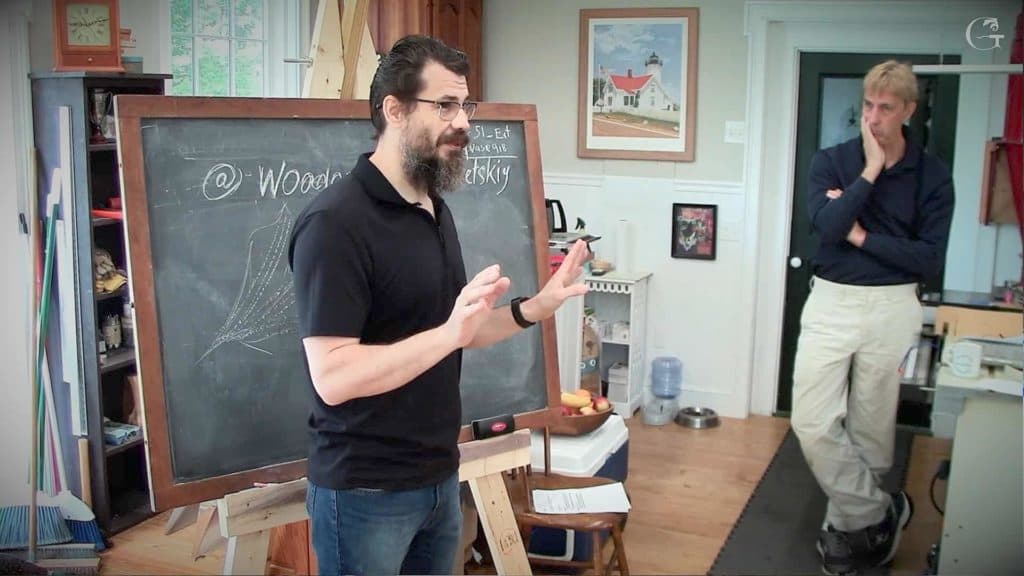
Alexander Grabovetskiy, woodcarver, School of Woodcarving · Published 2021
What did Byzantine carvers put under gold leaf before gesso?
Quick answer: In video 2 of Byzantine Acanthus lesson 5, I say the red clay came before the Italian gesso. Burnishing came next, a really thin second layer went over it, and then came oil and the gold leaf. Other lessons of mine tell the same story in their own words.
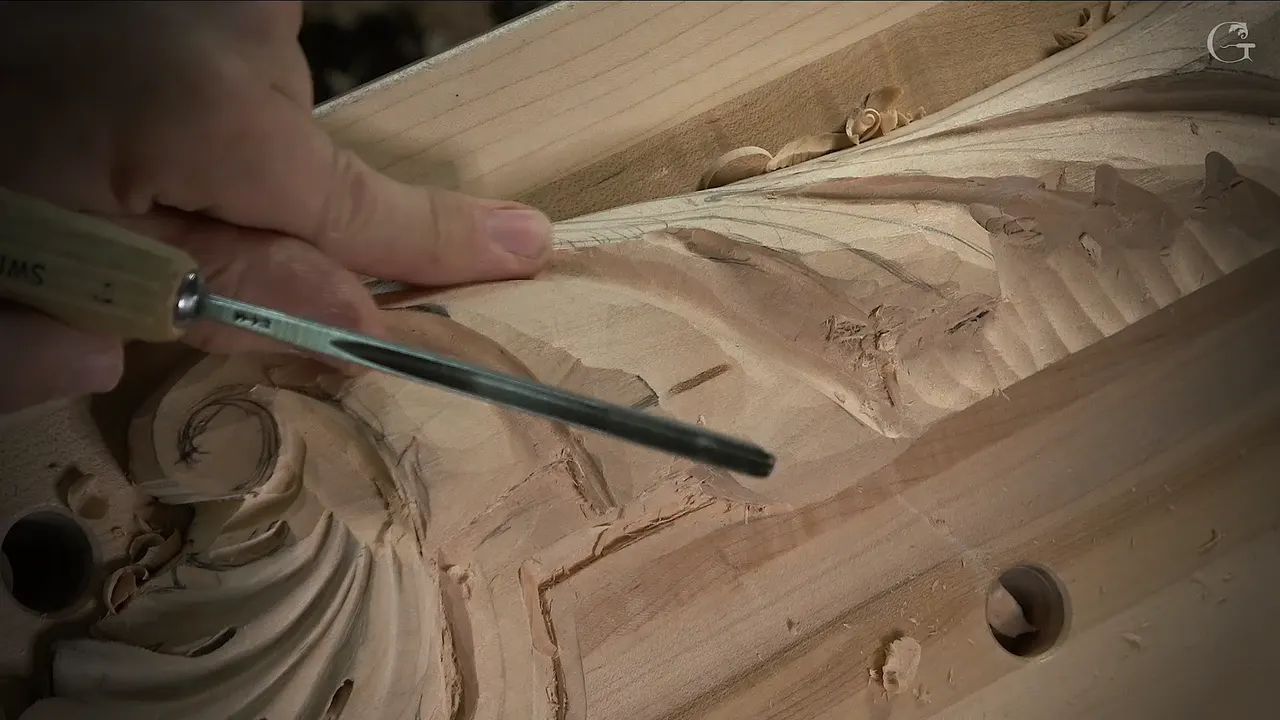

In Byzantine Acanthus 5, video 2, I tell the class a Byzantine leaf "was always gold leaf" and that before the Italian gesso "they used just the red clay." This page follows the red clay through that video, then through the other lessons where I told the same story.
Ever looked into a deep channel of an old carved leaf and asked how gold got in there? Ever wondered what sits under it? My answer in Byzantine Acanthus lesson 5 starts with what covered the carving.
Why did a Byzantine leaf get gold?
I put the rule first. A Byzantine acanthus leaf was "never left as a bare wood or finished wood or stained wood or whatever, shellacked wood." The next line says the rest: "It was always gold leaf." Channels were the trouble, I say, because "those cavities, those channels, it creates the big problem for the gold leafing back then."
Even the gold leaf itself was different. Nowadays, I say, "you can gold leaf anything" and "you barely apply it." The leaf of that time "was little thicker back then."

How did the red clay go on the carving, and what came after it?
Here is the order, in my words, line by line. About the gold leafing: "what they've done before the gesso, Italian gesso, they used just the red clay." I call it "just the first form of application of the gold leafing."
"Red clay is really thick," I say, and right after it comes "carve it without too many details, but a really beautiful shape." Next, a plan for that day: "inside also, we're going to create today a dome effect." Then "So it's really easy to gold leaf."

The clay gets worked next. "They would apply red clay, and then they burnish it, the clay itself," I say. It is "like taking all the facets out, and it looks like almost it's sanded." "Of course, they did not sand," I say. The tool I name is "sometimes pumice stone, just to make it a nice surface."
After that comes "another really thin layer of red clay." Then "oil, and apply the gold leaf on it." My word on the result is "It's going to stick really perfectly for years to come." And "you barely can take it out," I say.
The gold gets burnished too. "Then they burnish that again, that gold leaf, and that creates the small cracks in the gold leaf itself, and you can see the red color coming through, in those cracks." Big cracks get a fix: "if cracks are too big, then they just would apply another gold leaf layer." I end on "it stays almost perfect."
Which details did the Byzantine leaf leave out, in my words?
"So that's what's the difference," I say. Then "No details, not too many details." The same goes for facets, I say, and for the movements inside of acanthus. In a furniture-style, low relief acanthus "there's going to be stripes." Byzantine, I say, "didn't do that."
A question follows, and someone asks whether the piece is medium relief. I answer "that is a high relief." We use "just three quarters of an inch on top" (19 mm), "but most of the time, it would be thicker." The upper layer would be two inches (51 mm), which "would give a bigger head."
Then I say "they're using, again, on purpose of the gold leafing and inside, that creates the dome and the shadow effect." The shadow is "really thick, heavy shadow, just beautiful."
What else did I say in that video, besides the gold?
Byzantine acanthus had "huge eyes," I say, and an eye is "the space between two leaves." "People would look inside of that eye, and they can find some secrets inside." I name "some kind of hummingbird inside, or any stuff." And "when you look at it, it looks solid." "Byzantine used dowels," I say.
Touch comes up too. "People would come to churches, and people love to touch," I say. Next: "We feel much better than we see. The human hand can detect one thousandth of an inch" (about 0.025 mm). "And eye cannot." On furniture, I say, "You feel it."
Byzantine is "one of the most complicated acanthus you can find," I say. I go on: "if you master Byzantine acanthus, all acanthuses besides that" will be easy, I say. "Just like a piece of cake." Only the French are left out, and "they broke the rules," I say.
Did I have a gold project of my own waiting?
In that same video, gold was a plan of mine too. "I mentioned the project I'm going to do for a European castle," I say. Gold leaf is the plan for the whole castle. The wood is to come from France, and I name "the French lime wood."
"And then I'm going to carve it." My plan is to send it there, and "they're going to gold leaf the whole thing." I also say "I could take the whole thing as a gold leaf, gold leafing and so on, but I enjoy carving more than gold leafing for some reason." The style planned is "18th century Italian style," so "it's a little different approach." Whether I take it, I say "I don't know yet because that guy waits on me for a lot of years."
Where else did I tell the red clay story?
In Roman Acanthus lesson 16, second video, I clean a leaf with a gouge and say someday we will carve a Byzantine leaf. Next I tell the story of the Orthodox churches. Their "main idea, especially in ancient times, to make it as rich look as possible, and the way they've done it, they gold-leaf it."
"To do the gold leafing, you really need that smooth transition in the area like this, for the gold would stick." Clay comes next. "They didn't gold leaf just on the bare wood," I say. In place of it, "they would cover all the carving with the red clay." My comparison: "Nowadays, we're using just gesso." The old carvers used the red clay.

A tip comes with it: "In an area like this, it's a lot nicer to actually get with your finger and just to get in those areas and kind of make a really nice smooth transition with the red clay." And "after that, they would use gold leafing." About tools, "They never used any V tools back then. So the V tool was invented later." Still, "V tool is one of my favorite tools."

The first video of Venice Room workshop 163 comes at it from the other side. "Before the gold, they applied clay, red clay, just normal earth red clay," I say. It is "not like applying gesso." Their aim: "they wanted to make it a simplified version to get the gold leaf underneath." And "it's really hard, if you understand, to get right on the side of the undercut if it's too deep."

Then Turkey: "when you go to Turkey, modern Turkey, and go to some old churches they saved," I say. There "you'll see some gold leaf on some of the parts of the carving, and inside of the cracks of the gold leaves, you can see the red clay." My verdict: "I think it's really, really smart what they did. It's my personal opinion."
Then, in workshop 162, third video, I split the two empires. "Romans, they did not use gold leaf." Of the other: "Byzantine Empire, they used acanthus leaves in churches." Next, "they wanted to use gold leafing." They "started to actually make carving more beautiful by applying gold on it."
The Lily Box course, flower lesson 10, gives the order short. "They would carve it first." The red clay goes over it next, and "they would just burnish it, make it really smooth, the red clay." Then I say they put "the layer number one" of gold leaf, burnish again, and "they would put the second layer of the gold leafing."

"It's all gold leafed. All the carving is just covered with the gold." That was one of the main reasons for the lack of sharp lines. "They used really smooth transitions on inside and out." A V cut would be "really hard to get gold leaf" down inside, I say, "and nice and smooth."
The old tools were bigger: "They would use a much bigger. Maybe the smallest one would be about three millimeters undercut right there" (about 0.12 in). I add "the Byzantine wood carvers, they never used any V tools. They used only gouges and chisels." On that idea, "I kind of like that idea. I really like it."
The Modern Acanthus course, lesson 7, first video, brings the red clay up inside a talk about making a surface smooth. I say "they would carve stuff then they would put the red clay on top." One more line: "They would just put the red clay."
Why do sharp lines and gold not mix?
In workshop 28, third video, I say "you don't see those sharp transitions on a Byzantine style acanthus." And "if you're doing a gold leafing, it makes all the sense not to do the sharp transition," because gold will "stick a lot better on a smooth transition."

Over in workshop 8, first video, I am cleaning a part. An angled tool "would create a really sharp point inside, which I don't want to see." Then: "you really want to avoid those sharp lines because gold is not going to stick to it." And "you really need to get a really nice transition on inside."

Lesson 3 of the Byzantine course, third video, warns about a Roman-style leaf with a twist. "Too many lines, it's not going to be as soft" and, I say, the leaf is not good for the gold leafing.

The fifth video of workshop 18 says Orthodox carvings are "made for the gold leafing, by the way." "They created a technique," I say, and "you can gold leaf it on inside with no problem." Then "sometimes people don't even know how is it done." And "it is possible if you know what they did, the approach they used. Which is nothing complicated at all."

In the sixth video of workshop 65, I tie the big shapes to the gold. "Byzantine, they developed those really big movements for the gold leafing. That was the idea." Next: "the gold is a yellow-brownish color, and they needed to get those shades, those shadows." And "that's why they've got exaggerated eyes, they've got exaggerated pipes."

A short reason for the same pipes sits in workshop 152, third video: "they use that exaggerated pipes just because it's a lot easier to apply gold leafing on it." In an April 2020 livestream I say "this is made from solid piece, and you can't place any gold leafing" inside that one, I say. "But on Byzantine style, you are able."

What did I do before gold on my own work?
In the sandpaper video I turn to my own gold work and say "that is gonna be traditionally done gold leafing." Then it is "water gilded." And for the water gilding, "the surface has to be stabilized."

scrapers, I say, is a technique used "all over the Europe." Then "after the scraping, you could just burnish it with the same species of wood" and here I use American basswood.
The reason is the gold. It will "give you a shiny surface, really shiny surface." Then "It's gotta be shiny. Before you apply the gold leaf." My last step is 4,000 grit, and it "gives me beautiful, beautiful, shiny, shiny result." The surface is "gold ready."

The scrapers lesson says "I do have to make it smooth because it's gonna be gold leafed." It adds "I wouldn't do too much." It also says "what style of gold leafing you do" matters, and for water gilding "you really need to get" "that surface ready." The Grape Onlay final assessment says "authentic gold leafing" then "oil-based gold leafing. So the surface has to be smooth."
In Grape Onlay lesson 10, first video, I talk about the project behind me, a pipe organ: "that's gonna be all gold leaf." A viewer asks about gilding in April 2020. I answer "Some of my work is actually gets gold leafed." And "Yes, I will show on a Byzantine style acanthus."

Which lesson said what, in one table?
| Where | What I said about the gold |
|---|---|
| Acanthus 5-2 | Clay, burnish, thin clay, oil, gold leaf |
| Roman 16-2 | Clay first, then the gold leaf |
| Workshop 163 | Old gold cracks show the red clay |
| Lily Box 10 | Carve, red clay, burnish, two gold layers |
| Modern 7-1 | Carve first, red clay on top |
| Workshop 28-3 | A smooth transition holds gold better |
| Venice 8-1 | Sharp lines, gold will not stick |
| Venice 65-6 | Big movements made for gold leaf |
| Grape Onlay | Oil-based gold needs a smooth surface |
| Sandpaper video | Water gilding needs a stabilized surface |
Which part of your own carving should stay simple for gold? Every video of this lesson sits inside one tuition plan. The Byzantine Acanthus course page holds all ten lessons, lesson 5 here and lesson 6 next. Sizes follow my own figure first, then the other unit in parentheses, in inch and millimeters, and acanthus runs through all of it.
How it's done
- Carve the shape with few details. A really beautiful shape is the aim, and facets and movements stay few, with the details held back.
- Cover the carving with red clay. Red clay is really thick, I say, and it came ahead of the Italian gesso.
- Burnish the clay. Burnishing is like taking all the facets out, I say. Sometimes pumice stone gave a nice surface.
- Add a thin second coat. Another really thin layer goes on after the burnishing.
- Oil first, gold leaf second. Oil went on and the gold leaf followed it, which I say sticks really perfectly for years to come.
- Burnish the gold and fix big cracks. Burnishing the gold makes small cracks, and the red shows through them. Big cracks get another layer of gold leaf.
Frequently asked questions
What went on the carving before the gold?
The red clay came ahead of the Italian gesso, I say. Burnishing came next, then a really thin second layer. Oil came after that, and the gold leaf went on the oil.
What makes the cracks in old gold show red?
In Byzantine Acanthus 5 I say the gold was burnished again, and that creates small cracks in it, and the red color comes through. In Venice Room 163 the red clay shows, I say, inside the cracks of old gold in churches.
How are big cracks in the gold fixed?
I say another gold layer goes on when the cracks run big, and then it stays almost perfect. That line sits at the end of the gold story in video 2 of lesson 5.
What to carve next
- Byzantine Acanthus lesson 5
- Roman Acanthus lesson 16
- Venice Room 163
- Venice Room 162
- Modern Acanthus lesson 7
- Venice Room 28
- Venice Room 8
- Venice Room 18
- Venice Room 65
- Venice Room 152
- Byzantine Acanthus lesson 3
- Should I use sandpaper in wood carving
- Scrapers for wood carving
- Grape Onlay final assessment
- Grape Onlay lesson 10
- Byzantine Acanthus course
- Byzantine Acanthus lesson 6