

Alexander Grabovetskiy, woodcarver, School of Woodcarving · Published 2021
What does a wood carver mean by "sweeping"?
Quick answer: In video 3 of Byzantine Acanthus lesson 5, I use the word sweeping while a number 9 takes wood from the back of a leaf to the edge. Other lessons put it beside rotating the tool, slicing and not pushing. I also warn against forcing it.
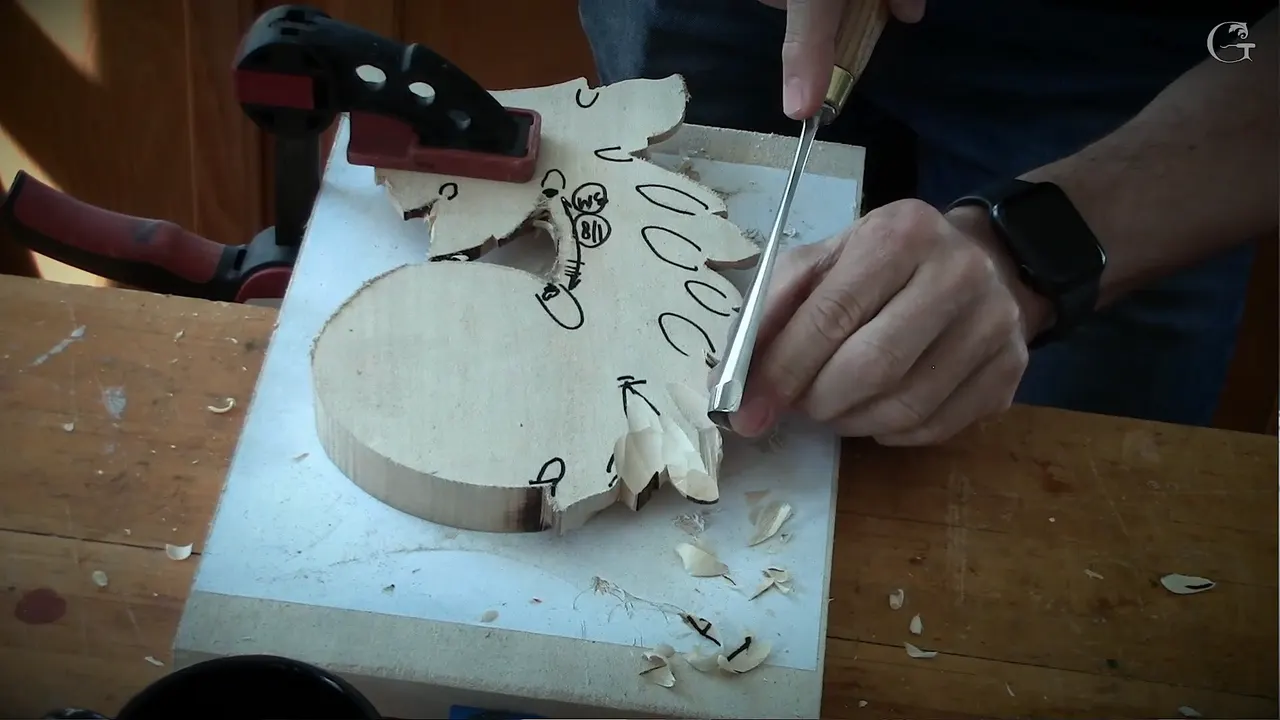

In Byzantine Acanthus lesson 5, video 3, I say "you are sweeping" while a number 9 clears the back of a leaf. Other lessons put my word on a tool that turns through the wood, and on a slice that does not push.
Ever pushed a gouge straight into a leaf and felt the grain grab it? Ever watched a thin edge crumble under a heavy hand? This page starts with the fifth lesson of the Byzantine course. Then it follows my word through the Roman acanthus, the Greek acanthus, the Acroterion and the Hashemi flowers.
What was my tool doing when I said "sweeping"?
The piece comes out first: "we're going to take that piece out." I ask "Can I use one of your chisels?" Then comes "put that upside down" and "undercut it." The job, in my words, is to "take that material out all the way to the edge." A clamp follows: "Why don't we use a clamp just to be safe?"

The tool is a number 9: "take number nine." Then the class hears "pay attention in the areas where those two leaves are meeting." There "those cuts are going to be much, much deeper in the body" and I add "be careful."

The line this page is about comes later in the video. First "this area, I have to do a little deeper" and "keep an eye what the grain does." Then: "every cut you do, every cut, you are sweeping. You are sweeping."
For a triangle area, "you could use a smaller tool if you have, and get to that point." Of the work on the back I say "it's going to create beautiful shadow casting."
Can a big gouge do small work while it sweeps?
Yes, and I said how in the same video: "When you're using big tool, you can use just the one part of the tool." It "becomes really a small micro-tool, and you bring that to the edge." Smaller works too, but "the bigger you have, it's better."
In Hashemi lesson 12 I say "bigger tools you use, cleaner the cut going to be. So much less to clean later."
Greek acanthus lesson 12 shows the small corner. The line is "I know on a camera it's impossible to catch, but I'm using just the right corner of this tool just to make my small micro rotation, micro sweeping cuts."

How close to the edge does a sweeping pass go?
The order is "bring it to the edge." My goal, in words: "You really have to just get to the edge, if you really want to make it look like it's light and almost airy." Then the payoff: "it's thick, but people are going to think it's just like a paper thin."
A little wood can stay at the edge, "about one millimeter or one and a half mil" (0.04 to 0.06 in). Then "later on, we can attack that from opposite side and make it like a knife cut. Beautiful outline." For the 1.5 my figure is "about 16th of an inch."

Where do I hold back?
Two places. The body of the leaf is one: "Don't take too much material in the middle of the leaf." More should come off the sides of the leaf, and not the middle. Grain can fight: "if the grain fights you, be careful."
One short stretch gets even less: "don't overdo" and "no more than maybe three millimeters, eighth of an inch on this side." Because the spot is "really important," I plan to "attack that part" and "blend with the upper piece." So "we need that material."
Near the end: "the only part you really don't want to overdo is this part." The place is between the round part and this leaf, and there "you really don't want to overdo it."
The circle is separate: "maybe just about six millimeters, quarter inch, or 10 millimeters from the edge" (10 mm is 0.4 in), and "no deeper than one-eighth of an inch" (3 mm). On tools, "it's easy if you do have a knife or skew." So "sometimes it's much quicker."
What comes before the sweep, a stab or a pass?
In video 1 of the same lesson the relief cut comes first. My words: "We have to make a relief cut first" with "number 11 and 3 millimeters" (0.12 in). The motion: "you're going to just stab it down, just like that. Few stabs in every triangle area." I give the reason a little later: "some people take a gouge and start cutting like this. And what happens, just because of the grain, you break the points."
Once step one is done, I say "we take now number two, whatever you got, 12 millimeters or 10 millimeters" (0.47 or 0.39 in), and "start establishing those cuts little by little. Don't go all the way right away." I warn the class that one stab does not make a beautiful shape: "Take your time, okay? And walk around." For an S shape I name "number 7 and 14 millimeters" (0.55 in).
Does sweeping mean turning the tool?
The Roman acanthus lessons spell it out in plain words. In the sixth Roman lesson, video 3, the tool is "number nine, quarter inch." A short order follows. "Make your sweeping move." My explanation: "What I mean by that, rotate the tool while you're making the cut."

I warn about depth in the same video: "I do make my cuts kind of really deep, but be careful with that." And I add "you can't glue that back."
Roman lesson 5, video 4, has the word beside a change of side. My words: "attack from two sides" then "keep an eye what side is clean side and concentrate on that side first, then go back from opposite direction." The sweep comes with it: "don't forget to rotate or sweep while you're carving. So you can see I'm just doing sweeping cut."

Slow motion comes in Roman lesson 6, video 6: "if I were doing this in slow motion, I am actually sweeping, just rotating." Before that I say "you can still achieve really nice long cuts, but first take small chunks out."

In Roman lesson 9, video 2, the turn gets a direction: "I am making a sweeping cut, rotating counterclockwise in this case. So I start on the right and rotate it to the left." After it comes "don't overdo it."
Further on, I take "number five, quarter inch" and watch "not to damage this straight line." Then "Again, sweeping." Video 3 of the same lesson has "sweeping inside or rotating" for the middle part.

A rotation comes in Roman lesson 11, video 2. I undercut an eye with "the same number eight" and say "I'm actually doing a rotation with my tool, or sweeping." The direction is "counterclockwise." I leave "about 3/32nds" (2.4 mm) in that area, because "later on, I'm going to show you a really nice, unique movement."

What did I say about sweeping in the Greek acanthus lessons?
Greek lesson 4, video 4, has "I'm actually slicing it." Then "I'm starting on one point, which is on the right-hand side of my sweep, and finishing on the left-hand side of my sweep." After that: "I'm just making sweeping cuts. Some people call it carver's cut, which is appropriate."

Hand placement comes up in that video as well: "please control your tool. I'm placing my hand, actually, to control it." Grain is the reason I give: "when you do work with the grain" and "you can chip this section."
Greek lesson 15, video 3, cleans marks off a background: "the same tool, we will just cut right on those marks and kind of make a sweeping cut just like this. Just micro sweep, and you can remove it." A better tool, I say, may be "number three," "just about half an inch" (13 mm). A little after that: "couple ways you could hold your tool. You could do it like this and just make sweeping cuts until those marks almost disappear."
The next video of that lesson says "just make sure you're just doing that sweeping move, like rotating moves." Then "don't force it." The next line is "If you force it, you break it." And "It's better to take your time and spend a little longer and do it the right way."

The Greek Acroterion course, lesson 2, uses "number five" around one section, "making sweeping, rotating movements." After that, "I will change my direction."
What does sweeping look like in the Hashemi flower lessons?
Each Hashemi lesson here has its own tool and its own warning. In lesson 5 of that course, video 4, it is "I can use still the same number eight" and "Just make sure you're doing sweeping movements, just like that, and don't force it because you can break in the main design." My next words: "it's better to come back and outline it again."

Hashemi lesson 9, video 5, has "but I'll use a skewed #3." Then "If you would ask me why I'm using skewed, I don't have to, but with every tool, I do a sweeping movement. Okay? Slicing." On a straight tool, "I don't have enough space to make a slice."
With the skew one, "I'm just pushing actually forward, but it's still doing exactly the same if I would slice it." And "Makes me much quicker. I can do much quicker cuts."

In lesson 10, video 3: "Those sweeping or rotating movements, they are really important." Then what my hand does: "I'm not pushing my tool. I'm actually rotating my tool sometimes right to left, sometimes left to right."
That video also names a marriage line: "That's what I call it, when the grain meets." I "approach it from both sides" until "that marriage line disappears." Lesson 12 has it again: "the sweeping cut, when I'm just rotating tool like that. And I'm not forcing it because I do have a marriage line."
The careful one is lesson 22, video 1. The pick is "number seven and one inch" (25 mm), with "Just sweeping carefully." The work has "no support on the bottom," so I say "Don't press too hard. You can easily break it" and "Just make multiple cuts."

By lesson 47, video 8, I use the word while I copy a shape: "to repeat as much as possible the outside shape but on inside." The pass goes "right to the left and then left to the right, just the sweeping cuts." I take "number five and 3 millimeters" (0.12 in), and the result I name is "beautiful shadow."

Does the word fit tools other than a gouge?
I use it for a router plane too. The Antique Style Rosette workshop has me clearing a background, holding "the main meat" and "make just sweeping cuts." About that choice: "You could just use straight chisels. But like I said, I have to make 15 of them, and for me, it's like production, and I always have to think how I can make it quicker."
Deeper into that workshop I say "I'm taking actually less than 10 millimeter" (0.4 in), and "I am watching my grain and how my wood behaves, because right now I can't make mistakes. And I'm just doing sweeping." Last, "I think this way is quicker for me."

In Plate with Butterflies lesson 2, video 1, the word sits on a slow pass along a line: "I'll just go right on the line and really slowly. I'm not pushing I'm still slicing." About the slow motion I say "I'm creating that sweeping."

Sharpening a Spoon Gouge uses it at the 3,600 grit step: "Exactly the same position. And just make my sweeping moves or rotating moves." Then "It's almost like a mirror already."
Which lessons said it, and what did the tool do?
| Where | What I did while sweeping |
|---|---|
| Acanthus 5-3 | Number 9 takes wood to the edge |
| Roman 5 and 6 | Rotate or sweep, with a quarter inch number nine |
| Roman 9 and 11 | Passes turning counterclockwise, starting on the right |
| Greek 4 and 12 | A slice, and a micro sweep with the right corner |
| Greek 15 | Micro sweep over marks and ridges |
| Acroterion 2 | Number five, with rotating movements |
| Hashemi 9 and 10 | A skew that slices, and a tool turned, not pushed |
| Hashemi 22 | Number seven of one inch, sweeping carefully |
| Rosette 1 | Router plane clearing the background |
| Butterflies 2 | Slow pass on the line, still a slice |
Which of your own passes could turn instead of push, the next time a gouge goes into a leaf? Every video of this lesson sits inside one tuition plan. The Byzantine Acanthus course page holds all ten lessons, and lesson 5 is where the back of the leaf gets its number 9 and its "beautiful shadow casting." Wood carving and relief wait in that course, with acanthus running through it in Byzantine style. Sizes follow my own figure first, then the other unit in parentheses, such as an inch figure beside millimeters.
How it's done
- Turn the piece over and clamp it. I put the piece upside down and ask "Why don't we use a clamp just to be safe?"
- Take number nine. A big number 9 here. A smaller tool works if that is all you have.
- Turn the tool in the pass. Roman lessons: I say "rotate the tool while you're making the cut."
- Bring the wood to the edge. "I'm just bringing everything to the edge," I say, and I leave a little wood, about 1.5 mm.
- Take less from the middle. "Don't take too much material in the middle of the leaf."
- Do not force it. The grain can fight you, so be careful, and do not force it. "If you force it, you break it."
Frequently asked questions
Which gouge cleared the back of the leaf while I was sweeping?
A number 9. A smaller one works, I add, but "the bigger you have, it's better." Where two leaves meet, I said the cuts would be "much, much deeper" in the body, and I added "be careful."
How close to the edge does the sweeping stop?
I said to leave "about one millimeter or one and a half mil" (0.04 to 0.06 in). A knife cut from the opposite side comes later, I said, for a "Beautiful outline."
Do I push the gouge in a sweeping pass?
My tool rotates in Hashemi lesson 10, "sometimes right to left, sometimes left to right." Butterflies lesson 2 adds "still slicing," on a slow pass along a line.
What to carve next