

Alexander Grabovetskiy, woodcarver, School of Woodcarving · Published 2021
What does a wood carver mean by "a little less"?
Quick answer: Byzantine Acanthus 6-1 has me saying the second bowl will be less deep than the first one, and the next lines ask about it. Other lessons carry my words for sizes, depths, tools and looks, with the figures I gave beside them.
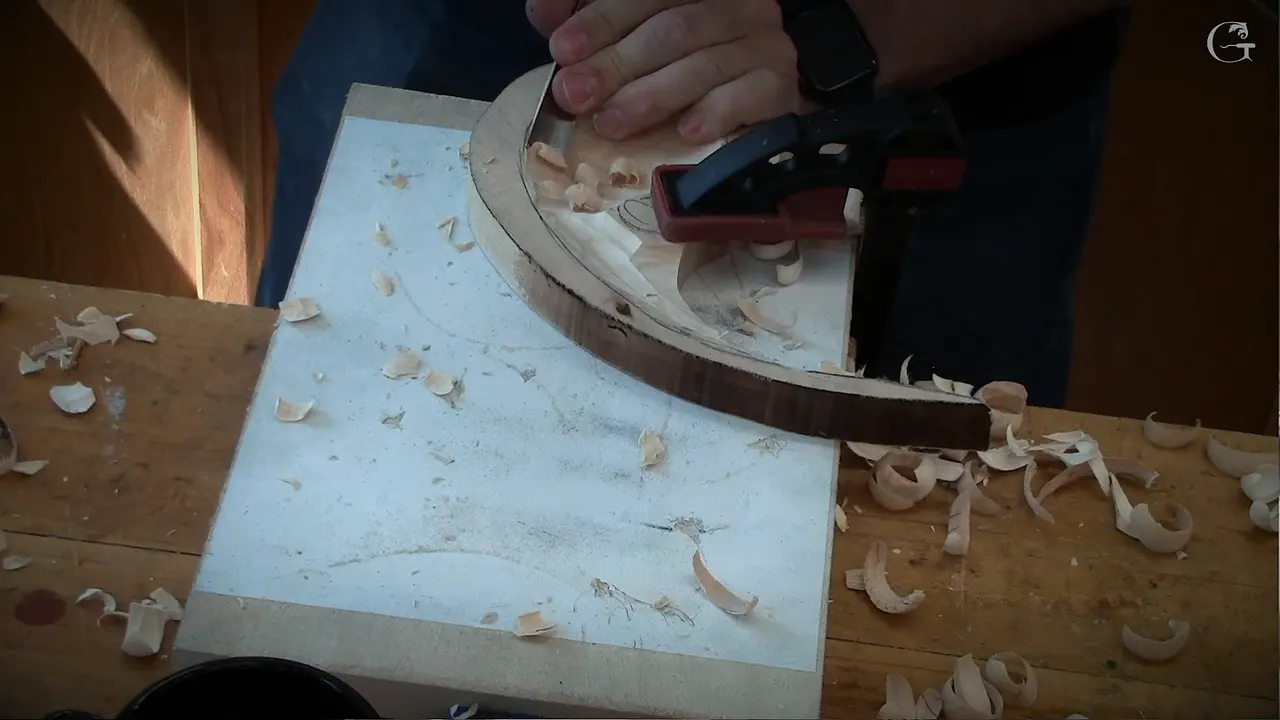

In Byzantine Acanthus 6-1, I say the bowl in the second layer should be "Less deep," compared with the one I carved on the back of the first. Other lessons carry my words "a little less" for sizes, depths, tools and looks, and this page follows them there.
Ever dug a bowl so deep that nothing was left to shape above it? Ever carved to a figure and wondered if the wood wanted something smaller? The first stop is video 1 of Byzantine Acanthus lesson 6, and the lessons where I said the same words come after it.
What did I say about the second bowl in this video?
A warning comes first: "don't go too deep in the middle." Then the plan: "We're still going to create the dish or whatever, the bowl inside, but don't go all the way because we need the meat." Then I say "It's going to be little less than what we did on the back, on a first layer. Do you understand that?"
Two short lines follow: "Little less deep" and "Less deep." A reason comes with them: "Really important because upper part, we're going to need that." Above it I plan concaves and convexes. Someone asks "This is the inside" and the reply is "That is inside. That is the backside. It's what we're working on."
How much wood comes out at the edge of the bowl?
The backside gets a bowl in the middle. Then, from one side, I say "be really careful." There I plan to stop somewhere and take out "only approximately quarter-inch cut" and a quarter inch is 6 millimeters (0.24 in).

No glue is needed for this part. "For this operation, we don't need to glue," I say. "You could, but we don't need to glue because it's quick." The job is "just scoop out." Then the plan is to glue the piece on top, and "really deep shadow" is the result I name.
Why does the second bowl stay shallow?
Video 2 opens with a question about a three-layer piece: should the bowl go deeper on the second layer? "I wouldn't," I say. "We're still just after a shadow." My reason is the chance "you're going to get through, so there's no reason."

I leave a door open. "But we'll see. We can probably deepen it later on if we need to." The tools are the same ones, and I say "we're just carving across the grain when we're just dishing out." Then, "Not with the grain, but across the grain."
What else do I ask for in video 1?
The video opens with "It doesn't have to be perfect, by the way, okay? Because like I said, it's the backside." I ask "I think now we can go ahead and do that operation, right?" Then comes a plea: "Please don't take long because really soon we have to work on a second piece."
Next, where not to carve. "Right at that end of the stem, don't do anything," I say. Then "Don't touch that area approximately two inches" (51 millimeters) "from the end of the stem. Don't undercut." I add "I'm glad I stopped before it's too late." My question is "Anybody made that mistake or no" and then "Good. I make all the mistakes."
Edges can wait: "refine the edges little later." Now I plan to take my plastic and lay it. "My goal is to trace whatever the black lines I placed," I say, and "Really important for me to get as close as possible to those lines." The second layer is a plan too: I plan to start from the backside and "create dome on inside."

On the second piece I ask "don't mix the face" and "That part is the face in my case." For the pattern, "Probably a good idea for me to use carbon paper," I say. A second thought follows at once: "Well, actually, I don't even need that. I'll probably just draw through." The reason for the backside now is "a lot easier to clamp if you're going to take care of it right away" and you can "attack that later."
I write the word on the back. "Am I spelling that correctly?" I ask, and "A bowl, right on the backside, okay? Make sure, don't mix it." Next, "Put F if you wish. That's the front." And "It's just a front because I know what I'm talking about. I saw people make that mistake."

Saved pieces come last. "Remember I said do not throw away cut-out pieces," I say. "If you want to, we can actually add another layer and do the true Byzantine height." My idea for a round piece is "cut a round piece, this section" and "once we've done with the backside, we're going to glue it on top." Another spot works too: "Or we can actually do that section right here. It's even better."
The video ends this way: "Everybody's agreed?" Then "So let's do it."
What did the next video do with the stack?
Video 2 says I can trace the existing piece and "scroll it out." I cut another piece and "left little longer just in case" and "I want to make sure it blends really nicely." Afterward I plan to glue it on top and clamp it: "We might going to need more clamps." Video 3 asks for a shape: "Beautiful arc. No straight lines."

There I plan to leave "approximately about maybe 10 millimeters, about three-eighths of an inch." Then, smoothly, "like a arch." Later I say "I guess I need to make it little lower." Next, "It just going to make better sense because I really need to blend everything."
What does a little less mean for a size?
Furniture Panel 39 has a depth I put at "about quarter of an inch, I would say." A second line says "I didn't measure it, but something like that, let me actually measure it." Calipers come next in my plan. After it comes "It's little less than a quarter of an inch."

Floral and Molding 13 has a center I name "maybe about quarter inch, maybe less, actually." Then "Maybe about, I don't know, five millimeters, five and a half millimeters. Quarter inch, okay?" In inches, 5.5 millimeters is 0.22. I end with "A little less."
Workshop 160 of the Venice Room gives two convex repeats: "in this one, it's approximately quarter inch." Then "And this one, little less" with "four millimeters or so." That workshop sits in the Venice Room course. Four millimeters is near 0.16 in. Before it, "I'm really close actually to that shape."

Workshop 106 names "six millimeters, and this part right here is going to be a little less." It should match "pretty much this edge." Then "that depth, about 30 millimeters from the high spot," or 1.18 in.
Grape Onlay 4 keeps a width of "about a quarter" for now. Next, "maybe a little less" plus "five millimeters, five and a half millimeters, something like that." Both figures are close to 0.22 in. The tool is "Number 11 and four millimeters" (0.16 in).

In workshop 5 I name a size, "about half an inch everywhere" and it "is going to narrow to approximately a quarter inch, six millimeters right there." And "Well, six, some spots maybe a little less, five millimeters, but pretty close." That size is 12.7 millimeters, and five millimeters make 0.2 in.

With grapes in Tray of Blessing 8 I say "an inch at the beginning, little less" and next comes "seven eighths to three quarters of an inch." In metric, an inch is 25 millimeters, seven eighths is 22 millimeters and three quarters is 19 millimeters.

Venetian Flowers Rosette 5 has a figure I first guess at about 1/2 in. Next, "A little less. Maybe about 12 millimeters." The same lesson has "There is multiple ways, multiple ideas you can develop." In Furniture Panel 18 a size is "3/16 of an inch," or "five millimeters approximately" and "a little deeper or little less, it should be okay."
Which tools were a little less?
Roman Acanthus 10 has a tool I look at: "It's not marked as a number eight, but for me, it does look like number eight. It could be number nine." A closer look gives "I don't see that this one is a true half round. Just a little less." Last, "I'll just continue digging."

In Hashemi Flowers 12 I say "Number nine is a true half round. Number eight is a little less." Same video, I plan number 3 near a half inch, and "It's actually 12 millimeters" (0.47 in).
Another tool in that lesson gets a plan: "I'll take number five, and it would be one inch also." After it, "a little less sweep, and I can have more control." One inch is 25 millimeters.

Hashemi Flowers 41 has "Maybe it's a good idea to use smaller tools." Number five is "eighth of an inch" and then "It looks like it's a little less. It's 3/32nd of an inch." In metric, 1/8 in is 3.2 millimeters and 3/32 in is 2.4 millimeters.
Over in Venice Room 63 I say I need to switch to a spoon of three millimeters (0.12 in). I add "I could actually use two millimeters, or actually I could start with four millimeters, just a little less push in." Then "Okay? A little less."

My spoon gouge sharpening lesson has "right now, this bevel is a little too sharp for me." The plan reads: "a little less bevel than what it is right now." The edge in question is the bevel.
How deep is a little less?
Workshop 92 names a depth, "about 10 millimeters deep," or 0.39 in. "It doesn't have to be 10 millimeters deep, by the way. It could be a little less." My reason for 10 millimeters is "just in case if I want to create some kind of movement on the leaves itself."

Workshop 90 has "approximately half an inch," about 13 millimeters. My next words are "I think I can go a little less," followed by "maybe about 10 millimeters." Last comes "look like a real material."
In Modern Acanthus 5 "Don't make it too fragile," I say, and "your fingers can feel if you are too much." Mine: "I kept approximately three millimeters thickness" and "I could go little less. It's okay, but it's gonna become fragile." Three millimeters is 0.12 in.

Hazelnuts 7 names "about 5/8 of an inch. About 16 millimeters." The same video adds "Obviously, it's not the final depth yet." Right after it, "a little less mess in my eyes."
Floral and Molding 4 has a size I left at "one-eighth of an inch, three millimeters" and "a little less, maybe two and a half millimeters." Taking wood comes up in Furniture Panel 15: "I can take a little less material at the first pass, which probably a lot of woodworkers would prefer that anyway." Then "Just get a lot less material at first."
Hashemi Flowers 42 holds a figure with a plan: "I know approximately I have to take an inch deep, but I'm going to take a little less" then "seven-eighths in the beginning."
What shape did a little less give?
In Venice Room 60 I decide on two millimeters, or 0.08 in, on one of the sides. The words are "a little less pronounced. A little less exaggerated, if you wish." My wish is to raise it somehow, though "I don't know yet how."

In lesson 28 of the Furniture Panel course there is a spot where "I kinda like the overall movement, although I have to do another concave on this side." The line goes "a little less, okay, it's not gonna be as pronounced."
Over in Venice Room 21 I say "Make it a little less concave" with "maybe number three concave, at least for now." In Lily Box 10 the plan is "little more concave right here and little less right there."

A hand push comes up in Furniture Panel 17: "if you're using just a hand push technique." Then "It's a little less control."
Where did I say it, in one table?
| Where | What was a little less |
|---|---|
| This video | The second bowl against the first |
| Floral 13 | A size just under a quarter inch |
| Workshop 160 | One convex beside its neighbor |
| Onlay 4 | A width of six millimeters or so |
| Venetian Rosette 5 | A figure of 12 mm or so |
| Workshop 5 | Some spots in a size near 6 mm |
| Roman 10 | A tool short of a half round |
| Workshop 92 | A depth that can drop under 10 mm |
| Modern 5 | A thickness of three millimeters |
| Furniture 15 | Material taken at the first pass |
| Hashemi 12 | A sweep that gives me more control |
| Sharpening | A bevel too sharp for me |
| Workshop 60 | A look that is less pronounced |
Which of your own depths could use a little less? Every video of this lesson sits inside one tuition plan. The Byzantine Acanthus course page holds all ten lessons, and lesson 6 is where the second bowl lives. wood carving and acanthus wait in that course, and my sizes come with my own figure first and an inch figure beside it.
How it's done
- Dish the second bowl less deep. I plan the second bowl as less deep than what I did on the back.
- Stop at the stem. I leave the tip of the stem alone and do not undercut it.
- Trace the lines. I plan to lay my plastic and trace the black lines, as close as possible to them.
- Mark the back. I write the word bowl on the backside and say an F goes on the front.
- Scoop out first. No glue is needed for this part, I say, because it is quick, and I plan a small cut on one side.
- Keep the scrap. Keep the cut-out pieces, I say, because they may add another layer for true Byzantine height.
Frequently asked questions
How deep is the second bowl in this video?
I say to stay out of the deep middle, and to stop short of all the way. My plan for one side is only a quarter-inch cut (6 mm).
Why not carve the second bowl deeper?
The upper part needs that meat, and I plan concaves and convexes above it. Video 2 adds that going deeper risks getting through, so there is no reason.
Which part of the stem stays untouched?
About two inches (51 mm) from the stem's end. Nothing gets carved there and nothing gets undercut, and I am glad I stopped before it was too late.
Which Hashemi tool is a little less?
What to carve next
- Byzantine Acanthus lesson 6
- Byzantine Acanthus course
- Furniture Panel 39
- Floral and Molding 13
- Venice Room 160
- Venice Room 106
- Grape Onlay 4
- Venice Room 5
- Tray of Blessing 8
- Venetian Flowers Rosette 5
- Furniture Panel 18
- Roman Acanthus 10
- Hashemi Flowers 12
- Hashemi Flowers 41
- Venice Room 63
- Spoon gouge sharpening
- Venice Room 92
- Venice Room 90