

Alexander Grabovetskiy, woodcarver, School of Woodcarving · Published 2021
What does a wood carver mean by "arching"?
Quick answer: In video 3 of Byzantine Acanthus lesson 6 I say "arching it" while a marker draws a curve on the layers. I call for "No straight line" and leave about 10 millimeters (0.4 in). Other lessons put arch beside a center point, a wave and a change in the grain.
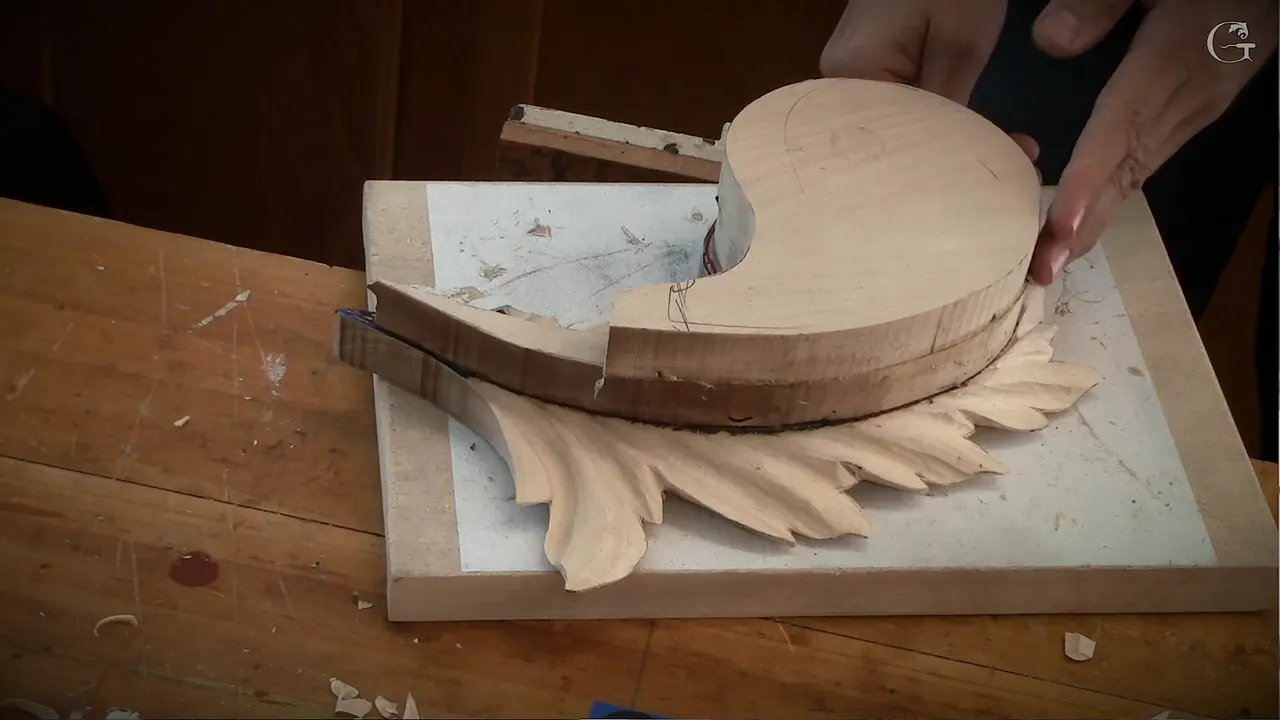

In Byzantine Acanthus 6-3 I say "just arching it" while a marker draws a curve on a stack of wood layers. Other lessons put my word, arch or arching, on a line, a leaf and a flower.
Ever looked at the profile of a leaf and found a flat run where a curve belongs? Ever drawn a curve that still came out dull? This page starts with lesson 6 of the Byzantine course. Then it follows my word through the design, Gibbons, Butterflies and Venice Room lessons.
What did I mean by arching a line?
The video opens on a piece to place: "This piece goes right there, right on top like this." Soon the room gets a job, to check the side view, and the line is "it's supposed to be 3D right now."

What the side view should show is "really nice transition downhill. Beautiful arc. No straight lines." I name "the arabesque idea" there too. And the move itself: "really smooth transition to downhill."
Figures come a little later. Between two points I say to leave "approximately about maybe 10 millimeters, about three-eighths of an inch" (0.4 in, and 9.5 mm for the fraction). The shape between them runs "smoothly, okay, like a arch, going to go up."
Then: "No straight line. Okay? Just like a creating an arch or arc, if you wish." I ask "Do you see what I'm saying" and say I will draw it with a marker. Next comes "Just arching it. Really important to understand we are in 3D, and everything makes big difference how you're going to do it."

The first step has its own sentence: "So the step number one, we're going to create that arch."
Which shape does the arch belong to?
Before the arch comes the overall shape. It is "we have to create overall shape" and then "just round." Next, "Pretty much we're creating roundness" and "look like a claw going like that."
Next I say "I don't know if it makes sense" and "Let me find the picture of it." One picture is "from the solid piece" and I say it is not exactly what we will do. About it: "But see, it goes like this and turns back."

A second picture comes from another carving, and I say "Take a look those acanthuses. So see what they do." My answer is "It goes that way and goes backward. But there's a different approach how you're going to finish that point." The choices I name are "You can go upward, you can go downhill, you can just do it to the side." And "It all depends how we're going to decide to twist it."
How does an arch start in the wood?
With a knife or a skew, I say, "from nothing, from absolutely nothing, okay, you just start blending." I keep one side up: "I'm keeping that side kind of high yet and start carving downhill." Without a knife, "you have a flatter tool." The upper part gets a pointer too: "which means I also have to point you to this part, upper part." Then "Make sense or no?"

A break happens in this video, with "Oops, I broke something." After it come "No, I'm going to redesign it" and "It's a French acanthus. I guess that's how they developed that, right? By breaking stuff."
Then "See, I follow that arc. But I guess I need to make it little lower." The reason comes right after: "It just going to make better sense because I really need to blend everything."

Near the end the marker comes up again. "see what happens if you don't clean up your marker," I say. And "It blends really nicely when I don't have any marker." Last comes "You don't even see the seam. It's going to look like it's solid piece."

The video before this one has me say "I cut another piece, and I left little longer just in case. I want to make sure it blends really nicely." That is the third piece.
One small thing happens early on. "It's glued to my piece of paper," I say, and then "I'll use it like that, and then I'll take it out and I'll re-glue it." Then: "By the way, we do have to glue it on a paper again."
Did I say arch about drawings too?
In Furniture Panel lesson 6, first video, I step back from the design: "I like this arch or this movement." Then "For me, it does look organic." A round object can help: "For example, I have tape left over." The tape is there "to just make the curvatures more accurate."

The second video has me draw: "I'll put another line or arch on the inside." Further on I say "couple lines, couple arches," going "just moving up like this." The drawing in lesson 5 is "energy movements like that" and I say it will have "some energy and some 3D feel in it."
In the second video of lesson 8 of that design course, the arch sits beside the straight line. "You can find lots of dots and lots of different curls or curves or arcs." My next words: "but never a straight line." In art, I say, "you add three more elements": a vertical line, a horizontal line and diagonal lines. Of the panel: "you can see lots of straight lines and a lot of arches and dots."
Venetian Flowers Rosette lesson 6 carries a point to a line, in its first video: "Of course, it has to be like an arch movement." Drawing by eye can feel hard. My answer is "you can always create your arch on a piece of paper and just place it and trace it."

Rosette lesson 1 has a way to draw "like oval arches": "just using calipers and the old measuring device, just a twine or rope." I add "a couple nails or screws will do." Later I say it is "actually the most ancient technique what Egyptians even used."
When is an arch not enough?
A line in Rosette lesson 5, first video, is "somewhat like a straight line, not straight, but like an arch." Then: "in real life, I think it's going to look much better if I'm going to create some kind of waviness." Later in the video: "it doesn't look really nice if it's really arches."

The second video of Floral and Molding lesson 7 has "that movement is a little too straight. Not too straight, but it's arching, but it just does not look good." The plan is "grab number nine" and then "curl it backward."

The Gibbons Maine class gives a plain arch a no in lesson 17: "it's actually just a simple like Arch. I don't want to see that." Instead comes the waviness I see on the bigger ones. Without a wave: "It's gonna be boring."
Over in lesson 15, first video, the word comes with a move to the center. It "cannot go just straight in. I want to create some kind of movement like arching. It's like a flowing to the center." It starts "almost laying parallel" and finishes "raising up like this." Later in the video: "so it's not straight like this. So it has to be arching." Just before that line comes a gap that matches the one in Byzantine lesson 6: "about 3/8 of an inch right there. I mean 10 millimeters" (9.5 mm, and about 0.39 in).

Lesson 16 of that class has "that is gonna be more like arching." Furniture Panel lesson 32 has, in its third video, "It's not like, you know, arch" with "movements like this."
What does an arch do to the grain and the sides?
Grain enters in Venice Room workshop 146, second video. I plan to start "somewhere right in the middle because it is an arch and the grain runs that direction, the grain will change." In Rosette lesson 6 I plan on "same number 11" and "7 millimeters" (0.28 in), and I say "the grain going to change the direction and sometimes you have to attack from the opposite directions."

In workshop 149 I walk the rise and the fall: "start rising up, up, up, up, up" and "go down, down, down." After that: "So if you look from the side, it's also going to arch. Okay? Or arc, whatever you say, arc or arch."
Workshop 139 has, in video 3, an arch in "different direction" and it is "more like a golden ratio arch, if you wish." Then I ask "See how I just swirl it" and say "more like you would see in nature."

In workshop 94, seventh video, a middle line is one I want to keep: "it has a really nice arch or arc." The ninth video has "like arc movement or arch" with a mallet plan for "a lot more control."
Lily Box lesson 10 has "I don't want to see any flat spots in the three dimensions" and then "there's not supposed to be any flatness, so it has to have some arch anyway, some movement anyway." And of the side view: "it should not have a flat. It has to arch it."

Grape Onlay lesson 9 has the "law of Arabesque" and sends the viewer to "my design course." It names "two main movements, what I'm referring to." Further on, of a big leaf: "an arch, there's gonna be a center point somewhere."
The part in lesson 14 is "arching this way." So "it's a good idea to introduce some kinda like a complimentary motion on inside" and then "a letter S almost. Not much, but still."

Which tools made an arching pass?
A flatter gouge shows up in Chamomile and Bow Rosette lesson 4, third video: "like number five in this case, and about 6 millimeters, quarter inch" (0.24 in). I show a slow pass, "just arching. Like if I would work on a dome." It is "a slicing pretty much" and it is also "really legit way to remove a lot of material at once."

A knife does it in Beginner workshop 1, third video: "about five millimeters out, or 3/16ths approximately" (0.2 in, and 4.8 mm for the fraction). I call the spot "your arch point." And "really accurate and nice arch looking cut."

In Plate with Butterflies lesson 4, first video, the movement is "arching that way" and I plan to stay away from my line "approximately three millimeters" (0.12 in) and to make sure it "lines up with that Arch." I add "if you really like the golden ratio, you will understand what I'm doing." Lesson 2 says "Arch like this and another Arch like that."

Byzantine Acanthus lesson 7, first video, has "keep that edge, what you created, that arc." Of that edge: "This edge, we're not going to touch." Then "that edge is supposed to have a really nice and beautiful arc." Also "I didn't leave any straight down wall. Everything blends nicely, like arch." Video 3 of that lesson has "So the arch is not really nice." Lesson 9 brings, in its third video, "create the arch going from that" and "let me do a marker for you to see that better."

Roman Acanthus lesson 6, first video, has the plan "establish semi-arch or concave movement on inside." Venice Room workshop 55, fifth video, has the old carvers. I describe a third level, "equal to architectural carving." My words: "Architectural stuff like corbels. They would create beautiful arches with some carved details and so on."
Which lessons said it, and what was the arch?
| Where | What the arch was |
|---|---|
| Acanthus 6-3 | A smooth arch that goes up |
| Acanthus 7 and 9 | Everything blends nicely, like arch, then a marker line |
| Panel design 6 | A line or arch drawn on the inside |
| Panel design 8 | Arches and dots beside straight lines |
| Rosette 1 | Oval arches drawn with a twine or rope |
| Rosette 5 and 6 | A near straight line, or an arch traced from paper |
| Floral and Molding 7 | A movement arching, but not looking good |
| Gibbons 15 and 17 | Flowing to the center, then a plain arch I turn down |
| Butterflies 4 | The main movement arching one way |
| Grape Onlay 9 and 14 | An arch with a center point, then a letter S |
| Lily Box 10 | Some arch, and no flat spots in three dimensions |
| Venice 146 and 149 | The grain changes in an arch, and the side view arches |
| Chamomile 4 | A slow pass arching, like work on a dome |
Which of your lines runs straight? Every video of this lesson sits inside one tuition plan. The Byzantine Acanthus course page holds all ten lessons, and lesson 6 is where the layers come together. Wood carving and relief wait in that course, with acanthus running through it in Byzantine style. Sizes follow my own figure first, then the other unit in parentheses.
How it's done
- Check the side view. The room looks at the side, and I want "really nice transition downhill."
- Leave a small gap. I give the gap in millimeters and again as a fraction of an inch.
- Draw the arch. I say I will draw it with a marker, and step number one is to create that arch.
- Start from nothing. A knife or skew starts it: "you just start blending," while one side stays "kind of high yet."
- Follow the arc. "I follow that arc," and I say it may need to go "little lower."
- Clean the marker. Without marker left, the join is not seen.
Frequently asked questions
How much wood did I leave between the two points for the arch?
I said 10 millimeters (about 0.39 in), then gave the same gap as a fraction of an inch. In that gap the line goes "smoothly, okay, like a arch."
Which tool starts an arch from nothing?
Knife and skew both start one, I said, "from nothing, from absolutely nothing." If you own neither, "you have a flatter tool."
Does a plain arch look finished?
Not in other lessons. Gibbons lesson 17 turns a plain arch down, and Rosette lesson 5 has "it doesn't look really nice if it's really arches." Both ask for waviness.
What to carve next
- Byzantine Acanthus lesson 6
- Byzantine Acanthus course
- Byzantine Acanthus lesson 7
- Byzantine Acanthus lesson 9
- Furniture Panel lesson 6
- Furniture Panel lesson 5
- Furniture Panel lesson 8
- Furniture Panel lesson 32
- Venetian Flowers Rosette lesson 1
- Venetian Flowers Rosette lesson 5
- Venetian Flowers Rosette lesson 6
- Floral and Molding lesson 7
- Gibbons Maine class 17
- Gibbons Maine class 16
- Plate with Butterflies lesson 4
- Plate with Butterflies lesson 2
- Grape Onlay lesson 9