

Alexander Grabovetskiy, woodcarver, School of Woodcarving · Published 2021
What does a wood carver mean by "most important"?
Quick answer: In video 2 of Byzantine Acanthus lesson 7, I say "Really important part. The most important part." right after telling the class they can walk around. Other lessons use the words about sharpening, shadows, cuts, a middle line, and design.
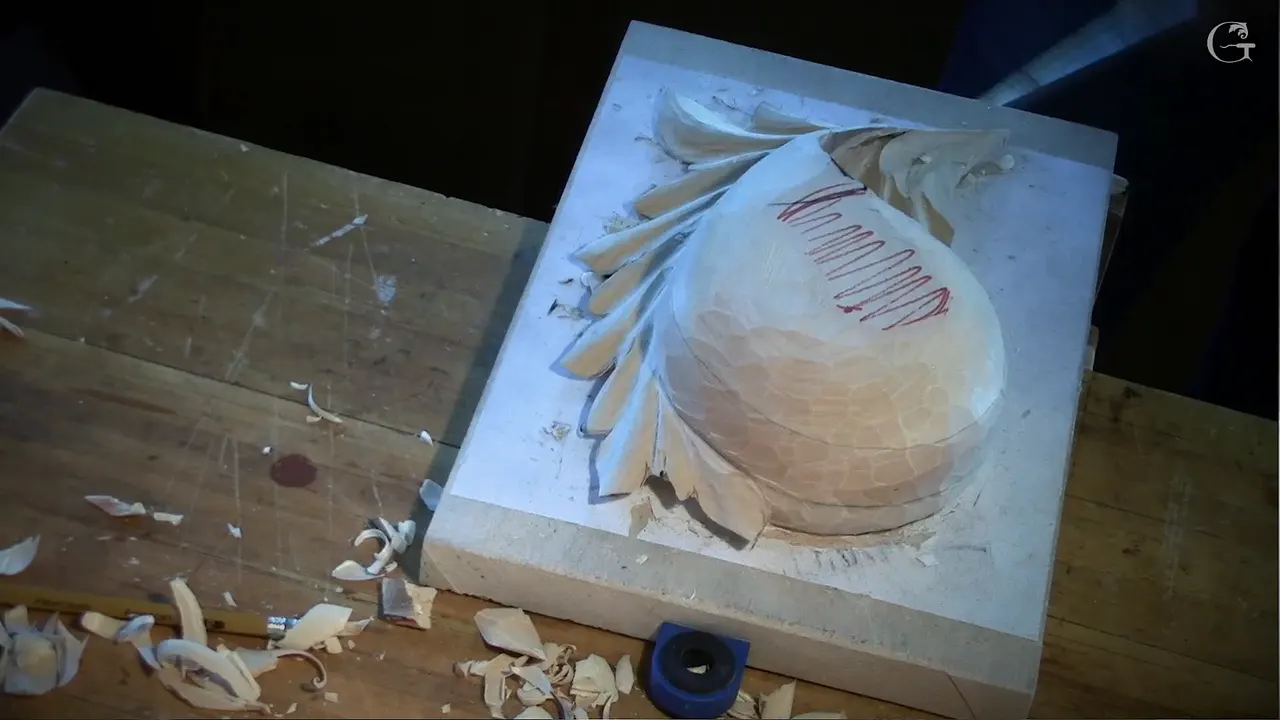

In Byzantine Acanthus 7, video 2, I say "Really important part. The most important part" and the next words are "So that is step number one." My other lessons carry the words "most important" too.
Ever heard a teacher call something the important part and wondered which part he meant? The first stop is video 2 of Byzantine Acanthus lesson 7, a Byzantine acanthus leaf. Other lessons come after it, and each one names a different thing.
Where does the line sit in video 2?
Before it, the talk is about the wall beside the stem: "Okay, take a look. See how that blends right now nicely to the stem." A rule for the class: "Remember always concave, convex, concave." Then "Again, convex, concave, convex, and concave."

The line before it is "So now you can just walk around." Then come the words from the top of this page. Later in the same stretch comes "Now we're going to develop the head."
Which tools came before that line?
A channel came first: "See that channel I created with the number 11 and three millimeters?" The channel is 3 mm (0.12 in). Of the result I say "It just looks absolutely like a solid piece."
A bigger gouge follows. "Number nine and 20 millimeters" comes with "blend from almost nothing." Twenty millimeters is 0.79 in, close to 3/4 in. The amount to leave is "approximately five millimeters or so, 3/16 of an inch on that side."

I ask for "kind of concave-y starting point" and "But create concave-y look." There is also a plan for later: "middle line, and going to bring that all the way like this. Everything is going to blend again back."
The reason for the untouched part is "why we didn't touch that part" and then "just because we want to blend together. We want to make sure it looks like it's the same piece." I add "So I left it rough." One more plan: "But let me actually take little more out." And a note on depth: "of course, I don't worry about if I'm going to do little deeper right here."
What did I ask the class after it?
"What I would like you to do, you tell me, there's the three different stopping points, like I mentioned, where we're going to stop the movement." Three options: "It can go downhill", "or it can go uphill", "or it can go in the middle." The question is "What's going to look the best?"

Next in the video: "Well, why don't we do uphill?" Then "So let's make the decision." The wood is to be "divided in multiple leaves" and my plan is "So let me start with the leaf number one division."
Thickness gets a look: "if you look at that thickness of this side versus the thickness what we've got right here, that would be 60/40 approximately." I plan to "create the pipe later." Then "Again, leaf number one, leaf number two. Makes sense so far?"
Is there a note on importance in video 1?
In the opening video of lesson 7 the topic is an arc: "Make sure you create that arc, okay?" A line follows, "But really important, overall movement has to be like an arc." Then a firm word about one edge, "So that edge, absolutely no, no. So don't go below that edge."

A flatter tool is enough: "any flatter tool, you can actually pretty much do it." Another line: "keep the high spot." One start: "start at the beginning of the glue line, okay?" The shape: "a bowl upside down, if you wish." On sharp tools: "carving against the grain works if the tool is sharp." The next words are "But if it's not, it's better to attack it from the right position."
One side is different: "it's actually going to roll underneath." I go on with "Which means what we have to do, really start creating that bowl even on that side. So it actually has to roll like that." Later I say "that side is kind of undercut a little bit" and "this side, it just blends."
What does video 3 do with the middle line?
In the third video I say "we have to make the decision where the end is going to be." Then "and that's going to determine our middle line. So we always start with the middle line." My own idea is "a good idea to bring the middle line all the way to that point."

After that comes "Maybe I should use a marker." A habit from the same video is "I'm always constantly checking from different points of view." And "Just establish the borders first." Hold on to the middle line, because it comes back in the lessons below.
What about the eyes in video 3?
"We can do actually huge eyes." For separations, "I always start my acanthus with the number 11, three millimeters with eyes." Once more that is 3 mm, about 1/8 in. Of the eye I say "it should look like a water drop later on."
Which skill did I call the most important?
The first straight gouge video begins on sharpening. It says "That is actually the main and the most important" and then "part of wood carving. Sharpening tools, you can't carve anything with dull tools. It's just absolutely impossible."

Straight gouge lesson 2 speaks of the grinding stage: "constantly check that. That stage is probably end of the grinding stage is the most important. Now you can't relax."
In Hashemi Flowers 8 I say carving is "a lot more" and then "removing or deducting wood from a block of wood." Before it comes "poking wood with the chisel doesn't mean that person carves." Then comes a list, "ability to design for carving" and "most important skills, ability to sharpen your tools and reshape the tools to your desire."
Greek Acanthus 10 has "your tools, they must, absolutely must, they have to be really sharp." A teacher gets quoted: "There's no such a thing as a bad wood. It's just dull tools." After that: "probably one of the most important." Undercutting comes up in Corinthian Acanthus 5, and the line there is "Well, the most important skills."
Which tool comes up?
V Tool Sharpening 1 says "Many people who try wood carving, they quit actually just because of the V tool." It also names a piece of the tool, "the most important, it's a keel."

My dining table apron course says "the V tool is one of the most important tools in a wood carving." The line follows "shallow carving, just outlining that with the V tool."
Shadows too?
The words in Venice Room 63 are "And carefully going to create that shadow." Then "I really need that shadow." And "But it's the most important thing in wood carving, shadows. Lights and shadows."

Hashemi Flowers 7 says "I strongly believe the shadows and the lights, it's the most important in wood carving." Then "Take a number three, and I'll take 5/8 of an inch or 16 millimeters." An April 2020 livestream on shadows says "I think it's probably the most important thing to understand those shadows."
Which line or movement?
Venice Room 57, video 6, has me saying "here is the middle line, which in this case, it's not really important. It is important, but this one, that middle line is the most important." Another video of that workshop gives "this particular pipe, this particular movement is the most important for me because it's most visible."

In Lily Box 3 I say "All I worry about is just my middle line." Then "the most important for me, need to recreate that middle line."
Over in Furniture Panel 29 I say "the petals supposed to have the middle part raised up, which is gonna be convex and convex in the middle, and two concaves on the side." Then "my most important convex, which is gonna be somewhere right there." In Lily Box 11 I say "I really don't worry if it zigs in inner sides yet. So I always can go back and clean that and blend it nicely." And "Well, the middle concave and side convexes."

Which cut or habit?
Byzantine Acanthus 2 says "the most important cuts. In woodcarving world, we call it slicing cut." Maine has it too, in Grinling Gibbons Maine 3: "I'm still creating that slicing cut and that's important."

An angle comes up in Butterflies 8: "work on your angle. That is the most important." Its reason is "you're not gonna train your hand to the right angles." Over in Butterflies 12, "the most important to remember. Keep that angle the same."
Another stretch, in Grape Onlay 5, has "attack from other angle, probably the most important" then "Not to rush it." Patience gets its own line in Grape Onlay 4: "Patience is the most important", with the sentence running on.
A tiny notch shows up in Venice Room 73: "But at least I'm going to know about that, and that's the most important, even if people are not going to notice it."
Which stage or step?
On the Furniture Panel 32 page, "you're shaping the wood" and "the most important step 'cause you kind of get the feel." Its reason: "sometimes when you draw something on a piece of paper or even on a board, like in this case, um, you really don't see how it's gonna look in real life." Floral and Molding 13 says "the most important stage would be to clean up everything and just make the final shape."

In Furniture Panel 16 I say "It's the designing stage. That is why I spent a lot longer on designing it. Okay. So that's the most important, the right approach to all the laws of design and the principles, I should say, of design." A bit later, "if you spent your time designing it" and then "really, really pleasing to the eye." And "But the carving process is not as complicated."
The April 2020 livestream Q and A has "the big chunk of this one-week class, I'm actually talking about design process, okay? Design process. Because people don't get design in all, and that is the most important", with the word "part" closing the sentence.

The same Q and A carries "wood carving has three big parts of it, okay? Three parts, which all of them really important. Of course, the first one is design." Sharpening comes second, and "of course, the most important is carving." Another one, the October 2020 livestream, has "designing is actually the most important."
Where do the golden ratio and accuracy come in?
Principles of Design in Wood Carving brings up the golden ratio: "your brain catches that as the most important spot on a canvas, if you wish." Lesson 2 asks "which one is going to be the most important?"
Roman Acanthus 5 covers eyeballing: "Like I said before, the most important is not how accurate you are. You still have to be accurate." And "Please don't get me wrong, but not to the extreme like if it would be generated by computer."
Anything that is not a tool or a cut?
Chamomile and Bow Rosette 4 has a line after carbon paper: "The most important, just to stay on those two lines." About a movement, Venice Room 68 says "hopefully, you're going to like it, yes. But most important, my client will like it."

Grape Vase 4 has "the white color is the most important. So please do not overdo it." And Venice Room 36 is about the website: "I have to just set priority what is most important." Then "videos, in this case, probably is the most important. Because everyone watching videos."
Where did I say it, in one table?
| Where | What I called most important |
|---|---|
| Acanthus 7-2 | A part, said right after "walk around" |
| Lesson 1 of the straight gouge sharpening set | Sharpening |
| Straight gouge, lesson 2 | The end of the grinding stage, when you can't relax |
| V tool sharpening 1 | The keel |
| Workshop 63 of Venice Room, video 6, on shadows | Shadows |
| Venice Room 57, video 6 | A middle line, this one |
| Lily Box, lesson 3, a leaf with a flower to come | Recreating the middle line |
| Butterflies 8 | Your angle, to train your hand |
| Grape Onlay 4 | Patience |
| Livestream April 2020 questions and answers | Design process |
| Furniture Panel 32 | Shaping the wood, to get the feel |
| Roman Acanthus 5 | Not how accurate you are |
Which of these would you carve first, and which one would you start on by hand tonight? Every video of this lesson sits inside one tuition plan. The Byzantine Acanthus course page holds all ten lessons, with lesson 7 here and lesson 2 too. Wood carving and relief wait there, and my sizes come with my own figure first and an inch figure beside it.
How it's done
- Blend the wall. I say to blend from the high point and leave about 5 mm (3/16 in) on that side, with a "concave-y" look.
- Look it over. Right before the line about the part I call important, I point the class to a walk around the piece.
- Move on to the head. After the line comes a plan for the head, and my question is where the movement stops.
- Pick uphill. The three options are downhill, uphill and the middle, and uphill is what gets suggested next.
- Begin at the middle line. In video 3 I say the choice of an end decides the middle line, so the middle line comes first.
Frequently asked questions
What came just before the line in video 2?
The talk was on concave, convex and concave again, in the rule I give the class. Right ahead of the line comes "you can just walk around."
What came just after it?
A plan for the head. Then I ask the class where the movement should end: downhill, uphill or in the middle. The next suggestion is uphill.
Which tools sit beside the line in this video?
A number 11 of three millimeters, about 1/8 in, made the channel. Then a number nine of 20 mm (0.79 in) blends from almost nothing, with about 5 mm (3/16 in) left on one side.
Is sharpening among the things I named?
What to carve next
- Byzantine Acanthus lesson 7
- Byzantine Acanthus lesson 2
- Straight gouge sharpening
- V Tool Sharpening
- Hashemi Flowers lesson 8
- Hashemi Flowers lesson 7
- Greek Acanthus lesson 10
- Corinthian Acanthus lesson 5
- Dining table apron course
- Venice Room 63
- Venice Room 57
- Lily Box lesson 3
- Lily Box lesson 11
- April 2020 livestream
- Byzantine Acanthus course