

Alexander Grabovetskiy, woodcarver, School of Woodcarving · Published 2021
What does a wood carver mean by "always start"?
Quick answer: In video 3 of Byzantine Acanthus lesson 7, I say "I always start my acanthus with the number 11, three millimeters with eyes," and later I give the middle line its turn. Other lessons use the words about movement, drawing, keel, cut and grain direction.
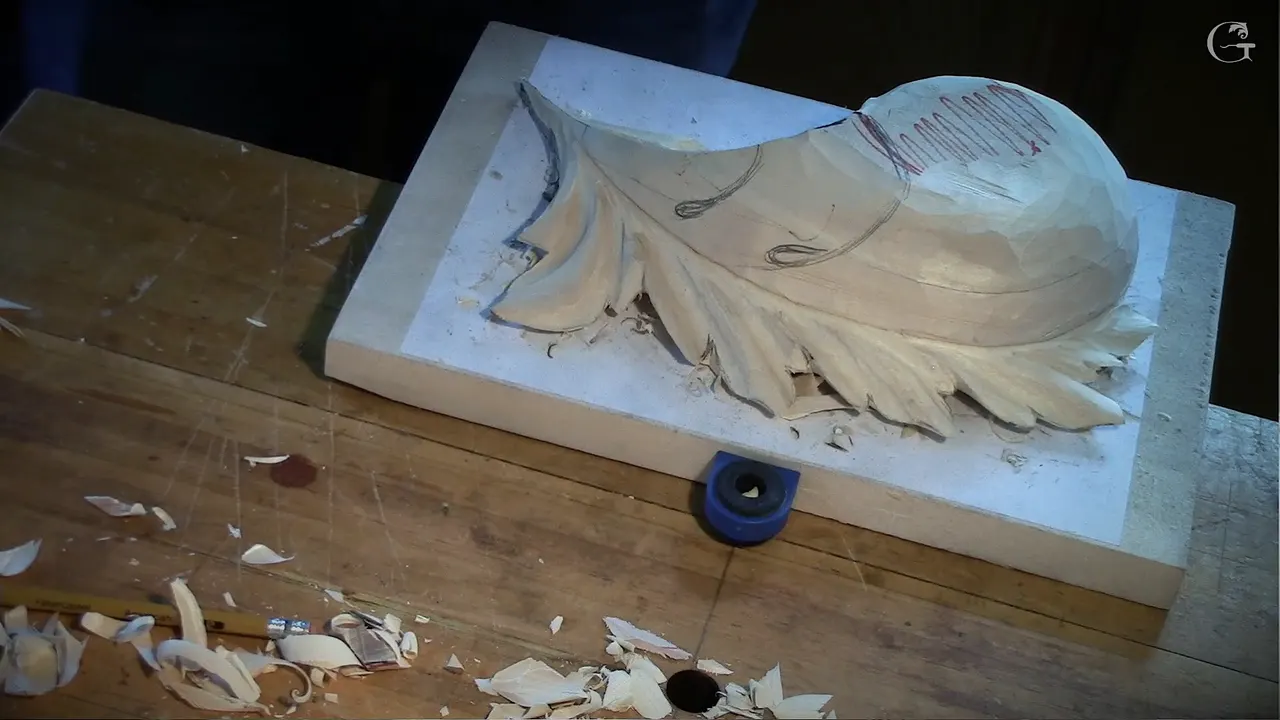

In Byzantine Acanthus 7, video 3, I say "I always start my acanthus with the number 11, three millimeters with eyes." Later the middle line gets its turn. My other lessons carry the words "always start" too, and each one points at something different.
Ever wondered what a carver does before anything else? Video 3 of Byzantine Acanthus lesson 7 is a Byzantine acanthus leaf. It names a tool and a line. Other lessons of mine name movement, drawing, keel and grain direction.
What tool opens video 3?
Ahead of the line I talk about separations. "To do those types of separations, we're going to need, I usually like to use the number 11, and we do have three millimeters on the list." The tool is a number 11 gouge of 3 millimeters (0.12 inch). As for the eyes, "we can do actually huge eyes if we want to." And "Let's do those first."
A plan comes next. A notch, then "second cut, if you wish to call that way." And a note on the shape: "I don't like overall movement right here." Then "So I really want to see better movement." "So the arch is not really nice."

The cut after that: "Number 11 and three millimeters right on the side." Then "In this case, would be on the right-hand side of the line."
Depth follows. "If you do have a five millimeters, just in case if you have it, you still can use the same tool just to get deeper." Five millimeters is 0.2 in. The wish is "I want to see that shadow." Then "I guess we can do that one also deeper." I check on the class: "So far you understand what I'm doing, right?" Then "Easy enough, just two cuts."
What follows the two cuts?
I plan a flatter tool to blend "the lower leaf, underneath of that one, and that one underneath of the head." Next comes "you're going to see that overlapping right here."

About the eye I say "it should look like a water drop later on." Also "We can actually even drill it deeper a little later." Then "But for now, with the flatter gouge, or if you prefer, you have a knife. So we just blend that thing."
Cleaning up comes next. "I wouldn't call it clean, but it's still, just to get that out." Next, the shape: "I don't see a 3D movement yet." So "I need to blend that better than what I have, okay?" A little later, "Now it's much better."
Why does the middle line come first?
I turn to the head of the leaf: "work on this head right now." A reminder for the class follows. "Remember what I said before, acanthus looking like a boat." This boat has "the middle", "the sides", and then "we start the divisions, okay?" Then "In three-dimensional world, it's the same thing." And "If you turn like this and twist it around", the boat stays a boat. The order is "Just establish the borders first."
The decision comes next. "We have to make the decision where the end is going to be." High, in the middle or low, and "that's going to determine our middle line." After that, "So we always start with the middle line."

My own idea: "I think it's going to be a good idea to bring the middle line all the way to that point." And "Just make it look like it's going up." Also "Maybe I should use a marker." Of the end point I say "the point where it's going to end up." For now, "visually", the plan is to place the middle line like that, and maybe somewhere it will "die right there."

Next: "you should be able to see development of the boat." "Fisher's boat shape." The video adds "you can twist it as many times as you wish."
One more line on the boat: "As long as you got the middle line, as long as you establish the boat, and then just do whatever you want."

The video ends on the eyes. "It gives me ability to add another eye." The count is next: "one division, two divisions, three divisions, and a five Fibonacci." Last comes "Correct?"
Where does the rest of lesson 7 begin?
Lesson 7 has a start of its own in video 1. "We're going to start at the beginning of the glue line, okay?" And "So really carefully." Then "I'm starting actually right here, at that point." Video 2 has "So let me start" and then "the leaf number one division." Also in video 2, "I like to break only in two steps because it's a Fibonacci on the lower side, okay?"
Where else do I say "always start"?
Other courses carry the same two words, and each one points at a different move. Here they are: design, keel, cut and grain direction.
Which movement opens a design?
The Law of Movement lesson of Principles of Design has me showing flowers and asking where they move. Before that comes "Let's say if you design for the guy living somewhere right there, so you start your movement." Right after, "the starting point, it's still on that side. So overall movement goes that direction." And "it goes pretty much the English way, American way. But it turns back." Then, "even in those complicated stuff, I always start with the movement."

Furniture Panel 5 gives the way a viewer reads: "if you do have a Western mindset, you always start from a left side and you're moving down like this." Of the East: "then you start from the right point, upper point, and you move downhill this way." "Most of those students read left to right," I add. I also say "I started my design movement from the beginning, so moving from the left upper corner."
There is a test on a drawn canvas, with a diagonal line and "a small vehicle." The question is "what direction does it move?" With a Western mindset, "it looks like it's going downhill because you always start from the left top and go that direction." Then "let me do the opposite", a diagonal from the right top. The answer is "going upward this direction."

A stretch of the April 2020 livestream covers how I estimate a carving. Here it is: "So it always starts with the drawing." Before it comes "it's a big dancing process between a client and me." Soon after, "you really have to consider how much time you spend drawing and designing, okay?" Then "yes, I do charge for time I spent on the drawing." About charging, "I didn't do that at the beginning." I thought "that should be a process included in a wood carving project", but "it depends on the client." I add "I love drawing, okay" and "But I enjoy carving a lot more." Later, "So that is the starting process."
Which part of a tool comes up?
V Tool Sharpening 2 turns to the keel of a V tool. This part is "usually like a smallest gouge. It's still somewhat rounds." Another line is "You can look at it as like number 11, but it's a really tiny round." Then "For me, it's a step number one." A short phrase follows, "I'm always start", then the keel is named.

On the same keel, "this bevel on a keel, it's about 10 millimeters or 3/8 of an inch." Video 1 of that set has "I usually start just establishing as low angle as possible on my keel."
Sharpening a spoon gouge has "I usually start somewhat close to the corner." I say I am "kind of afraid" of the corner itself, and "I don't want to kill my tool and create a odd shape." And the move is "just slightly away from the corner, without too much pressure." Before it comes "it's a 80 grit, and I can easily see where it's taking metal out." The work is grinding on a machine.

Which cut is named?
In Venice Room 50, video 4, I say "Double check." Then come the words "I always start", followed by "relief cut. I am trying to relief those triangles." Then "seven millimeters, same number 11 what I used before" (0.28 in). On tools, "I don't use, in this carving, V tools, because I would like to be authentic to the Venetian design and Venetian style of wood carving, and they did not use any V tools."
The reason goes on. "They just didn't have them." Also "they used gouges, and they used knives or skew chisels, if you wish, or just normal chisels." I add "I want to be authentic to that culture." A plan comes later in that video: "let me use four millimeters, number 11" (0.16 in), and "start digging a little bit inward."

Lily Box 6 has "This concave, I can always start", and the tool is "the same tool, with number three." Then "But again, working against the grain." Next, "let me use number eight and about three millimeters" (0.12 in).
The Tray of Blessing 1 has a tool lesson: "we call the right position slicing cut." It reads "you always start not in the middle of the tool." Then "closer to the edge, not all the way to the edge because it's, it's not gonna be workable." Later "you start your first cut and by the end you create like a rotation motion and you escape the cut at another side of the tool."

Which way does the grain run?
Grape Leaves Vase 2 says "I could take a back bent, maybe also number 3." Then "if you understand the grain, how it runs, you always start", then "from upper position going downhill." Then comes "The cut's supposed to be this way. Okay, so it's supposed to follow." Also "little by little, I can create a cut like that." It ends with "Although this tool needs to be sharpened."

Curly Kitchen Cutting Board 7 has "we're actually going to lay the knife really low." The detail is "You barely can fit your finger underneath." A rule starts "Although, the rule, you always start", which ends with "up-down." Then "You can see the grain runs this direction."

Cutting Board 4 says "Also important, the understanding of the grain." Then "I'm always starting from the high point and cut toward myself, just kind of downhill with the knife." The cut will be "much, much, much cleaner."
In Carving with the Grain from the Techniques Q and A I put it as "So you always start at that point or this point if you want to create that round shape." Also "you cannot go from the long to the short." Then "You have to still find the short grain and go to the long grain."
Where does a cut begin on a blank?
In Floral and Molding 1 I get to the band saw: "Let me hit my band saw, and I'll start cutting." Soon after it, "Also, I probably should tell you, you always have to start, if you have the shortest distance to the line, to the design." The gap is small, "only about quarter of an inch", 1/4 in or about 6 mm.

The next words are "So you can always start right here." Then "That would be a big mistake to start somewhere else, like right there." It leads to "a lot of waste." Also "I want to keep that part", and "Another good spot would be right here." And "closer to the edge, you have the design, that's your starting point."
Where did I say it, in one table?
| Where | What I name after those words |
|---|---|
| Byzantine Acanthus 7-3 | A gouge, number 11, of 3 mm (0.12 in), and later the middle line of the leaf |
| Law of Movement 1 | The movement, with a starting point on one side and a turn back |
| Furniture Panel 5, video 1 | The left top, for a viewer with a Western mindset |
| April 2020 livestream | The drawing, which I charge for, and which I called the starting process |
| V Tool Sharpening 2 | The keel of the tool, a really tiny round |
| Venice Room 50, video 4 | The relief cut, using a number 11 of seven millimeters (0.28 in) |
| Lily Box 6, video 6 | The same tool, a number three, even against the grain |
| Grape Leaves Vase 2 | The upper position, going downhill, as the grain runs |
| Curly Kitchen Cutting Board 4 | The high point, cutting toward myself, downhill with the knife |
| Floral and Molding 1 | The shortest distance to the line of the design, for a cut with the band saw |
Which of these would you try on a scrap tonight? Which sounds closest to your own work? Every video here sits inside one tuition plan. The Byzantine Acanthus course page holds all ten lessons, with lesson 7 among them. Wood carving and relief wait there, and my sizes come with my own figure first and an inch figure beside it.
How it's done
- Take the number 11. The eyes get a number 11 in 3 mm (about 1/8 in). A bigger one can go deeper.
- Make the two cuts. My plan is a notch, then a second cut right on the side, and a deeper one is possible.
- Blend with a flatter tool. My plan is a flatter gouge, or a knife if you prefer, so the lower leaf goes underneath the one above it and that one underneath the head.
- Pick the end point. The choice of an end point decides the middle line.
- Draw the middle line. I think it is a good idea to take the line to that point, with a marker maybe.
Frequently asked questions
Which gouge starts an acanthus with eyes?
A gouge, number 11, in 3 mm (about 1/8 in), with eyes. A 5 mm (about 3/16 in) one can go deeper, since "you still can use the same tool."
Which choice decides the middle line?
The end point of the leaf, whether it sits low, in the middle or high. My line is "that's going to determine our middle line."
How does the boat fit in?
The class hears "acanthus looking like a boat." Once the middle line is in place, "just do whatever you want."
Which part of a V tool do I name?
What to carve next
- Byzantine Acanthus lesson 7
- Byzantine Acanthus course
- Law of Movement
- Furniture Panel 5
- April 2020 livestream
- V Tool Sharpening
- Spoon gouge sharpening
- Venice Room 50
- Lily Box 6
- Tray of Blessing 1
- Grape Leaves Vase 2
- Curly Kitchen Cutting Board 7
- Curly Kitchen Cutting Board 4
- Carving with the Grain
- Floral and Molding 1