

Alexander Grabovetskiy, woodcarver, School of Woodcarving · Published 2021
What does a wood carver mean by "the fun part"?
Quick answer: In video 1 of lesson 8 in my Byzantine Acanthus course, I call one side of a leaf the fun part, the side with lots of wood left to dig. Elsewhere the word goes with shells, divisions, a router plane, drawn designs and projects that go on and on.
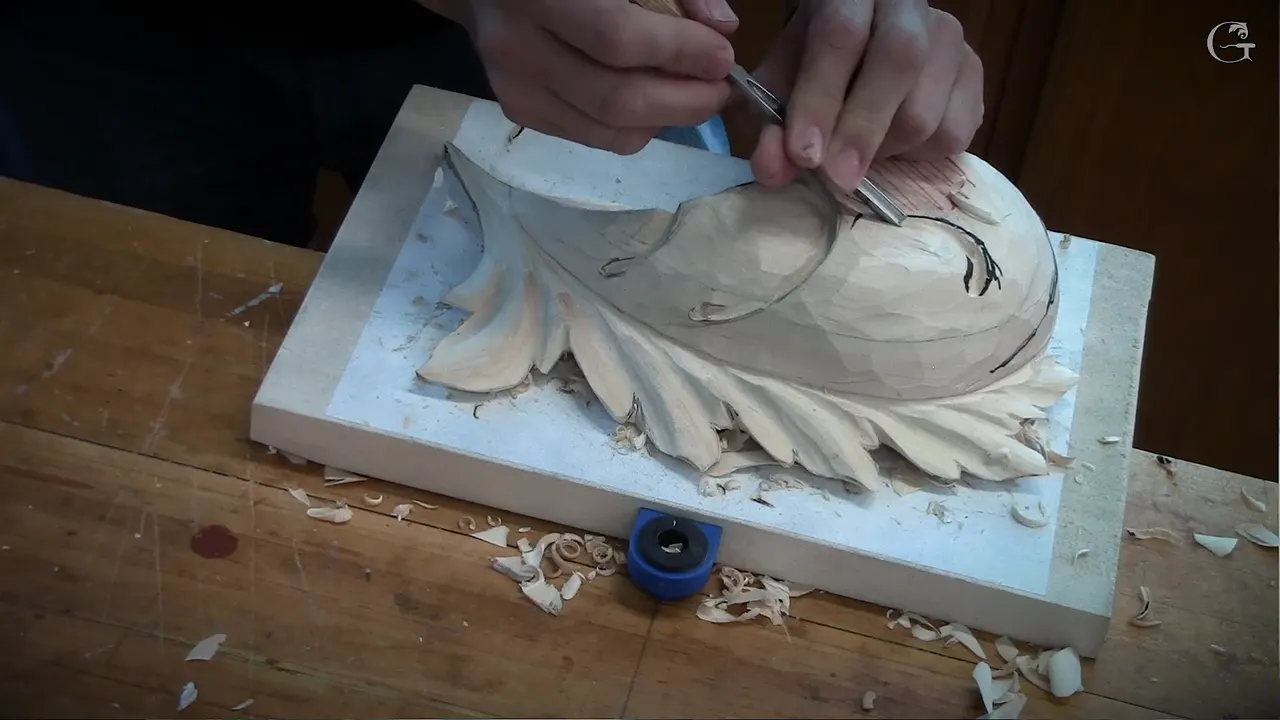

In Byzantine Acanthus lesson 8, video 1, I call one side of a leaf "the fun part." That side has plenty of wood still left to dig. The same word turns up in the Venice Room, the Furniture Panel, a lily box and more.
Ever reached the spot in a carving where the wood is finally thick enough to dig? Ever wondered which job a carver calls fun? This page starts with one leaf on a board in the eighth Byzantine lesson. After that it follows my word through my lessons, with a gouge in my hand most of the way.
Which part of the Byzantine leaf did I call the fun part?
The side with the point, where I plan a deep shadow. Before that I say "get the channel to the eye" and "we're going to just blend it." Then I move to this side. "So now on this side, so you got that point, right? On this side, wonderful people, that's the fun part."
Plenty of material is still there, and I say so: "we have a lots of material." "So later on, all of that going to be gone, but not now." The plan is "to dig inside and create a deep shadow" and I tell you this "just in case if you wonder what's going to happen right there."

What did I do in this video before the fun part?
I talk about spacing. "Think about the spacing," I say. What I have "looks like almost like this is 60 and that is 40." Then "when you're looking straight, you don't know that." And "when you look from the side, then it's going to make sense."
The leaf gets a middle line, and I ask you to make it yourself instead of a picture or plastic: "you could make a picture, or you could probably just get the plastic. But what I would like you to do, do it yourself." The outline comes next, "that main boat shape." I'm "not sure if you like that comparison to boat, maybe just a leaf shape."
Then a safety line. "Never carve toward yourself unless if you're dentist." Dentists "always work this way," I say, and "you have to lock your elbows. Not elbows, but whatever the part is. Your arm. Forearm." For my own work, "I still carved toward myself. Everybody does." And then, "I guess I'm breaking rules."

I ask you to watch how I hold my hand. "That hand is solid," I say, and "this hand is just almost does nothing." "Don't air carve. It's not airbrush, okay?" If it isn't the block of wood you're working on, "lock on whatever the surface you can find."
What came right after the fun part?
I say what I don't like: "I don't like yet how it shapes." I want "to roll it little bit backward" and "any flatter tool will work." That means "this part needs to be lower now." On the middle line: "Maybe actually I going to do it right here somewhere. So which means I have to take this out lower."

I give the reason for "that knife": "a lot of wood carvers, they don't know the use of the skew." In my words it is "one of the best tools actually you can have also for the wood carving. Fastest." And "you can do a lot of stuff with that."
Near the end I say "definitely I need to clean it, and so on." "We still have a lot of stuff to dig out later on." Last of all, "simple leaf, nothing more. That's it. And you can twist that leaf as much as you wish."
Where else do I say a part is fun?
Other lessons put the word beside other jobs, and not always the happy ones. Deep digs are in there, and so are drawn lines, a router plane and a very low bench.
Which jobs do I call fun when the wood is deep?
I finish a deeper concave in Venice Room workshop 63 and say "and now the fun part" (video 2). There are two ways to go: "I could convex it right away or actually get the whole thing below my concave and then convex it." I look at the piece "from this position" and "I really need to see this ridge." A chunk is "in my way." "I'm going to take number three," I say, to get rid of it.

I place it back in workshop 5, video 3, and "I can see it, and I can reestablish it." Then, "so now, that's the fun begins." What begins is a shell, and I say it will be "a beautiful shell."

In Furniture Panel lesson 27, video 3, "I'm kind of happy with the overall, you know, movement." My next move is "gonna jump and excavate this part" and "I think it's fun. Cause here I can go a little deeper with the same tool." The tool is the same number 11 at five millimeters (0.2 in), and "I can use just the sides of it and that's gonna gimme different type of cut."

Is a division or a design fun too?
"I'm ready for fun stuff," I say in Venice Room workshop 64, video 11. The stuff is "a division." A pencil breaks first: "my pencil broke." After a few tries at sharpening I'm back with "my beautiful and not cheap pencil, 8B, really short." I'm "glad I have a lot of them." Next up is "to create that division right there" and "another division right here." I add "I could actually go to extreme and divide even right here. But I'll see if it's necessary or not."

Plastic comes up again in Vase with Grape Leaves lesson 1, video 7: "I can probably just wrap that with the plastic and kind of draw over the plastic." "I would encourage you to try yourself to do the design process because it's fun," I tell you. And again, "It's really, really fun. You should try it."

Floral and Molding lesson 3 gives a reason in video 1: "I like that approach, not to do symmetrical stuff." Both directions the same would work. "The client probably wouldn't notice that." But for me, "it wouldn't be so interesting to work on." And then: "I want to make sure I'm having fun when I'm carving something." That is why "I decided to go a different route. When I designed that, I made different movements."
Which moves feel fun?
Here is Lily Box lesson 12, video 4: "I could actually make a flipping motion or just create small undercut right here. It will just give me really interesting movement. Really, I don't have to do that, but I love carving flowers, and it's really fun to create those type of movements." I use "just number eight" at "a 3/32 of an inch" (about 2.4 mm). See the lily flower lesson.

Petals take turns in Floral and Molding lesson 7, video 2: one is "going to go underneath, and the next petal going to go on top." I'm "kind of having fun with that type of work. I do."
The Venetian Flowers Rosette lesson 3 leaves the choice to you: "I can create another movement downhill this way. Just have fun with that, okay? So it's really up to you what you can come up."

The tool in Hashemi Flowers lesson 16, video 1, is a V tool: "number 16 and 6 millimeters, a quarter inch." The idea is "we could actually do really fun and really complicated thing." "We can actually bring this one down underneath," I say, and it will be "underneath really deep."

In Furniture Panel lesson 17, video 4: "I could do most of it with just the gouges, but for some reason, I'm really having fun. It just feels really good to use this router plane."
Workshop 8 of the apron course has the background by hand, which is "probably the most difficult part in this carving." I name another way: "you could use a router and just the eighth or even 16th of an inch bit" (about 3 mm or 1.6 mm). "It would probably make it a lot quicker. I've done it also. But you're kind of losing the fun of it."

Later in that workshop I say I was watching some of my videos a couple of days ago, and "it's still fun. You just feel like you're doing it again. Just feels fun."

Which projects count as fun to me?
I start from a table section that was sent to me in the Dining Table Apron course. The leaf will be 21 inches wide (533 mm). I plan "to use the old leaves, the antique wood, actually, to match carving." I call it "a really interesting project for me" and "a straight furniture carving." Then, "should be fun." When I open it ("let me open up," "probably could use a knife"), "I didn't see it yet myself, so I'm actually doing in real-time, so that should be fun."
In Greek Acroterion lesson 1, video 3, I say "I'll take my marking gauge again, clean that line" and "make it a little deeper." Then "I have to make a few more passes, I think." Then, "it's actually fun to do architectural wood carving." That is architecture work, and I add that it is "actually applied on furniture also." "You can find those palmetto designs on the furniture."

Grape Onlay lesson 12, video 2: I say I "left maybe about one 64th of an inch" (about 0.4 mm). "I could just go on and on and on. That's kind of fun." And "there's no end."

Chamomile and Bow Rosette lesson 4, video 3, has a hope for you: "Hope you like that detail and you're going to have fun making it."
When is a job not fun, or fun for someone else?
Lines of mine run the other way too. In that same Chamomile video I say "never put your hand at the front of your tool. So you will have a tendency to hold it like this. Your tool can slip and cut in the finger, so it's not going to be fun." The way I hold the tool instead is "behind your tool and carefully attack that."

Lily Box lesson 2 has a bench of "just a regular height" that is "kind of low for the wood carving" and "your back will get tired really quickly. And if you're doing that all day long, it's not fun" (video 1). The first layer lesson holds that one.
A paste for stropping gets its own line in workshop 82 of the Venice Room, video 1. It goes on "just a piece of leather" and I use it "only by hand because it is paste, really liquid-y, and if you're going to use it on machine, it's going to fly all over you. That's not fun."
Fun can be for the one watching. In Plate with Butterflies lesson 10 I say "there's no end" to the details: "You don't really need to, but who knows? Maybe you want to have some fun." In lesson 11, "that is enough for today" and "we're going to create some more fun stuff."
Fun can also be a challenge. Tray of Blessing lesson 4 has me saying "I can actually challenge those people a little more" and later "Having too much fun. Too much." Hazelnuts course lesson 8, video 3, has me asking myself why I would carve a deep spot ("Why would I do that? I don't know.") and saying "It's kind of fun, you know, just to get challenging areas."

Which lesson said which job was the fun one?
| Where | What I call fun |
|---|---|
| Byzantine 8-1 | Lots of wood to dig on one side |
| Venice Room 63 | The choice after a deeper concave |
| Workshop 5 | A shell that will be beautiful |
| Venice 64 | A division with an 8B pencil |
| Furniture 27 | Excavating with the sides of a number 11 |
| Lily Flowers 12 | Small undercuts and flipping motions |
| Hashemi 16 | A part I could bring down underneath, really deep |
| Vase 1 | The design process, drawn over plastic |
| Dining Apron | A table section I had not seen yet |
| Greek Acroterion | Architectural carving, with palmetto designs on furniture too |
| Grape Onlay 12 | A project that goes on and on |
| Tray of Blessing 4 | A bigger challenge for other people |
Which job on your own bench is the one you have been saving? Every video of these lessons sits inside one tuition plan. The Byzantine Acanthus course page holds all ten lessons, and lesson 8 is where the deep concaves go in. Sizes on this page follow my own figure first, with the other unit in parentheses, such as an inch figure beside millimeters.
How it's done
- Leave wood for the dig. Material stays on the pointed side for now.
- Take the channel to the eye. The channel runs into the eye, and I blend it as I did before.
- Roll the shape back. A flatter tool will do the job, I say.
- Lower the part for the middle line. That part comes out lower, and the middle line may sit somewhere right there.
- Plan a clean-up. A clean-up is still ahead, and so is more digging later on.
- Keep the leaf simple. A simple leaf, nothing more, and you can twist it as much as you wish.
Frequently asked questions
Where do I say it in Byzantine Acanthus lesson 8?
On the pointed side of the leaf, in video 1, once the channel is blended into the eye. The wood there will go later, I say, and for now I plan a deep shadow on that side.
Which tool do I name after that line?
A flatter tool, for rolling the shape back a bit. Later the skew gets a speech of its own, and I rank it among the best tools you can have for carving wood, and the fastest. There I stop to explain my choice.
Which lessons put fun beside a deep dig?
Furniture Panel 27 says I can go a little deeper with the same number 11, and Hashemi 16 has a plan to bring a part down underneath. Byzantine lesson 8 has the plan for a deep shadow. In all three lessons I use the word fun about the work itself.
What to carve next