
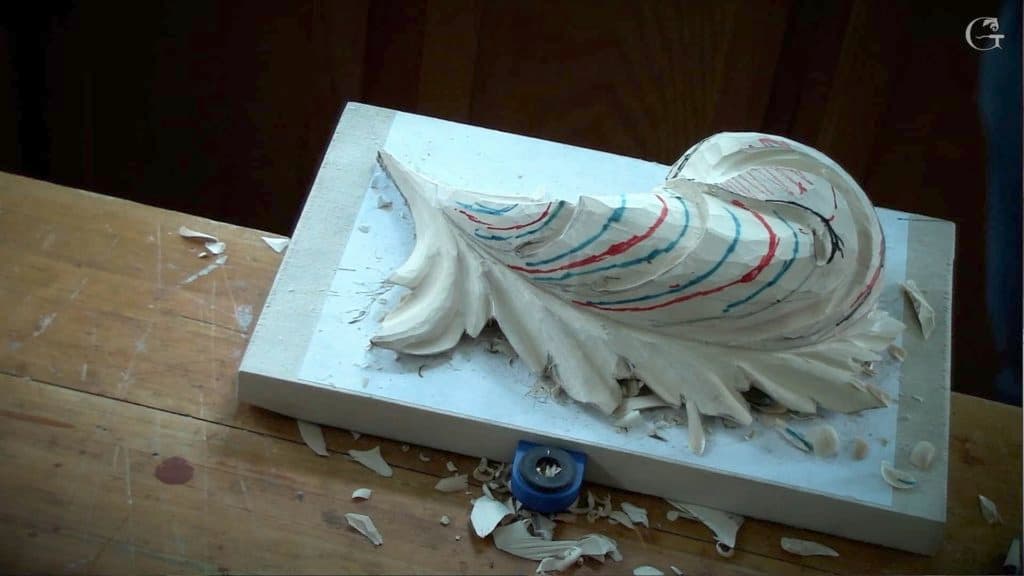
Alexander Grabovetskiy, woodcarver, School of Woodcarving · Published 2021
What does a wood carver mean by "work with the grain"?
Quick answer: In video 2 of Byzantine Acanthus lesson 8, the line comes after "I probably have to switch to smaller one," and before talk of depth and shadow. In other courses, the same words come with warnings: be careful, hold the tool steady, and keep it sharp.
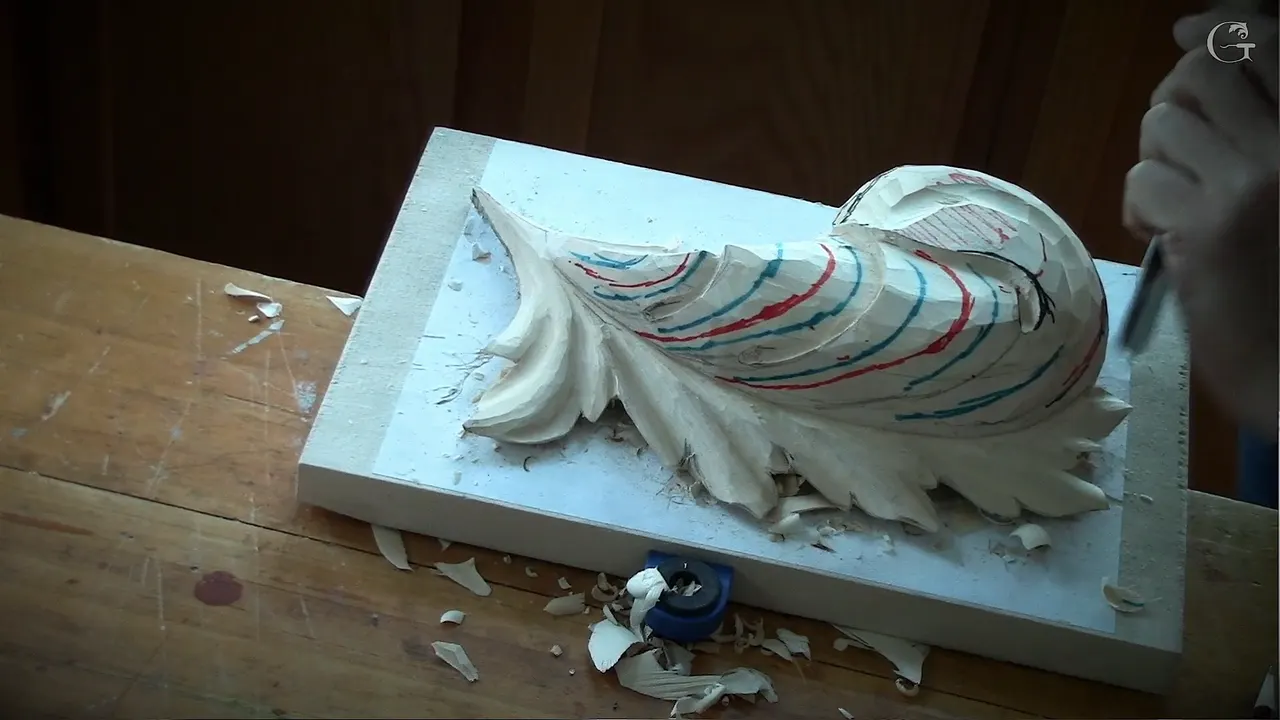

In video 2 of Byzantine Acanthus lesson 8, I say "And of course, good idea is just to work with the grain sometimes" and then I say "And don't be afraid to be too deep." My other courses use the same words, and the lines around them name tools, warnings, and spots where I do the opposite.
Does one wall of a groove come out clean while the other wall tears? Then you have already met the grain. Here is where I say it on the Byzantine leaf, and where it shows up in my other lessons.
Where does the line sit in video 2?
Before it, I say we have to find the center line of every division, and I name the rule again: "Again, 60-40 rule." A blue marker comes next, with "So to create the pipes and the center part, we need to create concave cuts."
The tool follows: "number nine and 10 millimeters." That is 10 millimeters (3/8 in), and a bigger one is "even better." On the ridges, I call them "really important." They "have to be like a high ridges" and "So I'm going to put the marker" there. Of the pipe I say "it's going to be a huge pipe."
Then comes the size. "So if you have a big, like a three-quarters of an inch, that's really good idea to use a big one." Three-quarters of an inch is about 19 mm.

The digging starts with "Big concave" and I say "Don't be afraid. We have a lots of meat." The reason follows: "We have thickness. That's why we didn't get the first layer all the way through."
A smaller tool is on my mind, "And here, I probably have to switch to smaller one." The line from the top of this page comes after it. Two more come next, "Like I said, it's supposed to have a three dimensions" and "We are after all the shadow we can get."
The tool is still in my hands, and I say I will do the concave on the other side of the center line, "Exactly the same." And once more on depth: "We really want to see that, okay?"
How deep did the digging go?
Video 3 of the same lesson picks up from there. "So I've got really deep cuts. Maybe it's not even deep enough yet." My plan is to "just bring everything up," until "those two ridges, become high spots." I name a flatter tool for it, "like number 2."
Looking back at the first dig, I say maybe some of you thought "Wow, that is deep." Then "And it was deep, but now it's actually created the beautiful pipe."

Did I say always or sometimes?
Here the word is "sometimes." A stronger word sits in Venice Room 98, video 12: "good idea to always," followed by the same phrase and "if it's possible." Both lines are mine, and each sits in its own course.
The Byzantine course touches it earlier, in lesson 2. There I hold the explanation back: "I am not explaining the grain yet. I just want to make sure you understand first the problem." A promise comes with it: "Once you're going to experience the problem, then I can answer the question" and the question is the one on this page.
Is it the safe way to carve?
Greek Acanthus lesson 2 puts both sides in one breath. "It's not as safe as you think sometimes, because the structure of wood, the grain, can work against you." Then comes "So sometimes you think it's easier, and yes, it's easier to cut, but you can make a big mistake if the grain of wood, and especially if there is inside of the wood itself, inside of this timber, a micro crack."
I come back to it: "So it's not as safe as it looks." And right after, "But sometimes you have to do that. You just absolutely have to do that." Farther on, I point at an edge: "see this edge could be right on the way of this split, and it could take this edge right with that." A small mallet could help: "Although you could help actually yourself if you would use just a small mallet."


Over in the Greek course, lesson 3 sends me the other way: "And again, I'm doing that across the grain." I call it "a good idea because I don't want to risk it." The danger is "you can easily dig inside of this section and break it out, or break it off."
A section of Hashemi lesson 2 has to go down, and I say "let me take number nine." On the direction, "I have no problem. Although, safer would be" the other way.
Roman Acanthus lesson 16, video 6, leans the opposite way. "I just feel it's safer if you go from a middle." Then "At least when I'm carving, I always get better results" with "my first cuts." And "I'm not going deep."
When did I call it safer?
Floral and Molding lesson 13, video 2, starts with "A couple of ways you could attack that." The first uses a number five. The second reads, "And you could attack first with the number 11 and attack with the side of the tool, pretty much the left side in my case, like a left wing, and carefully just go" along the grain "until you hit the line, okay?" Three short lines close it: "And that is also a legit way to do that." "It's actually safer somewhat." "Safer because you don't push anything."
In the dining table apron course, Workshop 6, I give a direction. "And the right way to cut from upper point down." I say it is easier going downhill, "from this point down with the V tool versus against the grain."

What makes me careful here?
Several Hashemi lessons carry a careful line. Video 5 of lesson 12 has "I got to be careful. So now I have to lower this down even more." Then the plan: "So I'll just go all the way and remove it." And "Which is not going to look as bad as you think. It's just going to be a little different movement."
A size shows up in lesson 17, "I could use about a 5/8 of an inch spoon," which is 5/8 in, about 16 mm. Next, "But I have to be careful" and a note on direction, "Along the grain, I should say."

In lesson 19, my plan is a V cut, "just carefully." Lesson 40 has a plan to undercut with the V tool. Then "And carefully, just because the grain runs this direction" and "if I'm going to push too hard, I can make a big mistake, and I don't want it."
What goes wrong when the tool is pushed?
Greek Acanthus lesson 4, video 4, tells it best. Early on I say "my grain direction goes more this direction right here." Later: "Please control your tool. I'm placing my hand, actually, to control it, and I'm actually also placing my pinky finger right here." The reason, in my words: "you do have a tendency to push too hard, and you can chip this section, and it's going to kind of fly out on you."

The fix is in my hands: "So that's why I'm controlling by pinky and I'm controlling by that hand my movement." And "I'm utilizing just my hand muscles when I'm working." Later in that video, about a really complicated carving: "You can easily break it if you're not controlling the tool, if you don't have enough support."
Back in lesson 8, video 1 has lines on holding the tool. "But carefully, I guide, but without pressure pretty much, but I still have to get solid." Two short rules follow, "Don't air carve" and "Always lock on something."
Which tool sat beside the grain?
A spoon V tool comes up in Hashemi 12, video 8: "I could actually use a spoon V tool." Then "That's a number 12, and that's eight millimeters," which is 8 mm (5/16 in). Venice Room 98 has a sweep: "I'm using number five. It's a sweep number five and half an inch," about 13 mm.
The next one is a plan. In Venice Room 50, I say "Maybe I can use a number two. And 60 millimeters," which comes to about 2 3/8 in. After that, "I have to change the position."

Roman Acanthus 6, video 2, has "10 millimeters, and I'll make my continuous cut." Next, "Keep an eye how your grain behaves." And "In my case, left side is a really clean cut," the one that goes the way of the grain, while "opposite side works against the grain."
How do I get a clean wall?
Corinthian Acanthus lesson 3, video 2: at this stage "it's really important" to go that way "and understand the grain." Then "You can see when I work in the right direction, my cuts are really clean." Just before them: "But let me take my big gouge."

In Roman 16, video 2, I say "we're just removing those facets." Going that direction is something you could do "if you feel comfortable and clean it even nicer." Next: "I know some wood carvers would say anathema to me, so they don't like that way. But on another hand, why not?" And "It actually works exactly the same as if you would use a hand plane." It gives "really, really, really nice clean surface, okay?"

When do I break the rule?
The second Greek lesson names a habit in its third video: "habit to break that law, because when I'm working on a complicated pieces, you really can't always follow the laws." Then "But for this, you really have to have sharp tools." Other spots give their own reason.
In Venice Room 49, video 10, I say "And yes, I am breaking the rule" and it is the one on this page, "because I do have a ceiling on another side, and I can't use tool from opposite direction." Then "So the only way I can work, it's only one direction right now."

In Hazelnuts lesson 4, video 2, I name the same rule and call it one "which I don't have a problem with breaking, I mean." Lily Box 9, video 2, shows the grain itself pointing the other way. The rule, as I give it, is "you're supposed to start with the upper part, with the higher part, and go downhill." Then "But in my case, the grain goes over here. It goes upward, right here." And "I have to go upward, just like that."

Furniture Panel 21, video 10, has me say I have to attack it from the triangle side, "From the point side, I should say." Then "Even if I have to break the rule." And "I found that for me at least, it's much safer, and I can create a much nicer curvature."

Does the grain ever make a job easier?
Hashemi lesson 11, video 5: "That's much easier this direction." The grain is my reason. Then "see how deep I can excavate underneath of that."
Hashemi lesson 25 has me say I have a grain "running this way." The attack follows from it: "from this side, going downhill that way, this direction."

Where did I say it, in one table?
| Where | What sits beside the grain |
|---|---|
| Byzantine 8-2 | A good idea, sometimes, and then go deep without fear |
| Greek 2, video 2 | Easier to carve, though a big mistake is possible |
| Greek 3, video 3 | Across the grain, to avoid a risk |
| In Greek lesson 4 | My hand and pinky keep the tool steady |
| Hashemi 2, video 1 | No problem, though the other side is safer |
| In Hashemi 12, video 5 | Careful, and I have to lower this down more |
| Hashemi 11 | Much easier in this direction |
| Roman 16, video 6 | Safer from a middle, on first passes |
| Floral and Molding 13 | A legit way, and safer because nothing is pushed |
| Apron course, Workshop 6 | Easier going downhill with a V tool |
| Venice 49 | A rule I break, with a ceiling in the way |
| Lily Box 9, video 2 | The grain in that spot goes upward |
Which of these would you try on your own bench first, and which would you keep for a day when the wood is cooperating? Every video of this lesson sits inside one tuition plan. The Byzantine Acanthus course page holds all ten lessons, with lesson 8 and lesson 2 here. Wood carving and relief wait there, and my sizes come with my own figure first and an inch figure beside it.

How it's done
- Mark the ridges. The marker goes on the ridges next, in my plan, and they are supposed to be high ridges.
- Take a big gouge. A number nine at 10 mm (about 0.4 in) works, I say, and a bigger one is even better.
- Do not fear depth. Going deep is fine, in my words, and it is supposed to have three dimensions.
- Think of a smaller tool. A smaller tool may be next, I say, and that is only a plan.
- Go the way of the grain. Good idea, sometimes, is what I say. Greek lesson 2 adds to be really careful, and lesson 4 adds to control your tool.
Frequently asked questions
What came just before the line?
Big concave, and lots of meat. Then a smaller tool came up, in the form of a plan. The words about it name no size.
What came right after it?
Words on depth and on shadow, spoken in a row. Next, a concave on its other side, the same way, is my plan.
When do I set the rule aside?
A ceiling in one Venice Room lesson and the direction of the grain in one Lily Box lesson each send me the other way. The hazelnut lesson adds that I don't have a problem with breaking the rule.
What do I do about a heavy hand?
What to carve next
- Byzantine Acanthus lesson 8
- Byzantine Acanthus lesson 2
- Greek Acanthus lesson 2
- Greek Acanthus lesson 4
- Hashemi Flowers lesson 2
- Hashemi Flowers lesson 11
- Roman Acanthus lesson 16
- Corinthian Acanthus lesson 3
- Floral and Molding lesson 13
- Dining table apron course
- Venice Room 49
- Furniture Panel 21
- Hashemi Flowers lesson 25
- Hazelnuts lesson 4
- Byzantine Acanthus course