

Alexander Grabovetskiy, woodcarver, School of Woodcarving · Published 2021
What does a wood carver mean by "wherever"?
Quick answer: In Byzantine Acanthus 8-3 I put the word before an eye on my leaf, and a "huge pipe" comes right after it. Other lessons of mine put wherever before pipes, separations, a stem, ridges and edges, with a cut named beside it.
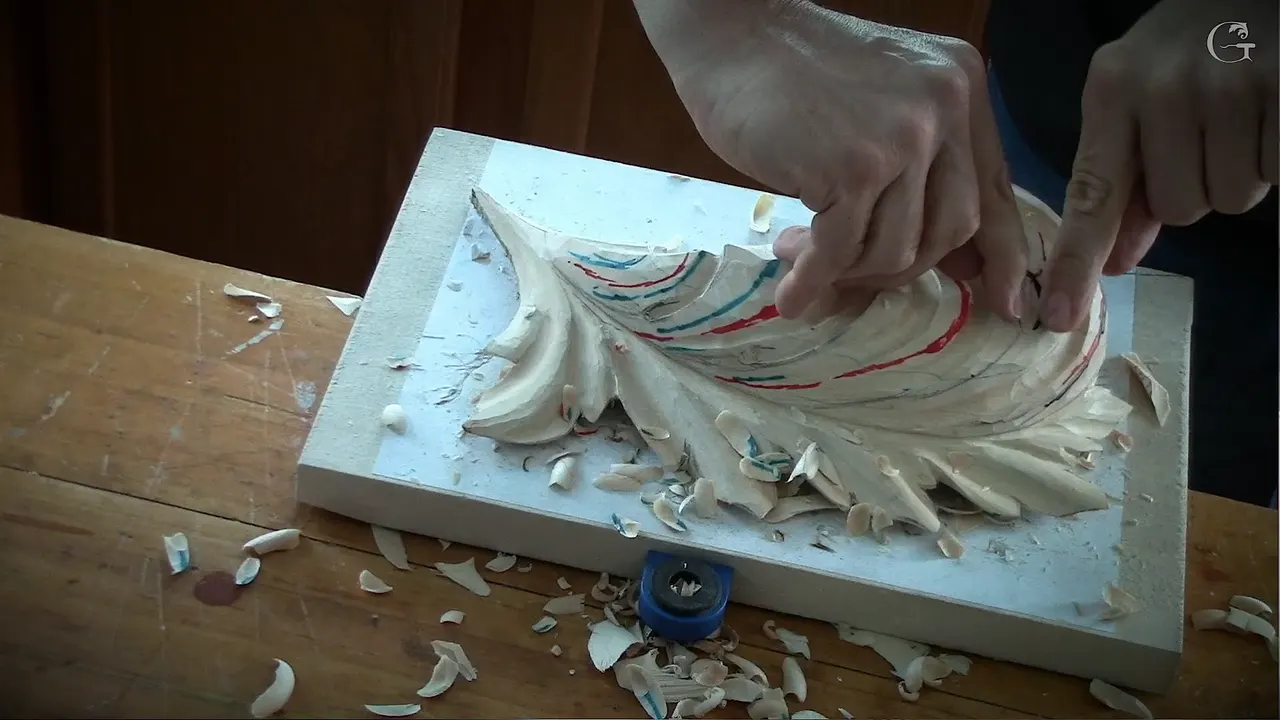

"Same idea going to happen wherever you see the eye." I said it in Byzantine Acanthus 8-3, right after "just really beautiful." My other lessons put the same small word in front of eyes, pipes, separations, ridges, a stem and edges. A cut or a shape sits beside it in each one.
Do you have a leaf with eyes marked on it? Is the first layer still thick? The lines below are for your bench, and each one names the lesson it came from.
What do I say in video 3 before the word wherever?
"So I've got really deep cuts," I say, and then "Maybe it's not even deep enough yet." My plan is to "bring everything up", until "those two ridges, become high spots." A flatter tool comes next, "like number 2", and I say "Let me do that with number 2, will work in this case."
We are going to "blend that and create convex", I say. The result will be "a big convex." A knife or a skew gets "exactly the same operation", and I say "Just attack that from the right point."

If I rotate, "you're not going to be able to see it." "See what I'm saying now?" I ask. "So those two ridges, they become high spots", I say next. "I can just actually bring that to that ridges." And "blend, and blend, and blend."
Another plan sits right after: "let me take the same tool, what I used before, and get rid of that mess I just created." Depth gets a line next: "maybe some of you thought", I say, and then "Wow, that is deep." Then "And it was deep, but now it's actually created the beautiful pipe."

"what I was talking about on Byzantine style and also Italian style" comes next, and then Baroque work: "the most beautiful work in the Baroque style, it's Italian style." Then "16th century, just when you look at it, just perfect." "That's what they did, big pipe." And "Over-exaggerated pipe, if you wish to call that name."
"And of course, it has to be really smooth and nice, just really beautiful." The line from the top of this page follows, and right behind it comes "That eye and that eye. We're going to have huge pipe like that, okay?" "So what we're going to do right here, just blend it" comes after that.

"So after concave, we're supposed to have a convex." Then comes "Concave, convex. Concave, convex, okay?" Then "we want to make sure it's not overwhelming one, so we can knock that down a little bit." And "keep that pipe higher than the middle part." After that I ask "See why we need all that meat?"

Near the end I plan to "take it and show it to you, even if it's not to the perfection yet." The last words are "It's just looking rough, but look."
Where else do I use the word next to an eye in other lessons?
"And wherever I have an eye, there's going to be a pipe." It is in vase lesson 1, part 5, after "a pipe going to the center." The next line is "if you don't know what the pipe means, I'm teaching about pipes in my acanthus design." The leaf is "growing uphill."

Vase lesson 2 spends more words on the eye, in part 5. An eye is "whatever the two leaves coming together", and I add "Not the eye, it's an intersection." My comparison is "like human eye." Then "take it to the center", where it is "also high spot" and "a pipe." The line is "also flowing."
The golden spot falls "approximately on the 62%", and I say "Just eyeball it, okay? It doesn't have to be exact." Every concave cut is "supposed to go to the same position, to the same golden spot." At a pipe the word returns, with "there should be concaves on both sides." Then "that is a concave, that is a concave." And "So deep in cut, okay?"
Red marks the convex cuts, and blue marks the concaves in that lesson. The red is "a convex cut", I say. About the blue I say "deep cut going in", and those spots are "low spots or valleys, if you wish." After two concaves in part 6 I say "I don't really like how this looks", and "I can deepen little bit this side." Later the word comes back at the blue marking: "it's exactly the same operation." The goal is "to make it as much 3D as possible without digging too deep."

In lesson 3 of the Byzantine course the word sits beside the eye, in part 2, with "the beautiful movement" next to it. I explain it as "one part of the leaf going to overlap another." My tool there is "Three millimeters, number 11", which is 3 mm (0.12 in). The flute goes at "2 o'clock", in my plan.
Byzantine lesson 3 has "whenever you see that transition" in part 1, then the word wherever and "an eye, just like a human eye." I plan to "place another high spot", which "we call between transitions a pipe."

How does the word sit beside a concave in other lessons?
Venice Room 55 has a bigger tool in part 12: "I could use probably a little bigger tool," I say. "That was half an inch, but I should use probably 15 millimeters, 5/8 of an inch." Half an inch is 12.7 mm, 15 millimeters is 0.59 in, and 5/8 of an inch is 15.9 mm. Where the orange is, it will be "at the center of my concave."
In future, I say, it will be convex, "on a micro level convex." "But as of now" it will be "a concave." Again, "big tool. That's what I'm using." And "I still want to raise this ridge."

An oak leaf turns up in Venice Room 96, part 12. "Wherever you have the main separations, this is the main separation, that is the main separation, you're supposed to have some kind of eye." Then "Not on oak leaves, but they did it." Then "So they did it, that's what I'm going to do."
The only difference between the oak leaf and the acanthus leaf, in this case, would be "roundness of the movement and outside." The movement is "supposed to be toward the middle line", and "that would be mistake if I would do something like this."

Which cut comes first at a separation or a triangle?
"I need to take out some of that", I say in Venice Room 14, part 5, and then "I can probably make the relief cut first." Next comes "Make the relief cut first with the number nine." Then "Wherever I see those triangles, I always try to do the relief cuts, okay?" It is "Just a straight-down cut like that." And the reason is "Because I learned my lesson too many times."
Rushing is not "necessarily the best approach." "there's a saying", I tell you: "If you're going to rush, you're going to make people laugh."

In part 1 of Corinthian Acanthus lesson 3 I say you can find a "close sweep gouge", and "place it wherever you need to make a cut." Then I say "And you can see what's the reason why we actually made that relief cut." The fibers: "the fibers on this side is weaker than on that side." And "Always, wherever it's possible to do relief cut, especially if you have time, which is really important also."
I add "But I try to do as much relief cuts as possible." Then "Same gouge." My tool is a number three, and I say "And that's a 16 millimeters." In inches it is 0.63.

"I'm gonna grab my number 11 and three millimeters," I say in the tray course, lesson 3. I place it "straight down." On a flatter tool: "a lot of guys, they have a tendency to just grab flatter tool and start carving like that right away, but it's not the best way because you're gonna break, uh, those edges."
"It's always better to just start with the like number 11 and create the relief cut like so." The tray line goes on: "wherever you have the divisions, you can kind of create the cut." After that comes "number two", with "not blend, but roll it a little more." In lesson 8 I name a number 2 when the deep cuts are in.
Byzantine Acanthus lesson 9 has, in part 2, "wherever you see the separation between the leaves, you really have to do a relief cuts." "the same tool, but carefully" comes next. And "You have to relief first."

What small cuts follow a ridge or a stem?
The vase course has "we want to exaggerate the triangle" at every concave, in lesson 3, part 2. Earlier in that part I say "I really like the number 11." A "smaller tool" will "create micro-notches." The word comes at the ridge, where "the notch" goes in, and at a concave, where "extra notch" goes in.
Later in that part I come to undercutting, with "number 11 again, and one millimeter." And "It could be one millimeter, it could be half a millimeter." One millimeter is 0.04 in, and half of that is 0.02 in. "wherever we see the area needs to be undercut" is the next line, and then "undercut it."

The tool sits at "approximately counterclockwise and maybe about 11 o'clock." Then "Flute facing out." And I plan to "undercut everywhere."
Small concaves have a place in Venice Room 78, part 5. "Clean that a little bit with the knife", I say, and the plan is "some concaves." "wherever I see a separation, right here" is the line, and I plan to "create a concave right there" and "another concave right here." They "don't have to be really deep. It's just for the shadow."

Smaller tools come up in Venice Room 35, part 7: "Use smaller one, like one-eighth of an inch or even smaller, maybe two millimeters, like 3/32 of an inch, and get that in." One-eighth of an inch is 3.2 mm, 2 mm is 0.08 in, and 3/32 of an inch is 2.4 mm. After it comes "Remove that plug." The plan covers "wherever the eye" will be.
Then "two millimeters is a little too big, and I have to go with the one millimeter." The tool is "Just one millimeter, number 11." Next I say "And get deeper."
A stem goes underneath in part 3 of vase lesson 2. "And wherever I've got the stem going underneath, I'll take probably just any number three." The size is "the 10 millimeters", which is 0.39 in. The cut is "slice it just like that, just to create the feel like it's going underneath of here."

Part 3 of Roman Acanthus lesson 16 puts the word on an edge. My plan is "to create an edge, and then undercut", and the amount is "maybe about 1/16 of an inch", which is 1.6 mm. The look is "this edge will give me a really, really more classical, I would say, look."
"Check before you make a really deep cut what the grain does." For the edges I say "1/16 of an inch or even less, like a 32nd of an inch or 1 millimeter will work." A 32nd of an inch is 0.8 mm, and 1 millimeter is about 1/25 in. Later comes "Refine my notch a little back right here." And "just go all the parts just like that." The word goes with "a part with the edge", and I say "So we can always do that everywhere."
"make sure you're not pressing anything. You're just slicing, okay?" And "Let the knife, let the tool do all the work." And "If you have a number one, just a chisel or a single bevel."
Where did I say the word, in one table?
| Where | Next to wherever | The shape or cut I name beside it |
|---|---|---|
| Lesson 8, video 3 | The eye | A huge pipe on that eye and that eye |
| Grape vase, lesson 1 | Each eye | A pipe going to the center |
| Venice 55 | Where the orange is | A concave dug at the center with a big tool |
| Workshop 96 | The main separations | An eye, even on an oak leaf |
| Venice 14 | Those triangles | A straight-down relief cut, number nine |
| Byzantine lesson 9 | The separation between the leaves | A relief cut, with the pass made carefully |
| Tray lesson 3 | The divisions | A cut after a number 11 relief cut |
| Roman lesson 16 | A part with the edge | A slicing pass with a knife or a number one |
Which eye on your leaf would you carve first, and which pipe would you try tonight? All ten lessons of Byzantine Acanthus sit in one course, with lesson 8 among them. My vase course, Corinthian acanthus, Roman acanthus and tray course hold the rest of the lines above, with one tuition plan for all of them. My sizes come with my own figure first and an inch figure beside it, in millimeters.
How it's done
- Bring the ridges up. In this video I plan to bring everything up until the two ridges are high spots.
- Blend a big convex. A number 2, a flatter tool, is my plan for it, and I say the blend will become a big convex.
- Dig a concave beside each pipe. A concave goes on each side of a pipe in the vase lesson.
- Start with a relief cut. Where I see triangles, I start with a relief cut, a straight-down cut.
- Lower the pipe a bit. Here I say the pipe can come down a little bit and stay higher than the middle part.
Frequently asked questions
What tool do I name for the blend in lesson 8?
A flatter tool, "like number 2." I say "Let me do that with number 2, will work in this case."
What goes beside a pipe in the vase lesson?
In the vase course I say "there should be concaves on both sides" of a pipe. About the blue marks I say "deep cut going in."
Which tool makes the relief cut?
In a Venice Room workshop it is a number nine, and in the tray course a 3 mm (0.12 in) number 11. The ninth Byzantine lesson keeps the same tool and goes carefully.
How small is the notch tool beside a ridge?
What to carve next
- Byzantine Acanthus lesson 8
- Byzantine Acanthus course
- Byzantine Acanthus lesson 3
- Byzantine Acanthus lesson 9
- Carving vase with grape leaves
- Vase lesson 1
- Vase lesson 2
- Vase lesson 3
- Venice Room 14
- Venice Room 35
- Venice Room 55
- Venice Room 78
- Venice Room 96
- Corinthian Acanthus lesson 3
- Roman Acanthus lesson 16
- Tray of Blessing lesson 3