

Alexander Grabovetskiy, woodcarver, School of Woodcarving · Published 2021
What does a wood carver mean by "right in the middle"?
Quick answer: In video 1 of Byzantine Acanthus lesson 9, I say a middle line goes between the eyes. Later I say "You're really removing just the plugs", in a section's middle. The same words come back for a convex, a deepest spot and a spine.
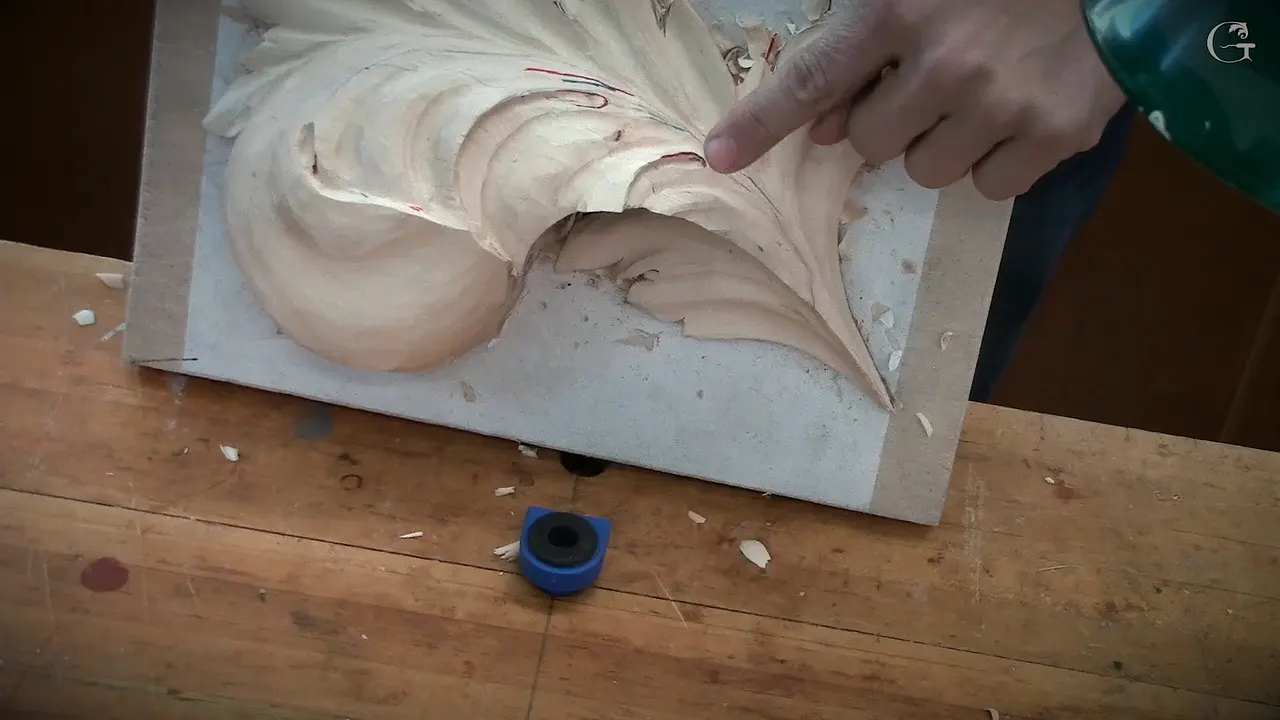

In Byzantine Acanthus 9, video 1, I say "Right in the middle of the eyes, there's going to be somewhere a middle line." Other lessons put a convex and a deepest spot in the middle, and keep a spine out of it.
Ever stood over a board full of drawn lines and wondered where one more line goes? The first stop is video 1 of lesson 9, a Byzantine acanthus leaf. Each of the other lessons has a spot of its own.
Where does the middle line go?
My words to the class: "Okay, look at my piece, please." Then comes "I know it's a bunch of lines. It's really confusing." The count is "One eye, two eyes, and three." Then "Three eyes." Each eye is "always a separation point between those leaves."
The middle line is "which supposed to be convex." Then, "So just to put between those eyes a line back with the pencil." After that: "You're going to clean it, but with the pencil."

About the pencil I say "It's a lot easier than a marker, like I do." Then "you can clearly see there's three leaves, three sections only." And "Just concentrate on eyes." Later, about a marker: "You don't have to put that with a marker because it's hard to clean."

How many separations per leaf?
"one of the separations is going to go underneath." Then comes the count: "three separations in every leaf." Of the leaves: "those three separations on those three leaves" and "On the big one, exactly the same thing."
Those parts are to be dug out: "we're going to dig that out, those parts." On the eye: "the eye is a starting point." And "It's always between leaves."
What does the convex between the eyes look like?
"Between those eyes is a leaf and each leaf has a convex." Then "Not really high, like a huge ridge, but kind of smooth", and "the pipes in those sections, they are raising up."

Of the eye I say "every eye is supposed to look like a water drop." From each side, "it's supposed to go this way downhill, and that way downhill." Last, "it creates the illusion of the pipe."
About a higher ridge: "Even if I have that ridge a lot higher, but still, it has to be just to kind of overall look like a convex from that point all the way here."
What comes out of the middle of a section?
Next, "we're also going to dig this out." Then "I mean, you don't have to, but it's a good idea." And "Let me show how" it goes "without drilling."

The tool: "if you have a three-quarters of an inch, it's a good idea." In metric that is 19 mm. Without it, "If you don't have three-quarters of an inch, number nine, you can use 10 millimeters, 12 millimeters, okay? Whatever you have." Those two sizes are 0.39 in and 0.47 in.
"You just place your cut like this, I mean, the tool like this, and we call it a plug cut." In that section's middle, "You're really removing just the plugs."

Next: "See? We're removing the plug, and then we attack toward the hole from the sides."

Where else does a convex sit, in my lessons?
Byzantine Acanthus lesson 3, video 3, carries "So, the middle part will become convex, okay?" Of a Roman style with that twist I say "Too many lines" and "it's not going to be good for the gold leafing." Next, "So pretty much, concave, concave, and convex" with the convex placed in the middle, "and we're going to soften it."
Byzantine lesson 4, video 2, names a tool: "you can take number seven and 14 millimeters." In inches, 14 mm is 0.55 in. And "in some of the spots, turn that upside down and get rid of the extra edges." After that, "So that's going to give you even better convex" in the middle.
Floral and Molding for the Panel 12, video 1, shows another acanthus: its middle is to get "a convex and two concaves", and then "exactly the same what I've done on the previous pieces."

Furniture Panel 28, video 3, brings a plan. "But I also would like to introduce convex" in the middle. And "Every movement supposed to have a two concaves."
Vase with Grape Leaves 2, video 5, works with red and blue marks. In each separation's middle: "a high spot" and "convex." For the red marks I say "when you see the red" and "a convex cut."

Acanthus over Moldings 2 is on molding work. The middle part is "convex" and "like a half a sphere I would say." A sphere is the shape I name. In Moldings 3, a hit in the leaf's middle: "It's gonna give me beautiful convex."

In Furniture Panel 33, video 2, a center line gets a concave. My plan: "I'm gonna follow my center line and I'm gonna create the concave." Also "So I don't wanna lose the main convex."
Which cut goes in a petal?
Chamomile and Bow Rosette 2, video 2, holds a plan. "Now I'm going to show you" what I plan in the middle: "a groove cut", then "smooth out both sides." And "that's going to look really nice."
Lesson 13 of the floral panel course, video 3, plans a cut: "a groove cut, like a concave cut," made in the middle of those petals, with "half a millimeter number 11." Half a millimeter is 0.02 in. It is to give me "extra shadow spot." I plan to start it "from the golden spot", not from the edge.
Greek Acanthus 5, video 4, names a V tool. "any 60-degrees V tool or 45-degrees V tool. Any will do." For example, "I'll take probably just the 45." Then the V groove should go in the leaf's middle, "but it's not necessarily applies to every detail."
In Hashemi Flowers 44, video 3, I say "maybe get deeper concave" in the middle, "going toward the center."
In First Cuts for Beginners 2, video 6, I say "But it was also common to put kind of V cuts in the middle of the leaves to make it look even more beautiful."
Hashemi Flowers 36, video 4, names an option: "Oh, I can actually make a concave cut", away from the middle, "probably to the left side from the center." Then "Make a small one with 1/8 of an inch" (3.2 mm).
Roman Acanthus 12, video 2, puts a concave cut at the center. "we divided that in three, which means I have to do small micro-concaves on the sides also." In video 7 of the grape leaf vase lesson 2, the order, in the middle, is "Then I've got concave", "then convex again, then concave again."
Where does the deepest spot go?
The deepest spot comes up in Modern Acanthus 1, video 2. The spot goes in the middle, and "It's gonna be one inch." One inch is 25.4 mm. Of "those outside like here and the other spots" I say "little higher."

Vase with Grape Leaves 1, video 8, gives a figure. The deepest spot is "somewhere" in the middle. Then "But now it's about 16th of an inch deep", and in metric 1/16 in is 1.6 mm.

A petal is the subject of Furniture Panel 20, video 2. "See, it's still really deep, but it's approximately maybe one sixteenth of an inch deep." Again 1/16 in (1.59 mm). Finally "So that is the deepest part is" in the middle of "that petal."
Which spot is the highest?
Chamomile and Bow Rosette 2, video 2, is on a leaf that is to wrap underneath. My taste: "But for my taste, it's a little too high." Next, the highest spot should sit in the middle.

The plan there: "So I want to knock that down approximately six millimeters or so." Six millimeters is 0.24 in. Next, "So which means I can safely do that" and "about a quarter inch."
Over in floral panel lesson 6, video 2, a high middle is fine with me. It looks slightly too high there to me, "which is absolutely okay." And "I have no problem with that."
Furniture Panel 24, video 5, has a tool plan: "let me get number 3, but a little bigger." The size: "Maybe about 10 millimeters", which is about 0.4 in, for "where I can hit the high spot" in the middle.
In Venetian Flowers Rosette 3, video 3, a raised part comes up on a petal. "I still want to see that raised part" in its middle, "because it creates a somewhat beautiful motion." Then it is "a little too high to the end", and I plan to get rid of it.
When did I leave the middle alone?
In Furniture Panel 19, video 6, a "middle spine, if you wish" is planned, and I say I am not going to place it in the middle. The plan: "If you divide that in 10, this section in 10, I'm going to move it slightly to this side and about 6 out of 10 parts."

Video 8 of that lesson adds "I'm still going to go with my golden ratio." The spine is to go "at the six out of 10", away from the middle.
Hashemi Flowers 38, video 3, shows the same split. "What I want to do, I want to establish the center", and not in the middle of it. Also "To be exact, I usually go about six parts out of ten." Then "It's actually by the Fibonacci sequence, by the golden ratio rule."
On measuring: "I just eyeball it. I don't measure it." And "But if it's just slightly off-center, usually that means it's good."
In Greek Acanthus 6, video 3, I say "because the movement of the leaf goes downhill like this, and goes this direction", and "I want to make sure my shadow" goes "on right side." And if my middle line went in the middle, "so it would not look good." And "I kind of have to move to the right, to the higher side slightly."

In Greek Acanthus 9, video 1, I say "Again, just going to place my middle line off center." Then "I moved that line about 3/32nds to the right-hand side", which is 2.4 mm for 3/32 in. One option: "I could use just a knife."
Where do I start the next cut?
Plate with Butterflies 2, video 1, is on a cut across the grain. "Now do not go all the way with that cut because it has to go smoothly in and smoothly out." And "So it is good idea to stop somewhere, you know, like in the middle."

My starting cut, I say, is to start in the middle of my previous one. And "the next are gonna be" in the middle too.

Floral and Molding for the Panel 2, video 1, comes at it with a ridge. "A ridge of my previous cut" is to lie in the tool's middle. Right after: "That way, it's a lot less effort."
Is anything in the tool itself in the middle?
Floral panel lesson 7, video 2, names a part of a gouge. "The flute is actually that groove" in its middle, "or in my case, it's a veiner number 11. That is a flute." Modern Acanthus 3 puts the flute in the tool's middle too.
V Tool Sharpening 2 puts a screw in the middle. "It's really important that you are trying to get your screw" in the middle of that metal part of the tool. After it comes "So just make sure you just kind of eyeball it, and make it tight."
Where did I say it, in one table?
| Where | What sat in the middle |
|---|---|
| Byzantine 9-1 | A middle line, drawn between eyes |
| Same video | The plugs of a section, taken out with a gouge |
| Floral Panel 12 | Convex and two concaves, in one acanthus |
| Furniture 28 | Every movement, a convex placed in the middle |
| Vase 2-5 | High spot and convex, for each separation |
| Moldings 2 | Convex, like a half a sphere |
| Modern 1 | Deepest spot, and the words one inch |
| Chamomile 2 | Highest spot, as I said for my taste |
| Butterflies 2 | My starting cut, in my last one |
| V tool 2 | A screw on the metal part of the tool |
| Furniture 19 | Spine away from it, six out of ten |
| Hashemi 38 | Center away from it, six parts of ten |
| Greek Acanthus 6 | Middle line to move right, for shadow |
| Roman Acanthus 12 | Concave cut, with small ones beside it |
Which of these would you try first on your own board? Every video of this lesson sits inside one tuition plan. The Byzantine Acanthus course page holds all ten lessons, with lesson 9 here and lesson 3 too. Wood carving and relief wait there, and my sizes come with my own figure first and an inch figure beside it.
How it's done
- Count the eyes. I ask the class to look at my piece, and the count is three eyes.
- Pencil the middle line. A convex line goes in pencil between a pair of eyes, which is a lot easier to clean.
- Plan the dig. The section is to be dug out. I say opening it right through is a good idea, though not a must.
- Pick a number nine. A number nine of 3/4 in (19 mm) is a good idea, or a smaller one.
- Open the hole. Once the plug is out, I work toward the hole, from each side.
Frequently asked questions
What line opens the work in video 1?
Between each pair of eyes, a middle line. It goes in with a pencil, and I say it should be convex. In my words the pencil is a lot easier than a marker, and I tell the class you're going to clean the line.
How big a gouge takes the plug out?
A number nine. A 3/4 in one (19 mm) is a good idea in my words, and 10 mm (0.39 in) or 12 mm (0.47 in) will do. I call the cut a plug cut, and next we attack the hole from the sides.
Does the spine have to sit in the center?
Not in three of my lessons, Furniture Panel 19, Hashemi Flowers 38 and Greek Acanthus 9. My split in the first two is near six in ten, and I eyeball it. A line slightly off-center, I say, usually means it's good.
What to carve next