
Alexander Grabovetskiy, woodcarver, School of Woodcarving · Published 2021
What does a wood carver mean by "sculpting"?
Quick answer: In video 2 of Byzantine Acanthus lesson 9, I say "That is sculpting, I guess" after I say the goal is to get to that first dome and everything else right here has to go. On the Venice Room I say "We're just sculpting pretty much the main shape." On the furniture panel I say "you're shaping the wood."
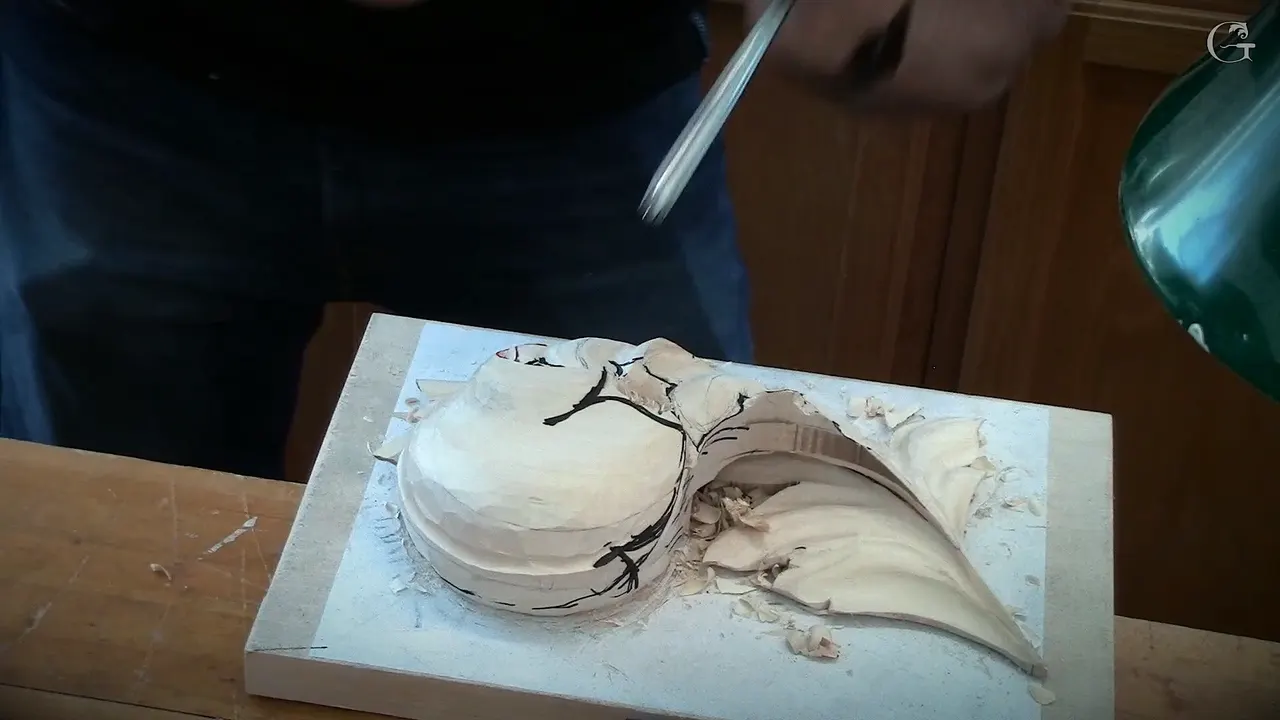

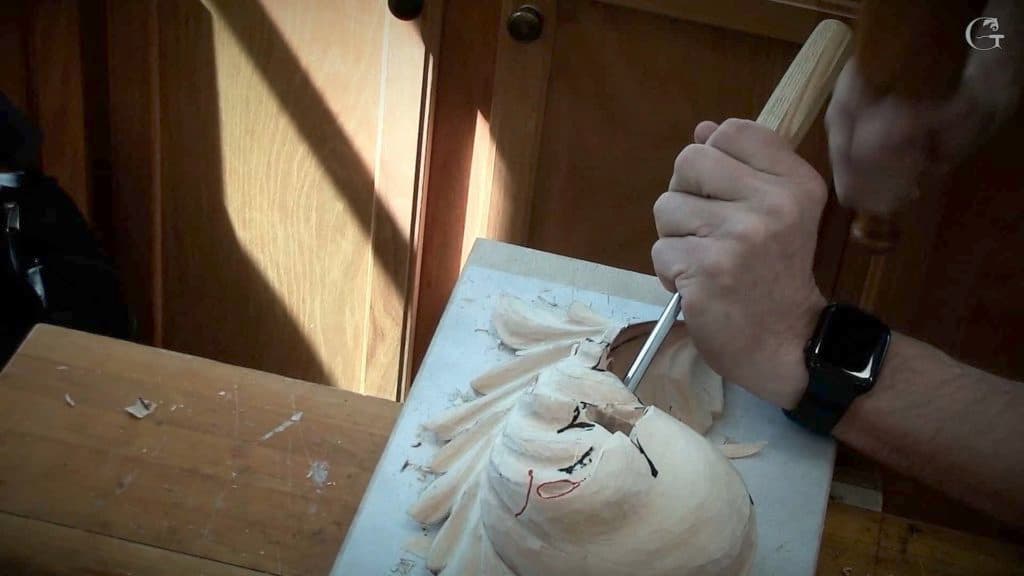
In Byzantine Acanthus 9, video 2, I say "That is sculpting, I guess" right after I name the first dome as the goal. The same word comes back on the Venice Room and on the furniture panel.
Ever stood over a hole in a leaf with a wall of wood still beside it? Ever felt the tool fight you? Video 2 of lesson 9, a Byzantine acanthus leaf, is where I tell the class what to do about both.
What was I sculpting when I said it?
The wood on the way to the first dome. Just before the line I say "But the goal is to get to that first dome, and everything else right here has to be gone also, pretty much." After the line I say what comes easier. Once the wood is through, "it's going to be a lot easier to establish the final, final form."

I offer to show it. "Let me show that to you so you can see." The rule is for the wall. All of it "has to be connected to inside dome or whatever the shape you got on inside" and near the wall I say "get as close as possible to the edge, but not too close."
My figure is "maybe about five millimeters, six millimeters, about quarter inch." Five millimeters is 0.20 in, six is 0.24 in, and a quarter inch is 6.35 mm.
The reason I give for leaving that much: "Later on, we're going to refine it just in case if you made a mistake, so you're going to have some meat." The warnings are short: "And just remove, but careful" then "Don't hit that first layer."
Why does the first cut go straight down?
In my words, that cut is what lends the overall shape its likeness. To the class: "As of now, I would like you to see a straight cut down." More detail waits for later, with undercutting and an even better effect. But the cut I am making now is, as I say, "what gives likeness to overall shape." It is "a really important step," I say.

Relief comes first wherever two leaves part. "And again, wherever you see the separation between the leaves, you really have to do a relief cuts." I use the same tool for it, but "carefully, okay?" The line is "You have to relief first."
At the start of the video I say "But also sometimes what helps, a mallet." Then comes the name of the cut, "See? That's why it's called plug cut. Yeah. You're removing plugs."
How do I handle a mistake on the leaf?
I make one, and I say so: "See, I already made a mistake." A question to the class follows, "So what do you do if you make mistake" and the line right after it reads "Redesign it."

About that mistake: "I'm not going to change too much shape", and I add a warning to be careful. For next time I say "I would use probably smaller tool next time."
How do I undercut once the hole is open?
Carefully, with a slicing turn. In the hole I start with "a straight down cut." With the hole through, the work changes: "we have to work from the sides, but we can start undercutting, just placing your tool toward that hole and carefully, again, don't forget to make the rotation movement slicing."

"Just every cut you do, just slice it." I stay with one tool, "And just undercut and undercut with the same tool". The stop is "approximately quarter inch for now between the ridge and the hole," which is about 6 mm, and I add "go inside of the hole from all sides."
Why use the number nine on that side?
A lot of material sits on that side. I put it to the class as "See how much meat we have right here" and I say some of them have "really big chunks in this area." Undercutting on that side helps with the final form.

The tool is "number nine, the big one." I "attack from the side like this" with the rotation movement "in my case, toward the left" and then "start digging in." Out of it I want "really smooth transition from the first layer to the second."
Why is the wall so fragile at this point?
Plainly: "But be careful not to break it, because right now it becomes fragile." I say to make it "airy and light" and if you overdo it, "you're going to break it." The blend runs on "until we meet the first layer."

I ask the class "Why is that important to do right now" and answer: "it's fragile now, it's a lot easier, actually, a lot less material to remove and to create those shapes." As for the wall: "you can also start removing this wall and just go toward that dome inside" and the gain is "a lot easier to work on this leaf."
What if the wood fights me?
Get a smaller tool. "If you have a problem, if you feel that it fights you, just get the smaller tool, okay, and attack with the smaller chunks."

For the wall I say "so we really have to dig in, but be careful how you do it" and "Don't destroy the lower layer." About a mallet: "You could, if you do have a mallet", and "even with the mallet, you're still doing a slicing."
Where else do I say sculpting or sculpture?
In Venice Room 63, video 3, the word shows up as "It's more sculpture right now than anything else." Then "We're just sculpting pretty much the main shape." I check as I go, "constantly checking and rechecking from different points of view how it looks, and if it doesn't make sense, I'm redoing it."

A slope comes up: "And looks like I can slope a lot more right here." Then "That's just too bulky or bulking out too much." After that I say "Like I said, I'm just pretty much just sculpting it." And "Just want to make sure it just really smoothly transitions up and do whatever makes sense."

High relief has rules, and I say they still apply: "if you know a little bit about high relief, you still have to follow some type of rules." Near the sides I hold back, "But I don't want to do too much because I don't want to lose a feel of it." Of one spot: "Not chopped, but it just kind of moves in." So it is "more organic if you wish."
The camera is above the work. "Again, you're just seeing it from a camera above and you don't see from the side, but I see that from all of the sides and it makes a lot more sense."
Venice Room 58, video 9, has "So I created first the main overall shape". For the surface: "And right now, it doesn't look too smooth for me, and I need to take a little bit off this side." Then the picture of the work, "And it's just like a sculpture almost. You just take a little slice by slice. So it's not like one swoop, one cut, and it's all done."

"So little by little, just creating the form, creating that shape." I add "And I'm looking from different points of view" and "I can just kind of slice it little by little, go closer to that detail."
A tool in Venice Room 74, video 5, gets the word: "Somewhat flat tool, that's what I'm using, like number two and 50 millimeters, in this case." Fifty millimeters is 1.97 in. "It's more for sculpture, I would say." Then I call it "a more sculpture tool or sculptor's tool", and "a really good tool also to have."
Further on I say "Oops, that is not bueno." And "If I would just continue to do that, I could break this part, and that would not be a good idea."

Depth comes up in Venice Room 60, video 8. "Don't dig too deep inside of the wood." The mistake I name is "when people trying to get too much wood at one time" and I add "It was my mistake, by the way, too." The line with the word in it: "So it's better, even if you're doing a large sculpture, not to dig too deep."

Where does carving turn into sculpture on a furniture panel?
Furniture Panel 32, video 1, has "and then you start digging the details after". Of the shaping: "So you're pretty much creating shape, you're shaping the wood". It is "the most important step". My reason is "'cause you kind of get the feel."

Of a drawing on paper or on a board: "you really don't see how it's gonna look in real life". "But still, once you're gonna carve or sculpt" brings changes, "Make some changes 'cause it looks different, not what you expected." That works in this case, I say, "because I'm not working for the client."
In the same video: "I'll use a mallet by the way, keep an eye what the grain of the wood does." About the details I say they are "kinda weak spots and you can chop too much".
Furniture Panel 21 has it beside measuring. "Because not on all of the projects you are able to measure." Then "For example, if you work in sculpture, or is not always possible to actually measure", which leaves going by eye. And "And project like that trains your eye."

On Furniture Panel 18, video 9, I show a pointing machine: "a pointing machine in your workshop." Of measuring the depth of the background I say "That's probably the easiest way." About who uses it: "So it's actually sculptors using it, and I also use that in carving when I'm doing a full 3D in round."

Easy to use, I say, "even for flat panels" because "it has a needle, and I attach the base." For this project it is "almost overkill for this project." Further on: "Or if you're in a sculpture, you create your sculpture first from clay." Then "And then if you would like to carve that out of the stone, like limestone or other types of stones."
In Roman Acanthus 2, video 2, I name the tools. "Probably when you're doing relief carving, yes, a V tool is one of the most important. And of course, gouge." Then "But let's say if you're working on a big sculpture, you using more gouges than V tool, so that would be probably more accurate."

Which spot did I change in lesson 9?
Video 3 has it. "I have a spot I don't like, and I want to show what you can do." About the spot: "This little thingy. It just doesn't look really nice." I say I'm after "nice and organic form", and my plan is to get rid of the spot: "What I'm going to do, I'm going to get rid of it."
Of the rest: "I'm okay with rest of it, but who knows?" And "Maybe by the end of today, we're going to change something else."
Which lines in my April 2020 livestreams have the word?
The wood movement video has one. "I clay it first. I'm using clay, model it, and then I carve it from it if it's complicated sculpture." Next: "Not the case like what I'm working right now."
The lighting video has a line. "I always laminate for this reason, even if I'm getting a sculpture." And I give the reason, "I did not want to carve a solid log, otherwise it would just crack."
A knife works too, I say: "even on a sculpture, you're still able to use a knife." The money video has "If it's a sculpture, let's say like those lions I showed you before, it takes absolutely different time from carving a canvas." And "A canvas is much easier, for example, than those lions".
These sit in the April 2020 livestream lesson. The gouge sharpening lesson has one more, in a list of what we will learn: "carving for furniture, architectural carving, ornamental carving, just fun carving, just sculpture carving."
How wood carving and sculpture split apart is on the Venice Room 55 page.
Where did I say it, in one table?
| Where | Said about this |
|---|---|
| Byzantine 9-2 | Getting to the first dome, with the rest gone |
| Venice 63 | The main shape, checked and rechecked |
| Venice 58 | A little slice at a time, not one swoop |
| Venice 74 | A number two of 50 mm (1.97 in) |
| Venice 60 | A large piece, and a shallow dig |
| Furniture 32 | Creating the shape, to get the feel |
| Furniture 21 | A piece I cannot always measure |
| Furniture 18 | A pointing machine that sculptors use |
| Roman 2 | More gouges than V tools, on a big one |
| Livestream, wood movement | Clay first, then a carving made from that model |
| Livestream, lighting | Laminating every time, even for a sculpture |
| Livestream, money | A different time from carving a canvas |
| Livestream, knife | A knife still works, even on a sculpture |
| Gouge grinding | One kind of carving on my list |
Which of these would you try first on your own board? Every video of this lesson sits inside one tuition plan. The Byzantine Acanthus course page holds all ten lessons, with lesson 9 here. My sizes come with my own figure first and an inch figure beside it.
How it's done
- Start with a cut straight down. I want the class to see it, and I say it lends the overall shape its likeness.
- Undercut toward the hole. When the hole is through, I place the tool toward it and make the rotation movement, slicing every cut.
- Leave a quarter inch. For now I leave approximately quarter inch (6 mm) between the ridge and the hole.
- Blend with the big nine. I attack with number nine, aiming for a smooth transition between the first layer and the second.
- Stop near the edge. I get close to the edge, but not too close, maybe roughly five to six millimeters (0.20 to 0.24 in).
Frequently asked questions
Which words come right before the line about sculpting?
The first dome is the goal, and all the other wood there is to go. Then, I say, the final, final form comes easier.
How close do I go to the edge of the wall?
Near it, with wood left over. My figure is maybe about five or six millimeters, about a quarter of an inch (6.35 mm). Later I refine the edge, so some meat is left if something went wrong.
Which gouge do I name for the blend into the first layer?
Number nine, the big one. My rotation goes toward the left in my case, and I attack from one side, digging in. The aim is a really smooth meeting of the first layer and the second.
What to carve next