
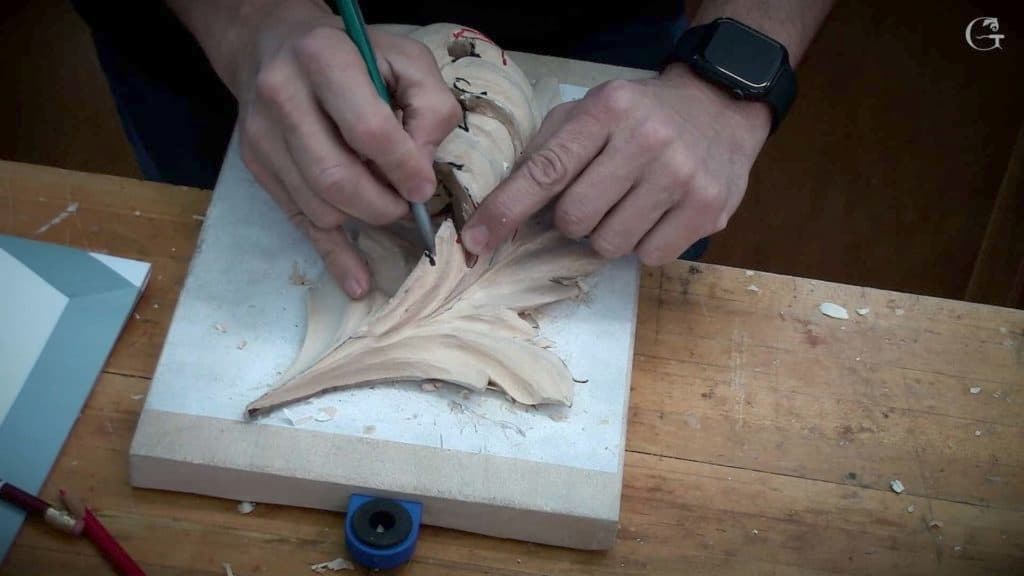
Alexander Grabovetskiy, woodcarver, School of Woodcarving · Published 2021
What does a wood carver mean by "on the list"?
Quick answer: In video 3 of Byzantine Acanthus lesson 9, I say I did not put a small tool on the list. I give the market as the reason. Tray of Blessing 4 keeps a skew off a tool list. A huge Venice workshop has no tool list at all, and I give three reasons for it.
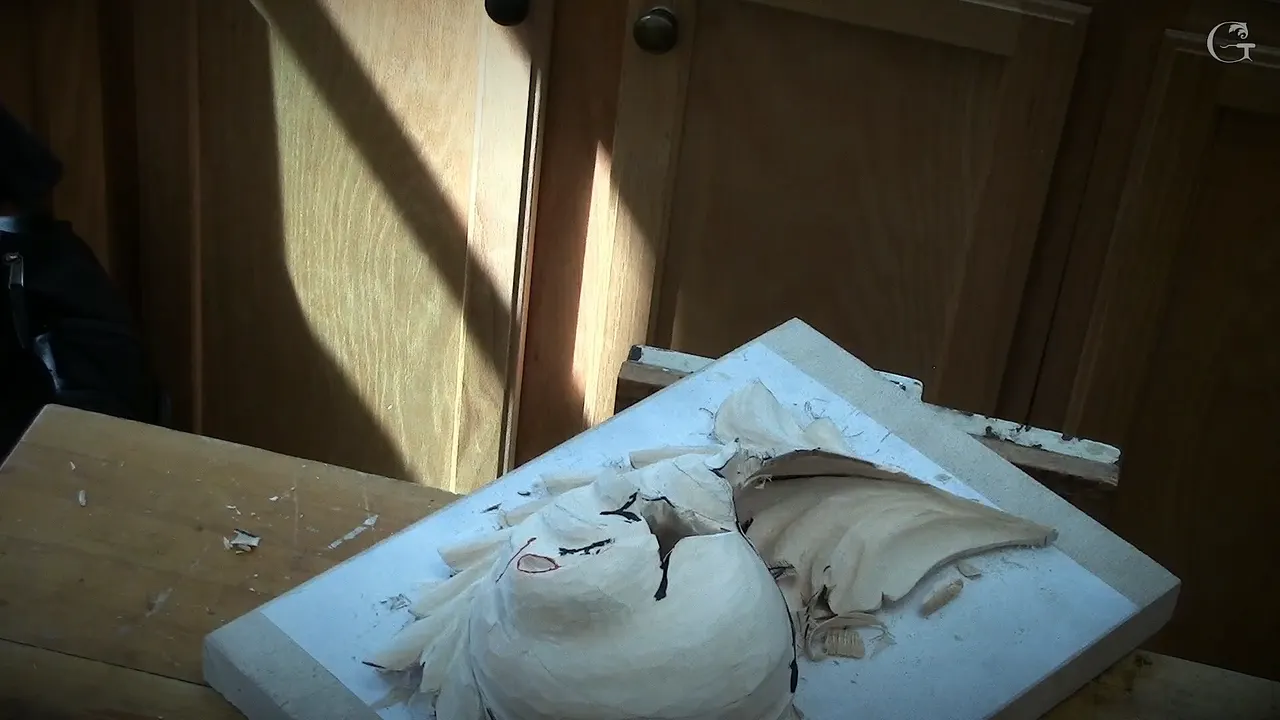

In Byzantine Acanthus 9, video 3, I say "But I didn't put that on the list because it's hard to get those tools on the market." Other lessons name a skew and old tools that stay off a list, a spoon that sits on one, and one huge project with no list at all.
Ever bought every tool on a course list and then watched a video that used one you never saw? The first stop is video 3 of lesson 9, a Byzantine acanthus leaf. Each of the other lessons gives its own reason.
Which small tool is missing from my list in video 3?
I start with "I'm not sure if you have a small tool, but 3 millimeters, that's what we used." Three millimeters is 0.12 in. After that: "So just because we don't have a thickness anymore, so we can start digging pretty much later on inside."
The smaller one comes next: "But if you do have a small tools like I do, it's actually even easier." The line at the top of this page follows right after it.

What it can do: "plug cut, boom." Next, "take a knife or other small tool and create that shape like a water drop shape." Also "I can actually even undercut with this tool."
About the opening itself: "By the way, this you don't need to do." Then "Even without it, still going to look good, but take a look." Last, "With that hole, it looks even better."
How did the black line fit in?
The video opens on "you can see that black line I left." Next, "same like we did on the outside", with "number 11 and 3 millimeters."

The job: "just blend that together." Then "Until it disappears." And "we can just blend even more until it just creates a beautiful transition." Last, "It's going to look like it's from the solid piece."
Why did the layer stay thick at the start?
The question from some of you was "Why did we leave that thick at the beginning? We could actually carve this out." I answered "I knew we're going to bang from the top, and we needed that support."
Then the warning: "If we would not have anything supporting underneath, that would be a big problem." Later I say "repeat myself why I did what I did."

The words that follow: "We needed that support for future projects. Even if it's going to be a really light and airy, you really need support if you want to bang with the mallet."
Where did the arch go, and where did the bridge stay?
I point to a line: "I'm not sure if you can see that I placed a line right there." Next, "create the arch going from that moment." And then "let me do a marker for you to see that better."
After the marker: "Just like that. And all that is going to be gone." About the bridge I say "keep that bridge to the end if you do have that bridge."

"Because once you're going to undercut, so sometimes you have a tendency to crank on it, just use that as a leverage. Try not to hit that." That is why I kept it, in my words. Also "if you're going to remove that too soon, the grain runs that direction, and that becomes really weak."
"So you can break it." And "Not that it's the end of the world." A voice in the room says "I broke it", and I answer "But that's why I kept that bridge to the end." Last, "whatever the supports you could keep, keep those supports."
Does the eye have to go through?
"you could still kind of make it deeper to create that shadow," I say. Then "Really doesn't have to go all the way through." And "It's still going to create the shadow."

The next move: "and even place it upside down and get inside a little bit underneath of that pipe and then remove it with the same tool."
Small tools help more there. "You can get rid of whatever the mess is right there." Then "That's it. It creates the shadow." On how it looks: "It looks like a hole, yeah. But it's not."
Do you see what I mean by the bridge? Then I ask "Do you understand what I just said? Keep the bridge." When I work on the inside: "you can just actually use the advantage of the dog and just to clamp it like that."

Which spot did I decide to change?
"I have a spot I don't like, and I want to show what you can do."
The spot itself: "This little thingy." The next line is "It just doesn't look really nice." Then "I'm after nice and organic form." My plan is "What I'm going to do, I'm going to get rid of it." Next, "I still have one separation. It's still in Fibonacci, so I'm not going to do something off."

I close with "I'm okay with rest of it, but who knows? Maybe by the end of today." I leave room to change something else before the day is done.
Which tools did lesson 9 tell you to buy?
In lesson 9, video 1, the plug cut has a size and a fallback. "if you have a three-quarters of an inch, it's a good idea," I say, and that is 19 mm. Without it, "number nine, you can use 10 millimeters, 12 millimeters, okay? Whatever you have." Those two sizes are 0.39 in and 0.47 in.
In video 2, after a mistake of my own, I say "I would use probably smaller tool next time." After that I take "number nine, the big one" and say "if you feel that it fights you, just get the smaller tool, okay, and attack with the smaller chunks."
Which other tools did I leave off a list?
In Tray of Blessing 4, video 2, I talk about a skew: "a one inch, well, not exactly one inch, but 25 millimeters." That is 0.98 in. That one, I say, stays off the tool list, and "it's kind of hard to find, you know."

Right after: "but if you can get hold of it, that would be really good tool to have." Just before, I say "we can actually create a really beautiful surface."
Tray lesson 3, video 1, puts a spoon on the list: "Obviously you do have on the list a spoon later on." About a tool I name in that part: "I didn't put that on the list because it's kind of hard to get by." Then "Nobody's selling that anymore almost."
Then, with it: "See how quickly I can establish the shape."

Earlier in that video I say "that is the spot where you break your tools" and "especially when you just get right underneath." Also "If it fights, you always attack. Try to attack from another side and you'll find it's actually much easier from another side."
In Tray lesson 1, video 1, I say "I gonna stick with the same tool, what I placed on the list."
Which old or odd tools were hard to track down?
Corinthian Acanthus 5, video 3, is on a skewed gouge. "You can easily make yourself, actually." The way: "Buy just a normal gouge, and you can remake, reshape, whatever, resharpen those gouges."

The skewed one gets "you can get to really tiny spots." Also, "much more than you actually thought at the beginning how good those tools are."
"Like I said, if you can't buy them, and I'm pretty sure it's almost impossible sometimes to buy those skewed gouges on the market. They're just not widely available." Then, on what to buy: "You can just buy normal number three or number five, whatever." About my number seven: "I resharpen that with a really low angle, and I can get really deep."
Chamomile and Bow Rosette 1, video 3, shows two small ones. About them: "I'm not using them when I'm filming most of the time because those tools are hard to find." Then "Those ones are antique tools." Last, "I doubt anybody can find them."

The bigger one: "this one is a little bigger, maybe about four millimeters or so, but I can get really inside and create my twists just for the flowers." Four millimeters is 0.16 in. About those petals: "I'm not showing that to you and explaining what tools I'm taking because you saw this one I've done with just the regular tools. I didn't have to do some specialty tools."
My advice if one turns up at a flea market: "just buy it, okay? Even if it's super expensive." And if you plan to work on tiny spots like that, "that's just a must-have tool."
How come one huge project had no tool list?
In Venice Room 21, video 7, I say "to answer the question about the tool list for this project, I am not planning to." The tool I name is "a number 11 and 5 millimeters, 3/16 of an inch."
First: "I try to name. If you follow along and watch everything, so you will hear every tool I'm using." And "Yeah, there is a tool list." Then "just listen carefully what I'm saying."

Next: "I'm not expecting anybody to carve that huge of a project. So we're talking about maybe hundreds of different tools, which you're not going to probably buy if you're just a hobbyist."
Third: "this project is huge, and it takes a long time to carve it, and it takes time to edit." And "I'm not planning to re-watch every minute of this project and edit my tools." About it: "That would not be really, really wise."
Video 11 of the same workshop adds "another reason why I don't list the tools in those workshops." Then "when I list the tools, I have to use a minimum amount of tools, understanding that not every one of you have a lot of tools."
The other side: "I just open the tool chest and grab whatever looks right for me for this operation without even thinking." And "Don't have to think twice, just grab the tool." That time it was a number five and 8 millimeters, or 0.31 in. Earlier in that video, "Use number seven and 4 millimeters," or 0.16 in.
In Venice Room 67, video 1, I say "it's just number 11s from half a millimeter all the way to 30 millimeters." Those sizes are 0.02 in and 1.18 in. Then "Just in case if you want to know the list of tools, just get all of the number 11s."

When is a list a good idea?
In Flower Rosette 5, video 1, someone asked "Is it good idea to list tools I'm using?" I began with "Yes, it would be probably a nice idea."
Then the split. "Although on simple projects like this one, yes, it would be easier for me to list all the tools, and you can just buy if you don't have those tools." And "on another hand, like on a bigger project, like Grinling Gibbons course, it's almost impossible to create a list."

My reason there: the list would be "tremendously long." Also "some of the tools I use you don't have to buy because same results you could actually achieve just by using the tools you have."
With no tools yet, I say "the number one tool which you have to really buy to carve is a knife." I then name a chip carving knife.

In Byzantine Acanthus 7, video 3, a list holds a size. I say "we do have three millimeters on the list." Also "I always start my acanthus with the number 11, three millimeters with eyes." A short note on the figure: 3 mm is 0.12 in.
In the Grinling Gibbons class in Maine 4, third video, I say "You can grab #11-3mm. You should have that on a list and you also get the ideal outline."
Where did each list line sit, in one table?
| Where | What I said about the list |
|---|---|
| Byzantine 9-3 | A small tool kept off |
| Byzantine 7-3 | A 3 mm number 11 is on it |
| Tray 1-1 | The same tool I placed on it |
| Tray 3-1 | A spoon is listed, another tool is not |
| Blessing tray 4-2 | A skew of 25 mm stays off |
| Corinthian 5-3 | Skewed gouges, not widely available |
| Chamomile 1-3 | Antique tools that few can find |
| Venice 21-7 | A huge project, and no list |
| Workshop 21-11 | No list, I grab whatever looks right |
| Venice 67-1 | All the number 11s, I said |
| Flower Rosette 5-1 | A list is easier on simple projects |
| Maine 4-3 | Number 11, 3 mm, on a list |
Which tool on your own list have you never used? Every video of this lesson sits inside one tuition plan. The Byzantine Acanthus course page holds all ten lessons, with lesson 9 and lesson 7 among them. Wood carving and relief wait there, and my sizes come with my own figure first and an inch figure beside it.
How it's done
- Blend the black line. A number 11 of 3 mm (about 1/8 in) blends it until it disappears, and I say the result looks like it's from the solid piece.
- Keep the bridge. I leave the bridge in place until the end, because if I remove it too soon the grain runs that direction and it becomes really weak.
- Plug cut with a small tool. A plug cut goes through, then a knife or another small tool shapes the opening.
- Go deeper if you stay short of through. Going deeper still creates the shadow, and a small tool can remove the mess.
Frequently asked questions
Which small tool does video 3 leave unlisted?
A small one, and the reason I give is the market. My black line tool is a number 11 at 3 mm (about 1/8 in). With a small tool, I say, the plug cut and the shaping of the opening get even easier.
Does every lesson of mine have a tool list?
No. In Venice Room 21 I say I am not planning a list for that huge project. I give three reasons, and I add that you will hear every tool I use. On the simple Flower Rosette I say a list would be easier.
What about a tool you can't buy?
A skew is a really good tool to have once you get hold of one, I say. Skewed gouges you can make yourself from a normal gouge, by remaking, reshaping or resharpening it. For old tools my word is "just buy it."
What to carve next