

Alexander Grabovetskiy, woodcarver, School of Woodcarving · Published 2017
What gouges do you need to carve an acanthus leaf?
Quick answer: The gouge kit for an acanthus leaf is short. In my Corinthian course a straight 35 mm (1.38 in) number 5 set the outline in, number 9s near 13 and 10 mm (0.5 and 0.4 in) carved the lobes, and a V tool undercut them. For most tools I also named a stand-in, like a number 8 for the 9.
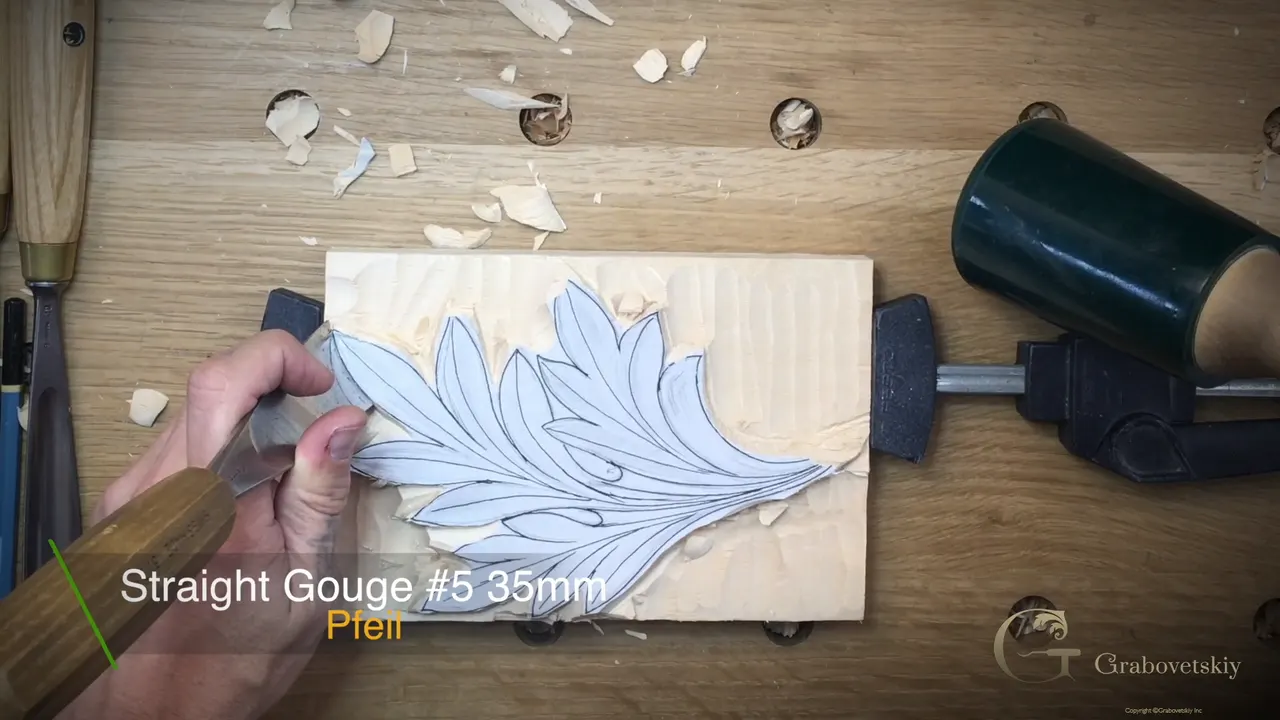
The gouge kit for acanthus leaf carving is a short row, and on my Corinthian leaf most of the work went to number 9s and one wide number 5. A V tool took the undercuts. Small gouges rounded the pipes. For most of them I also said, right there on camera, what else would do the same job. This page is about part 2.3, the last video of lesson 2 of my Corinthian acanthus course, where the outline gets set in.
Have you ever read the tool list for a carving and wondered which of those you really need? Would it help to see the sizes from one real leaf? Below is what went into this leaf, lesson by lesson, with the swap I named beside each tool and what I said would work just as well.
The tools on this leaf, short version
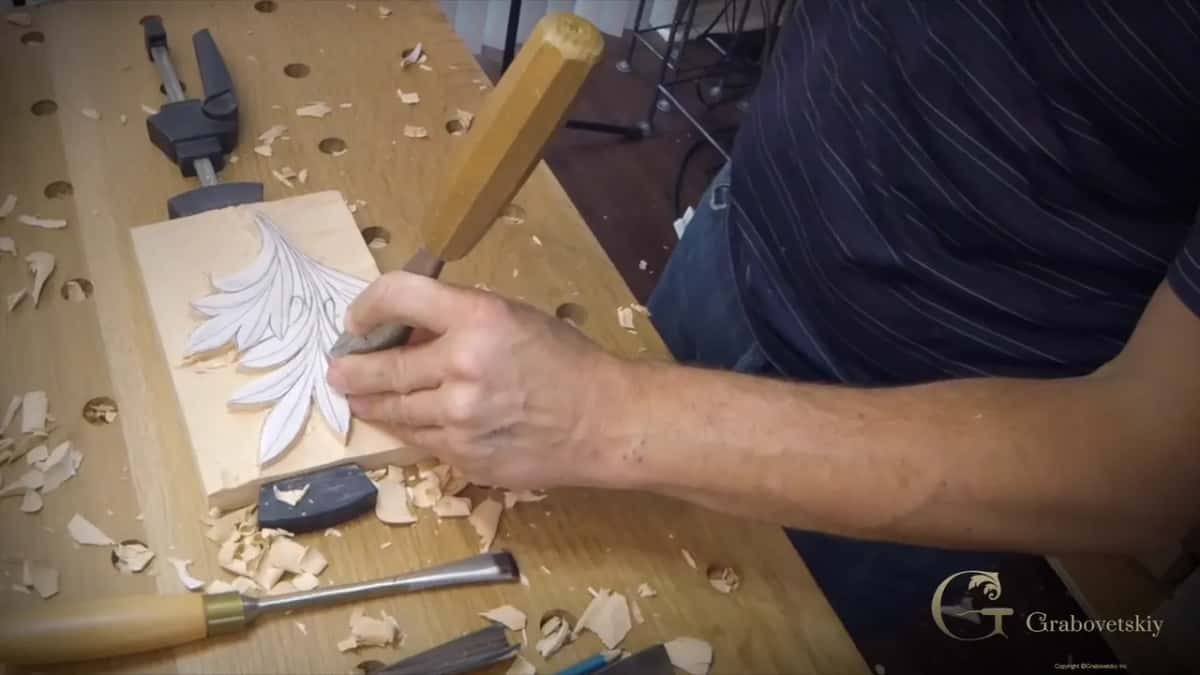
A straight number 5 gouge, 35 mm (about 1 3/8 in) wide, set the outline in, straight down to the background.
Where it would not fit, a smaller 5 and a smaller 7 did.
Number 9s carved the lobes, about 13 mm (1/2 in) and 10 mm (0.4 in) wide.
An 8 works there too, and your width can differ from mine.
Undercuts take whatever V tool you own. A 45 degree one is probably the best.
Small gouges with no number stamped on them still did what I needed.
What gouges do you need to carve an acanthus leaf?
Gouges and a chisel. In lesson 1 I said those are the only tools we're going to use on this leaf, and it's a really deep relief.
Which gouges depends on the job. The outline wants a wide, shallow one whose curve sits right along your line. The lobes want number 9s in more than one width. The undercuts want a V tool, the pipes want small gouges, and the ground near the lines takes a number 5, then a number 3.
The one tool that's hard to buy, the skewed gouge, you can make yourself from a plain one, the way I made my number 7 skew.
If the ornament is new to you, the Corinthian order is the column style whose capital is wrapped in acanthus leaves, and the acanthus ornament has its own page on Wikipedia.
Which gouge sets the outline in?
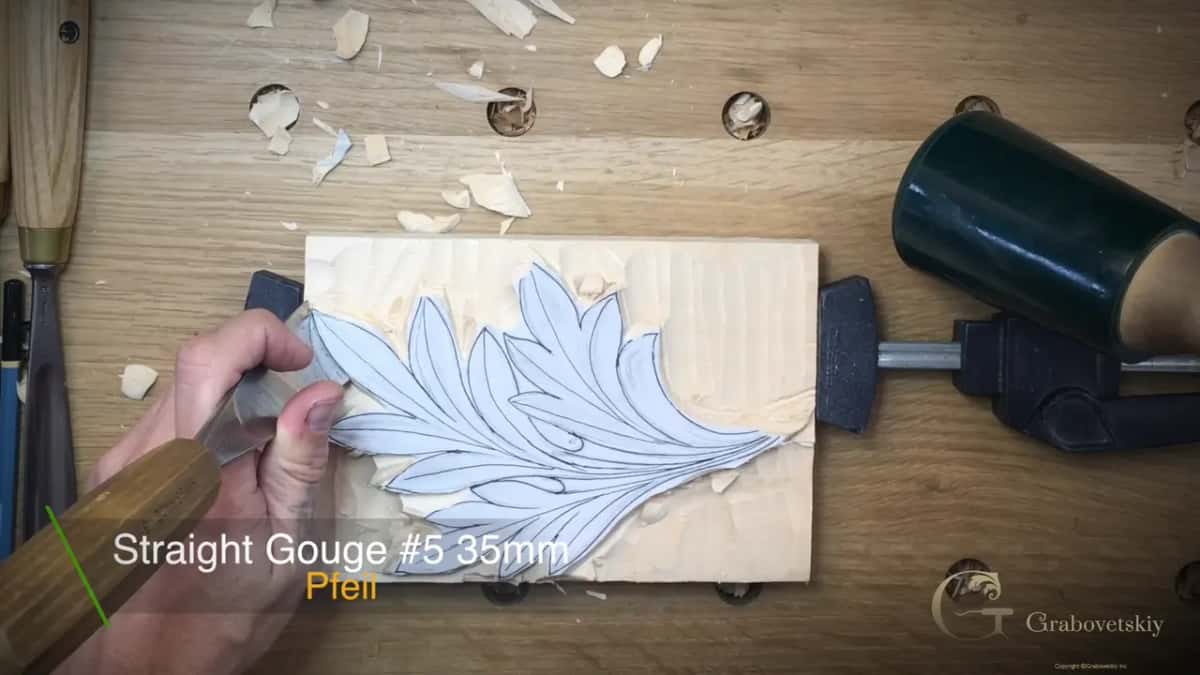
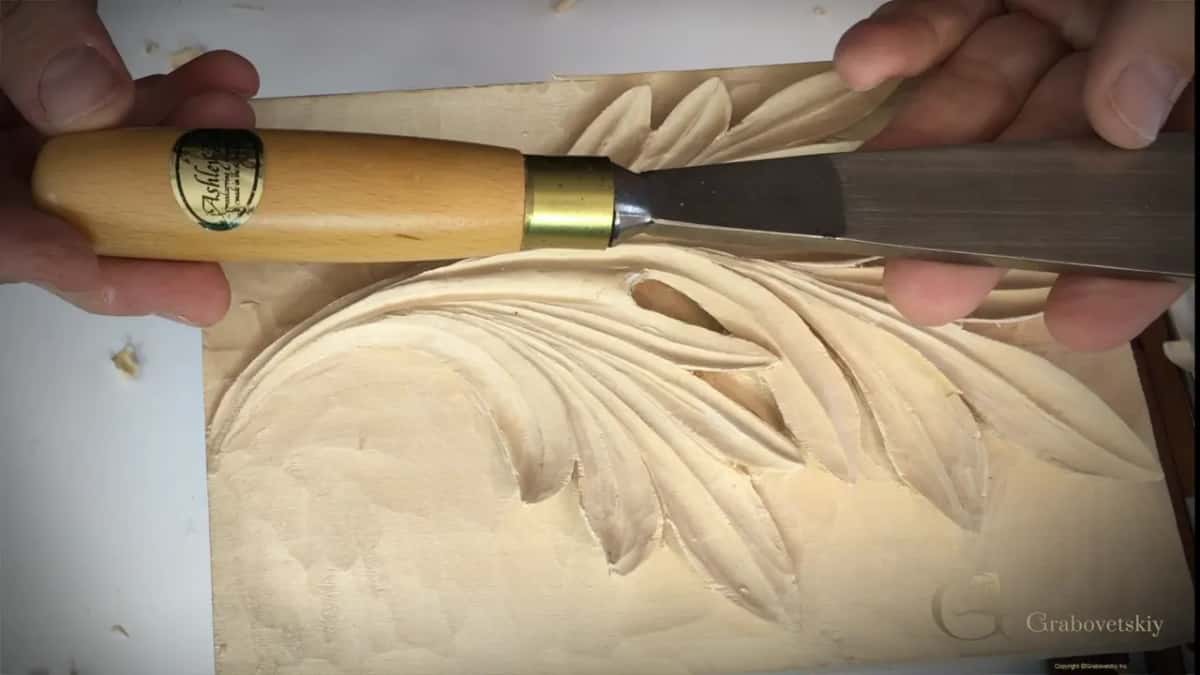
A wide, shallow one. Mine was a straight number 5, 35 millimeters (about 1 3/8 in), from Pfeil, and the tool card on screen says the same. You want a gouge that's really close to your outline. I put it straight down and took it all the way to the background, wherever it would fit.
I kept checking it against the line. "Let me check if I can fit this one right here," I said, and it fit. Almost every curve on that leaf was really good for the number 5. It fit really perfectly almost everywhere.
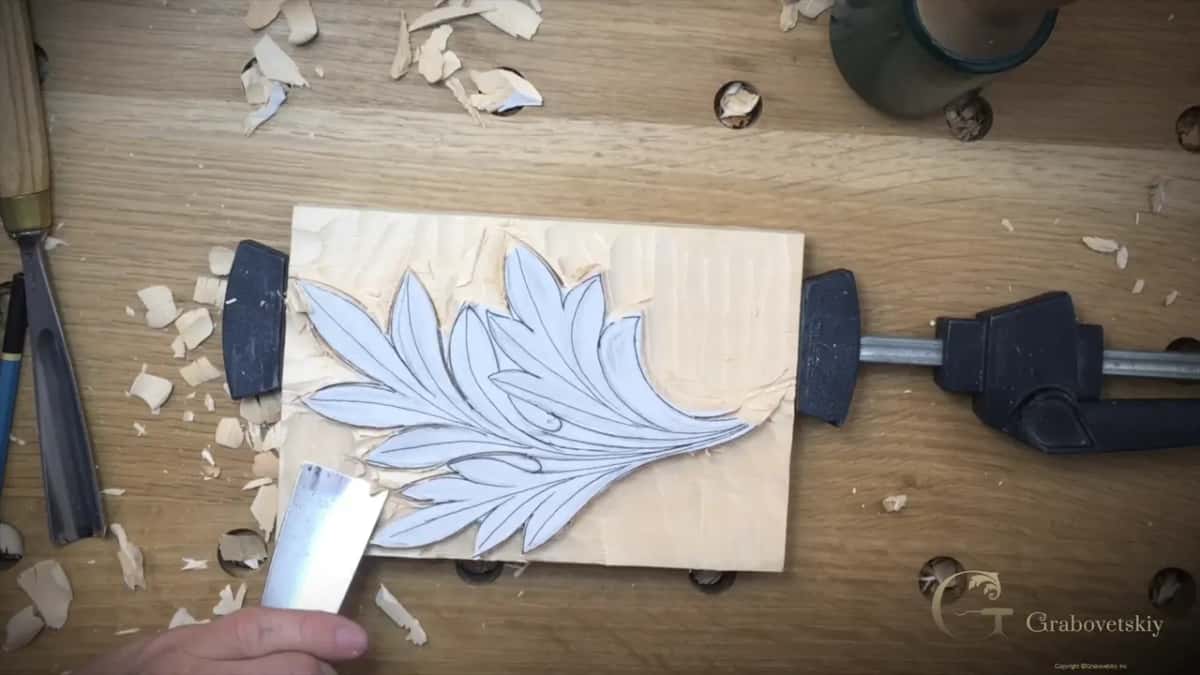
One area was much smaller than the gouge. I worked it anyway, with just one end of the edge, and called that the privilege of a big tool. Then the same 35 mm (close to 1.4 in) gouge cleaned a little more of the background, now closer to the line we had set in. Get this out, I said. This chunk out.
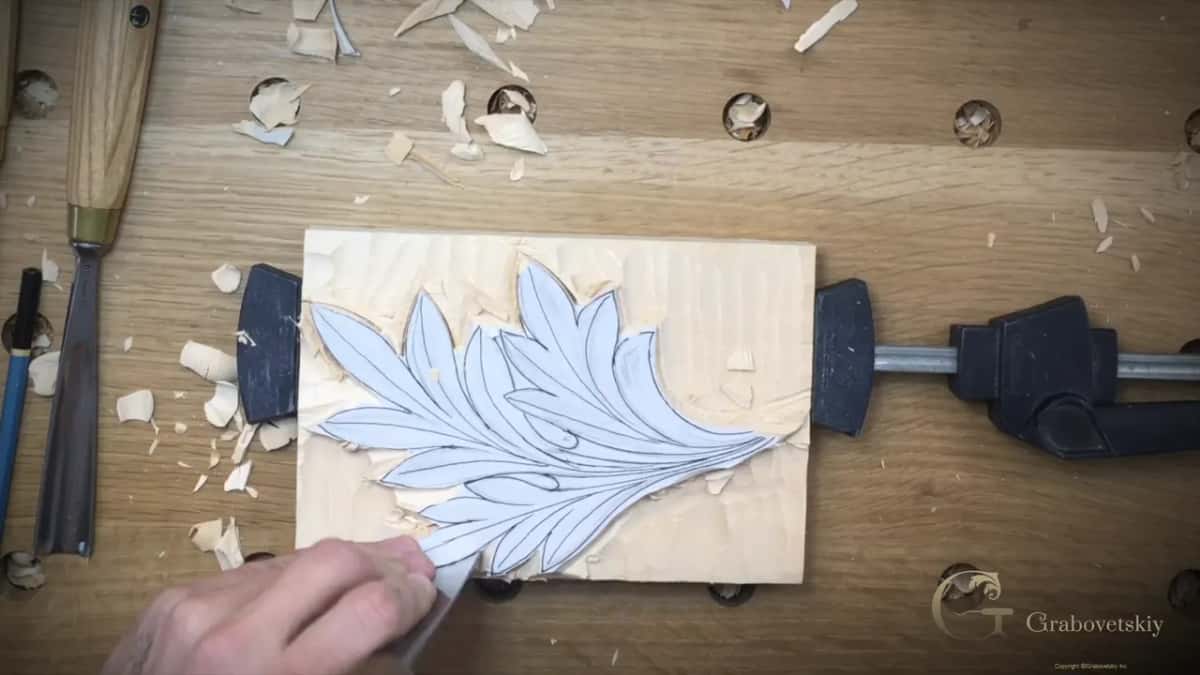
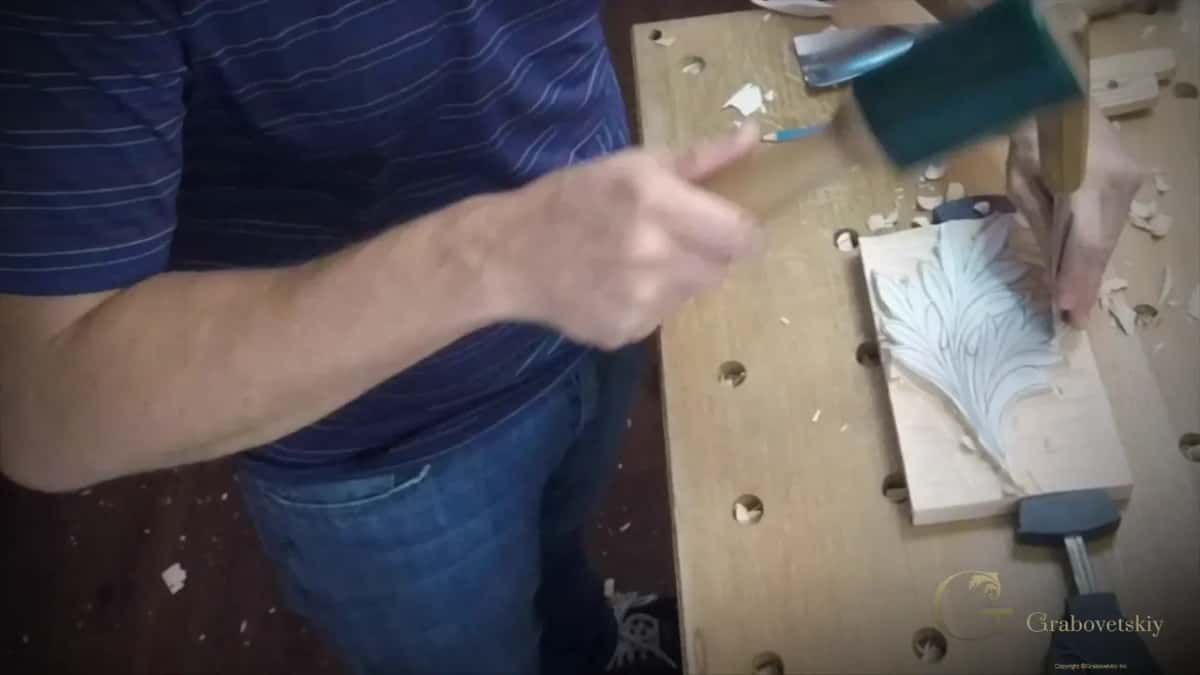
When one side was set in, I did exactly the same on the opposite side.
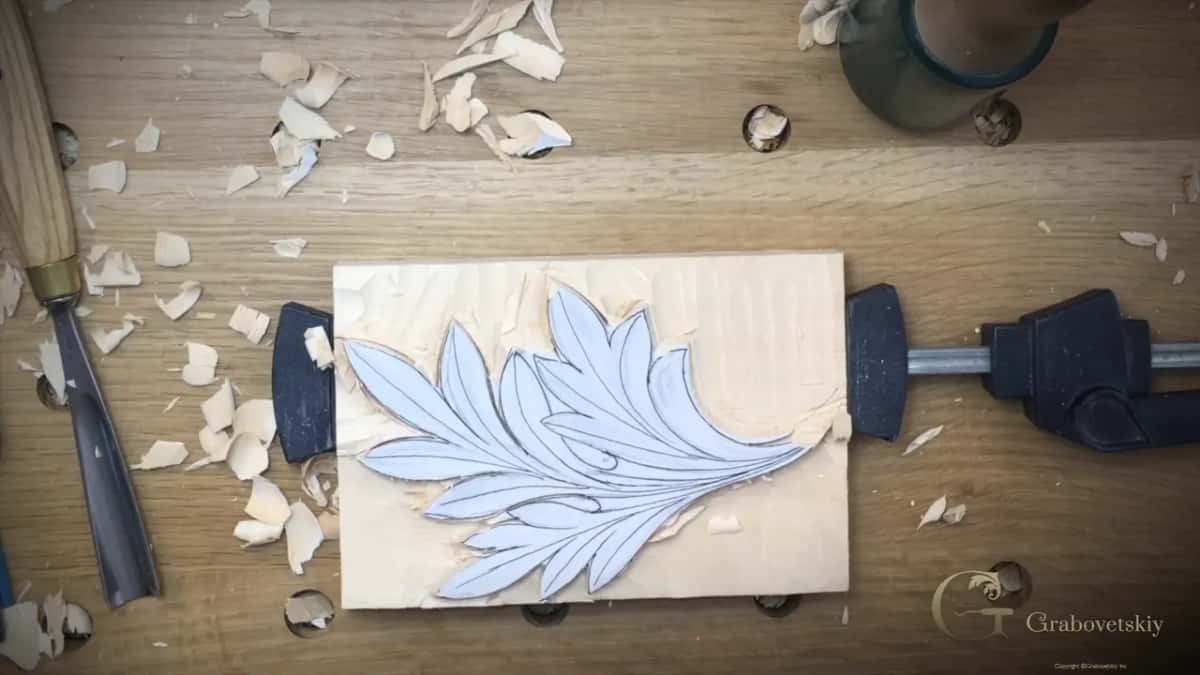
A few spots asked for less. I found another number 5, just a smaller one, and it looked absolutely perfect. Next I checked a number 7. It would fit, I said, but I needed a smaller number 7, and that one fit absolutely perfectly.
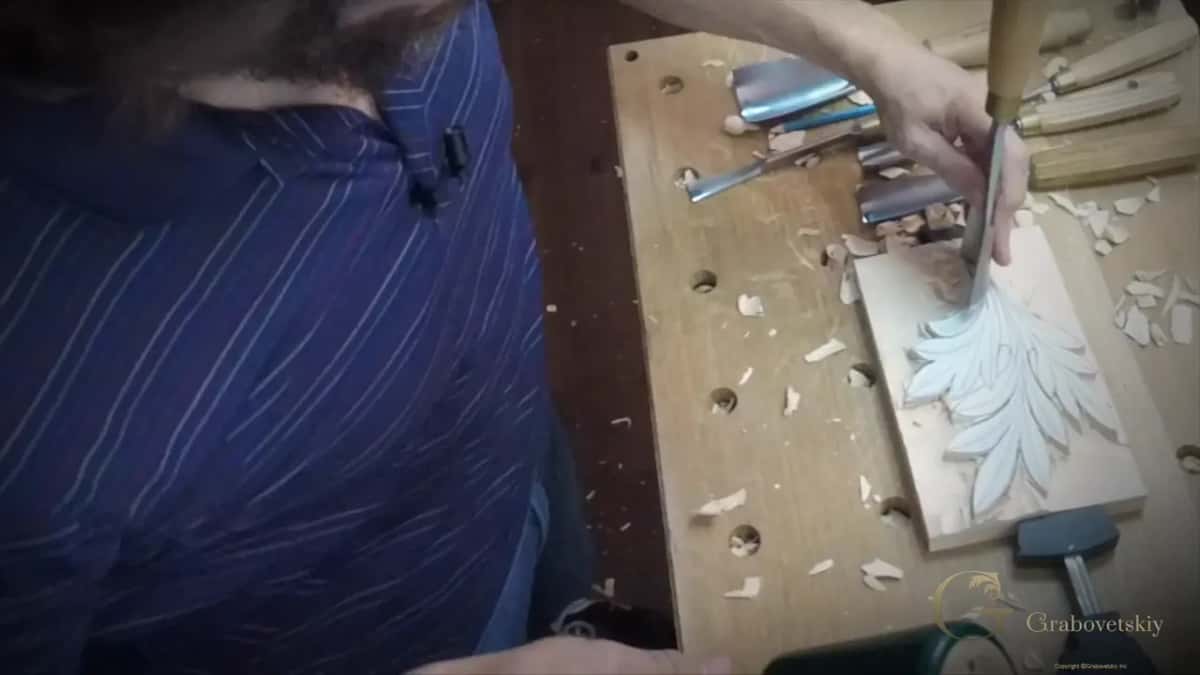
You could do the whole outline with just the number 5, actually, following the line around. It would probably do, and fit nicely. Just check what you have.
That last line is the reason for this whole page. I said it while setting in one Corinthian leaf, and I said much the same on the Greek, Roman and Byzantine leaves, which you'll read below.
Must your sizes match mine?
Close is enough. In lesson 6 I took a number 9 about 10 millimeters (about 3/8 inch) to clear the wood between the pipes. Then I said a number 8 will work too, if you have a number 8. It doesn't have to be 10 millimeters or three eighths of an inch. The width could be a little different, which just gives you a different depth you can reach with your carving.
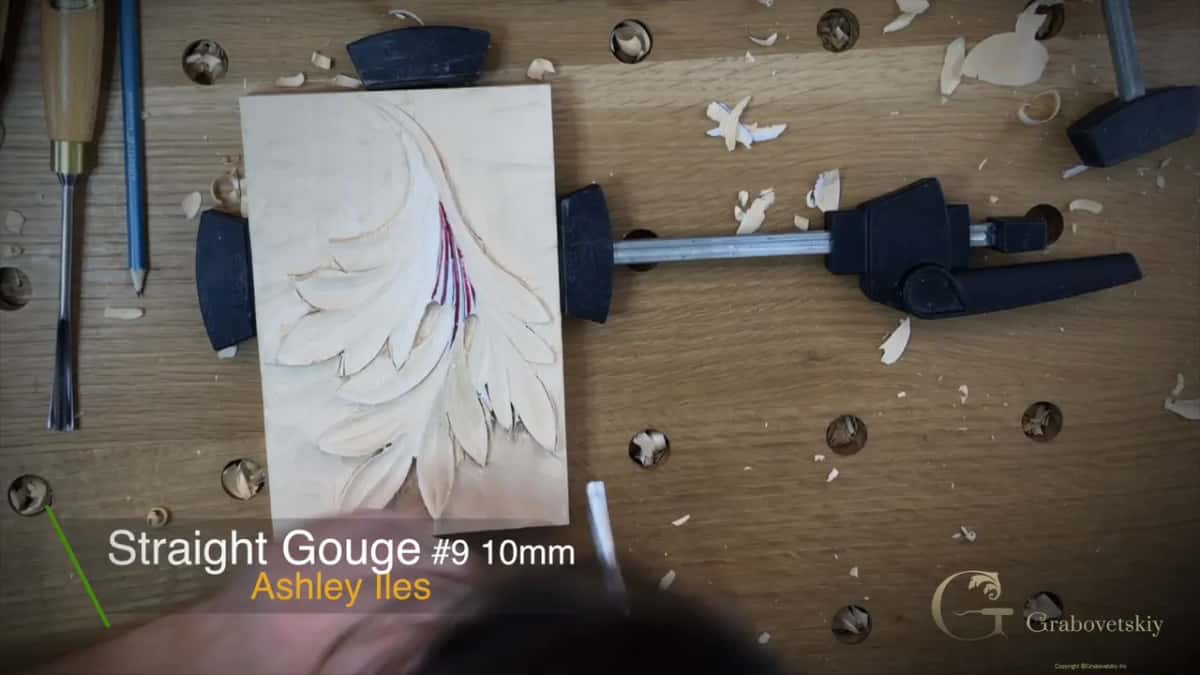
The lobes in lesson 4 went the same way. I needed a gouge smaller in how wide it is, and I stopped to think which one would be appropriate. Still a number 9, around half an inch (13 mm). Then a spot wanted an even smaller number 9, about 10 millimeters (0.39 in). Later a bigger lobe came along, and I picked the little bigger number 9 back up, because that lobe was a little bigger.
Two widths of one shape did those lobes, and I went back and forth between them. Even when the undercuts were finishing in lesson 5, I used the side of a small number 9 to take out what was left in the corners.
Back in part 2.1, when the ground came down first, I used a big number 7. The small one will also work, I said, and so will a number 9; mine was 20 millimeters (about 3/4 in). I prefer the big one because it takes a lot more material at once.
What if a gouge has no number on it?
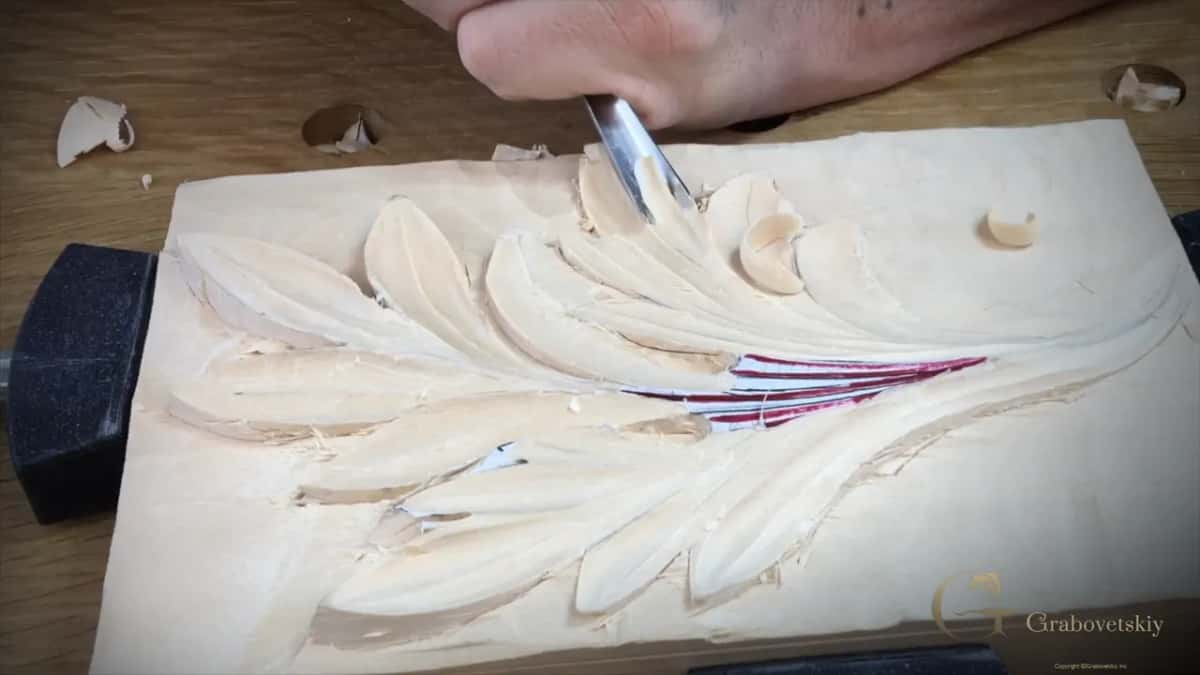
Use it anyway. In the pipe area of lesson 6 I picked up small Dockyard gouges to fix the middle lines, and they don't have numbers. Some look like a 9 to me, some like an 8, but they're still gouges. They will do what I need, I said.
The tiniest one I took between the pipes is less than an eighth of an inch (3 mm). A really, really small gouge.
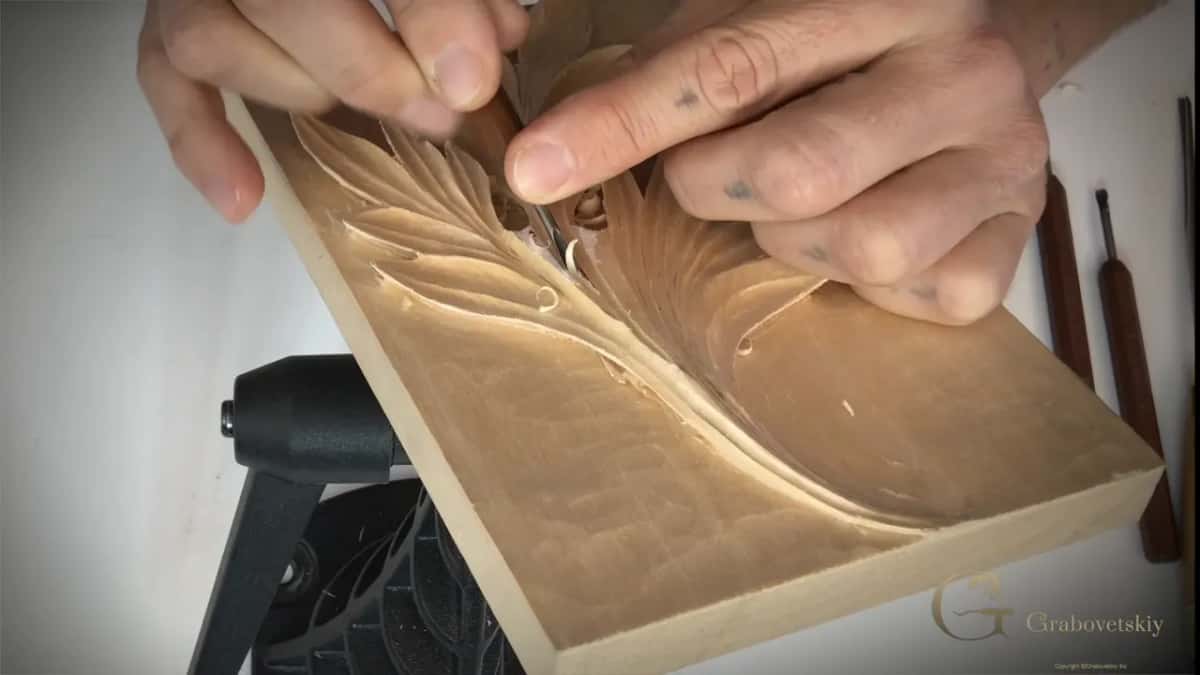
Rounding the pipes was the same. Pretty much any small gouge, about a #3 or #5, will work, I told you. I called the one in my hand a regular #3, then caught myself: it was a #5, a fishtail. A back bent would be an excellent tool there as well. Mine is marked 25, a 6 mm (about 1/4 in) back bent, and with it you can sometimes get into really, really deep areas.
Which tools trade places on the background?
The 5 and the 7 do, on this leaf. Lesson 6 takes off the last of the ground, the 1/16 of an inch (1.6 mm) I left above the final background line. A 5 or a 7 will work there, I said, so I took about a number 5 and placed it right on the line.
The ridges it leaves come off with the same tool, or another way. I do have a background tool for that, but just any number 3 will work, laid on those ridges with slicing movements. One of my background tools is a two and a half: less than a 3, but not a number 1. It's a really good tool for the final clean.
Job | Mine | Stand-in |
|---|---|---|
Setting in outlines | My straight #5, the 35 mm (1.4 inch) one | Whatever fits the line |
Lobes and sections | Number 9s, half inch (13 mm) and 10 mm (close to 0.4 inch) | Number 8 works too |
Fixing middle lines | Small Dockyard gouges that carry no number | Number 9 or 8 |
Rounding each pipe | My fishtail number 5, or back bent | A small 3 works |
Ground beside lines | About a number 5, right on it | Or a number 7 |
Final background clean | A two and a half background tool | Any number 3 works |
Undercutting the lobes | The 60 degree V tool I had | Whichever V you own |
Can you make a gouge nobody sells?
You can. Skewed gouges come in really handy on work like this leaf. I have a right one and a left one, and more than that, and the one I used there is slightly bent, by Henry Taylor.
They're hard to find on the market. Sometimes it's almost impossible to buy them, because they're just not widely available. So buy a normal number 3 or number 5, whatever, and reshape it. I even have a number 7 skew. I resharpened it at a really low angle, and with it I can get really deep and remove a lot of material. You'd be surprised how much more you use one than you thought at the beginning.
The V tool comes first in lesson 5, and there I said any V tool will work. A low angle, like 45 degrees, would be the best probably. The 60 degree one I was using gave about the same results; the 45 just has more flexibility to get into the lowest points.
Why do I keep telling you to work with your own tools?
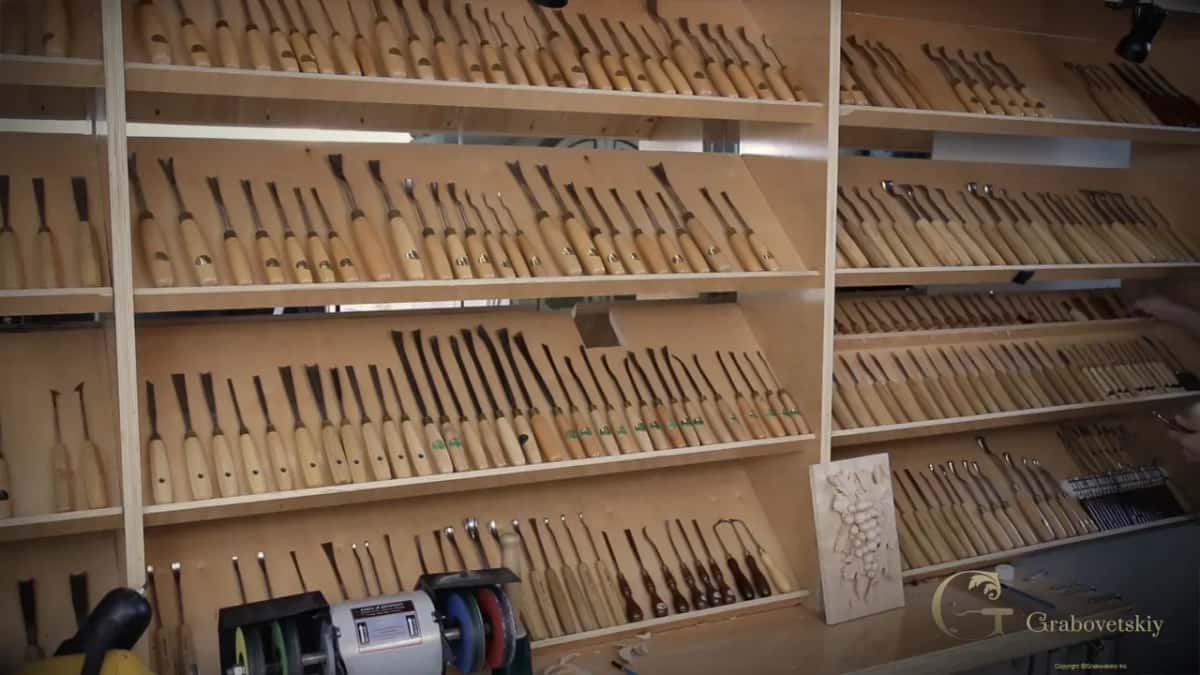
Most of you don't have that big collection, and I know it. On my Greek acanthus, lesson 8, I said I could take one big gouge that matches the big area, make one pass, and be done. But I do understand most of you don't own that, and you have to use the tools you own. So there I used whatever minimum tools I had on my workbench.
On the Roman acanthus, lesson 5, I took a 13 mm (1/2 in) number 3 to recreate the outline, and told you it could be another one. You can check what you have, and if it fits really close, it should work.
In Greek lesson 15 a bigger tool was in my hand, and I said a normal number 3 would do, or whatever you have. The results are still going to be really good, as long as you make that sweeping, rotating move.
The Byzantine leaf, lesson 2 opens on the same idea: get your biggest number 9, whatever number 9 you have. Mine there was three quarters of an inch, 19 millimeters or so. The one in my hand was 20 millimeters (close to 3/4 in).
On the chamomile and bow rosette, lesson 2, carving a stem that runs toward the center, I used different small tools. Whatever you have, you can probably use it, I said. Mine was a number 4, and I said a number 3 can be used too.
There's also a reason I don't list the tools in the Venice Room workshops. When I list them, I have to use a minimum amount of tools, understanding that not every one of you has a lot of tools. In workshop 105 I said it again. Use the tool you have, not exactly mine: any type of tool, a number 9, or a number 10 if you own one. I kind of like a mallet there, for control, but even by hand it's still doable.
Can one gouge carve a whole acanthus leaf?
One gouge can carve beautiful things, and it still limits you. I'm going to be honest with you about both halves. In the Roman course, lesson 7, I said the idea that you can get by with a minimum amount of tools is maybe good, but I don't really support it. The more tools you have, the more unique stuff you're able to do.
The true master can use only one gouge, and I've done it. One gouge and one knife can make lots of beautiful carvings, and that's absolutely true, but it still limits you. One of my heroes, Grinling Gibbons, kept collecting tools, I said, and you can see his designs grow into much more complicated work, work he couldn't do before he got those tools.
It comes down to what you really want to do. If it's just a hobby, maybe you don't need really complicated tools, and you can get by without them. If you want some unique work, I'd suggest getting all the wood carving tools you could. And I know it's all about the money. I do understand that.
There was a time when I had only one knife and one gouge, a number 7, by the way. I was still able to do my work. You really don't have to have a lot of tools to make something nice, I said on a live stream in October 2020. But you are limited, really limited, without plenty of tools.
And it's slow. I did some really good work before with only those two tools, I said in Venice Room workshop 50. It just takes much longer. Much longer.
Where part 2.3 leaves the leaf
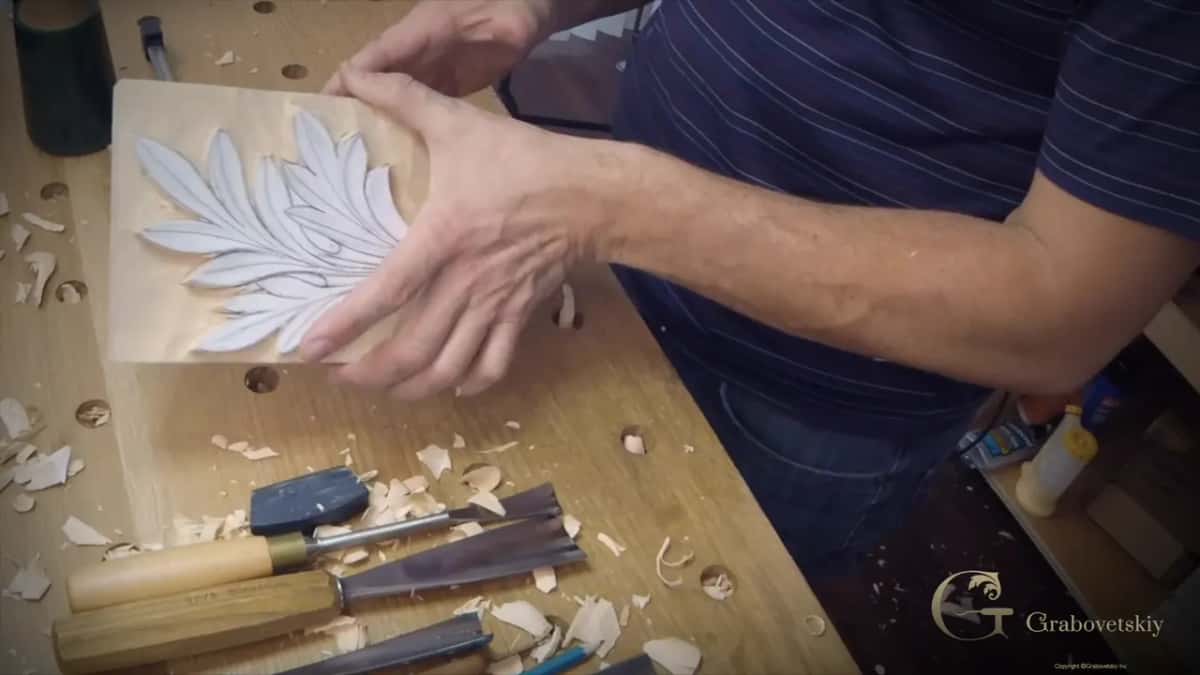
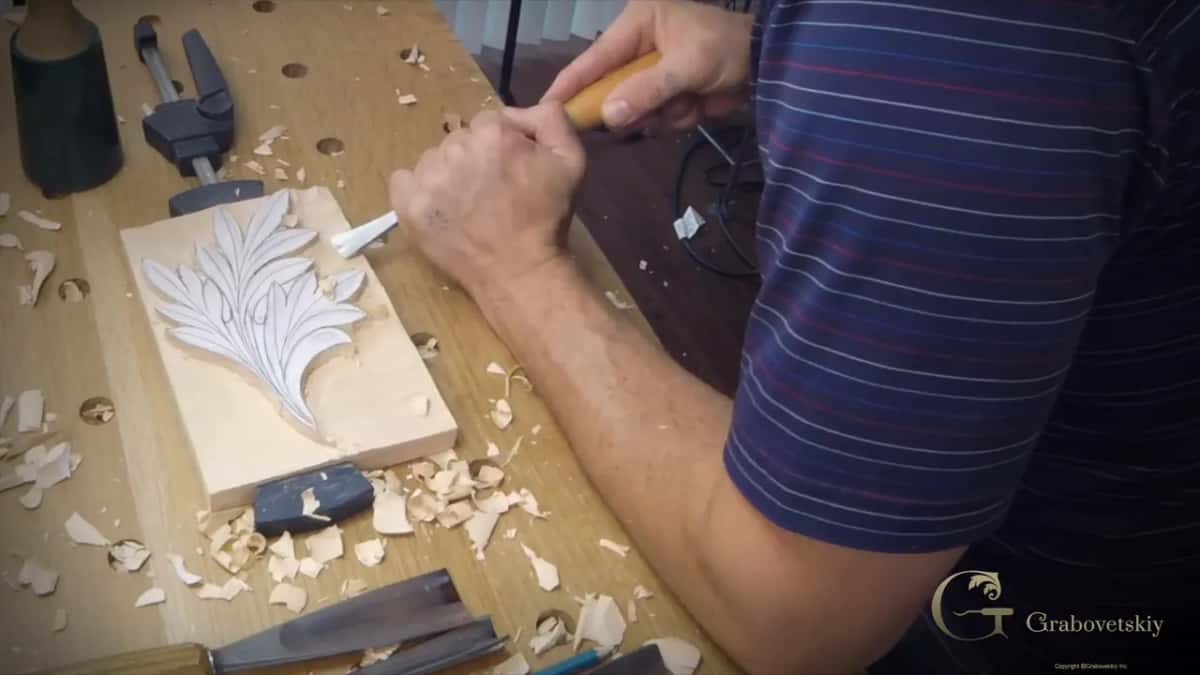
That stage is done. The whole picture is set in, on both sides of the leaf. By now, I said at the end, you should have something looking like that, and lesson 3 starts on the main form. The Corinthian course page has every stage in order.
This part and the two before it are full videos, and you can watch them with tuition. Take the gouges you already own, hold each one on your line, and see which ones fit.
How it's done
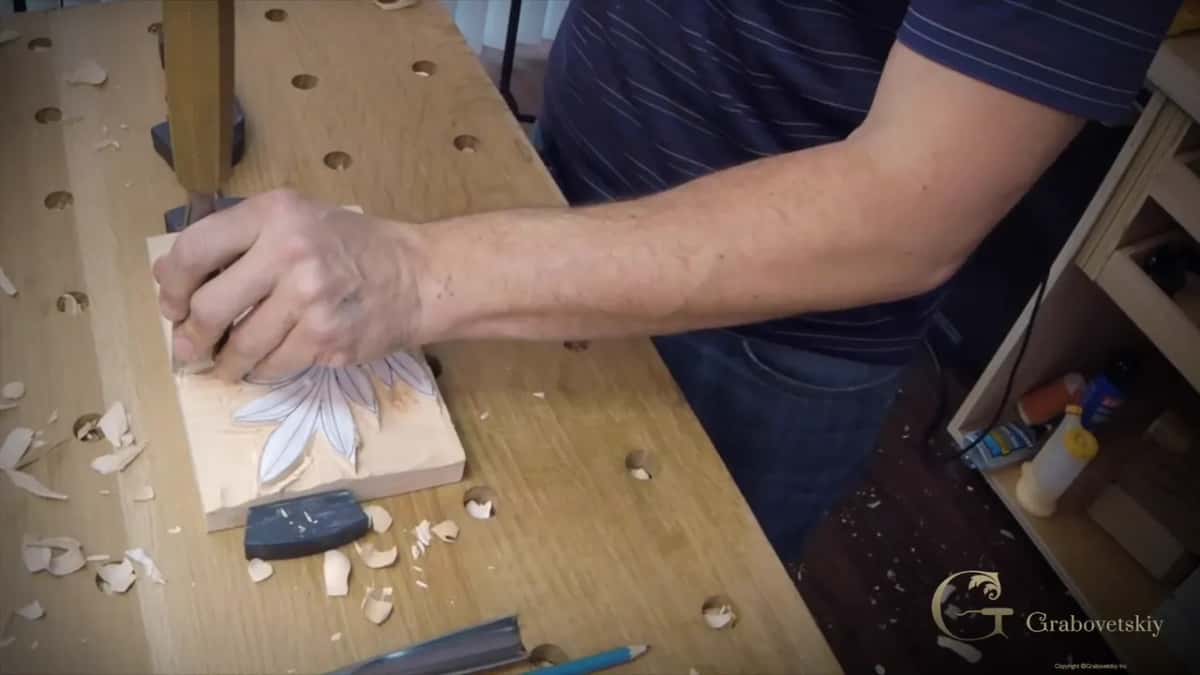
- Hold the gouge on the line. At a new spot I check whether the gouge matches the outline closely. If it does, I use it there.
- Set it straight down. I put the gouge straight down and take it to the background.
- Use one end in a tight spot. In a spot much smaller than my gouge, one end of my edge still does the job.
- Drop to a smaller size. If the wide one won't fit, I go to a smaller 5 or 7.
- Clean the ground closer. The same number 5 cleans the background a little more, closer to the line I just set in. Then the opposite side gets the same.
Frequently asked questions
What are the best gouges for carving an acanthus leaf?
For me it's the gouge that fits the spot you're carving. My Corinthian leaf took the big number 5 for the outline and number 9s for the lobes. For the Roman leaf I said a different number is fine, and if your gouge fits really close, it should work.
What size number 9 do I need for acanthus lobes?
A half inch one, about 13 mm, did the wider sections on my leaf, and about 10 mm (about 3/8 inch) went where they got tighter. A bigger lobe sent me back to the bigger one. Your number 8 will work too, and your width can be a little different from mine.
Can a number 5 gouge do the whole outline?
On this Corinthian leaf it probably could. My wide number 5 fit almost every curve, and I said you could do the outline with just a number 5, following the line around. Where the big one didn't fit, I went down a size in the 5 and in the 7.
What to carve next