

Alexander Grabovetskiy, woodcarver, School of Woodcarving · Published 2023
What does a wood carver mean by "the same spot"?
Quick answer: In Butterflies 10, video 2, I said it while I drew the wing's lattice. Other lessons put the same words beside lines that run to one point, a gouge turned in a circle, and my own position when I say I am still there.
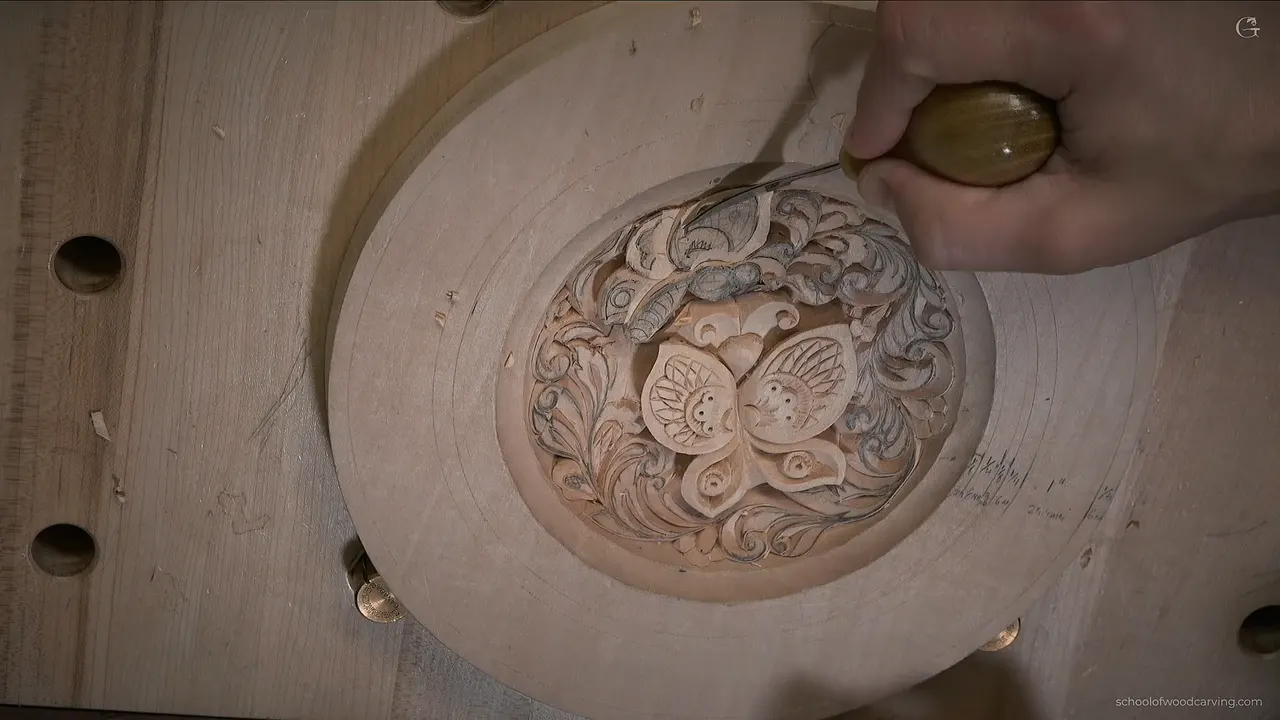

In Plate with Butterflies 10, video 2, I say "the same spot" while I lay out a lattice on the second butterfly's wing, and I say it again when I redraw it. Other lessons of mine put the same words beside lines that meet, a gouge that turns and a place I am still at.
Have you ever drawn a line toward a point nobody can see? Did the second line from that point ever wander? Then you know why I keep saying it. Lesson 10 of the butterfly plate has it, and below I take you through the other lessons.
Where do the lattice lines on the wing start?
The wing gets a plan. I need to "recreate my letters or whatever you call this part," I say, and "I'm talking about on that design." The center is next: "Everything's supposed to go to the center, and maybe I'm going to just..." Then, "Invisible, my center is going to be right there."

Spacing is next. "Approximately one eighth of an inch spacing," I say, which is about 3.2 mm. After that comes "And the opposite direction from the same spot." Next, "Three millimeters," or 0.12 in. The spacing is "right here at the end" and my verdict is "Right, and that is good, I think it's a good lattice."
Nothing in those lines says the invisible center and the same spot are one place. I do put them together further down this page, in the furniture panel lessons.
Do I come back to the same spot when I redraw?
After "Okay, here you go," I say "So I've got the second part." The redraw is next: "Let me redraw that again." And: "You know what? I'm going to do a little change from what I had before." The phrase returns, "from the same spot" with "the same idea, same letters."
"All right. same idea." The plan is "my preliminary cut" and "It's the same detail." Then the depth: "And again, it's only one millimeter deep," which is 0.04 in. "So I do not do more than that. You really don't need to."
Names come next for the wing detail. "Now, we're going to work on the lattice detail, or whatever. I don't know." Then a little further, "Whatever the grid, it's okay."

The next video of lesson 10 carries the words on. "Okay, so cut number one," I say. Another cut goes out of the same spot, with a plan to run it "all the way here." It has to be "really low."

Butterflies 8, video 2, uses the words too: "let me do a slight angle" and "pay attention to the angle." Then: "Toward the intersection" and the cut starts on the same spot.

How deep does a lattice cut go, and why a knife?
The depth I give is small. "Only one millimeter deep, that is all what we need." There is room below it: "If you can pull half a millimeter, it could be even better." That half millimeter is 0.02 in.
For the lattice the plan is "multiple cuts in one direction." I add "That way I can control much better overall movement." My distance from the line is "maybe about half a millimeter or some spots away from the line," about 0.02 in. Later in the lattice comes "the opposite direction cut, same angle."

With the knife comes a warning: "Don't press too hard, you can break those details." A cut stays within one millimeter, I say, about 1/25 in. Also: "If you think it's easy, it's actually not that easy, you really have to control pressure of the knife."
Do it correctly, I say, "you'll be able to carve also sunflowers and so on."
Then the groove: "About one millimeter wide, that's what I'm doing, my V cut" and that width is about 1/25 in. Asked why I do not use a V tool, I say "So knife will give you the true, really sharp line on the bottom of the groove."
How do I talk about the grain and the opposite side?
A rule comes first. "And I know sometimes you have to break rules," I say, about attacking with the grain. "But sometimes it's just impossible." And: "if you have sharp tools, it should not be a problem."

"Let me change the knife and attack from the opposite side," I say, and then "Again, I do have a marriage line." If you are just watching, I say, you are "probably not going to understand what I'm talking about." And: "Once you're going to carve, you'll know exactly what I mean by the marriage line."
A cut "exactly the same what we've done on this butterfly" is planned. For it I plan to use a knife with a curve, and I plan to "hold almost flat." "Just because it has that curvature, it helps me to attack without damaging the edge."
What changes do I plan on this butterfly?
Another plan: "So the next one, I probably should do same idea what I've done right here."
Changes come with that plan, "We're going to do some changes" and I add "I think it's going to look better. It's going to be more true to the overall design."
Next I question my own words. "I don't know if I can say that or not, because we are designing right on the fly." I take it back. Those butterflies, I say, "used to be carved for centuries." Then: "It is historical, I'd say, design."
The small gouge comes first: "So let me get a small gouge. A really tiny small one." Then "I need to probably make it a little sharper" with "a couple of strokes." With "the same tool," I plan "the same holes." The holes have a name: "I call it the plug cut because it just removes the plug." The worry is pushing: "I'm just trying not to push it too hard."

Where else do lines run to the same spot?
Furniture Panel 29, video 2, says "all the movements gonna go to approximately to the same spot, if you look from above." The center is an invisible line: "invisible center line and it's gonna go somewhere right there, not exactly to that point, but it's inside somewhere."

Then comes the logic: "all the movements they do have to go to the same spot. Okay? Just like that. And I hope it makes sense."
"Couple concaves on the side" is part of my plan, and "let me grab my previous number eight." Video 3 of that furniture panel lesson says "go toward the same spot right there."
Next stop is The Tray of Blessing 3, video 1. My plan is a bigger number nine for a concave beside an eye, and my words are "they gotta go from that same spot approximately, but your cuts becoming more accurate and accurate."

Floral and Molding for the Panel 5 has me stop. "Hold on just a second, let me explain what I mean by that." One point must sit level with my concave, and it will feel "pretty much rolling to the same spot." Also: "I love that type of stuff, like intersections."

A pencil comes out in Venice Room 130, video 1. "I do have a spot right here where I have a connecting point right there." The first line is mine. "The second line also goes to the same spot." Accuracy is loose: "I really don't have to be super accurate, but somewhat."
Workshop 93 of the Venice Room, video 10, has two concaves, and another one heads "to same spot." Carrying it "around" is my plan, and that way, I say, it will look "really swirling."
Venice Room 1, video 5, names a first push pin and says "now I have to do exactly the same operation on both sides." About a line I add "goes exactly to the same spot, let me double-check."
Venice Room 86, video 6, brings a measuring plan. Of a line I say "it goes to the same spot, pretty much. Almost to the same spot." Nearby sits a higher spot: "You don't see it, but it goes like that."
Lily Box 4, video 3, has "And this one is gradually going to the same spot."
Concaves and convexes in Venice Room 139, video 2, need not sit where mine sit, and "everything's supposed to be kind of wavy."
Does a gouge turned in a circle end in the same spot?
Plug cutting is the plan in Venice Room 40, video 7: "create some plug cutting cuts." Any number nine "has a true radius. It's not like a U shape." Then: "if you place it and rotate," the cut finishes on the same spot.

My own words get a fix: "I should say" the gouge will "finish the cut" on the same spot. Then: "It's probably a more accurate way to say that."
An example comes from Venice Room 52, video 10. "All of the gouges, actually, doesn't matter how big or how small, it's a true radius." With number five, "about 16 millimeters, about five-eighths of an inch," a cut that continues "the curvature" will "finish exactly" on the same spot.

Veiners differ. "Number 11s, they are not true radiuses." I call one "like a Latin letter U" and "You can't cut plug."
In the April 2020 livestream on sharpening a number 11, I use a board. "Just rotate like this, and a good gouge will always end up" on the same spot, which makes a perfect circle. A huge gouge does the same: "even if you're going to pull a really huge gouge, like I have right here," it ends on the same spot.
What do I mean when I say I am still right here?
Other same-spot lines come with my own position. Grape Onlay 8, video 2: "I'm still at the same spot. I'm still right here." After that: "I would like to just kind undercut right underneath."

The same line shows up in Grape Onlay 10, 3 and 11, and each time a new view comes with it. At 10, I look "from the opposite, you know, direction." Number 3 has me say "Let me reposition the camera and you can see much better." Last, 11 reads "from the side, and again, if you look from above."
An apology sits in Furniture Panel 36, video 3: "Please accept my apologies that you are not seeing it clearly." Then Venice Room 86, video 12: "I am at still the same spot. Here's the spot I drilled."
How do I come back to the same spot?
Lily Box 6, video 2, brings a plan. "A concave cut exactly in the same spot where I just used my tool on." It will go "downhill, like a three-dimensional concave."

In video 4 of Lily Box 4, I say "try to attack from this side now." Then: "Again, same spot. I can feel like I'm catching that grain."
In Venice Room 43, video 11, a tool goes away. Then: "this one still remains in the same spot, and that one remains in the same spot. But I need to give a shape downhill like that."
Glue comes into Furniture Panel 21, video 11. I plan to "put little bit of glue underneath and push it back" and I want it to fall "right in the same spot." Later still: "I just hit the same spot which I just glued. And maybe I have to just wait until it dry and then come back."

A drawing gets a look in Furniture Panel 11, video 5. "I'm looking again at the same spot, and I'm not 100% happy with this." After a slight rasp in Lily Box 5, video 8, I say I will pick up "later on from same spot."

Where did I say it, and what did it point at?
| Where I said it | What the same spot was there |
|---|---|
| Butterflies 10-2 | Lattice lines drawn in the opposite direction |
| Plate video 10-3 | Cut number one, then the next cut |
| Plate lesson 8-2 | A slight angle, toward the intersection |
| Furniture Panel 29 | Movements that go to one point, seen from above |
| Tray of Blessing 3 | Concaves around an eye, approximately one spot |
| Floral and Molding 5 | A line rolling to the same spot |
| Venice 130, part 1 | Two lines meeting at a connecting point |
| Venice 1, part 5 | A line going exactly there, and a plan to double-check |
| Venice workshop 93 | A second concave I plan to carry around |
| Venice workshops 40, 52 | A turned gouge ending in one place |
| Grape Onlay 8 | Me staying right here while I plan an undercut |
| Workshop 6, Lily Box | A planned concave cut where my tool just worked |
| Panel lesson 21 | A glued piece I want to land in place |
Which spot on your carving do your lines run to? Where does your gouge end when you rotate it on a board and let it finish the cut? If you can point at it, the words are yours. The butterfly plate course holds lesson 10 with all three of its videos, and this page shows the tuition plans. Sizes on this page keep my own figure first, with the other unit beside it.
How it's done
- Aim the lines at the center. On the wing I say the lines head for the center, and I call that center invisible.
- Name the spacing. I name the spacing for the line ends and say it is good, a good lattice.
- Draw the opposite direction. Out of the same spot goes the opposite direction, I say.
- Carve many cuts in one direction. I plan multiple cuts one way, staying off the line, then the opposite direction, same angle.
- Keep each cut shallow. I warn against pressing too hard, since you can break those details, and I say a cut stays under 0.04 in.
- Use the knife for the groove. The groove is about one millimeter wide, and a knife gives the really sharp line on its bottom.
Frequently asked questions
Where did I say it in the butterfly plate?
Video 2 has it while I draw lines on a wing, and the words come back as I draw again. Video 3 carries them on, in one cut and the one after it. Lesson 8 pairs them with a slight angle and the intersection, in its second video.
How far apart are the lattice lines?
My words are "approximately one eighth of an inch spacing," about 3.2 mm, and then "Three millimeters," or 0.12 in, with "spacing right here at the end." Everything heads for the center, an invisible one. Then I call the result "a good lattice."
Does a gouge turned on a board end on the same spot?
For a true radius, I say yes. Any number nine "has a true radius," and its cut ends on the same spot. For a number 11 it is "like a Latin letter U," so "You can't cut plug." Size does not change that for a gouge.
What to carve next
- Plate with Butterflies lesson 10
- Plate with Butterflies course
- Plate with Butterflies lesson 8
- Furniture Panel lesson 29
- Tray of Blessing lesson 3
- Floral and Molding lesson 5
- Venice Room workshop 130
- Venice Room workshop 93
- Venice Room workshop 86
- Lily Box workshop 4
- Venice Room workshop 139
- Venice Room workshop 40
- Venice Room workshop 52
- Grape Onlay lesson 8
- Furniture Panel lesson 21