

Alexander Grabovetskiy, woodcarver, School of Woodcarving · Published 2023
What does a wood carver mean by "the best way to describe it"?
Quick answer: Butterfly lesson 10, video 3, has me stop for a word in the middle of a sentence, and right after it I say I want a little slanting, because of the shadow. Other lessons hold the same stop, about a bump, rough cuts, a tool and a stain.
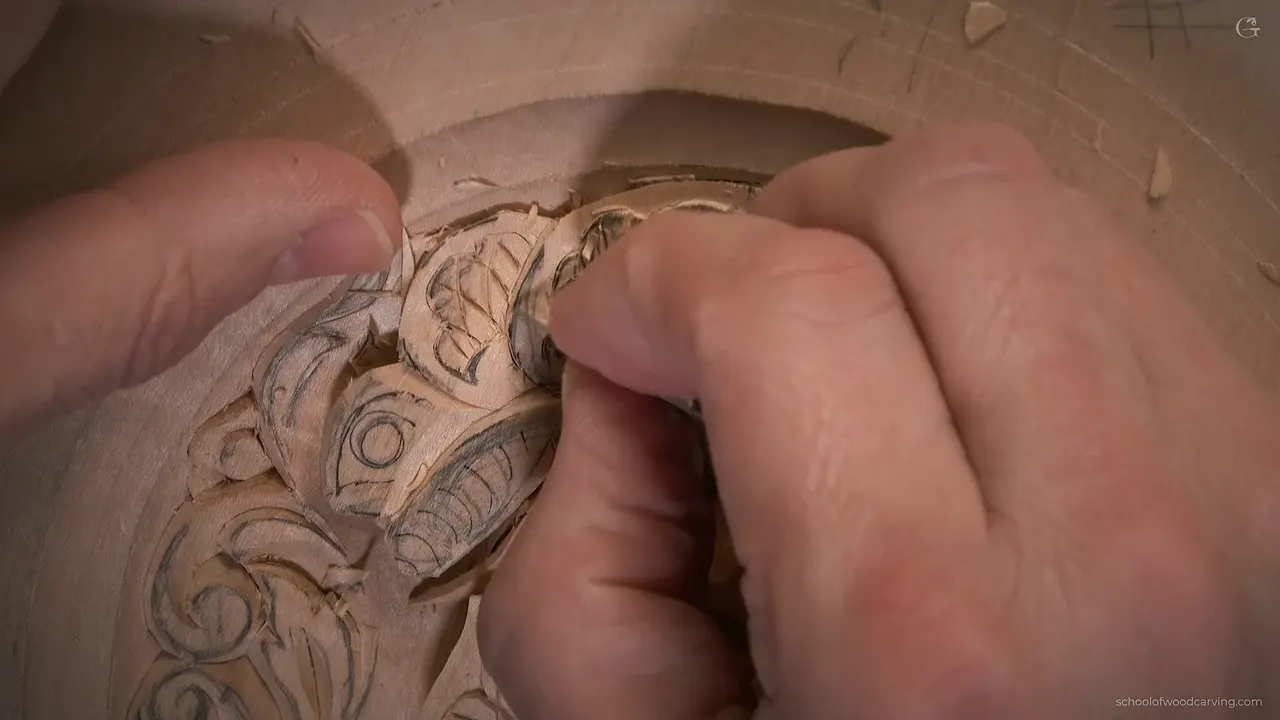

In the third video of butterfly lesson 10, I stop in the middle of a sentence for a word I don't have, and right after it I say I want a little slanting there, because of the shadow. Other lessons hold the same stop, about a bump, rough cuts, a tool and a stain.
Is there a spot on your carving where you know what you want but not what to call it? Could you give someone the amount, the look and the reason, even without the word? Then you already know my stop. It sits in lesson 10 of the butterfly plate, and this page follows it through my other lessons.
Does the second butterfly need a scraper first?
Within the first minute of the third video I say "it doesn't look clean" and "you can always scrape it." For anyone with no professional scraper, I show a utility blade and say "you can always use just blade" and "just make sure you just follow the direction of the grain." In my case, I say, "the grain goes that direction, like this." The scrape is slight.

It takes off the pencil marks, "and you can see much better the result." Then my honest line: "That's why I don't like to use pencil, by the way. But for the lesson's sake, it's all right." I add that you can "blend all the cuts with the scraping."
I leave something for later: "I'll do it a little more, a little later. I'll clean it." Still, "at least you can see it just matches pretty close." Then comes "I don't need to put more detail." At once I change my mind: "I can put one detail right here." The reason I give: "So that way it's going to match those guys."
How low does the knife lie for the outline?
"Let me outline first," I say. I ask you to "pay attention how low my angle is and how I'm holding my knife." The grip, I say, is "almost like a pencil or pen."

The line starts as "cut number one." The next one begins "from the same spot," going "all the way here." Both stay low: "Again, it's got to be really low. Low angle I'm talking about." One spot needs more: "this spot I need to cut a little deeper." My fix: "I'll just recreate my previous cut and go slightly deeper with that."

"That is what I'm after," I say, and I leave a way back: "I can always come back and clean it if I'm not happy."
What could I not describe on the plate?
Right after that, I begin "I'm going to give a slight" and I stop. "I'm not sure what's the best way to describe that." Next comes the look I don't want, in plain words: "I don't want to see that flat."

So I use other words. "I want to do slanting a little bit," I say, and then I give the amount: "Not much, but a little bit." My reason is "how it's going to affect the shadow" and I think it will look really good.
"I care how it looks," I say, and I ask you to look too: "See that slanting?"
What about the eye on the smaller butterfly?
"And inside, obviously, this eye, I got to do again, plug cut." A second stop follows: "Hold on just a second. Let me think." My plan is a slightly bigger gouge, "exactly the same what I used previously."

Two sizes, I say: "the bigger one and the smaller one," for "the same effect, the bigger cut and a smaller cut." I add that "those guys are bigger in case with the first butterfly and much smaller on the second one." I doubt myself out loud: "Maybe this one is actually a little too big. Maybe not, maybe it's all right."
I need "an eye or just a small plug cut right in the middle, in the center, or closer to the center" and "it doesn't have to be right in the center." I plan "multiple cuts right inside my previous cut just to give some curl." A note about the screen: "I know it's deceiving in the camera." The wood at that moment is "just a mess, my pencil mess" and once it's scraped, I say, it will look really nice.
What do I say about the last passes on the head and body?
A full cleanup can wait: "I don't want to spend air time scraping and so on." A couple more details still wait on the butterfly. One I plan to carve "almost like cutting a bread, like poking little by little." Next: "I don't need to rush anything." And to you: "if you need to recreate that cut multiple times, take your time. Take your time."

After that detail, "you can just clean it slightly. But I'm happy how it looks." This butterfly ends with a head to separate from the body. I plan to round the head a little with the knife, "multiple cuts until you're happy" and "blended from all those positions." You can spend a lot longer there, I say, and "Maybe I will do it also a little later."

Those final passes are easy: "Straight down cut, almost no angle, almost like 90 degrees." I correct myself: "It's not really 90 degrees, but almost 90 degrees." The depth is "I don't know, half a millimeter or so" (0.02 in). For the blend, "my knife is almost flat." One warning is plain, and I give it with a reason: "Don't create too deep of a cut because it's not going to look nice."

The plate comes next: "We got two butterflies." A little cleaning is left, and "we're pretty much almost ready to jump on everything else."

Where else do I stop for words?
This stop is not new to the plate. Across my videos there are spots where I can't put a name on what is under my tool. Saying so comes first, then I tell you what the tool does or what the shape is close to, and I keep carving. Every lesson below has a page open to any visitor.
What do I say when a shape has no name?
A petal in Furniture Panel 21, video 10, is "going to grow from underneath, go uphill, and then go downhill like that." It has "a little bump, like a mountain almost." I take it back with "Not a mountain." With no word for the bump, I say what the carving will do instead: "it would be convex right here." My tool is a number 3, "one-eighth of an inch" (3.2 mm).

The volute in Roman Acanthus 2 "is not simple volute." "It will be angled," I say, and then I lose the word and say what it isn't: "it's not when you're looking straight from top down." Next I go on to "set main outline of this volute" with a V tool, "any V tool which you have." The main point of that workshop, I say, is "to establish those volutes on the sides."

My "first curl" in Greek Acanthus 1 gets a doubt right away: "I'm not sure if you can call it curl." The word I swap in is "the volute movement." That gives me "the main flow" and I add "really important to understand what is flow."

Video 9 of Venice Room 58 repeats my order: "I created first the main overall shape, then I create that smooth." I stop and answer my own question with one word: "Movement." It doesn't look right yet: "it doesn't look too smooth for me, and I need to take a little bit off this side." And "it's just like a sculpture almost. You just take a little slice by slice."

Small details are the subject in Lily Box 2, video 10. "If you're going to miss those small details," I say, it's "not the end of the world." Still, I think it looks much better with them, "even if nobody else is going to see them." My word for those small movements comes with a doubt. I don't know the best one. Even so, "it's still nice." Next, "I'll use 1 millimeter, number 11" (0.04 in).
Step one in Venice Room 76, video 10, is "I have to create the channel." I start a comparison and drop it. For the wood, it means "that part right here is going to be somewhat waste" and "I need to remove that."
Which moves and looks do I struggle to name?
Rounding comes up in Furniture Panel 20, video 10: "I can just make it rounding just like that." The next line takes it back: "It's not really rounding." That stops me short of a word. I do say "I am creating chamfer cuts, but gradually going from underneath up." My wish for the surface: "I really want to make it look smooth transition."

A molding runs right underneath in Furniture Panel 29, video 1, and I say I can work "with the tool upside down." For that type of cut I stop short of a name, and I say so out loud. Then comes "Kinda rolled it right underneath" and a limit on the look: "that is just preliminary, it's not the final look."
A worry about a word shows up in Hashemi Flowers 48, video 6: "Maybe I'm not that clear when I'm saying blending." I point to it: "you can see a lot of rough cuts." I could leave them, I say, but the rough cuts "create too sharp of a shadow" and "I don't like that." The plan: "I'm going to blend those cuts and soften a little bit the shadow line." My target is "a soft transition."

Petals are the subject in Hashemi Flowers 30, video 3: "the petals, they have to look like a boat." And: "At the end, it can look just like this." I ask for the word and carry on: "it cannot be just a true perfect round." It means "I have to just dig out some more areas on inside."

Different planes come up in Greek Acanthus 4, video 1: "At different planes." Out loud, I ask what I'm trying to do. "So it cannot be flat surface." "It has to be more like a 3D form" with some parts that "have to go down" and others that "stick a little higher than other ones."

What about a tool or a stain?
Naming a tool trips me in Greek Acanthus 12, video 1. I'll take "probably just a knife," I say, then I change my mind, and I admit I don't even know how to put a name on the tool. The tool I mean to use is "a right-hand curved tool." With it, "I can actually get really deep in areas like that and undercut just like that." And "I still can make a shadow and make it look like it's floating."

Viewers asked about glue in Greek Acroterion 4, video 1: why I don't dilute my glue when I'm "gluing my design right on the top." Some wood carvers, I say, "add some water to glue" and "I don't think it's anything wrong with that." My finding: "When you dilute that glue with the water, it has a tendency to penetrate inside of the fibers."
That is fine for a clear coat. For a stain it is not: "even if you're sanding and you apply your stain, you can see some spots." Two words for it: "blotchiness or something else you can say." Glue straight from the bottle: "I don't see that problem. You can see it's actually staying right on the top of my work piece."
Is it always about wood?
Not always. In Flower Rosette 5, video 3, I talk about my time in jail: "While I was in jail, actually, Soviet Union crashed or was destroyed." I stop there with "I don't know what's the best to describe." Plain facts follow, "There was absolutely no food, nothing." I was not there for a crime, I say, but "for my beliefs."
Where did each stop come, and what came next?
| Lesson | Where I stopped for words, and what came next |
|---|---|
| Butterflies 10 | A little slanting, with the shadow in mind |
| Furniture Panel 21 | A petal with a bump, then a convex shape and a number 3 |
| Roman Acanthus 2 | A volute that is angled, set out with a V tool |
| Greek Acanthus 1 | A first curl that became the volute movement |
| Venice Room 58 | One word, movement, then a little off one side |
| Venice Room 76 | A channel to carve first, and waste to remove |
| Panel 20, furniture | A rounding, then chamfer cuts |
| Furniture 29 | A molding underneath, and a look that is only preliminary |
| Hashemi Flowers 48 | Rough cuts with a sharp shadow, so I blend them |
| Hashemi Flowers 30 | Petals shaped like a boat, then more to dig out inside |
| Acanthus 4, Greek | Different planes, a 3D form, some parts lower |
| Greek Acanthus 12 | A curved tool left unnamed, then what it does for a shadow |
| Acroterion 4 | Spots under stain from glue thinned with water |
| Lily Box 2 | Small details of movement, then a number 11 |
| Flower Rosette 5 | The Soviet Union crashed, with no food in jail |
Which spot on your own wood carving would you stop at, and what would you say about it? Lesson 10 sits in the butterfly plate course with all three of its videos, and this page shows the tuition plans. Sizes on this page keep my own figure first, with the other unit beside it.
How it's done
- Scrape along the grain. Drawn with the grain, the blade takes the pencil marks off.
- Hold the knife low for the outline. The grip is almost like a pencil or pen, at a low angle, and the second line starts from the same spot as the first.
- Recreate the cut to go deeper. Where a spot needs more depth, I recreate the earlier cut and go slightly deeper, without rushing.
- Slant it a little bit. I wanted slanting a little bit, not much, because of how it affects the shadow.
- Plan the eye with two sizes. I planned the bigger gouge and the smaller one, with the eye in the middle or closer to the center.
- Finish straight down and blend. Final passes go almost straight down and stay shallow, and the blend uses a knife held almost flat.
Frequently asked questions
What did I want from the slanting on the second butterfly?
I wanted a little bit of it, and "not much." Flat was the look I did not want, and the shadow was my reason. I said I think the result will be good, and I asked you to look at the slanting yourself.
How deep were the last passes on the head and body?
They went almost straight down, close to 90 degrees, and they stayed shallow, about half a millimeter (0.02 in) by my guess. I blended with the knife almost flat. I warned that going too deep would not look nice.
Can a utility blade scrape pencil marks off a carved wing?
I showed a utility blade in video 3 and said to follow the direction of the grain. The scrape clears the pencil marks, and you see the result much better. I also said I don't like to use pencil, but for the lesson it was all right.
What to carve next
- Plate with Butterflies lesson 10
- Plate with Butterflies course
- Furniture Panel lesson 21
- Roman Acanthus lesson 2
- Greek Acanthus lesson 1
- Venice Room workshop 58
- Lily Box lesson 2
- Venice Room workshop 76
- Furniture Panel lesson 20
- Furniture Panel lesson 29
- Hashemi Flowers lesson 48
- Hashemi Flowers lesson 30
- Greek Acanthus lesson 4
- Greek Acanthus lesson 12
- Greek Acroterion lesson 4
- Flower Rosette lesson 5