

Alexander Grabovetskiy, woodcarver, School of Woodcarving · Published 2023
How many parts should you divide a carved border into?
Quick answer: I weighed eight parts against seven for the border of my butterfly plate, and I settled on six. I said I would use calipers. The next video counts twelve curves around the rim, and elsewhere in my courses I split things in three, five and eight, and say you need not.
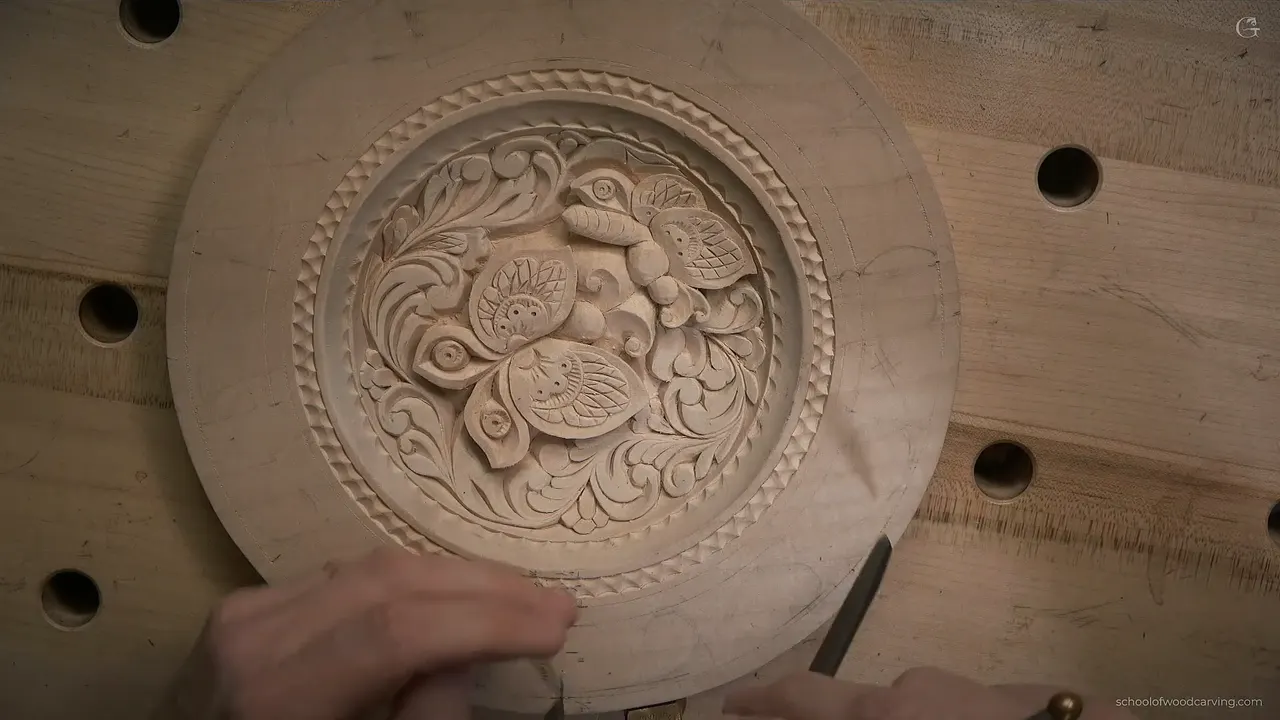

On the rim of my butterfly plate I could have split the border in eight parts or in seven, and I chose six. I said I would use calipers, and I planned to subdivide each part approximately in half. By the next video I count twelve main curves on the rim. Other lessons have me dividing in three, five and eight, and saying you need not.
How many parts does a border need before it looks right? Do you count first, or start drawing? Part 1 of lesson 12 is my answer for the plate, and after it I show where else in my courses I counted out loud.
How did I land on six parts?
Part 1 opens at the rim with "Okay, my dear friends, I am ready to work on the border." My head was on the look of it, "I kind of thought about how is it supposed to look?" Then I weigh "eight parts" against "seven parts." In the end comes "I made a decision to divide that into six parts."
"I just tried to just play with that," I say, and I also say "I'm not going to overcomplicate stuff."
The calipers do the marking: "I'll just use the calipers and I'll subdivide it in six, in six parts." My hope for the result is that it will "flow much better" and I say it again with "I hope it's going to flow much better," closing with "Let's put it that way."

How do you mark the six parts?
The marks need not be perfect, and I say so in plain words. When one lands right I say "Looks like I'm right almost on a mark right there" and "Okay, that is good." Next comes "Double check" and I go over the marks one by one with "So that would be this one. This one."
Later I run through them again: "That is that one. That one. This one." I do it because "I want to make sure." The extra marks on the rim get an explanation too, "I already tried to play with that. So that is why you see multiple marks" and the matter is settled with "But six is going to be good."

Next I state a plan for the six parts, "just subdivide that approximately in half." The next video starts a count, "Let's count how many moments I have," from one place round to 12. The count carries the reason for six: "That is exactly Fibonacci sequence. That is why I subdivided that in six to get the 12, the main curves." And I say "I think it's actually going to flow really nicely."
Why keep the border simple?
After the marks comes the design, "somewhat simple." My next lines are "I don't want to overwhelm with my border" and "I don't want to take the eye out of the main development" and I sum it up with "I think it's probably better to put this way."
One distance guides the drawing. I "stay approximately away one sixteenth of an inch" (about 1.6 mm) from the lines, "because I really need that V-Groove." A later line adds "a lot easier for you."

Of that "somewhat simple" design I say "It's still going to look nice." While I draw I come back to "overcomplicating stuff."
What went inside each part?
At one spot in part 1 I ask "What did I do" and say "Some kind of mistake." After it comes "that would be preliminary movement" and then a request for time, "let me think what we can do."
Volutes are one possibility. "I could just create whatever the volutes I have if I wanted to." About that I add "I'm not sure if I wanted to or not," so it stays a plan, and the border is "just a border," I say. I do not want to overwhelm it.

Sizes come next, and the first is "about 7mm, something like this little over quarter inch" (7 mm is about 0.28 in). I name element number one. The second element is a plan, an element closer to the first. Of the whole look I say "going to look really nice something like that."
Each detail stays "in the same approximate on the same design flow" and there is a plan for the inside too, "I can also make the cutout." Copies need not match, "Don't need to put everywhere exactly the same" and the idea stays one idea with "some kind of variations" that "doesn't have to be exactly like it's done by machine."

How did the count change on the other side?
For the opposite side my plan in part 2 is "exactly the same in opposite direction," only now "just the two." The last spots are planned too, "the same detail like I've done on the inside, like triple movement." I say "those three versus two, again, 60/40" and add that the count is Fibonacci. The golden ratio is "Not really necessary for this particular design." On direction I say "if you're going to just do the same movement, that's absolutely okay" and "I decided to make the movement the opposite direction."

I also say I do not want to "make it too busy" and afterward "I think that is enough." The drawing has "plenty of movement," I say.
The second video also holds a promise of the drawing: "provide the pattern of what I'm going to carve" and "Whatever I drew."

Do I count the same way in other lessons?
A count is a choice for me, not a rule. "You don't have to divide in five," I say in the Hashemi course, and in the Hazelnuts course I say three is not a must. The numbers below are ones I said out loud, with the words that stood beside them.
When did I count five?
In Hashemi 30 (part 1) the talk is of one flower, "in five petals" and I call the count rough: "Approximately five." Seven or eight would do too, "if you wish." Next to it stands "there's no such a thing as perfection in nature."

Part 4 of that lesson brings the same freedom, "You don't have to divide in five" and some sections can become "semi smaller leaves, not the leaves, but petals." I add "I like to follow the Fibonacci number," which "after five, it will be eight" and for that moment "So right now it's six." On splitting a section I say "if I do that, I have to repeat that" and "I have to find a couple more spots where I can do that."

Over in lesson 35 (part 3) I say you can subdivide "as many parts as you wish," five or more, while "I like to be really close to nature." Lesson 31 (part 1) is "subdivided in eight, but not equal parts." Then comes lesson 38 (part 3), where "right in the middle of it" is not the place for a center, and it goes "approximately to the one side." For how far I say "I usually go about six parts out of ten." I tie it to "the Fibonacci sequence, by the golden ratio rule" and I say "I just eyeball it. I don't measure it." In the end, "if it's just slightly off-center, usually that means it's good."

Five comes up in other lessons. Corinthian Acanthus 1 (video 2) says "we're going to divide into five separate leaves" with a caption on the screen, divide in 5. I describe that leaf with "really kind of sharp point" and "five points altogether." Maine class 8 (part 3) says "subdivide that in five." Furniture lesson 12 (part 4) has the five parts of a flower as "the main division of this flower," meant to look "grown from inside."


When did I count three?
The acanthus leaf is my example for threes. Roman Acanthus 1 (video 2) points out that "the main leaf divisions, they divided in three and the small sections, subdivided even more in threes." Over in Byzantine Acanthus 4 (part 2) it is "Each of those, we're going to divide in three." On where a separation goes I say "calculate approximately what's logically the spot you're supposed to create the separation."

In Venice Room workshop 32 (part 10) I say "it has to be divided in three" and one of those divisions is planned as "hidden on inside." Workshop 50 (part 1) opens the main divisions with "three parts at first" and "everything's supposed to go to the center line."
Hazelnuts 3 (part 3) calls three a pick, "I like to divide in three" and adds that another count would do. Each lobe is "going to have its own multiple subdivisions."

For the Tray of Blessing (lesson 5, part 2) I count one to five and go on to "subdivide it in three main lobes" and I warn "you can't put too many." Inside them, on the small separations, I say "you could count, but I'm not gonna do it this time." One spot in Roman Acanthus 14 (part 3) gets no threes, only "a simple single return."
Four and two appear as well. Chamomile and Bow Rosette 1 (part 2) says "I would like to divide that in four" and a real flower in Lily Box 10 (part 8) is "just divided in two sections. Two triple sections," which is "for some reason, in nature how it's created."
What do I do when the counting gets hard?
Ten parts helps. In Furniture Panel 14 (part 1) the line is "I can divide that in ten parts and find my golden ratio. I would say six parts out of ten." It is "approximate" and I say "I could take a caliper and probably measure, and I would be more accurate with that. But I'm sure I'm pretty close."

Furniture Panel 19 (part 15) takes six of ten to "my high spot" with "move downhill this direction." My aim there is "some different movements."
Back on my plate, lesson 11 (part 2) has the same idea: "find your center, offset slightly, and that's going to be your starting point." Before it I say "don't worry about calculating" and of the carvers in Northern Europe in the ninth and tenth centuries I say "they just did that naturally, whatever felt like natural and so on."

In Roman Acanthus lesson 5 (part 1) comes a shortcut: halve the length and "just move down a little bit." Workshop 61 of the Venice Room (part 11) goes by eight, "it's actually sometimes even easier" with a "5:3 ratio." Halving gives "four parts and four parts" and "move five" is "pretty close to golden ratio," which is "a lot easier" for some of you. My own pick is "personally, I like 6 out of 10."

In Furniture Panel 1 (part 3) I put the golden ratio in simple terms: "if you divide the board in 10" then "about six parts."

Do the parts have to be equal?
Equal parts are not the rule, and Hashemi 30 calls petals "just semi same. They're not the same, but just approximately." In Greek Acanthus 7 (part 1) has me saying I would move a middle line "either to the right side or to the left side." The Hashemi lesson 31 line was "not equal parts" as well.
In Roman Acanthus lesson 3 (part 1) I halve a length, "divide that right in half" and a split in four gives "three-quarter from overall." Accuracy has limits too: "If it's not completely accurate, don't worry about it" and "You're still human being" and "you can't do like machine, although you can try to."

How do my counts line up?
| Where | What I said about the count |
|---|---|
| Plate 12-1 | Six parts, after eight and seven, with a decision and a hope that it will flow better |
| Plate 12-2 | Twelve, which is why I used six |
| Hashemi 30-1 | Five petals, with a higher count allowed, said next to a line about nature |
| Hashemi 35-3 | Five, or as many parts as you wish, and close to nature |
| Hashemi lesson 31 | Eight parts, and not all of them equal |
| Corinthian 1-2 | Five separate leaves, with a caption on the screen that reads divide in 5 |
| Roman 1-2 | Three, then threes again, on a leaf that decorated temples |
| Hazelnuts 3-3 | Three, a pick I like and not a must |
| Panel 14-1 | Ten parts to find six, approximate and pretty close |
| Venice 61-11 | Eight parts, then halves, and my own pick, six of ten |
The third video of lesson 12 starts the knife work with "Couple of first cuts," one "on the outside" and the second "on inside" uld you like to carve a border on the rim of a plate of your own? Pick your count, mark it, and check your marks. The butterfly plate course has every video of lesson 12, and this page shows the tuition plans.
How it's done
- Think how the border should look. Compare eight with seven, as I did, and pick one count.
- Mark the parts with calipers. The calipers do the work of setting out all six marks, and they do not need to be perfect.
- Double check the marks. Go over each mark once more, to make sure.
- Plan to halve each part. My plan is to subdivide each part, roughly, in two, which gives twelve in part 2.
- Leave a gap before the lines. Stay about 1/16 in (1.59 mm) away, since the V-groove needs room.
- Keep the design somewhat simple. Hold back the detail so the border does not compete with the main development.
Frequently asked questions
Why six parts and not seven or eight?
On the rim I weighed eight against seven and picked six. My hope was a better flow around the plate. Part 2 reaches a count of twelve, and I tie that twelve to my choice of six.
What tool marks the parts?
Calipers. I mark the six parts with them, go over the marks again, and tell you perfect marks are not required.
How much room should the drawing leave from the lines?
About 1/16 in (about 1.6 mm). I tie it to the V-groove, and I add that it makes the work easier for you.
Should a border be as busy as the middle?
What to carve next
- Plate with Butterflies course
- Plate with Butterflies lesson 11
- Hashemi Flowers lesson 30
- Hashemi Flowers lesson 31
- Hashemi Flowers lesson 35
- Corinthian Acanthus lesson 1
- Maine class lesson 8
- Furniture Panel lesson 12
- Roman Acanthus lesson 1
- Byzantine Acanthus lesson 4
- Venice Room workshop 32
- Hazelnuts lesson 3
- Tray of Blessing lesson 5
- Roman Acanthus lesson 14
- Furniture Panel lesson 14
- Venice Room workshop 61
- Furniture Panel lesson 1