
Alexander Grabovetskiy, woodcarver, School of Woodcarving · Published 2022
What does a wood carver mean by "flute up"?
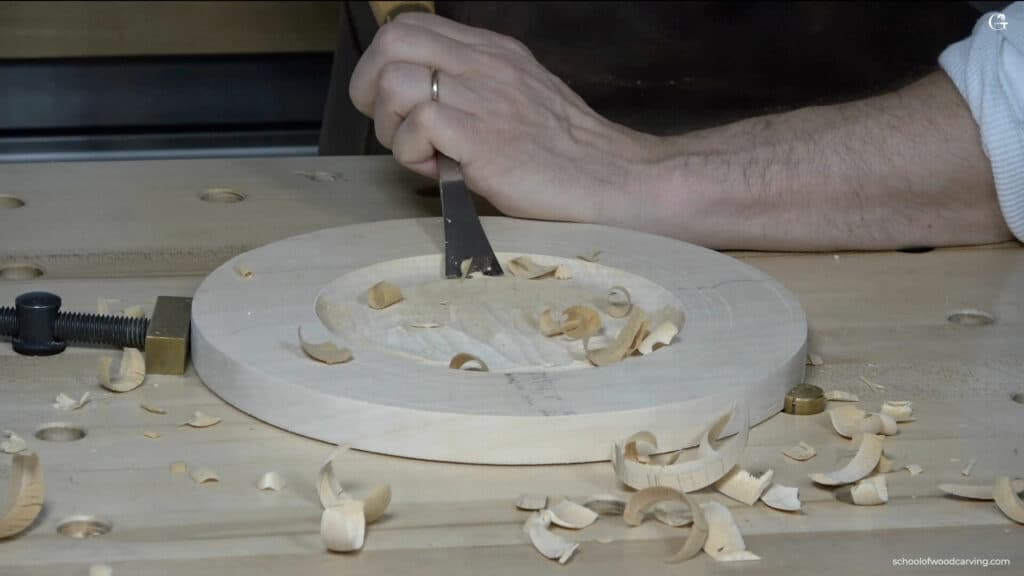
Quick answer: The flute is the groove in the middle of a gouge, I say in Floral and Molding 7. A Tray lesson says pushing in flute up is not good. On the plate I call my first pass a slicing cut, as I do in other lessons too.
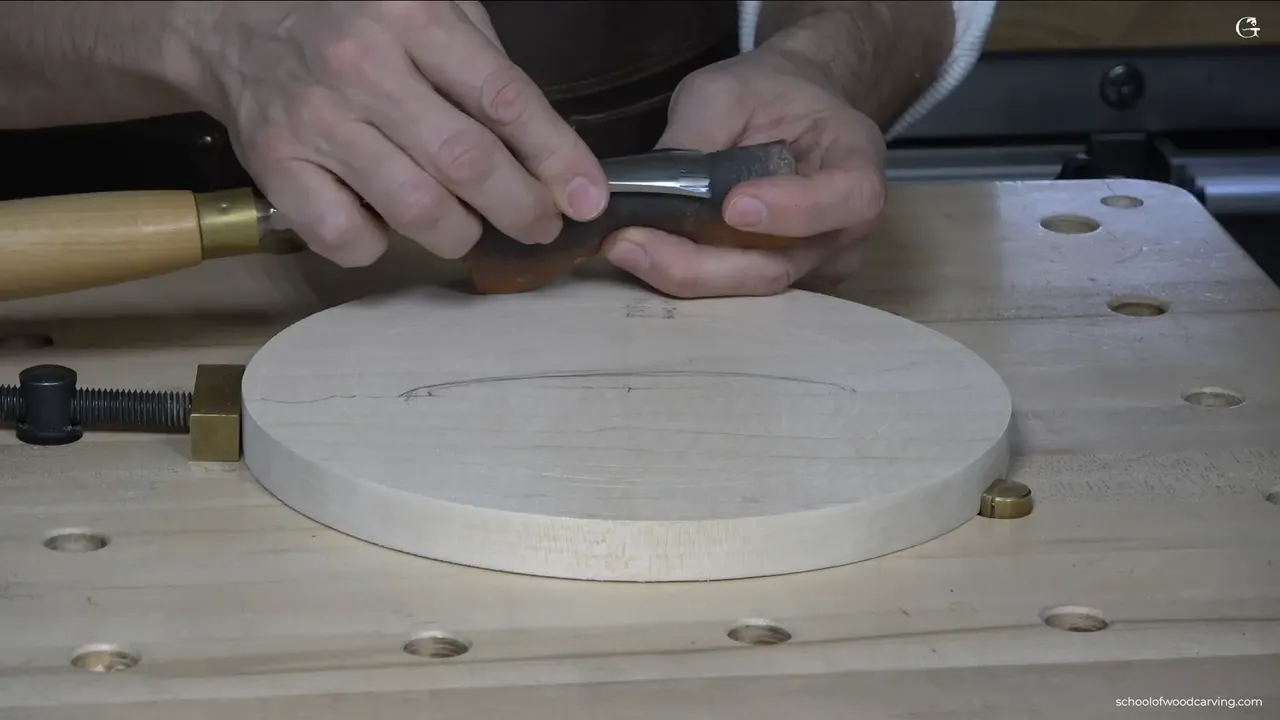

In Plate with Butterflies 2, video 1, I start a cut with one side of the gouge and finish it on another side, and I call that a slicing cut. The word flute rides along with that cut in my other lessons. In many of them I say what the flute is, and where it points when the first pass begins.
Do you have a gouge on your bench? Does it have a groove down the middle? Then you hold the tool I mean, and you can follow every line below with it in your hand. Start with lesson 1 of this course for the plate itself, and come back here for the dish.
What did I do with the number 7 before the first cut?
The video opens with the tool. "Let me grab 7/8 of an inch, number seven, and I hope it's sharp," I say. That is 22 mm. If it is not, I'll strop it now, and I remind you that "it is always better to stroke from inside."
On the strop I say "just a few strokes and then outside." The reason is short. "You really don't want to roll that edge inward." For sharpening itself, see the Maine class.
How should a bulk of wood come off the plate?
Before the first pass I talk about a lot of wood. "When you removing a bulk of material it is always better to carve across the grain." Then comes "much easier to control." I also say "I'm not going to catch any grain" and "I'm not gonna break anything."
The second thing is cleaning. "It is always good to clean it with the grain." You really need to get support underneath the cut, I say, so "there's gonna be supporting grain underneath." I add that I have said it "multiple times," "just in case."
What does flute up mean at the start of a cut?
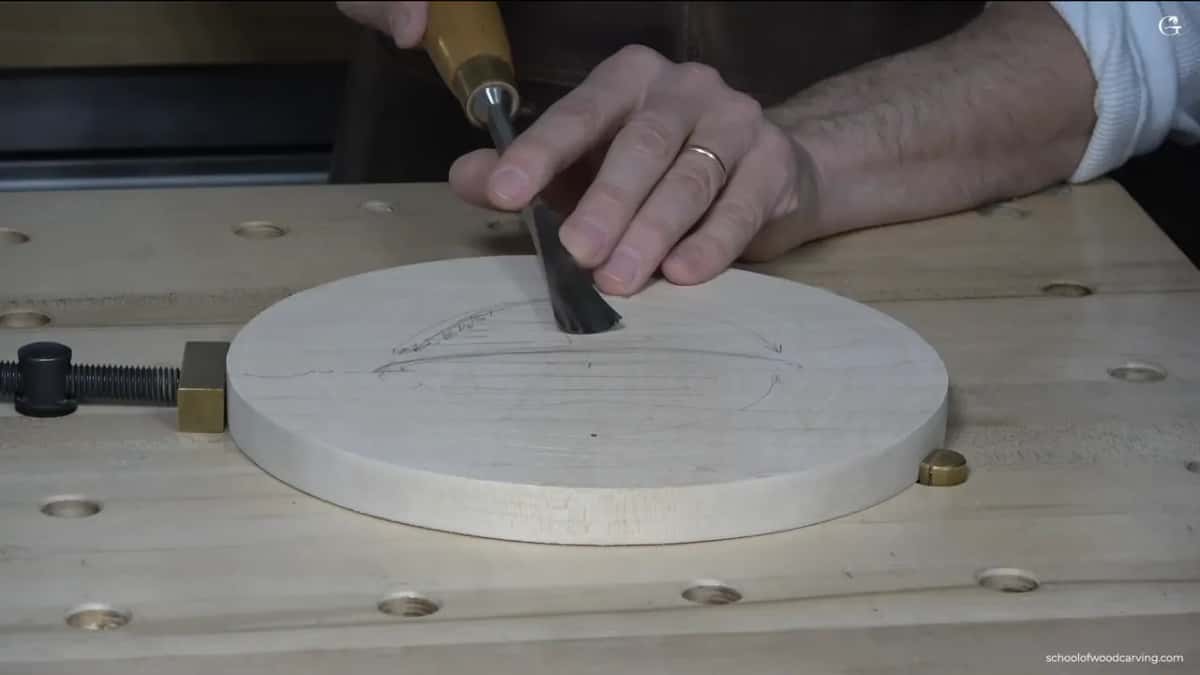
The caption line just before my slicing line is hard to read, so I leave it out and quote what is clear. The tool goes "to the left or to the right." My line for the whole move is short. "You start you cut with one side and you finish you cut it another side. It's called a slicing cut."
Tray of Blessing 1, video 1, is plainer about the start. What I see "a lot of times" is people who "place the tool with the flute up." They "start pushing like this, and that's not good" and I say you are pushing with "the whole wedge." My own name for the right start is "slicing cut."
Placing the groove to either side is the other way, and you begin "closer to the edge," not "all the way to the edge." By the end, "you create like a rotation motion."

Video 2 of that lesson says it as a short order. My cut begins on the left of the tool and ends on the right, and "it could be both." The order is not to start with the flute up, "don't push it like that."
Grape Onlay 1 makes it a warning. "I never start with my flute up," I say, and I add "another mistake" I see when people carve. They go in straight and dig. Of that start my words are "you're fighting that wood really hard."
Better, I say, is "to start with the slicing cut right away." Turn the flute "to about 11 o'clock" or the opposite way, and then "you starting on one side and you finishing cut on another side." The plate in video 1 gets that same two-sided cut.
Where did my first cuts go?
The first cut is to be "pretty close to the last line." I name it "my last line." People, I say, "be really really careful" and "make sure you don't cross those lines."
My plan is to stay off the line a little. "I can stay away somewhat from that line, maybe about one millimeter for now" (0.04 in). Then "I'll just excavate."

I tell you not to run the whole pass. "Do not go all the way with that cut because it has to go smoothly in and smoothly out." It is a "good idea to stop somewhere, you know, like in the middle" and the next cut is to start "right in the middle of my previous cut."
I step the cuts one way "just because of the grain. Okay, it's easier for me." And "you can see I'm slicing through the fibers with no problem." A stop shows the depth too. "You can see how deep you went in my case. I'm almost 6 millimeters" (0.24 in), and I add "I probably should not take too much of the material."
About one side I say "it's important to keep that side somewhat like, you know, really smooth and nicely going." And "it has to have some movement."

How does the cleaning cut get to the line without crossing it?
The cleaning cut is next, and the plan is exact. "I'll position my tool like a 45 degrees to the line" and "I'll create my cleaning cut right to the line, but we really careful."
Inside the dish, "the grain runs against you right now just because it's inside." So "now my supporting gonna be on this side." And "the clean side is gonna be opposite direction."
What I have done "in this quarter," I say we have to repeat on all those sides. Check as you go. "Double check how deep you go from this point to deeper spot and make some adjustments. And you should be fine." My depth is "about the quarter inch in, about six millimeters" and a quarter inch is 6.35 mm.

The tool does some of the work, and the shape matters. "Remember you will repeat the shape of the tool," I say, "I mean the profile of the tool." And "when you cleaning, it's automatically it gives you the same depth if you just to get really close to the line."
My hands have a job too. Keep "approximately the same pressure" and "the same position of the tool" and you cannot remove too much. In my case it is "I don't know maybe about 1/8 of an inch above" (3 mm). I am also trying to keep the same angle.
At the line I'll go "really slowly" and "I'm not pushing I'm still slicing." Calipers help, too. "Because I used calipers but not the pencil I have a somewhat really sharp line so it's a lot easier." And if you "used only pencils," it is all right. "Like I said, it doesn't really have to be perfect."

What is the flute, in my words?
In Floral and Molding 7, video 2, I say I will probably need a "one millimeter tool, number 11" (1/25 in). Then comes the word for anyone who does not know it. "For those of you who don't know what the flute is of the tool, the flute is actually that groove right in the middle of the gouge, or in my case, it's a veiner number 11. That is a flute."
In the thirteenth lesson of that course I repeat it. "Again, I'm going to repeat myself what is flute. And the flute is a groove on the inside of the tool right there." A line about tools in general follows. "Not every tool has a flute, but that's a good idea to identify the part of a tool." Open Molding 13 to hear it.

Venice Room 100, video 3, brings in a trade. "At least woodturners refer that as a flute, and that makes sense."
Furniture Panel 29, video 1, puts the flute on a clock. "12 o'clock would be just up, okay, 12 o'clock, one o'clock toward the right, let's say 11 o'clock toward the left."

A few more, and short. In Gibbons in Maine 4 I say "it's called the Flute of the tool." In Acanthus over Moldings 2 it is "called flute." A Hazelnuts lesson has me apologize, "I'm sorry if I didn't explain that before" and you can find it in the Hazelnuts course.
Grape Leaves 2 has a number 11 at 3 millimeters (0.12 in), placed "straight down." The groove, I say, is "called flute on inside that groove."

The Maine sharpening class has the word too, and of the screw there I say "that part called flute."
In which videos did I name the flute?
| Where I said it | What the word names in that video |
|---|---|
| Floral Molding 7 | That groove down the gouge's center |
| Hazelnuts 7 | The center of the tool |
| Furniture Panel 29 | The center part, with 12 o'clock just up |
| Floral Molding 13 | The groove inside the tool, right there |
| Venice Room 100 | The part inside the tool, and woodturners use it too |
| Maine sharpening class | The tool's center, where the screw is centered |
| Gibbons in Maine 4 | That center thing, the flute of the tool |
| Modern Acanthus 3 | In the middle of the tool is the flute |
| Acanthus over Moldings 2 | Called flute, in the tool's center |
| Grape Leaves 2 | The inside groove, facing out from the carving |
When does the flute stay up?
Flute up also shows up as the normal way. Hazelnuts 4, video 1, has a huge number 7, an inch and a quarter (32 mm), used "with the normal way" and I say "that is really important."
A number 3 at "about half an inch" (12.7 mm) sits in Hazelnuts 8, video 1. "I will use number 3," I say, and "the flute the normal way up."
In Molding 12, "my flute is facing up." With a number 11 "you can blend pretty much right away." And "I can rotate any direction and use just either side of the tool. So that is a really, really good thing."

Modern Acanthus 2 has "the normal way" then a turn to "approximately to one o'clock." In Grape Leaves 3 the plan is "the tool straight down, the flute facing up" and then "twist a little bit the flute counterclockwise to about 1:00."
Byzantine Acanthus 7, video 3, has the tool "approximately maybe 1:00 or so," flute up, and "I just blended that like this." In Furniture Panel 26 a tool looks like "letter U," used the normal way, flute up, "like to 12 o'clock." If you lay it on its side, "it's gonna become a flat tool."
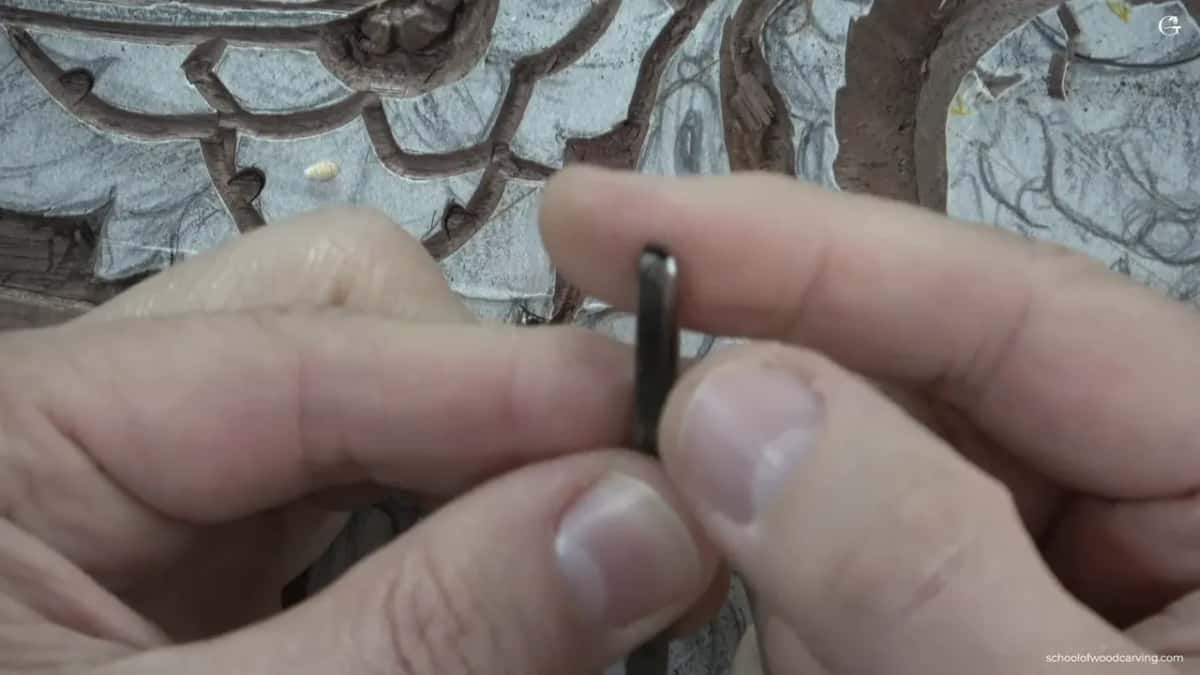
In Tray 3, I plan to "get my flute up number 11, three millimeters" (0.12 in) for the first initial cut. Those lines are all mine. One says do not push a flute-up tool, and others call it the normal way. I give each one its own lesson and I do not blend them.
When do I turn the flute away from up?
Tray 5, the first video: "I position my flutes approximately 11 o'clock and I am carving slightly right underneath creating undercut pretty much right away." Then my plan is the flute "upside down" and "I'm gonna dig in like so."

Grape Onlay 14, video 2: "I'm using my tool upside down" and my flute points "to six o'clock." I say I do see the shadow now. In a Hazelnuts lesson I say "My flute is upside down."
A clock plan comes in Venice Room 91, video 3. "If the flute is up right now, like this 12 o'clock, I'm going to create my cut about 2 o'clock or so carefully." In Molding 13, I plan to "also attack underneath of this petal" and "I have to undercut it."
The Grape Leaves vase lesson has a cleaning pass, and I place my number 11 "straight down, then facing flute outside" and "clean it like that, okay, without undercutting. It's going to be too early to undercut."

What did I reach for to clean the inside of the dish?
Back on the plate, I say "I have to clean them inside a little better." "A couple ways you could do it," I say, "obviously with the same tool." A flatter tool, "maybe like the number five or even number three," would "help you a lot."
For that flatter tool my words are "that would be number four because it's a London Pattern which is in England." And "number four in England equal to number three in European chart." I plan to "just use about one inch" (25.4 mm).

About that clean surface, I say "it does not have to be perfect since the majority of it is going to be anyway taken out by the design." The butterflies get drawn in the next videos of lesson 2, and lesson 3 follows. The course page holds all of it.
Which side of your gouge will start your next cut? Every video of this lesson sits inside one tuition plan. My sizes come with my own figure first and the other unit beside it, in millimeters or inch.
How it's done
- Grab the number 7. Take the 7/8 inch (22 mm) tool, and strop it if it is not sharp.
- Take the bulk off. Carve across the grain, with supporting grain underneath.
- Slice the first pass. Start on one side, finish on the other.
- Keep clear of the line. Keep about 1 mm (1/25 in) away for now, and stop partway through.
- Begin the next cut halfway. Set it at the midpoint of the previous one.
- Clean at 45 degrees. Position the tool at about 45 degrees to the line, then go right to it.
Frequently asked questions
What is the flute of a gouge?
On a gouge it is the groove, I say, and woodturners call it a flute too. A veiner number 11 has one. Not every tool has a flute, but naming the part of a tool is a good idea, I say.
Should a first cut start flute up?
Tray of Blessing 1 and Grape Onlay 1 both warn against it, and the first of them puts the groove to the left or to the right instead. Other lessons call flute up the normal way.
How far from the line should the first cut stay?
About a millimeter (0.04 in) away for now, off the line I call my last line. I tell you to stop the pass partway so it goes smoothly in and out. At that stop I am almost 6 mm (0.24 in) deep, and I add that I probably should not take too much.
What to carve next
- Plate with Butterflies course
- Plate with Butterflies lesson 1
- Plate with Butterflies lesson 2
- Plate with Butterflies lesson 3
- Tray of Blessing 1
- Tray of Blessing 3
- Tray of Blessing 5
- Grape Onlay 1
- Grape Onlay 14
- Floral and Molding 7
- Floral and Molding 13
- Venice Room 100
- Furniture Panel 29
- Hazelnuts 4
- Floral and Molding 12