
Alexander Grabovetskiy, woodcarver, School of Woodcarving · Published 2022
What does a wood carver mean by "flatten"?
Quick answer: In Plate with Butterflies lesson 2, video 2, I show a big number 2 gouge and call the flattening quick work that can stay imperfect, since most of the floor goes away with my cuts. Other lessons name a background, a surface for a volute and a spot on the panel.
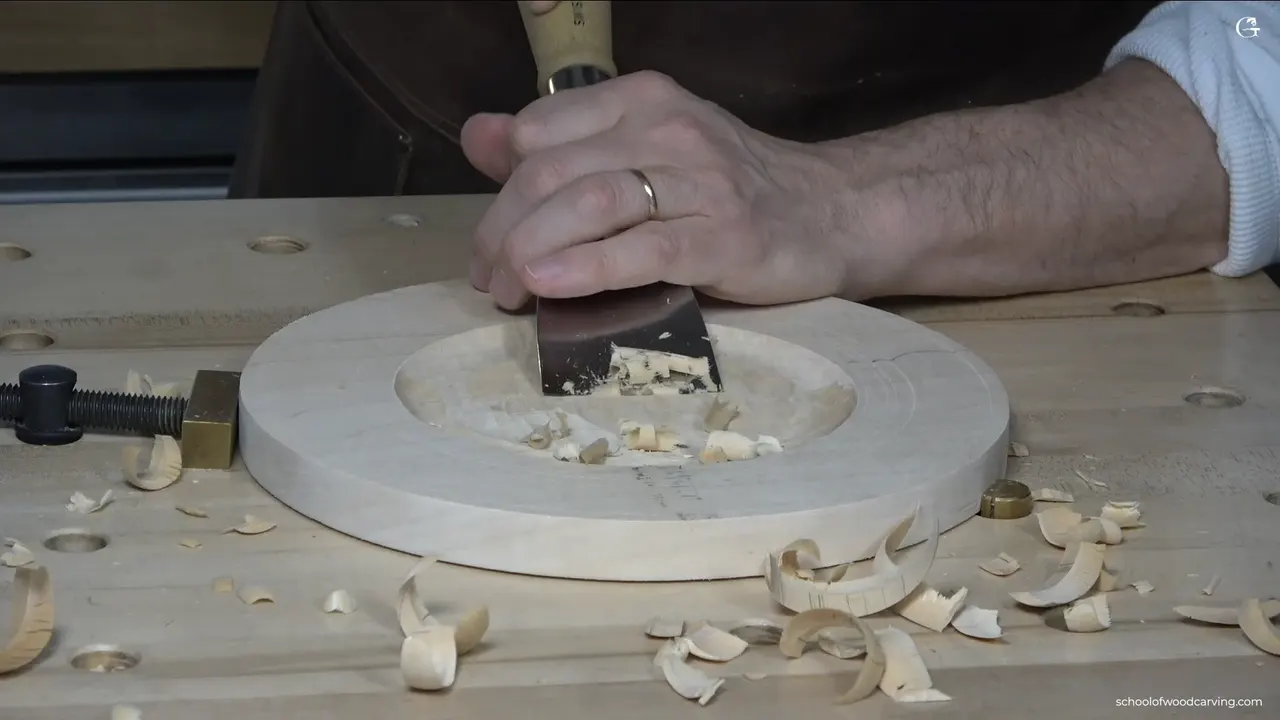

In Plate with Butterflies lesson 2, video 2, I show a number 2 gouge, 60 mm (2.36 in), and say "I can actually flatten that pretty quickly." I add "I don't need to make it perfect." Other lessons of mine use the word for a background, a surface for a volute, and a spot on the Venice Room panel.
Your dish is hollowed and you want a clean place to draw. What goes in next? This video answers it. The butterfly plate course holds the lessons around it, and lesson 2 is the lesson this video belongs to.
Which tool flattens a hollowed dish the quickest?
The video opens with this: "if you do have number two, especially the really really big one like, you know like this." "It's a 60 millimeters," I say, and "That would help you." Then "Like I said don't have to have it." If you do have one, "that would give you much quicker" cleaning job.
Size is the only difference I name: "The only difference between small tool and big is just gonna give you much quicker result." Then comes "Flattening. Like I said majority of it's still gonna be gone with all my cuts, but somewhat, okay."

Is the number 2 flat enough?
Almost, in my words. "even with the number two," I say, "it's almost flat." And "you don't have to use this." What the big tool gives you is "an idea if you have a bigger tools, it's always better."
Then the number 7: "let me get the number seven again." About the number 2 I say "I hit some of the spots with number two, which I have absolutely no problem with it." One spot is deep: "right there's kind of deep spot." And "That's okay majority of it's gonna be gone anyway."
What did the dish get first?
The dish takes shape in video 1 of this lesson. I take "7/8 of an inch" (22 mm) in a number 7 and say "I hope it's Sharp." For a bulk of material, "it is always better to carve across the grain." My first pass will be "pretty close to the last line" and I say I can stay away "maybe about one millimeter" (0.04 in) "for now."
Do not go all the way in one pass, I say: "it has to go smoothly in and smoothly out" and "it is good idea to stop somewhere." At the stop I can see the depth: "I'm almost 6 millimeters" (0.24 in). Next I say I'll position the tool "like a 45 degrees to the line" for the cleaning pass. Inside the dish the grain turns, and "The clean side is gonna be opposite direction."

Then the canvas. "What you need is just like a canvas you're gonna work with okay?" Next come "So just the clean canvas" and "a flatter tool, maybe like the number five or even number three. That would help you a lot." My own is a number 4: "number four in England equal to number three," on the "European chart" at "I'll just use about one inch" (25.4 mm).
The plan is to "attack with the flatter tool," "across the grain at first." That video also says it need not be perfect, since the design takes most of it out.
Where is the middle?
"So now I would like to find the center," I say. "to find the center, I'm going to use a calipers again." The opening is "about five inches" (127 mm) off "my tape measure" with the calipers going on "one Mark and then the six mark." "Again, that's gonna be approximate," I say, and "there's gonna be five inches."

"Now remember we excavated some of it." My plan follows: "all I need is just attack from different points and then it's gonna give me a lot more chance to calculate."

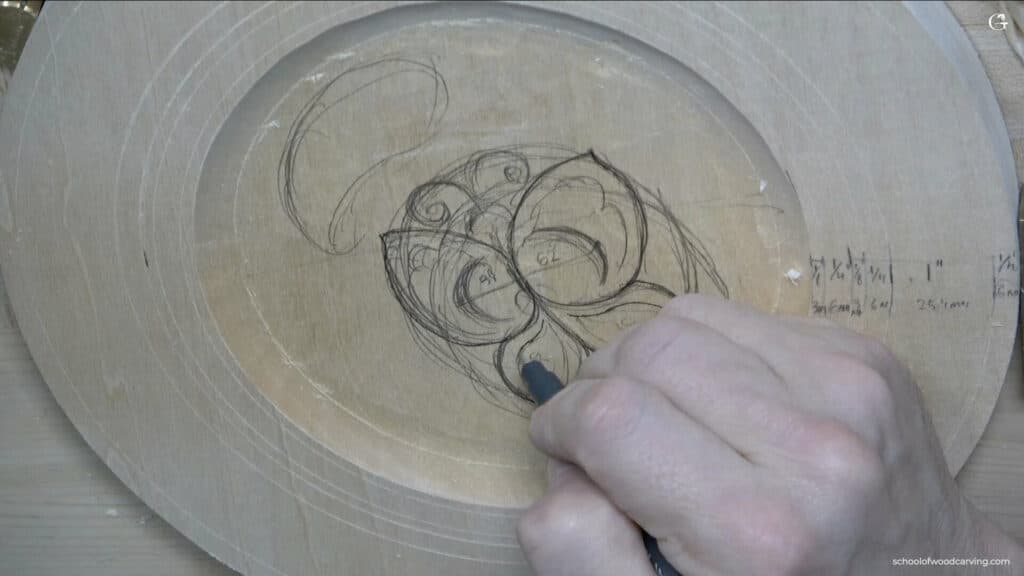
Marks go on in pencil: "I'll just use probably pencil. It's gonna be safer." Arches come next, in my plan: "some kind of Arch like this and another Arch like that." A second spot gets this: "There's gonna be another Mark right here" and I call it "my approximate Center" with "I'll double check" to follow.

How far in does the knife line go?
"Approximately, I would say 3/8 of an inch from this point," I say, about 10 millimeters (0.39 in). Measuring is out: "I'll just eyeball it approximately 10 millimeters." Both sides get a check: "if you wish you could double check this side."
A small twist follows: "Maybe I can just twist slightly. half a millimeter to the left and I create preliminary cut. Well Mark, I should say." Half a millimeter is 0.02 in. I call it "my knife cut" and say "you will understand little later what I mean by that." The line matters: "And I need that line."

Does the floor of the dish have to be perfect?
The word comes back when I look for the middle: "It's not going to be perfect and in a center" and "somewhat off a lot actually." My own mark gets "I doubt that's a perfect." Inside the knife line I say "if it's not perfect on inside, don't worry about it. So we'll make it look really nice."
What do I draw on the clean floor?
"let's Draw Something," I say, and I ask "how much space do I have?" The answer is "approximately 5 inches and maybe 1/8 something like that" (about 130 mm). "Again, if I have a five inches space so my main element is gonna be about three inches" (76 mm).

I say "I'm really big fan of golden ratio of Fibonacci Sequence" and "Let's say I've got three inches and five inches." Then "So it makes me happy." My pencil comes first: "I'll do just the pencil first." Of the butterfly itself I say "If you're looking for the perfect. Anatomically butterfly. It's not the one."

One side gets more of the room: "Put your 60% on this side 62% 38 on this side doesn't have to be that way." Then "No, it doesn't." A black marker will outline it, I say: "so that way it's good in place just for the camera sake." The liner is "a really good 0.5" and "It's not really thick it's really tiny line."

Wing lines get "Somewhat like a s curvature" in my plan, and I say "I think it's gonna look good." A gap follows in my plan: "step aside about 3 millimeters" (0.12 in).

Which flatter tool does video 3 name?
Video 3 closes its words on one: "Right now try to remove those facets, you know with some kind of flatter tool." Then "maybe number five number. 6 that doesn't really matter what tool." Earlier I say "Don't worry about cleaning up" and "Just bring everything down."
Which Lily Box lessons flatten something?
The first is Lily Box 2, video 13, which gives the word to a background. Undercutting leaves with a number 11 is the plan, and I say "Don't cut just straight down like a groove." Lean the tool and it is "a lot easier for you to flatten that background." It will be "much cleaner that way," I say, with no "grooves like that" and "much deeper" shadow.

A piece of paper comes up in Lily Box 5, video 1: "It's just a piece of paper, and I can always reprint that." Then "Since I do have a flat surface, it shouldn't have any problem." And: "So if you remember, I flattened this, and that's almost planed." Then "that would be really easy for me to lay it like that, and trace it."
The same lesson, video 5, names a tool: "Let me use a flatter gouge and recreate my, how I call it, canvas, where I can create better movements." "just number three" is the tool to "flatten a little bit this region." I say a ridge "doesn't look good" and "let me see which gouge I can fit." One gouge I set aside: "I think it could be a big mistake." I'll use number three, I say, and "just try to give a nice edge." Then "Now it's just too rugged." "This part is fragile, almost broke."

And in video 8: "I'm just recreating my working space." "That way I can easily redraw and recreate my main movements and make a lot less mistakes." Then "Flatten this a little bit." Next, "I'm using just the number three and six millimeters" (about 1/4 in). "Quarter inch, number three" (6.35 mm). My plan for later is to undercut "right here in this section."

Over in Lily Box 6, video 4, I say "this second volute will be lower than the upper volute. So I need to flatten that surface first." And video 6 has "I'm not afraid to actually flatten a little bit this area." My reason is "my high point," "this one right here."
I add "carefully, without forcing" and "Really important, just not forcing anything, not to rush it." I'll "go almost down to the ground," I say, leaving "maybe about 3/32nds or even less" (2.4 mm, 0.09 in) between "this ridge and my background." "Couple millimeters maybe."

What do I flatten on the Venice Room panel?
Venice Room 26, video 6, has "I'm using a number 11, seven millimeters" (0.28 in), then "I'm going to use a flatter tool." Next: "Going to flatten this out, but I don't want to lose the movement, overall movement." Of depth: "I'm not sure how deep I should go right here."

Then Venice Room 92, video 6: "let me flatten it." After it I say "now just a preliminary shape" and "this needs to be rounded a little bit" and add "I can just use a upside-down number seven."
Then comes Venice Room 94, video 12, with "just then clean everything, just flat and flatten the spot." Next: "So that is what's going to happen" and "the rest of those areas are going to do exactly the same." Showing it completely is hard "just because of the position of the piece and the camera position."
In Venice Room 43, video 8, I say "Maybe yes, maybe no" and "Maybe it's actually a better idea." Then "Flatten it a little bit" and "Let me think."
Venice Room 100 uses the word for the carved shape. Video 2 says "flatten up and you're not going to see too much movement in this section." And in video 3: "So now I need to flatten that."
In Venice Room 108, video 1, I say "I've done this area, pretty much just to flatten that. And I placed some lines back." The next section "has to be lower" at "six millimeters above the surface" (about 1/4 in).
And Venice Room 160, video 3: "I've got the same equal depth on both sides. Now I can just flatten it, and it's going to be easier for me to go a little deeper to create this shape." The depth is "about 2 millimeters down on both sides" (0.08 in). Then my plan is "somewhat flat, like number 1, maybe a back bent."
Which other courses use the word?
Hashemi Flowers 3, video 4, has a knife for it: "I'll take just a small knife, really small, tiny knife, and flatten the top." "See" and "That's not good," I say. I ask "What just happened" and answer "That means I have to lower this down even more."

Carving Grape Onlay 4, video 2, has me say "Let me flatten it slightly and remove some of the material right on the side." Then "I have plenty of space right here," about 10 millimeters (about 3/8 in), and it will be a tendril. "I'll use some number nine and quarter of an inch, about six millimeters or so" (0.24 in).

In which videos did I say flatten? One table has them.
| Where I said it | What I flatten in that video, and with what |
|---|---|
| Butterflies 2-2 | The dish floor, using a 60 mm number 2 |
| Butterflies 2-1 | A clean canvas, using a flatter tool |
| Then Butterflies 2-3 | Facets, using number 5 or 6, maybe |
| Lily Box 2-13 | A background, once the tool leans over |
| Lily Box 5-1 | A surface I flattened, now almost planed |
| In Lily Box 5-5 | A region, using just a number 3 |
| In Lily Box 5-8 | My working space, using number 3 at 6 mm |
| From Lily Box 6-4 | The surface for the second volute, first |
| From Lily Box 6-6 | An area, down almost to the ground |
| Venice panel 26-6 | A spot, keeping the overall movement |
| Venice panel 92-6 | Another spot, before a preliminary shape |
| On Venice Room 160-3 | A spot, after equal depth on both sides |
| Hashemi 3-4 | The top, using a tiny knife |
| Grape Onlay 4-2 | One spot, slightly, before a number nine |
Which flatter tool is nearest your hand? Every video of this lesson sits inside one tuition plan. My figure comes first with the other system beside it, in millimeters and inch, so you can check a size against your own gouge.
How it's done
- Take a big flat tool if you can. A number 2 gets the floor done faster, and owning one is optional.
- Flatten the dish and stop short of perfect. Quick work with the big tool, and the design removes the rest.
- Reach the deep spots with the number 7. The number seven comes back, "let me get the number seven again," and a deep spot is okay.
- Mark the center from different points. Calipers off a tape measure, pencil arches, and an approximate center to double check.
- Place the knife line. Eyeball it a little way in, then double check each side.
- Pencil the first butterfly. Three inches (76 mm) of a five inch (127 mm) space, in pencil, then a black 0.5 liner for the camera.
Frequently asked questions
Which gouge flattens a hollowed dish the fastest?
A big number 2 gives a quicker cleaning job, I say, and you do not need to own one. The only difference between a small tool and a big one is speed. I call the number 2 almost flat, and my carving removes most of it anyway.
Must a carved dish floor be perfect?
Skipping perfect on the flattening is fine, I say, and a deep spot is okay. Video 1 adds that the design takes the floor out. At my center mark I say I doubt it is perfect, and inside the knife line I say not to worry.
Which number is a flatter gouge for the dish floor?
Video 1 names a number five or even a number three, and my own is a number 4, which equals a 3 on the European chart. Five or six comes in video 3, and I add that the exact tool doesn't really matter.
What to carve next