
Alexander Grabovetskiy, woodcarver, School of Woodcarving · Published 2022
What does a wood carver mean by "naturally"?
Quick answer: In Plate with Butterflies 3, video 1, I tilt the knife somewhat inwards and call the angle naturally comfortable, with no degrees given at all. Other lessons put the word beside my pinky and a sharpening jig, and beside curling petals.

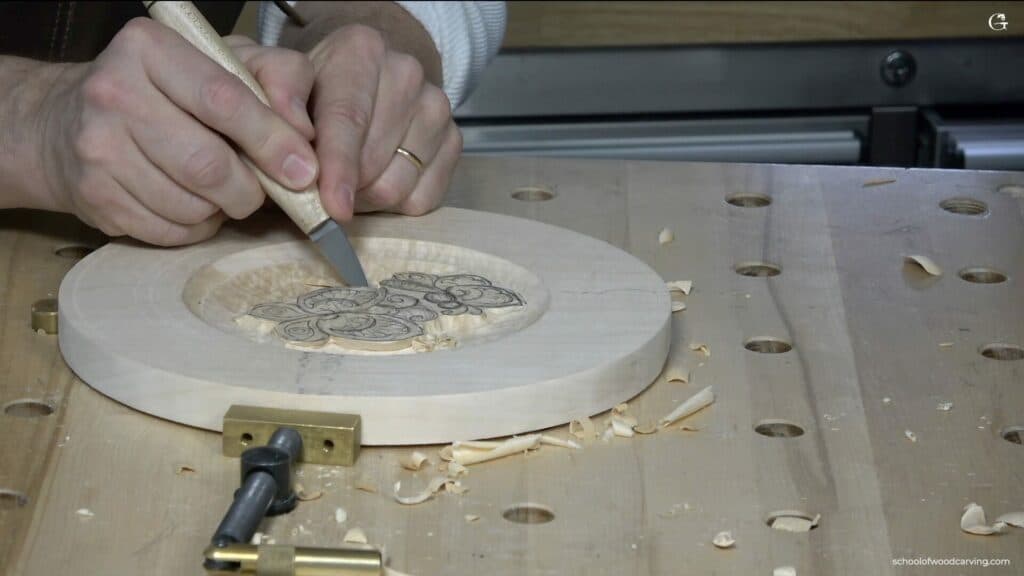
In Plate with Butterflies 3, video 1, I tip the knife "somewhat inwards" under the butterfly line, and I call the angle naturally comfortable for me. There is no number to give. "I can't tell you" the degrees, I say. Other lessons of mine put the same word beside a grip and a curling petal.
Does your knife sit in your hand without strain? Is there a round plate on your bench with a butterfly drawn on it? Then lesson 3 of this course is the place to start, and the lines below show where the word turns up.
What came before the knife in this video?
There is a clean-up. "Make it little cleaner look," I say, and "we're gonna need that later to make sure it's just really clean." Then: "I'm happy with that step." Around the butterfly: "don't worry about all that mess around."

"Create the cut down now," I say. It "could be either with the knife. Or with the same number nine what we use previously 10 millimeters." That number nine is 10 mm (0.39 in). "Preliminary we can just remove majority of that mess," I say.
For the final cut I name the knife or a gouge, and the cut is "Just the straight down cut." It works "inside of those like areas like triangle area." Of this project: "we are introducing some gouge techniques." At another triangle I tell you "I have to attack that from the right positions" and "I can go pretty close right now to the line" of my butterfly.
Another line: "remove whatever you able to just make it somewhat clean, but don't overdo it." I add "You still gonna have a chance to clean that little later."

How far inward does the knife tip?
My knife is "similar to number 12," but "that's a different brand that is a Russian brand and I kind of like the steel." Getting one: "It's impossible to get it now." Then: "I have to present that my knife. Not 90 degrees. But somewhat inwards so I'm gonna create some kind of undercut underneath of that line. Okay, really important to understand."
A smaller tool is an option too: "I could probably grab a smaller tool preliminarily and just create that undercut right away." My pick: "I'll just use probably just the knife."

Now the angle itself. "How many degrees I've got you don't really have to measure it." You "can see approximately." Then: "what's the angle I'm holding" and the words after it are "naturally comfortable for me and I'm gonna undercut." After it: "And make that line somewhat. Really nice."
The final cut has a limit, in my words: "do not recreate the cuts and don't cut deeper than quarter inch." That depth is 6.35 mm. And for a second pass: "If you need to go second time. Make sure you just got in the same spot."
What does the number seven do after the knife?
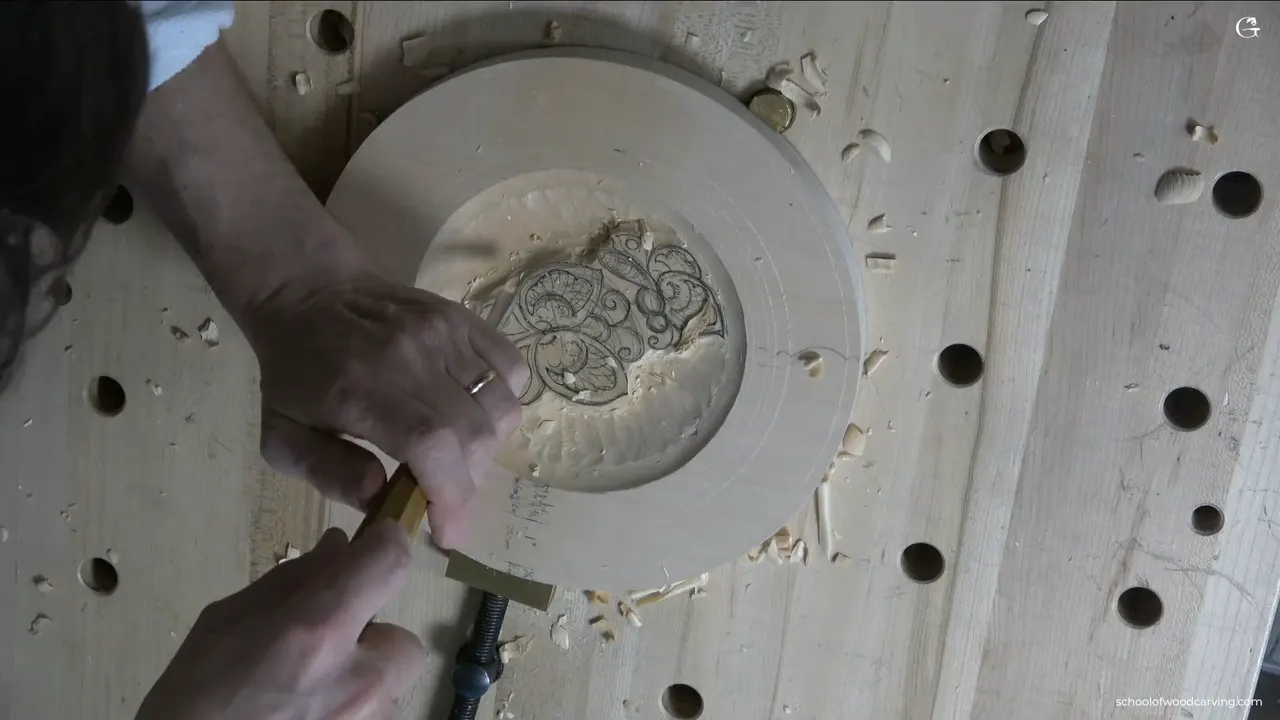
"I have to grab number seven again" and mine is a bigger one. Then "just create my cut over that cut." And: "I will use just the corner of my tool." Then: "I'm not forcing. I mean you could try to present the full body of the tool, but I doubt you able to."

"That is how it's supposed to look," I say of the cut. Then the depth: "that's the space between this point and that surface" and "it's about six millimeters deep about quarter of an inch." Six mm is 0.24 in. All around the plate: "I will continue to do exactly the same." And my hand: "I'll try to stay and with my hand exactly the same angle." And: "you do the same all around."
My warning is short. "Be careful," I say, "if it just erases too much." Then: "remove some more material before you do this cut." If a big tool does not feel comfortable, "grab a smaller number seven." The next words are "I'm gonna just clean that."

Before the gouge, the knife can take the chip out: "you could actually preliminarily just remove some of that chip with the same knife." It's "a little easier for you than to attack with the number seven." "So you can just take the chip out." Then: "It's cut all the way through." And: "If it does not fly out recreate that cut and it should. Be removed really easily like that." One more caution: "you don't dig too deep to the wing."
What do videos 2 and 3 add about the same hold?
The second video puts the hold near the line: "it's a pretty close to the final line." Close to the final line: "You still create the angle on inside." And "You still do the same angle, which you've done whatever the wing is." A spoon gouge comes up too. "I'll use number seven and 10 millimeters," I say, about 0.4 in, and "it's gonna help you a lot." Even where it is not as clean as you wish, "look how deep Shadow it casts."

The antennas get a different hold. "You do not undercut underneath of those antennas," I say, and "whatever you see antenna Ninety Degrees. But whatever you see the wing that is going to be undercut." The same rule comes back in the third video: "my antenna I'm gonna be straight down cut 90 degrees" and "I don't want to attempt that in one cut create multiple cuts."
"Oh, I've got the wrong knife," I say, and "let me get the right knife." On the recut I say "I can recreate that cut as long as I'm holding the same angle." On depth I say "it's about the same depth" and add "It doesn't have to be quarter."

Where else do I say naturally?
The word turns up in other lessons too. Some lines are about my hand, and some are about the wood. Hand lines first.
Butterflies 8, video 2, goes around the body itself: "somewhat straight like a 90 degree cut." Then, "Although I don't really have to. I can actually create a little angled cut." The ask is to "pay attention to the angle I'm holding and how I'm holding my knife in a hand just like that." One more word for the hold: "naturally naturally just a slight angle." And: "go from the same spot."

Tray of Blessing 8, video 1, sends the cut "Just not straight down, but outward slightly." The tool is a number two: "I like number two because it has a slight curvature. It's naturally follows the motion." The corner shows up again: "you use only corner. Only corner." "I see what I'm doing with this finger. I'm controlling my motion." And: "Try to maintain the same angle, what you've got on another side, on this side as well."

At the sharpening jig in the Maine Coast class, video 1-5, "this jig has some limitation." On the jig: "you just follow the curvature of the tool. Follow that sweep." Yet for a U-shaped tool, "the knob hits the bar, and naturally, you want to raise it."

Lesson 24 of the Hashemi course, video 3, has my pinky: "I actually place my pinky right below it, and I do create a support because I can't press too much. And it comes naturally." Then: "when I'm attacking from this side, let's say I'm placing the whole hand on the bottom."

In Hashemi 36, video 2, I'll use "just a spoon gouge." And "sometimes I'm grabbing tools on my workbench." "I don't think, actually, what the tool going to be, the next tool. I'm just grabbing whatever naturally comes to my mind."
Grape Onlay 12, video 3: "in those eyes, I place my tool upside down with flute down to six o'clock." Next, "I don't know how I develop, but even here, I cut. I don't leave it right there. I'm hooking." I "do it like naturally": "cut hook, cut hook." That way it's "cleaner on inside" and "you're able to see much better on inside."

Hashemi 47, video 9: "I could rotate my piece and approach from another side," but on a huge piece "I really can't walk around, and I can't rotate, and I have to attack from just the one point, from where I'm standing." Then: "It naturally comes, different techniques, how you attack your piece, what hand you're using."
The Mastery questions use cursive writing as the example: "you developed the writing skill while not crossing the borders." And, I say, "But later on, you don't even need those lines because you feel it naturally." On depth: "I say how deep you're supposed to dig" and the example is "six millimeters deep, which is a quarter inch." After it: "it doesn't mean I pre-planned that." I "see that before" and "it developed."
Design Principles 4, video 4, has curves that fall on 40% and 60%. "If you take a calipers," I say, the split is the golden ratio. Then comes: "I'm not saying you have to calculate all the time, but somehow you just get to that, naturally."

Butterflies 11, video 2: "don't worry about calculating, just stay away approximately just a little bit." The video takes up the golden ratio and the carvers of the ninth and tenth centuries in Northern Europe. The ones in the countryside, I say, "they really didn't worry about it. They just did that naturally, whatever felt like natural and so on."
In a livestream about clay modeling, the question is whether I model before I carve: "I do have to confess. Yes. For a long time, I did not." "I am able to think and see in three-dimensional world," I say. I guess it's "because I'm carving since six years old" and "that ability just came naturally since I started to carve." And: "when you carve, it's a proven fact, actually, you developing the ability to think and to see in 3D."
Which lines are about the wood?
Venetian Flowers Rosette 4, video 1, is a plan, not a finished cut. "I'm going to leave approximately maybe no more than five millimeters or so," about 3/16 of an inch, and "That way, it's going to curl naturally." Five mm is 0.2 in, and 3/16 in is 4.8 mm.

Hashemi 44, video 3: "I really like how it naturally goes uphill, and I see a wall." "So I'll take a knife also and just bring my cut all the way to the edge, because I really like how high it goes."

Hashemi 47, video 6: "naturally, I really like the movement" and "it actually already has a big curl inside." In Hashemi 36, video 2, "it's actually formed my next movement." I can take a small gouge, a number four, and "make my separation, which is naturally happened, and I am absolutely okay."
Lily Box 12, video 4, has a part that is "just raising up little bit." Then a question and an answer: "Did I plan for it?" "No, but it's naturally happened." The movement gets a verdict: "I kind of like that movement." What I don't like is a "really sharp shadow on this side, and I need to take care of it."

In Venice Room 59, video 4: "That is good. It just flows naturally, goes in, and then goes on the ceiling." In Venice Room 10, video 5, "I can create another notch," I say, and "Just kind of naturally asking." Then: "they had a lot of notches like that."
Where can you hear it?
| Where I said it | What the word points at in that video |
|---|---|
| Butterflies 3-1 | The angle of my knife under a wing line |
| Butterflies 8-2 | A slight angle, held in the hand |
| Tray of Blessing 8-1 | A number two that follows the motion |
| Maine class 1-5 | A knob that hits the bar, so you raise it |
| Hashemi 24-3 | My pinky, placed right below the tool |
| Hashemi 36-2 | Whatever tool comes to my mind |
| Grape Onlay 12-3 | A cut and a hook, one after the other |
| Hashemi 47-9 | Ways to attack from the one point I stand at |
| Mastery questions | Borders that you stop needing |
| Design 4-4 | A 60-40 split you just get to |
| Venetian Rosette 4-1 | A curl that follows the wood I leave |
| Hashemi 44-3 | A shape that rises uphill into a wall |
| Lily Box 12-4 | A part that raised itself, with no plan from me |
Which line would you try on your own board? Every video of this wood carving course sits inside one tuition plan. The butterfly plate course page holds every lesson, with lesson 4 after the one on this page. My sizes carry my own figure first, with the inch figure or the millimeters figure beside it.
How it's done
- Clean the mess lightly. Take the majority of the mess off with the knife or the number nine, 10 mm (about 3/8 in), and don't overdo it.
- Set the final cut straight down in the triangles. Use the knife or a gouge held straight down, which works especially inside the triangle areas.
- Tip the blade in under the line. Not 90 degrees, and no measuring the angle.
- Keep within a quarter inch. Stop at a quarter inch (about 6 mm), and send a second pass into the same spot.
- Come in with the corner of a number seven. Only the corner of the number seven enters the wood, and I don't force it.
- Repeat the cut around the plate. Same hold, line after line, around the whole plate.
Frequently asked questions
How many degrees should the knife lean for an undercut?
I give no degrees in my video, and I say you can see the lean approximately. The knife goes somewhat inwards under the butterfly line, and I say "I'm gonna undercut" from the hold that suits my hand.
How deep should the final knife cut go on the plate?
A quarter inch (6.35 mm) is the limit I name for the final cut, and a second pass goes in the same spot. After the gouge, I put the space between the point and the surface at about 6 mm (0.24 in) deep.
Which part of a number seven goes into the wood?
Just the corner of my tool is what I will use, and I'm not forcing. Presenting the full body of the tool is something you could try, I say, but I doubt you will be able to. If a big tool does not feel comfortable, I point you to a smaller number seven.
What to carve next