
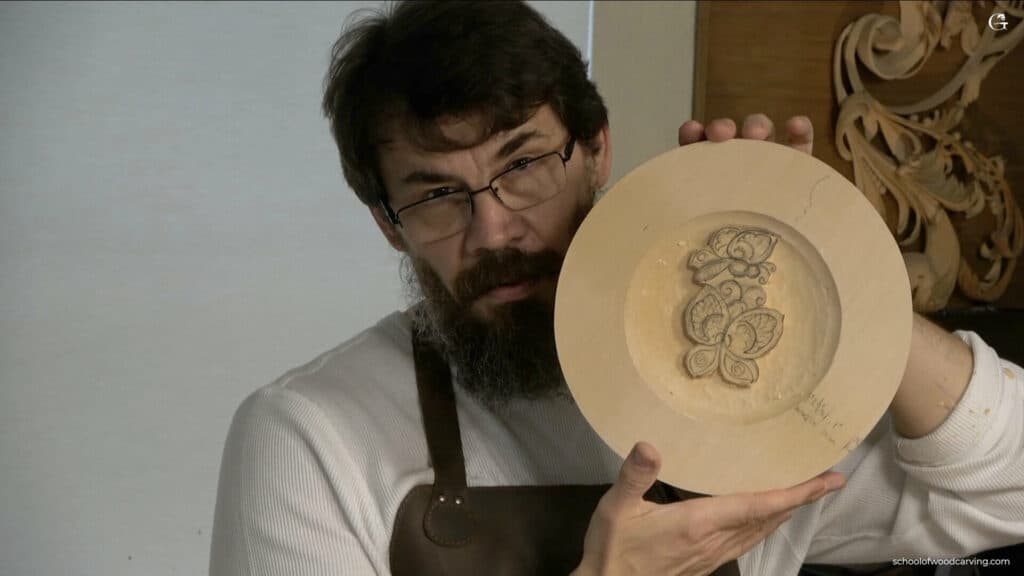
Alexander Grabovetskiy, woodcarver, School of Woodcarving · Published 2022
What does a wood carver mean by "what's left"?
Quick answer: In the third video of Plate with Butterflies 3 I outline my main movement and ask what's left. The answer there on the plate is a seven and cleaning. Other lessons put the same question before blending, undercutting, a tendril or a stem.
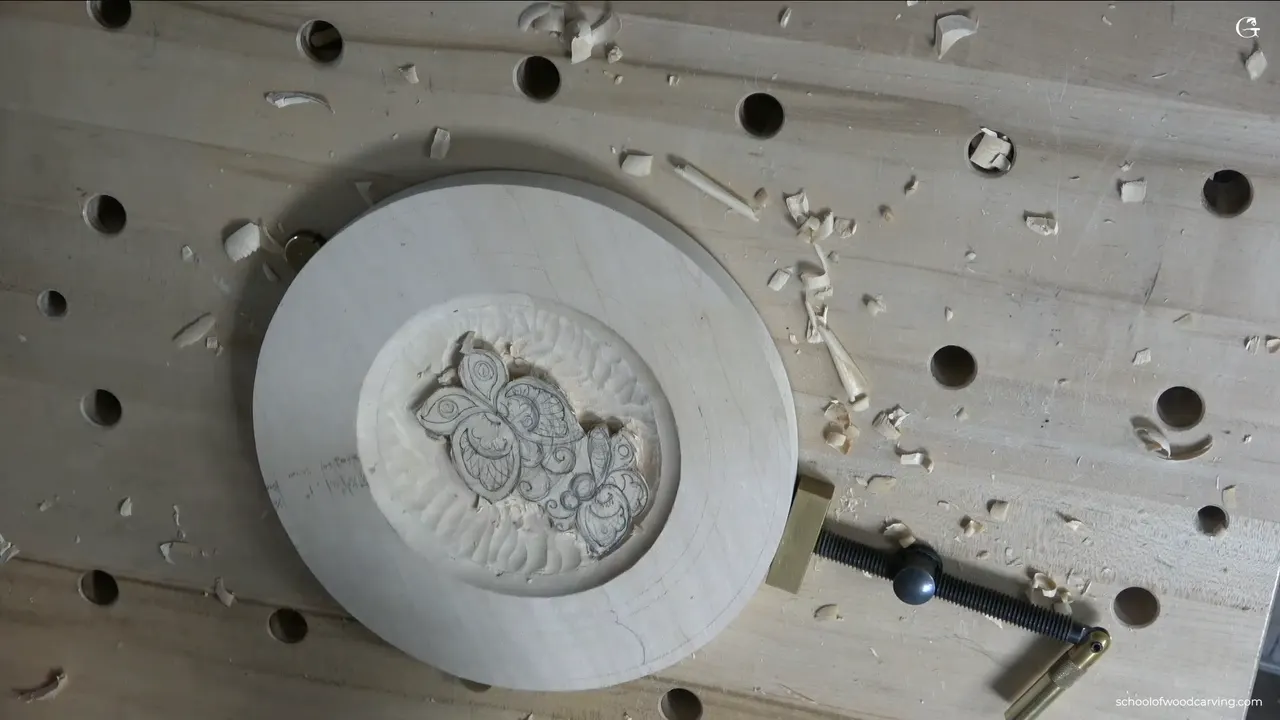

In Plate with Butterflies 3, video 3, I outline my main movement and ask what's left. Number seven and a clean-up are my answer on the plate. In other lessons it comes up before blending, undercutting, a tendril or a stem.
Have you walked a knife around every butterfly on a plate? Can you see one spot that still holds a chip? Then you know where I ask. Start with lesson 3 of the butterfly plate, and the lessons below show what I name when a job is half done.
What did the first two videos of lesson 3 leave behind?
One job ends in video 1. "Okay, so I'm happy with that step," I say. Next, "don't worry about all that mess around." A cleaner look is for later: "we're gonna need that later to make sure it's just really clean."

Near the end of video 2 comes "Now all I have to do just the clean that thing." A number seven or a spoon does it, I say. The video ends on the waste. "Let me remove that waste as much as I can." And "if it does not fly out. Recreate the cut and that should fly out."
What was left after the straight down cuts on the plate?

Another undercut opens video 3. "The whole line pretty much it's gonna be undercut," I say. Then "I'm gonna do A few times" and "my antenna I'm gonna be straight down cut 90 degrees." "I don't want to attempt that in one cut," I tell you. I mean to "create multiple cuts."
The knife can take off the majority of the waste. "That you can see it's a straight down cut." Then I look for a way to show you: "Let me try to find the right angle for you." And "Hope you can see that better."

Next up is the number nine. "I can probably grab number nine," I say, to "just preliminarily remove some of the material" and get "little closer to those lines." Straight down, "just like that." And "that way it's going to be a lot easier for me." Depth is "about a quarter inch" (6 mm).
Some things stay untouched. "I do not touch the design yet," I say, and "I'm not working those lines yet." The outline is the main movement, "so now what's left?" Then comes my answer: "It's pretty much just use number seven."
A spoon number seven would do, and "you can use number five if you want to." It is "only cleaning process." The cleaning goes "to the line just to the line."
Is a rough surface all right at that point?

I call it "absolutely all right" and "at this point, it's okay." And "A lots of it's going to be gone with the secondary design," I say, the one I mean to put "on inside."
Then one spot: "the last spot I've got is just that spot." Next comes a check. "Double check depth all around," I tell you, and "just make sure it's about the same depth."
"If you need to create little deeper cut please do it." Suppose you "overdone it and just got little too deep on one of the areas." Then "you have to probably do exactly the same all around." The depth is not fixed either. "It doesn't have to be quarter," I say. "Like I said keep an eye the thickness of your material what you're using." And "Do not overdo it because we still have to create some carving and inside also."

A slip shows up. "Oh, I've got the wrong knife," I say, and "let me get the right knife." Of the cut itself: "I can recreate that cut as long as I'm holding the same angle." And "I should be okay."
What stays for the facets and the back side?

"Spend your time remove some of the facets," I say. "But don't be too crazy about it." "There's gonna be lots of movements on inside," I say, and "just give a cleanup job."
"It's gonna be really beautiful 3-dimensional project," I say, "somewhat simple, but still beautiful." Then "That's it for now until the next step." A last verdict: "So it looks in my opinion already really good."

The back side comes last. "I have to keep an eye," I say, and "I do have some carvings on the back side." Most of that carving will be removed anyway. The edge needs work, and "We still have to work on an edge." It gets "some kind of shape" and we "flip that upside down" later.
Which lessons name cleaning as the last job?
Floral and Molding 14 starts with a close question. The first video says "I think maybe I'll just finish it," even with simple movements, and "what's left to do on that piece." My count is "only those two guys to do" then "just clean up and clean up and clean up" then "of course, paint." Those two are "small acantuses." And "just in case, if you never carved that," I'll show you.
The third video of lesson 13 in that course calls "the main idea of that piece" "pretty much achieved." Then "all what is left for me, it's just to clean." The rest, I say, "you can probably do yourself."

A flower lesson has it too. For Hashemi Flowers 49, video 8, the job is "just to clean, just to refine all the petals." "I'll do that off-camera." And "you don't need to see all the steps of cleaning." For it I name "small tools like that, like number five."

Roman acanthus has it in lesson 16. The fourth video has "what's left, we can just clean on inside." Then comes the tool. "We use probably just a number three," or "I could use number four, 10 millimeters" (0.39 in). Of the way in, "I like to work across the grain" and sometimes "a 45 degrees angle and just slice it to the final cut."

Another sits in Venice Room 37, video 3: "what's left is just the cleanup on that element." Then "overall element, it's just looking really good." And a try with the sandpaper: "Let me use just the sandpaper," I say, "just to see how nice that is."
A second workshop, 78, calls it "just the finishing up touches, pretty much what's left." That was video 8. Next comes "Let's see how easy it is" and "now it's got to look more or less like finished."

Lily Box has it in lesson 7, video 13. "All that's left, just the blending." For that, "Number 7 will do, and 6 millimeters" (about 1/4 in). I add "I can feel if there is some roughness" and you "can feel it with the fingers."
When does a cut come before the cleaning?
At times the job I name is a cut. Take Furniture Panel 27, video 3. "What's left to do?" I ask, and "I need to undercut right underneath of here." The tool is a "really tiny, small spoon."

A size comes in Furniture Panel 36, in the first video. I want it to feel like "it's a tendril, not like a leaf," which means it is "not gonna be more than one and a half millimeters" (about 0.06 in). "That is gonna be my boundary," I say. I'll use "the same tool what I used previously," a number nine of "six millimeters about quarter inch."

Over in Maine class 14, video 3: "The last part what's left?" First comes "I need to work on my stem." That one waits, "a little later because anyway you don't see what is going on on inside." But "this wall is visible" and "I need to undercut it a little better."

The same class has it earlier, in lesson 9, video 3. "So what's left," I ask. "I need to lower this side closer to the center because this little too high." I name a "flatter tool maybe even."

Cabernet Sauvignon 6 is a tray lesson, and in the third video I put it as "what's left for me to do" and the answer is "just work around the wine." An extra idea: "I can excavate this section." I'll use "number 11 and three millimeters" (about 1/8 in), "if I can find one."
Greek Acanthus 11 plans a V-tool in video 3. "I'll get inside and just make cleaning cuts," I say, and "Just remove all the junk, what's left." Greek Acanthus 9 names my V-tool as "small one, three millimeters, and still 45 degrees," for "remove what's left after the back bend." In lesson 12, video 1, I say "let me take again number 12A V tool, which is a short bent." Then "remove what's left."
Corinthian work puts it in lesson 5, video 4: "I'll take just a small number nine and use also the side of my small number nine and remove extra material what's left in those corners."
A skew cut comes first in Venice Room 71. Then, in the first video, I plan to "take care of all what's left right now after my skew cut." A straight tool "not going to cut it," I say, so I name a spoon of "Four millimeters." I add "to be really mindful how much material I have."
Can what is left be a plan?

In Hashemi Flowers 14, video 2, I warn "be careful with thickness right here." My figure is "about 1/16 of an inch right now is what's left," or about 1.6 mm. "So I don't want to overdo it." A plan sits in video 5: "Now I have to blend in the ridge with what's left after this one."
A drawing comes in Venice Room 58, video 11. "Right now I've got quarter inch" (about 6 mm), I say, "So that's what's left." The walls are "really rough." One option is a cut "called like a keel" and "It's still going to cast some shadow."
A chunk is the answer in Venice Room 85, video 11. "My drop going to go all the way to the backside of it," I say, and "this chunk is actually what's left on that side."
Divisions are the job in Venice Room 74, video 9: "just to get the right divisions." I say "we've got three main divisions on this one." And each one is "divided in three also."
A wavy field is in Venice Room 139, video 2: "what's left is just the concaves and convexes" and "everything's supposed to be kind of wavy." The leafage around, I'm going to do "off camera." A different line sits in Roman Acanthus 8, video 3: "I don't worry about what's left inside." And "I can always take small gouge again and remove it."

The butterfly plate carries the idea in other videos too. Back in the plate course, lesson 10, video 3, names "the last part," "those cuts, which is really easy actually." The cut is "almost no angle, almost like 90 degrees" and "not that deep," about "half a millimeter or so" (1/50 in). My question in lesson 2, video 2, is "how much space do I have?" The figure is "approximately 5 inches" (127 mm) "and maybe 1/8."
The same course has one more, in lesson 8. In the third video I say "I'm ready to do the next detail, which is not as complicated whatsoever." Then "just to work on this leaf right here" and "some leaves are sticking from underneath of the flowers."
Which videos have the phrase, and which job stays in each one?
| Where I said it | Still open in that video |
|---|---|
| Butterflies 3-3 | A number seven, and only the cleaning |
| Plate lesson 10-3 | Straight down cuts, almost 90 degrees |
| Plate lesson 2-2 | How much space sits on the inside |
| Floral 14-1 (molding) | Two small acanthuses, then the cleaning |
| Floral 13-3 (molding) | Only the cleaning, with the rest left to you |
| Hashemi 49-8 | Refining the petals, a number five |
| Hashemi 14-2 | A thickness of about 1.6 mm |
| Roman Acanthus 16-4 | Cleaning the inside, a number three |
| Venice Room 37-3 | The cleanup on that one element |
| Venice 78-8 | The finishing up touches on a piece |
| Lily Box 7-13 | Only the blending, a number 7 |
| Furniture Panel 27-3 | An undercut with a tiny spoon |
| Furniture Panel 36-1 | A tendril of no more than 1.5 mm |
| Maine class 14-3 | The stem, and one wall to undercut |
| Workshop 58-11 | A quarter inch between two points |
| Venice 85-11 | A chunk on one side of the drop |
| Workshop 74-9 | The right divisions, three main ones |
| Cabernet Tray 6-3 | Working around the wine on a tray |
| Venice Room 139-2 | The concaves and convexes, kind of wavy |
Which of these is nearest to the job on your own board? Every video named here sits inside one tuition plan, and the butterfly plate course page holds lesson 3 with its three videos. My sizes come with my own figure first, and a figure in inch or millimeters beside it when a conversion helps.
How it's done
- Outline the main movement. The design lines stay alone for now, and the outline comes first.
- Reach for a seven. Spoon or straight, a seven does the cleaning, and a five works too.
- Stop at the line. The cleaning goes just to the line.
- Look at the depth. Check it all around so the wall sits at about the same depth everywhere.
- Hold one angle. A cut can be recreated as long as the same angle is held.
- Mind the back side. Back-side work means a close eye on how deep the front goes.
Frequently asked questions
Which tool does the plate need once the main movement is outlined?
I name a number seven, spoon or straight, and a number five works too. Cleaning to the line is the job there. I do not touch the design yet, and a secondary design is still to come on the inside.
Does a rough surface matter at that stage?
I call it okay at this point. A lot of it goes away with the secondary design on the inside. Depth gets a check, and I tell you not to overdo it, because the inside still needs some carving.
How much depth does the wall get?
A quarter inch (6 mm) is a figure I give in this video. Later I say the depth doesn't have to be quarter, and your material's thickness is what to watch. My own plate has carvings on its back side.
What to carve next