
Alexander Grabovetskiy, woodcarver, School of Woodcarving · Published 2022
How many flowers should you draw in a carving design?
Quick answer: The flower count is a number I check while the design is still a drawing. On my butterfly plate, lesson 4, I counted six flowers, said six is outside the Fibonacci sequence, and planned a couple more. Other lessons of mine count leaves and movements too.

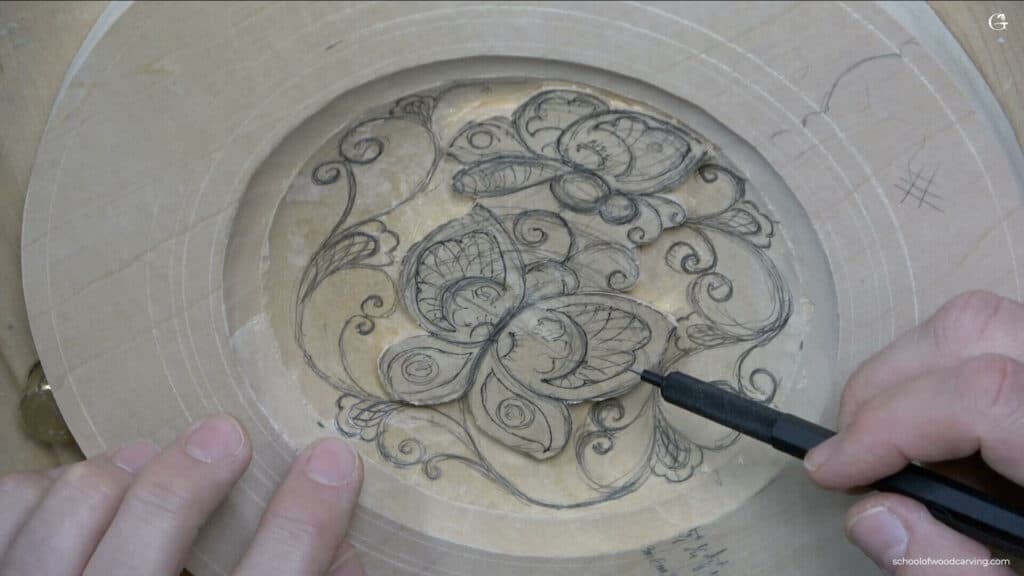
The flower count is a number I check while the design is still a drawing. Lesson 4 of the butterfly plate, video 2, has me counting six flowers on a drawing, and six did not please me. Other lessons of mine count leaves, movements and petals, and they land on other numbers.
Have you drawn a few flowers around a carving and wondered whether the number is right? Can you point at each one and count them out loud? Then walk with me from the butterfly plate into other lessons, and see where a count held and where I changed the drawing. All three videos of this drawing sit in lesson 4 of the butterfly plate.
Why did six flowers bother me on the butterfly plate?

Six sits outside the Fibonacci sequence, and I said so out loud. The flowers came first, though. I told you I wanted stylized flowers, in a style I called common to the northern, "Nordic I should say," of the 8th and 9th century. Each flower sits about three millimeters (about 1/8 in) from its line, and I said I would do exactly the same on all of them. At one point I turned the plate around so you could see how it is supposed to look. "You can see just doesn't look right," I said, "but once you just rotate that it becomes right." Then a reminder: "please keep in mind. It's not parallel projection."
Next came "let me see if I missed anyone" and I counted out loud, one through six. "I don't like the idea that you have only six flowers like that," I said.

"You probably guess why?" I asked, and gave the reason in the same breath: six is not in the sequence. Five or three, I said, would be fine with me. Eight is the next number up, I said, and "I have to stick somewhere a couple more." A plan, nothing more, and the video ends on it.
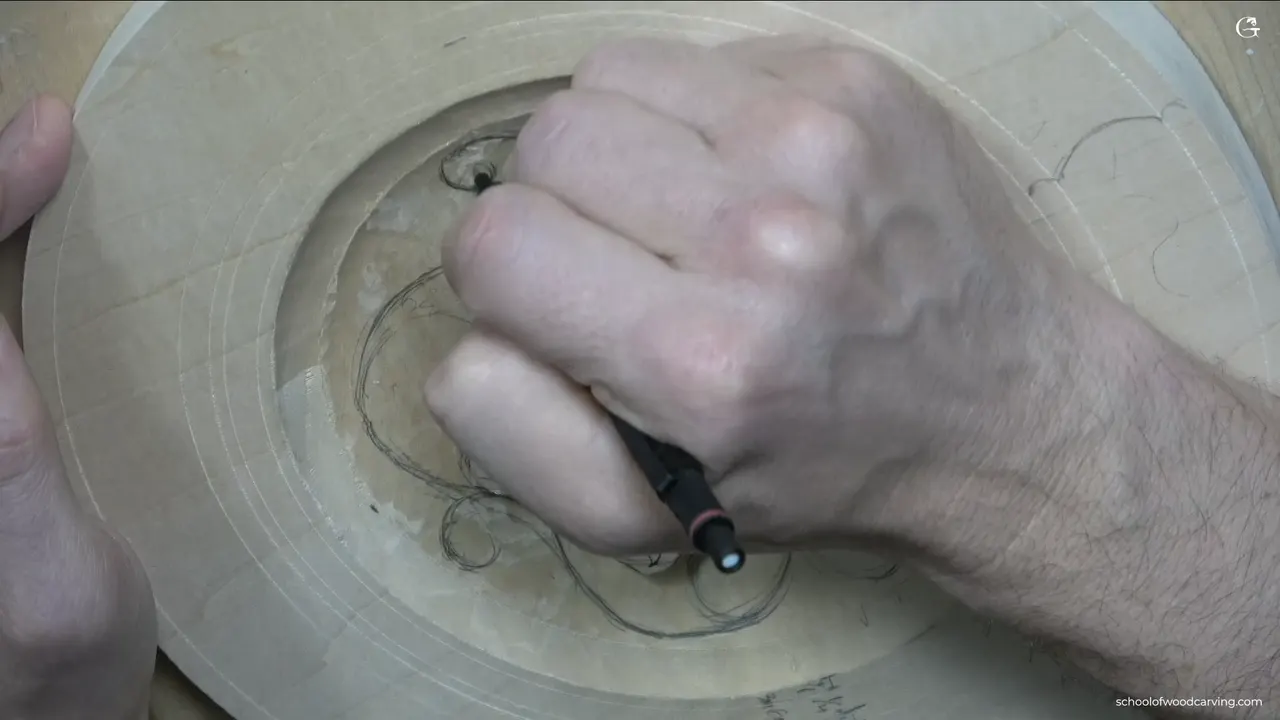
Before I drew any, I counted again, in case I had "miss calculated." Six again. My words after it were "so let me do a couple more."
What happened to the count in the next video?

The next video has another count, and it reached thirteen. "So we've got right to the sequence," I said, "Fibonacci sequence, of course." Two short lines follow. "Don't have to." And "If you don't feel comfortable with that, don't do it." Next I added "In this case. Nobody's gonna count really."
Just before that I had a different worry. Two of my flowers looked too much alike, "too similar" and one of them could shrink to something "much smaller." And "let me put marker before I forget," I said.
Which other numbers went on this drawing?

Flowers were not the only numbers. Video 2 opens on a shape I wanted a little bigger, "about 10 millimeters or so" (0.39 in). Pairs of curls come next, and each pair gets a split: one curl takes 40 percent of the space, its partner 60. You do not really have to calculate it, I said. The pairs that follow got the same split.

Gaps got numbers too. Near one shape I planned to stop about 1/8 of an inch, about three millimeters, from the line. Between neighboring shapes I left about a 16th of an inch, about a millimeter and a half. "Leave that space. For the cut," I said, and a separation cut would go in there. Sizes for the small volutes came in video 1: five millimeters (0.20 in) at the most, then six (0.24 in), and the smallest about three (0.12 in). On gaps, that video says "pretty close to 3 millimeters" is enough, and I said I should be okay with that. The plate itself is 10 inches (254 mm) across. One line did end up "a little too close to this line." "Maybe it's good," I said, and "let's leave it."

One size went too far. I drew a volute and wondered whether it could get "even bigger." But on the other hand, I said, I see the size of the head, and the size of the volute is about the same. About the head I said "I don't want to lose it" and about the whole thing "that is not good." I planned to make it smaller. The idea, I said, is for the butterflies to stand out from the design, and "you really have to surround with the smaller details." It is "the law of space again." My design videos cover the space around the shapes, and I pointed you to that segment.
How do I count along a line to find 60 and 40?
I count parts along a line, and the usual count is six out of ten. Venice Room 41 (video 12) puts the golden ratio at "62 parts out of 100" and then "Or simplified ways, six parts out of 10" (lesson page).
In Roman Acanthus 5, video 1, I took a line and divided it "in 10 parts like we did before." "You count about six parts down," I said, and "the edge of the eye will be exactly at the six points right here." For a quick version I said to "just divide that in half and just move down a little bit." The middle line in Venice Room 65 (video 10) gets the same count. "I'm going to count six parts from this point and move that direction," I said, and added "I'm not counting really, I'm just eyeballing."
Grape Vase 2 says it again, in video 5 (lesson page). "If you take this point, count to that point, and count to this point," I said, "this is going to fall approximately on the 62%" and the other piece is "38%." Then "Just eyeball it, okay? It doesn't have to be exact." Vase 1, video 2, adds "62%, which is a golden ratio if we count 100% point to point" and "we can use those sizes to fill our piece." The curls on the plate use that kind of split.
How did I count leaves and movements in other lessons?

The plainest case is the grape vase. In Grape Vase 1, video 11, I said "Now let me count," started from one spot, and ran up to eleven. "I need, I guess, one more somewhere," I said next, and that I can probably "just stick somewhere right here." Later in the same video came a plan to count "one more time" and "I still have doubts how many leaves I've got."

One count slipped my mind in video 10. "I forgot to count," I said, and my plan was to outline first and count after. In video 3 I said "I still have to count how many circles I have, what I have to fill" and "maybe I can get couple of them right there like a cluster." Soon after I said "all of those are like Fibonacci sequence." Of one spot I said it falls "approximately on the same line." "Not exactly, but pretty close."
The design lessons put numbers on paper first. In Furniture Panel 14, video 4, I said "if you know about the Fibonacci sequence, starts one, two, three, five, eight, and so on." In that design I was "trying to be pretty close to those Fibonacci numbers." My count was "three flowers" and "eight leaves" and I planned to count the petals once carving starts. Right after it came "I'm happy with this development right here."

Not every count comes out well. Venice Room 97, video 1, has me at six leaves, "and that is not good." My plan was another eye with a leaf under it, and I added "I do change on the fly, which I think it's okay."

Nine is the count in Venice Room 99, video 5, "which is not Fibonacci." "Maybe I should just eliminate that completely and just leave those two." Next came "I'll just get rid of it" and then "now I am removing it. That's called just a process."

In Byzantine Acanthus 1, video 1, a count came out right. Seven movements, I said, "and the main goes back, eight." My words for it were "those are Fibonacci movements on this side, on the first layer."

The Maine class, video 2, has "Let's count" in the middle of a line about flowers. A little later came "I want to make sure it's gonna be by Fibonacci number" and even if nobody will see it, I said, "it's gonna bug me if it's not."
What do petals and seeds have to do with it?

In Hashemi Flowers 35, video 3, I talked about nature and said "You can subdivide as many parts as you wish." "But I like to be really close to nature." "If you're going to count the flowers," I said, "as far as I know, it's always close to the Fibonacci number." I hedged it myself: "I'm not saying that's the absolute truth" and "at least if it's a small subdivisions like this." Five works, so does eight, I added, "on and on and on." Further on I pointed ahead: "I talk little more about Fibonacci numbers and sequence in another workshop, the furniture panel."
The design course goes further. In Design principles 3 I said "if you take a flower and if you look at the flower and count how many petals it's going to have, it's always going to be on the Fibonacci sequence." Then "five petals, eight petals, 13." The sunflower comes next. "Do you know how many seeds there are? Fibonacci sequence, no joke. Count that."
The same video adds the numbers out loud, from "3 + 2 = 5" and "Now 3 + 5 = 8" up to "eight plus five, 13" and "Now 13 + 8 = 21" and then "on and on and on."
Is counting required at all?

No, and I say that in more than one lesson. Hashemi 35 goes on from the petals. "It doesn't have to be." Then, for anyone who does not like Fibonacci numbers, "just feel free, create whatever you feel is going to look better." My own view follows. "In my opinion, if I can get closer to the nature, well, I think it's closer to the nature with Fibonacci numbers. It's going to look better."
The tray of blessing lesson skips a count. Cabernet Sauvignon 5 (video 2) turns to separations on a small scale. "You can't put too many," I said, and "you could count, but I'm not gonna do it this time. I just gonna express myself."

A rule and its loosening both sit in video 1 of the butterfly lesson. The golden ratio came first, with one space at "approximately 62%" and the other at 38%. Then I went back on it. "You really don't have to stick to that rule in that type of carving." Greek and Roman culture, I said, "really stick to those rules" and in this case "it's not really a big deal" and it is "still gonna look nice."
Advice about the drawing itself sits in video 1 of lesson 4. "Even if you gonna be able to print that I still highly highly highly recommend to practice to draw." The style is "pretty much repetition of the same movements."
Some counts are not about drawing at all. Hashemi Flowers 11, video 7, has me asking how many mistakes I make. "I don't know. I didn't count." In lesson 5 of the butterfly plate, video 1, I pull toward myself with the blade outward. I said "you can count if you wish" and "I kind of like to count to approximately like 50." Later came "I lost my count and well" (lesson page)

Which lessons held a count, and what did each one show?
| Where I counted | What the count showed and what I said |
|---|---|
| Butterflies 4-2 | Six flowers, a number I disliked, so more planned |
| Butterflies 4-3 | A count that reached thirteen, no need to follow it |
| Grape 1-11 | Eleven leaves, and one more needed somewhere |
| Grape 1-3 | Circles to fill, maybe a small cluster |
| Panel 14-4 | Three flowers and eight leaves, petals to count at carving time |
| Venice 97-1 | Six leaves, not good, and a new eye planned |
| Venice 99-5 | Nine, not Fibonacci, and one removed |
| Byzantine 1-1 | Seven movements and the main one makes eight |
| Maine 2-2 | A count of flowers, wanted to match the sequence |
| Tray 5-2 | You could count the separations, but not this time |
| Hashemi 35-3 | Petal counts close to Fibonacci, as far as I know |
Which of these counts would you try on your own drawing first? Every video named here sits inside one tuition plan, and the butterfly plate course page lists the lessons with all their videos. My sizes come with my own figure first, and a figure in inch or millimeters beside it when a conversion helps.
How it's done
- Draw the flowers. Every flower gets the same gap to its line, and I draw all of them alike.
- Count them out loud. I say the numbers out loud, one through six.
- Check the number. Six fell outside the sequence, so I named three or five as numbers I would accept.
- Count once more. A second count, since I might have miscalculated. Six again.
- Plan the next flowers. The next number is eight, so I planned to add more somewhere.
- Let it go if it feels wrong. If the sequence does not feel comfortable, skip it, since nobody counts.
Frequently asked questions
How many flowers did I want on the butterfly plate?
Six did not please me. Three or five would be okay with me, I said, and eight is the next number. A couple more flowers have to go in somewhere, I said.
Why did six bother me in a count of flowers on the plate?
The Fibonacci sequence has no six, I said. A second count gave six again, and my next words were "let me do a couple more."
Must you follow the Fibonacci sequence?
No. The butterfly plate lesson calls it not required, and says to skip it if it does not feel comfortable. In Hashemi 35 I said to feel free to create whatever looks better, though I think it looks better with Fibonacci numbers.
What to carve next
- Plate with Butterflies lesson 4
- Plate with Butterflies course
- Plate with Butterflies lesson 3
- Plate with Butterflies lesson 5
- Grape Vase lesson 1
- Furniture Panel 14
- Venice Room 97
- Venice Room 99
- Byzantine Acanthus lesson 1
- Maine class 2
- Hashemi Flowers 35
- Hashemi Flowers 11
- Venice Room 41
- Venice Room 65
- Roman Acanthus 5
- Grape Vase lesson 2
- Design principles 3