
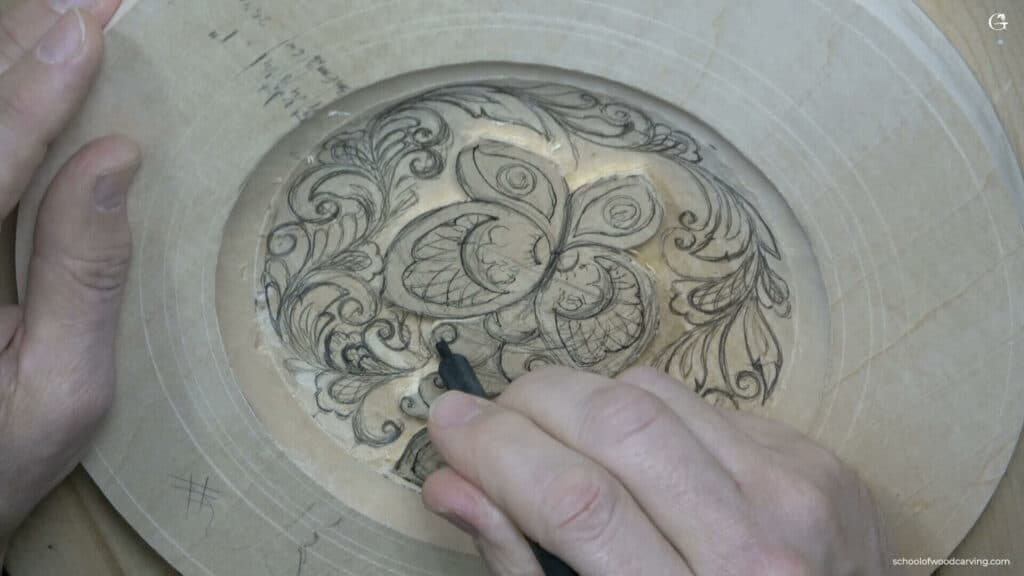
Alexander Grabovetskiy, woodcarver, School of Woodcarving · Published 2022
What does a wood carver mean by "negative space"?
Quick answer: Negative space comes up in Plate with Butterflies 4, third video, where I call some wider spots important and plan to leave wider openings. In Furniture Panel 8 it is a space I have to consider. In the grape vase course it sits at an intersection.
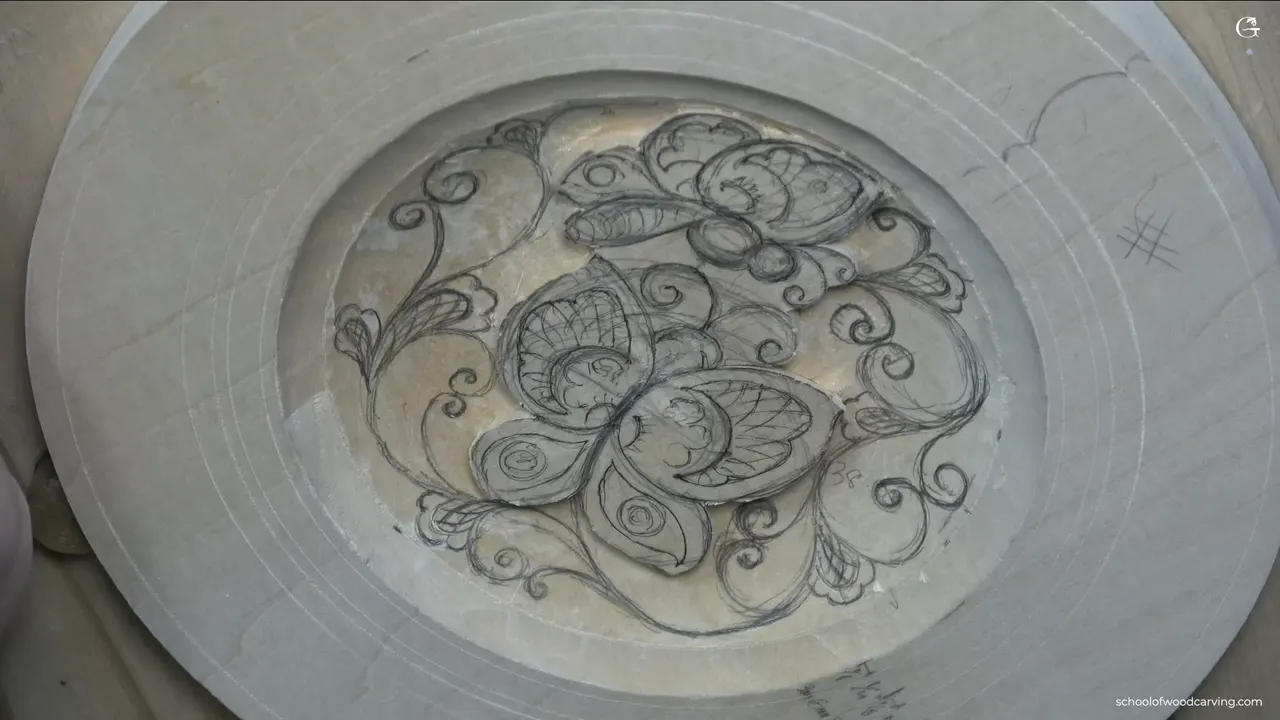

In Plate with Butterflies 4, video 3, I say the wider openings matter too, "like negative space." That is where I name it on this plate, and other videos of mine put the same words on ground that still waits for its design.
Do you have a pencil in your hand and a board with a design on it? Can you point at one open spot where nothing is drawn yet? Good. What follows is for you. It starts with lesson 4 of the butterfly plate and goes on to the other lessons where I say the same two words.
Where did I say negative space on the butterfly plate?
Earlier in that video I say I can create "that type of movement" "everywhere I can find the spot." Then comes "Maybe I'm not gonna do everywhere, maybe this is not good." The plan that follows is "So I'm gonna leave some of the wider openings like those ones."

"So I still need some kind of wide open spots," I say a few lines on. Then the line this page is named for: "But what I'm talking about some wider spots they also important, like negative space." I add "if you wish that term." Last comes "No, that's a good term negative space."
On another patch I say, "Well, I don't like this area, I really don't like this area." A leaf, I say: "Some kind of leaf, maybe grown this way." One spot I plan to leave open. The next one needs a leaf.

Two flowers come up in that video, and I like the spots but not the pair. "I kind of don't like that because they are too similar," I say. Of one of them, "I can probably make this one much smaller." What is left over needs an answer too, "And I have to fill that space with something else."
The tiny movements get their reason: "the why I do those real tiny movements, it's a law of space." Later: "a lot of those small details." How can you create one "without neighboring detail"? My answer is "You can't."
What space did I leave around the butterflies?
A boat comes up in video 1. "When you draw a boat, you really don't know how big or how small the boat is," I say, "if you don't have anything besides." The diameter of this plate is 10 inches (254 mm), and I want to exaggerate how big the butterflies look. "To do that" I have to fill the space around them.

The margin: "I will stay away from my line," I say in the first video, at "approximately three millimeters" (0.12 in). "I don't need to do more than that." The second video gives both units in one line, "about 1/8 of an inch about three millimeters to this line."
Between the small shapes the gap is smaller. "Even if you don't see that space," I say, and then "leave it." In my next words, "leave that space. For the cut." "There's gonna be separation cut everywhere," I say, and space "everywhere everywhere everywhere." The size I give is "about 16th of an inch about millimeter and a half" (0.06 in).

Of the volutes in those curly spots, "They don't have to be huge," I say, and "it's better not to make them big." Sizes follow. "Maybe five millimeters the most right here in this case" (0.2 in), then "about six millimeters" (0.24 in) for the next one. A third I say will be even smaller.

In video 2: "It's not done yet, so we need to do a lot more details." Neighbors get unequal sizes there. "If this one is about 60% this one is going to be about 40%," I say, and you "don't have to really calculate."
"The idea is those butterflies they got a pop out from that design," I say. For that "popping effect," I add, "you really have to surround with the smaller details in this case." Once more, "It's the law of space again."

How much room do I leave around a design?
Lesson 2 of the Furniture Panel course has a number in it. "We do have a 10-millimeter board" (0.39 in), I say in video 1, "so 10 millimeters would be good." The border is next, and I say I have to decide "how much space" it gets. And then "I want to leave more space around before I start carving."
"Let's say if we are going to leave about 20 millimeters or 3/4 of an inch," I say, and the unit pair is 20 mm (0.79 in) or 3/4 inch (19 mm). "It should be really good" and it gives "plenty of space to work with." Then, to finish the thought, "So I'll do just exactly 3/4 of an inch."
How did negative space show up on the furniture panel?
My furniture panel is in the Furniture Panel design course. In lesson 8, video 1, I say, "I also have to consider my negative space, which is this one" and the question is how it gets filled. "I don't know yet, but it doesn't feel really good because everything else just goes to the narrow."

My repair line reads "I have to fix this and make law of repetition from narrow to wider, even on negative space." I expect it to look "much better" if I do that. A little later, "Then I kind of unite this space and I unite the movement."
The panel returns in lesson 11 of the panel course. Video 1 starts with an if about "my second focal point" and goes on "I would like to get attention maybe to the negative space." Next, "Let me think." A plan follows, "Maybe just to put movement like that."

"I like that movement that repeats everywhere," I say a few lines on, and "anti-hero or the second hero of the story or of the design." Over in video 5, "That's still preliminary, like I said, the details coming up." Later in it comes a plan. "This space right now is going to serve me as a negative," I say, "because I'm still going to fill with the flowers and movements right here, all that space."

Can negative space sit at an intersection?
Vase with Grape Leaves 1 puts both words side by side. Its third video has "I still have to count how many circles I have." Next, "I hope you understand the logic behind what I'm doing." After that, "I've got the big circle and it's going to be positive space, but I've got intersection right here." Right after, "It's a negative space between those two."
Then "But it still falls approximately on the same line," I say, and "Well, pretty close." Then "Not exactly, but pretty close." Same video, a different thought. "If this is a main idea, a hero, I can make the small one like antagonist, like anti-hero, if you wish, right here." That one has "I can" in front, so it is a plan.

The seventh video is more open. "I've got some negative spaces," I say, and "I've got some spaces I could fill with some grapes itself if I wanted to." And "I don't know if I want to do it or not yet." The other idea is "movements on the inside." About that one I say it is maybe what I will do, "but not now yet."

Why do I say an empty spot supports the design?
Principles of Design, lesson 2, video 3, has a picture in front of me. "See what surrounds," I say. "So that guy has spot, which is empty spot." And "it's also part of design." Emptiness is also a support, in my words there, and "Space around makes big difference."
Now the fight. "That emptiness versus busyness, they also fight for the idea." One of them says "it's supposed to be empty" and the other disagrees. Later: "It's the idea behind it's still golden spot."
Principles of Design, lesson 4, video 3, brings a measuring word. "Empty space, also golden ratio," I say, and "How you fill the space, also." Then "Inside of the simple flower, also" and "Everything." The golden ratio has its own page if you want the number behind it.
On a live question and answer in April 2020 I say design process is "a big deal" for me. "I really am big about the spaces, the negative space, positive space, golden ratio, all the mathematics and stuff like this." That answer holds a story about a class with no right piece of wood. With the whole class, I say, "we developed on a blackboard the design" and "that was actually exciting project."
When do I fill an empty spot?
A spot can be plainly too empty. In panel lesson 14, video 3, one line reads "Maybe something right here." Next: "Otherwise, it's too much empty space right here." Further on, "I like overall movement, but I don't want to see empty space."

Lesson 12 of the panel, video 2, has the same worry. "Now I need to fill this space," I say there, and "That's too much empty spots." What I reach for is small. "I need to make smaller leaves and maybe filler, I call it filler flowers, which is really small, tiny flowers."
Another video is plainer. "Those flowers called filler flowers. So you fill kind of empty spaces with those flowers, but they always look beautiful." You find them, I say, "a lot of times on furniture, the period furniture."

In workshop 56, video 2: "Or maybe shell. Why not?" A section follows. "I'm talking about this section right here, it's a lot of empty space." Next, "I do not want to lose my movement, but I also want to do a division."
In Venice Room 70 it is video 9. "There is some empty space, which you don't see that on a camera, but I do," I say, and my plan after it is "a big concave right here." Of that plan I say "I think it's going to look good." One more from workshop 48, video 6: "I do have a lot of empty space, which I'm not too happy about."


Does a spot need filling at all?
At Venice Room 28, video 11, comes "I need to make the decision how I want to see that empty space." Then "Or I could fill it somehow."
A little later I say "there is multiple ways I could fill that space." Then: "The question is, do I need to fill it or not, that's the first question I have to answer, or I shouldn't even bug."
In workshop 31, video 12, the line is "I don't want to leave it empty." Next, "Although, sometimes it's a good idea to leave some spots empty, okay?" Then "But I think I should do something right there."
Workshop 99, video 5, adds a line. "Maybe I should just eliminate that completely." Then "I added this one, and now I am removing it." Of that I say, "That's called just a process." Next, "Just to create some open spot, open space" and "Otherwise, it just doesn't look too good." Furniture Panel 14, video 6, has an element I don't like. "I'll just get rid of it," I say, and then "I'm going to leave it empty like that."
In which videos did I say it? One table has them.
| Idea | Where I said it and what I did |
|---|---|
| Wider openings | Some of them to be left open, said in Butterflies 4-3 |
| Small gaps | A space kept between the little shapes, from Butterflies 4-2 |
| Room around | About 20 millimeters to leave around the design, in Furniture Panel 2-1 |
| Negative space | Something to consider and fix, from the panel course 8-1 |
| Second focal point | Maybe the negative space gets attention, panel course 11-1 |
| A space to fill | Still to be filled with flowers and movements, panel course 11-5 |
| An intersection | The one I called negative space, said in grape vase 1-3 |
| Spaces with grapes | Some I could fill if I wanted to, from grape vase 1-7 |
| Emptiness | Also a support for the design, said in Principles 2-3 |
| Empty space | Also the golden ratio, in my words, from Principles 4-3 |
| Positive space | Named beside it on the April 2020 livestream |
| Too bare | A spot where I did not want empty space, panel course 14-3 |
| Filler flowers | My answer to too many empty spots, from panel course 12-2 |
| First question | Whether to fill the spot or not, said in Venice Room 28-11 |
| An open spot | Something to create, said in Venice Room 99-5 |
Which open spot on your own board will you leave open on purpose? The butterfly plate course holds lesson 4 with all three of its videos, and this page shows the tuition plans. The sizes on this page keep my own figure first, with the other unit beside it when a conversion helps.
How it's done
- Leave wide openings. Some of the wider openings on the plate stay empty in my plan.
- Hold the margin. I stay about 3 mm (1/8 in) away from the scratched butterfly line.
- Keep the small gap. Between small shapes I leave about 1.5 mm, for the cut.
- Ask whether to fill. My first question at Venice workshop 28 is whether the spot gets filled.
- Add a leaf to a bad patch. Where I really dislike an area, I say a leaf is needed.
- Fix the narrow part. The fix on that panel is the law of repetition, in my words.
Frequently asked questions
What did I name negative space in Butterflies 4-3?
The wider spots I mean to leave open. I tell you in video 3 that they matter too, and that is where the words come in. A patch I really don't like gets another answer, and there I say a leaf is needed.
Is negative space a spot or the gap between two shapes?
Either one, in my words. In the grape vase course an intersection is a negative space, beside a big circle I call positive space. The furniture panel gives me a space to consider, with its filling still a question to settle.
How wide is the gap between shapes on the plate?
About 1.5 mm, a 16th of an inch (0.06 in), I say in Butterflies 4-2. The scratched butterfly line keeps about 3 mm (1/8 in). For the small gaps I tell you to leave that space for the cut.
What to carve next
- Plate with Butterflies lesson 4
- Plate with Butterflies course
- Furniture Panel design course
- Furniture Panel lesson 8
- Furniture Panel lesson 11
- Furniture Panel lesson 12
- Furniture Panel lesson 14
- Vase with Grape Leaves lesson 1
- Principles of Design lesson 2
- Principles of Design lesson 4
- Venice Room 28
- Venice Room 31