
Alexander Grabovetskiy, woodcarver, School of Woodcarving · Published 2022
What does a wood carver mean by "it doesn't mean"?
Quick answer: In Plate with Butterflies 6, third video, I say what fine does not mean at a butterfly's edge. In Hashemi Flowers 16 I say smaller tools doesn't mean too small, and in the floral course I say blow this piece is no explosion.
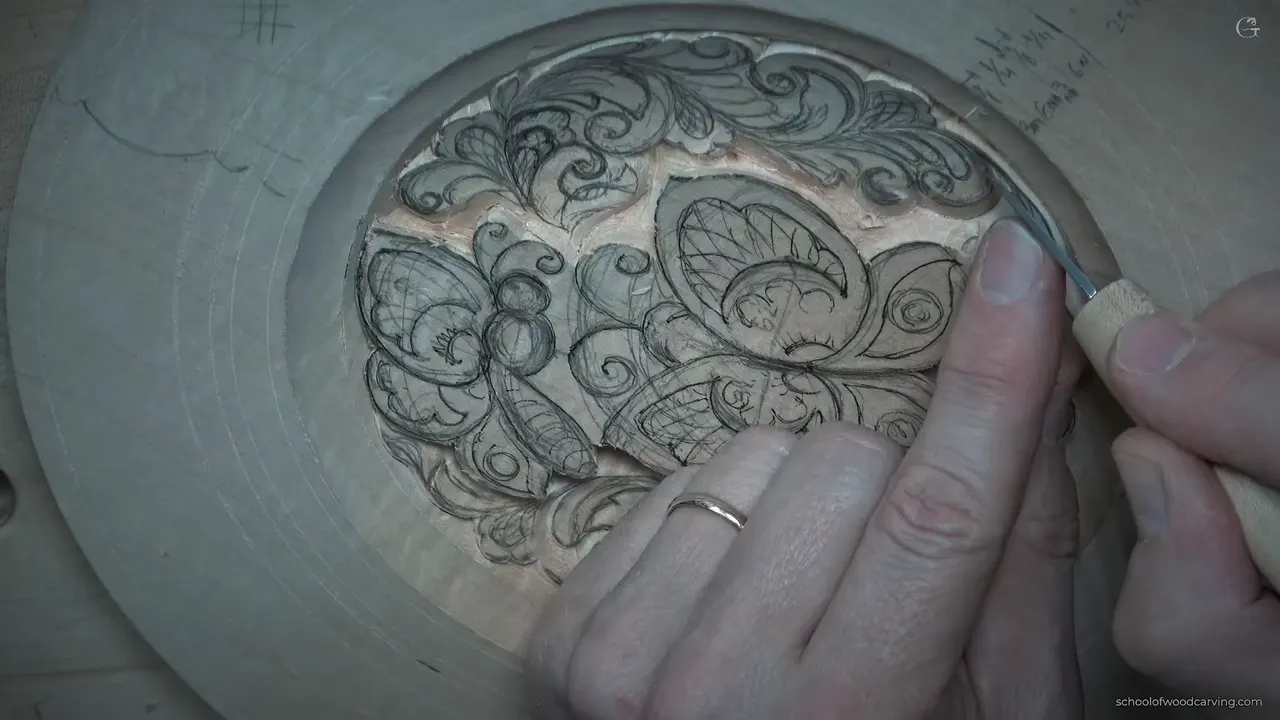

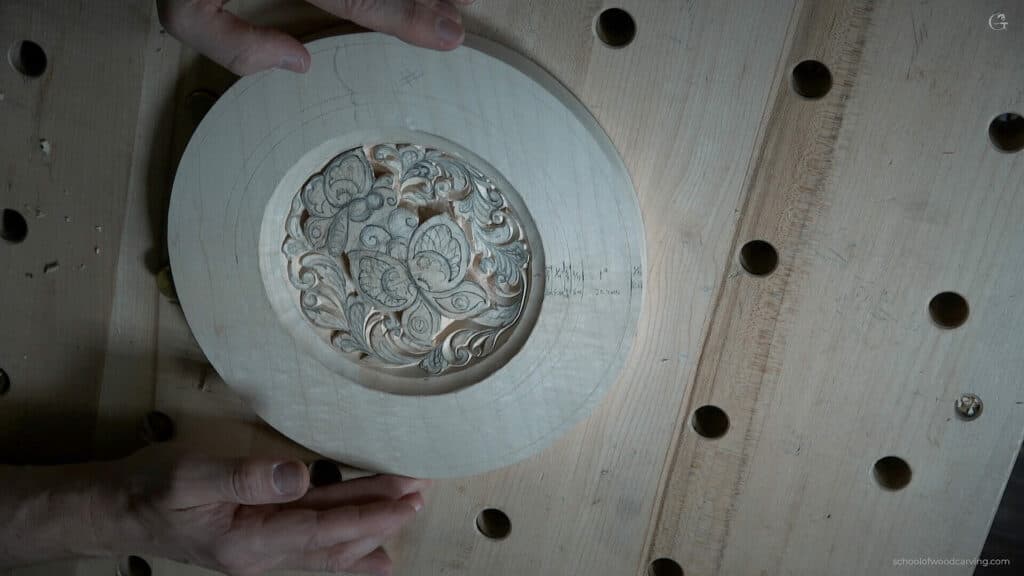
On the butterfly plate I stop in video 3 to tell you what fine does not mean when my knife meets a butterfly's edge. Other lessons of mine put the same words behind a word I just said, and the word can be small, round, good or quick.
Do you have a knife in your hand and a plate on your bench? Is there an edge in the design you would hate to nick? Good. What follows is for you. It starts with lesson 6 of the butterfly plate and goes on to the lessons where I use those words.
What does fine not mean on the butterfly plate?
Video 3 comes to the edge of a butterfly. "If I need to change the direction and it looks like I do," I say, and then "you could say again just grab the edge of butterfly, which is absolutely fine." Next come the words this page is named for. "Well, I don't want to when I'm saying fine. It doesn't mean you can just chop that completely but you know just little but it's all right."

A flower comes next. "Kind of don't like what happened right here with the flower," I say. "That's okay. We'll fix that movement little later. When I gonna attack flower, okay, so should not be a problem."
A little further on I plan a repair. "Let me actually put the line back because I really don't like what happened here," I say. Then "Maybe I can actually right away make a cut before I forget." Right after that, "That way I'm not gonna forget."
Video 1 has a separation I can cut right away. "I can do it right away. Although I don't have to but let me actually do right away. Why not?" Later in that video comes "create microcut really don't have to but it's gonna give me a little more movement."

Video 2 has the edge again. "I'm actually hitting the edge," I say, and that is why I am not working on those butterflies yet. Later it is "I don't want to do it too much" and "That's okay that stage." One area has a butterfly in its way. "This is somewhat challenging area," I say, and "I have that part of my butterfly right on the way."

Then "So I have to just be careful how I remove it. I have to take my time." Video 1 names what too much force does, and it is "If I'm gonna just create too much force. I gonna break this side. That's not gonna look nice."
In video 3 I look at two spots. "Okay, I don't like how it looks this area," I say. Then "I can always refine that." For another spot the words are "It doesn't look as clean" and then "I can go back and clean it." On a tiny curl I say "take a little bit more patience to clean everything around." The video ends with "that's it for now and next time we'll just do a lot more."

What else does a word of mine not mean?
Hashemi Flowers 16, video 3, has it with a tool size. The lesson has "Let me take a number eight, and I'll take 10 millimeters" (0.39 in). Then "Yes, when I'm saying smaller tools, it doesn't mean too small."
As an example of too small I give "If I were just to take 1/8 of an inch" (3.2 mm), "that would take me forever. Just too long." The size I call small is the 10 millimeters I'm using right now. "That's already small."

Round is the word in Hashemi Flowers 39, video 1. "Just make them round," I say, and "I'll use exactly the same number four." A completely round shape is not required. "Just semi-round."

Another one is in the floral course, lesson 6, video 2. "Okay, let me blow that," I say. "By the way," I add of "blow this piece," "it doesn't mean I'm going to create an explosion." The meaning is "just a hairdryer, a hair fan, okay" and after it, "Now it looks clean."

Vase with Grape Leaves 1, video 12, has a background in it. "That is the background," I say. Of the word coloring, I say that is not what I'm doing right now. "Although, it's kind of looking good already."

The Mastery talk of my Q and A course has a quarter inch in it. I say it was not something I pre-planned. "I see that before" and "about quarter inch, six millimeters" (0.24 in), "but it developed."
A diagonal comes up in the panel design course, lesson 7, video 1. "That would be called the baroque diagonal," I say, and the meaning is not a style, since "It's actually translated as a strange." Then "This would be the strange line."
In Flower Rosette 5, video 1, I talk about a knife. "A chip carving knife," I say, and its price is not cheap. "It's still expensive tools." Then "it's made for the chip carving style."
Does a good look mean a finished carving?
Hashemi Flowers 49, video 1: "It looks good to me," I say, and "it doesn't mean it's completely finalized and finished, but the overall main movement."

Two lines I need not connect are in lesson 8 too, video 1. "But there is a movement I can feel like this," I say. "But invisibly, I still kind of have to just do something like that and then raise this line."
A shadow line appears in the same design course, lesson 8, video 4. It is not 100% how I want to see it, I say, since later I will look at it "with a fresh eye" and see if I really like it or I don't like it. I may add something. "But overall, I do like it."
Chips are the topic in Furniture Panel 19, video 15. "Sometimes when you see really close, you see all those chips," I say, and that does not make it unclean. I do not want to spend too much time cleaning it all the way right now. "Later on, I'm going to look at it and see what needs to be changed, what needs to be fixed."

Greek Acanthus 4, video 3, has me saying not to worry if a cut is not as clean yet, since "that is not the final cut yet." Messy is no answer either. "You still have to try keep the final form. Try to maintain that."
Light is the topic in Roman Acanthus 16, video 5. "It just gives that extra light spot," I say, and my wood is not darker on both sides. "It's just the way the light hits." Then "let me turn one of the lights off, and you'll see what I mean."
Are perfect, shallow and quick what they sound like?
The Dining Table Apron course, workshop 16, has the word perfect. "Now, it doesn't have to be perfect because it's done by human being," I say. "Of course, you can make as perfect as you can, but it doesn't mean you have to make it sloppy or childish."

Depth is what Furniture Panel 17, video 3, talks about. "1/16th of an inch deep carving" (1.6 mm), I say, "It's still time-consuming operation." A shallow cut is not an easier one. "Some people don't understand," I say, and "It is absolutely not."

A rush shows up in the scroll saw video of Lily Box 1. "If you rush, you can make mistakes and get off lines," I say, and rushing does not make the cut quicker. The job still takes "about the same amount of time."
Speed comes up in Venice Room 39, video 10. "Some people don't really care about if they break anything," I say, and "All they care about how much work they've done in one day." As for me, "between the quality and speed, I would still probably choose quality."

Should a hard spot make you stop?
Venice Room 66, video 11, has a side I cannot reach. The lesson gives "I have absolutely no access from opposite side" and then "Let me try, maybe I'm able to some degree." After that, "But it's really not convenient." The next words are "But that doesn't mean it's impossible."
In Venice Room 59, video 4, "it is a little challenging because transition to the ceiling part." My answer is "I'll just use a back bend" and after that "And see, back bend helps me a lot."
Venice Room 28, video 9, has a spot that is deep. Its lesson gives "It is so deep now, it's almost impossible to excavate" and then "kind of harder, I should say. Yet it's a really, really nice shadow." The last words are "I like it, and I like it a lot."
In Greek Acanthus 2, video 3, the cut runs along the grain. "We're working with the grain, along the grain, and that's like I said before, it's not the safest," I say. "Be really careful when you're doing it." Then I say you can still do that, and to be really careful when you do.
Hazelnuts 2, video 3, speaks to anyone who never carved. Its lesson says "The carving itself is kind of challenging, especially for those of you who never carved." A beginner can pull it off "if you follow the right directions or right rules." Then "Don't take too much material at once. Keep some extra material, and you should be okay."
For Venice Room 8, video 6, I say "it's still going to be big but controllable." Then "It doesn't mean I can't do that. Of course, I am able to, but if I can eliminate a problem at the beginning, why should I create that?"
Do tools and skill make the carver?
Tools come up in Venice Room 3, video 1. "If you are designing a certain job, keep in mind what tools you have," I say. Then "it doesn't mean you're not going to be able to do with other tools, but if you do have a tool which fits perfectly to the job, you can really expedite the process."
A review comes in Furniture Panel 15, video 5. "It's too early for me to tell you the truth," I say. "Just because I've got those tools for free, it doesn't mean I have to give a really good or bad or whatever review."

In Hashemi Flowers 8, video 1, I say "Anybody can learn how to poke a chisel in a piece of wood, but the main idea of wood carving is to learn how to design for the chisel." A designer who draws well on paper may not be able to design for woodcarving, I say, "because it's absolutely different medium."
Video 3 of the same lesson takes a question. Poking wood with a chisel does not turn a person into a carver, I say. Taking wood from a block of wood is only part of carving. "It is ability to design for carving."
Extreme undercutting is the topic in Roman Acanthus 8, video 4. "I think the extreme undercutting creates the beauty," I say. "I know some of wood carvers, they don't approve extreme undercutting, and I absolutely do understand why. Because it becomes fragile." Fragile wood still makes beautiful things, I add, and "the crystal is really fragile."

Curly Kitchen Cutting Board 8, video 2, has a flat design. This lesson says "it's somewhat flat. That's the idea, actually, of this particular design, more like a flat carving." A flat design is still carving, I say. "It still looks beautiful. It just looks a little different from a classical."

In which videos did I say it? One table has them.
| Word | The video where I said it |
|---|---|
| Fine | Butterflies 6, video 3, where my knife grabs the edge of a butterfly |
| Smaller tools | Hashemi 16, video 3, beside the 10 millimeters |
| Make them round | Hashemi 39, video 1, with semi-round as the answer |
| The word blow | Floral 6-2, the hairdryer one |
| Coloring it | Grape Leaves 1, video 12, said about a background |
| About a quarter inch | Mastery |
| The baroque diagonal | Design course 7-1, where I name the two diagonals |
| A chip carving knife | Rosette 5, video 1, and what the knife costs |
| It looks good to me | Hashemi 49, video 1, beside a convex cut |
| A shadow line | Design course 8-4, where it is not 100% how I want it |
| Chips up close | Panel 19, video 15, and a clean surface that still has them |
| Not too perfect | Apron 16, with sloppy or childish beside it |
| A shallow carving | Panel 17, video 3, and the time it takes |
| Rushing | Lily Box scroll saw 1-3 |
| A tool that fits | Venice 3, video 1, and other tools |

Which word of yours do you want to fence off next? The butterfly plate course holds lesson 6 with all three of its videos, and this page shows the tuition plans. Sizes on this page keep my own figure first, with the other unit beside it.
How it's done
- Switch direction when the cut asks. Near a butterfly I say "if I need to change the direction and it looks like I do."
- Touch the edge only a little. My words are "just little but it's all right."
- Leave a flower you dislike for later. Of a flower I do not like, I say "We'll fix that movement little later."
- Bring the line back. The plan is "put the line back."
- Cut before you forget. The words are "Maybe I can actually right away make a cut before I forget."
- Return and clean a spot. A spot that does not look clean gets "I can go back and clean it."
Frequently asked questions
How far does fine go at a butterfly's edge?
Just a little grab, in video 3. Chopping a piece off the butterfly is not what fine means there. A little is what I mean.
Do smaller tools mean the smallest tool?
Not in lesson 16 of the Hashemi course, video 3. A tool of 1/8 of an inch (3.2 mm) "would take me forever," and I call 10 millimeters (0.39 in) "already small."
Is a good look the same as finished?
In lesson 49 of the Hashemi course I call it not "completely finalized and finished." In lesson 8 of the design course I say I will look again with "a fresh eye."
Is a shallow carving an easy one?
What to carve next
- Plate with Butterflies lesson 6
- Plate with Butterflies course
- Hashemi Flowers lesson 16
- Hashemi Flowers lesson 39
- Floral and Molding lesson 6
- Vase with Grape Leaves lesson 1
- Furniture Panel design lesson 7
- Flower Rosette lesson 5
- Hashemi Flowers lesson 49
- Furniture Panel design lesson 8
- Furniture Panel lesson 19
- Greek Acanthus lesson 4
- Dining Table Apron course
- Furniture Panel lesson 17