
Alexander Grabovetskiy, woodcarver, School of Woodcarving · Published 2022
What does a wood carver mean by a "beautiful tool"?
Quick answer: In part 3 of Butterflies 7 I grab a knife, say a deep cut near a higher part is almost impossible with the usual knife, and call this one a really nice tool, a beautiful tool. Part 1 talks about soul in a tool. Other lessons give the words to a rasp, a router plane and a tiny spoon.

In lesson 7 of the butterfly plate I talk about the soul of a tool, and in part 3 I call one knife a beautiful tool. Other lessons of mine give the same words to a number 11, a router plane, a rasp and a tiny spoon.
Have you ever picked up a knife and felt it settle into your hand? Do you have one tool you reach for first? Then you know what I am trying to say in this lesson.
What does it mean when I say a tool has a soul?
Lesson 7 opens with a glitch, and the flowers I carved earlier are lost footage. "It was my stupidity," I say. "I forgot to turn on microphone." So I plan to explain what I did, and I want to show you a couple more tools you could use on that project.
The knife from before was a Russian made knife. Any knife will do, and "doesn't matter what knife you use. It's still gonna work."

Next come the tools themselves. A tool is a piece of metal with a handle, and yet "some tools they do have a soul not like in spiritual sense." And "it's all depends how you look at it."
My example is a river stone. It looks like an unmovable object. Go down to the level of atoms and "you'll find out everything moves and you cannot move without the life." The Hebrew word for life is also translated as soul in the Bible, I add.
I add "I'm not trying to get you know religious." What follows is "you just get that tool in your hand and it just feels like part of your hand." One of those brands is one "I really admire really love." Of those tools: "It's really excellent." If you get the chance, "it will help you a lot" and "just get them."

Tools like these are made by hand. "You have to wait sometimes a month two months before they even get to that order."
Which knives were in my hand for the flowers?
Near the end of part 1 I say "let me work on it" and take up the small detailing knife. My plan is to pull it toward myself. A long straight pass worries me. "I feel like if I gonna continue just the straight cut like this I can break some fibers."

Part 2 brings out the two knives with "some kind of curvature." "It's just so awesome," I say, because "it has a border and that border is on the way sometimes." With them I can "attack this detail and it's not on my way." So these are "excellent tools you have for the cases like that."

A skew follows. It is for areas the normal knife cannot reach, almost impossible ones. "I'm saying almost because it's still possible but kind of painful." In that area the "detailing tool is excellent."

Why do I like one knife of mine so much? I tell you in part 3. From the side, I point to a part that sits higher. "With the normal knife for me," I say, "it's almost impossible" to get that deep cut, and then "but this one I can." Right after that come "really nice tool beautiful tool" and "Still kind of, you know, unknown tool."

The little blade rides low. "My knife is pretty low," I say. Raise it and "it's gonna be hard to create a straight line." Lowered as far as it goes, "it's much easier to create really beautiful and flowing line." I like this knife "because the blade is so small and tiny."

A stem runs beside one flower, and I do not want to destroy it. The sides still have to come off. "Just because I have a really sharp tiny point," I can do both and "still keep that stem." If it breaks anyway, "It is what it is. What can you do?"

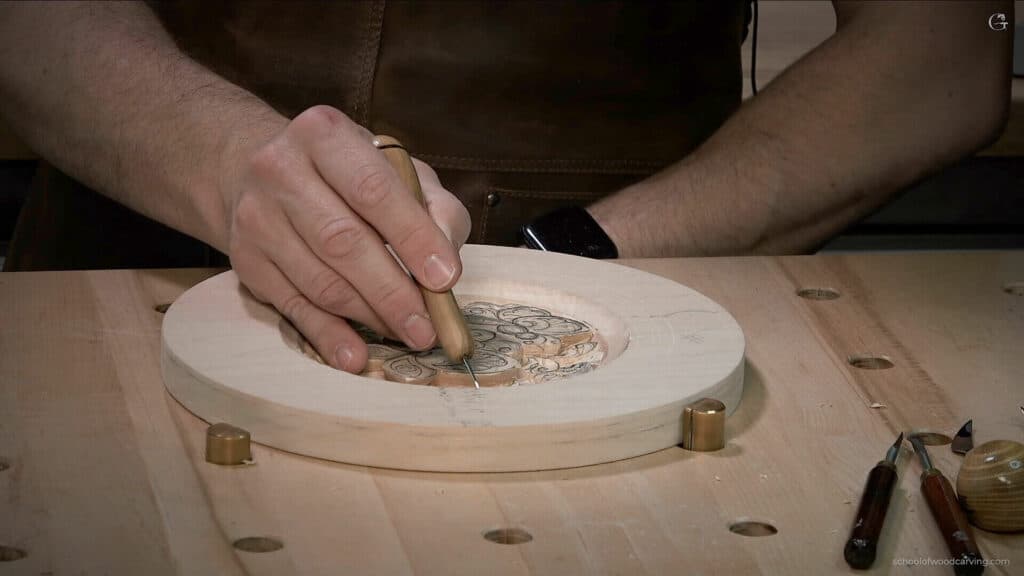
My grip is plain: "I'm holding that as a pencil" with "my hand placed solidly" and the other hand guiding. "I have a lot of control that way."

One more line explains why my butterflies wait. I want to make sure I feel my knife, and "every tool you got to use for a little bit before you really feel it."
What was I carving when I picked them up?
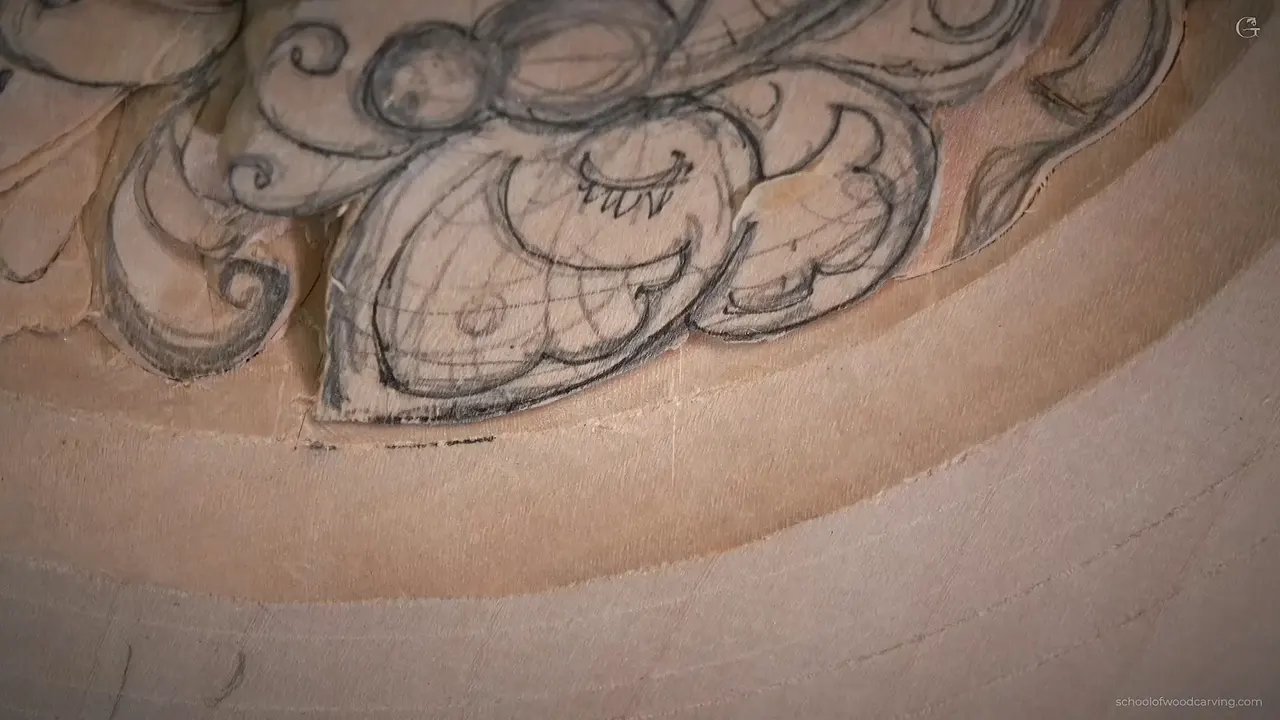
Part 1 retells the flowers I lost on tape. I outlined them first. After that I dug deep where each flower meets its stem, "just cast The Shadow." A couple of cuts came first, and then "really deep about 1/8 of an inch deep" (about 3 mm). I did that "everywhere. Okay, every flower."

The middle part is "supposed to be raised up" and the petals are "slightly below and exactly the same idea." At the triangle spot where petals meet, I try to go as deep as possible "because I would like to see that shadow dark spot." That is an eighth of an inch again, and I say three millimeters. My warning is "be mindful what you have another side."
The next step is "I have to separate them." Three petals, "one two three" and a cut right between them, "to make sure it looks like a flower." It's got to look like a flower. I will make it a little more beautiful later, "but for now just to create those separations." Later we put work on the inside.

The pencil marks do not have to be really accurate. "Please don't pull your hair over that." I say in part 2 "I want to make sure I'm removing that pencil," because "pencil creates a lot of mess." A second clean waits: "for now, it's good."
Around the same elements again, I plan a "little deeper cut in this section" because "I want to create that deeper shadow." A big chip sits there, "Just on the way, and I don't need it."
Why does the flower look so weird? I did not design it, and "I was not the author of those flowers." About the eighth and ninth century "it was a common detail. Ornament, you can find it on the outside of the houses carved on the boats" and I mean "early Vikings." That style, I say, was all over Europe: "Norman's style Slavic style Germanic Style."

Which tools do I call beautiful when a cut goes under?
Acanthus over Moldings, lesson 4, video 3, has "Gonna get the number 11 again." The size is "maybe two and a half millimeters" (about 0.1 in). "It's a beautiful beautiful tool." The brand is German, I say, and "I don't think you can find that brand anymore."

Over in Modern Acanthus 6, video 1, I say "I'm gonna take my beautiful the most beautiful tool which is number 11." A little later: "I'm after that detail," which is "supposed to go somewhat underneath."

On the Greek leaf, in lesson 6, video 4, I say I could take a knife again and remove the stuff. "It's easy, but there is a beautiful tool designed just especially for cases like that." This tool "works exactly the same like a knife, but I can get even deeper." Further: "I can undercut even more extreme."
My three undercutting tools in the Greek course, lesson 10, are a right hand, a left hand and a straight one. "If I can't get with some other tools, I would just use that." I also say "Beautiful tools for undercutting, but I'm not using it every day." And for me, "it's not everyday tool."

A tiny spoon earns the word in Furniture Panel 27, video 3. It is a "Really tiny, small spoon" with "A small tiny hook like this." A tool like that was "a common tool in 19th century" and "the new manufacturers, they don't do that." So "that's beautiful, beautiful tool for operations." Other tools can do the job too: "you're still able to get that undercut."
Another spoon gouge sits in Grape Onlay 6, video 2. My plan is "just that number three, spoon gouge." Then "really beautiful tool."

My number nine in Venice Room 54, video 5, is a different one. "This one is my favorite one," I say, and it is 6 millimeters (0.24 in) with "a really short end" and "it's a beautiful tool." Then "my favorite from quarter inches" and "I like it for some reason, this one, a lot."
Which tools get the word for how they feel in my hand?
My number five gets its turn in the Greek course, lesson 8, video 3. "Let me take again number five," I say. "I just love how it feels." My fingers lie right on top of the tool, and underneath it has "some slight roundish feel." Then "My hand's not as tired."

Venice Room 10, video 3, brings a rasp. "Let me use a rasp again," I say, and "maybe just make it a little smaller." Then I say "see what I mean" and "It's just a beautiful tool." It "doesn't leave any abrasive on the side of the wood, but it gives me a really good result."

Floral and Molding 2, video 1, wants a flat surface. "If you do have a router plane, it's such a beautiful tool, especially if you're planning to do something for furniture." Surfaces, I say, "are going to be absolutely dead flat."

In Furniture Panel 15, video 7, I say "Let me, again, try my beautiful tool and get on inside." The warning follows: "please don't fool yourself. Sometimes, that tool not going to go in some spots." And "I need to get a smaller blade."
During the April 2020 livestream I show a file, out of the box. It "gives me absolutely beautiful, clean cut" with "Absolutely no effort" and "It's just beautiful tool." The brand stays unnamed: "It's too early."
Does a beautiful tool have to be perfect or used every day?
Perfect, no. Another April 2020 livestream tells of old tools from a garage sale. A man brought a whole bag of them. "You're welcome to get any one of them for free," he said. I found one "which I really love" and "that's a really beautiful tool."
Of the same tool I say "It's a half a round, but it's not really good one." Rotate it on a board and "it's going to rock." A good gouge is the other case. Of a number seven I say "That is a really good gouge" and rolled on a board it "still going to end up at the same location."

A pointing machine gets the word in Furniture Panel 18, video 9. "I really don't need to, and I'm probably not going to use it," I say, and "it's almost overkill for this project." Still, "it is a handy tool." Next: "Beautiful tool." A "3D duplicarver in your hands," I call it.
A utility knife blade turns up in Furniture Panel 30, video 3. "I need to get rid of this paper," I say, and name "most beautiful tool called utility knife scraper. I mean utility knife blade."
Two more passages say it flat out. Greek lesson 11, video 2, has "Also really excellent tools. Beautiful tools." In Chamomile and Bow Rosette 3, video 1, I grab "my own number 2," a flat tool of 12 millimeters (about 0.47 in), and say "Beautiful tools" then "I'm not opinionated."
The soul comes back in lesson 11 of this plate. Of a right hand and left hand pair of knives: "it's just the nice tools USA made, and it just has some soul." And "Sometimes it's a really good idea to invest in good tools."

Which tool was which, in one table?
| Tool | Where I said it and what I was doing |
|---|---|
| A knife I grab | Butterflies 7, video 3, beside a higher spot on the plate |
| Number 11 | Acanthus over Moldings 4, video 3, and a German brand |
| Number 11 again | Modern Acanthus 6, video 1, with a detail going underneath |
| Undercutting tools | The Greek leaf, lessons 6 and 10 |
| A tiny spoon | Furniture Panel 27, video 3, with a hook on the end |
| A spoon gouge | Grape Onlay 6, video 2, a number three spoon gouge |
| A number nine | Venice 54, video 5, with a short end, 6 millimeters (0.24 in) |
| Number five | Greek leaf, lesson 8, and what it does for my hand |
| A rasp | Venice 10, video 3, with no abrasive left on the wood |
| A file | Livestream April 2020, the one with a clean cut |
| A pointing machine | The panel course, lesson 18, and why I may skip it |
| An old gouge, free | Livestream April 2020, with a half round that rocks |
| A scraping blade | The panel course, lesson 30, scraping paper off |

Which knife do you reach for first, and which one fits your hand best? The butterfly plate course has my knife work from lesson 1, and this page shows the tuition plans. Sizes here keep my own figure first, with the other unit beside it.
How it's done
- Try a curved knife when a border is in the way. A border gets in the way in part 2, and the knife with some curvature reaches the detail.
- Hold a tiny blade low. My knife rides low, and a raised blade makes a straight line hard.
- Hold the knife like a pencil. I hold it as a pencil, hand placed solidly, with the other hand guiding.
- Give a tool some use first. Use each tool for a while before you judge how it feels.
- Dig the stem spot first. Outline the flower, make cuts where it meets the stem, and dig that spot deep so it casts a shadow.
- Keep the stem next to your cut. A really sharp tiny point lets me clear the sides and "still keep that stem."
Frequently asked questions
What did I mean by a tool having a soul?
In part 1 of lesson 7 I say a tool can have a soul, and add "not like in spiritual sense." What I describe is a tool that "feels like part of your hand." A river stone is my other example, and I add that it depends how you look at it.
Which knife did I call a beautiful tool in the butterfly lesson?
One I grab in part 3. Seen from the side, a part sits higher. With the usual knife a deep cut there is almost impossible for me. I say "but this one I can," and then I name the knife a beautiful tool.
Is a beautiful tool always a perfect one?
Perfect, no. In one of my 2020 livestreams I found an old tool I love and call a beautiful tool, yet I say it is "not really good one." Turn it on a board and it rocks, I say, and I call it "not true gouge."
What to carve next
- Plate with Butterflies lesson 7
- Plate with Butterflies course
- Plate with Butterflies lesson 11
- Acanthus over Moldings lesson 4
- Modern Acanthus lesson 6
- Greek Acanthus lesson 6
- Greek Acanthus lesson 10
- Furniture Panel lesson 27
- Grape Onlay lesson 6
- Greek Acanthus lesson 8
- Venice Room lesson 10
- Floral and Molding lesson 2
- Furniture Panel lesson 15
- Furniture Panel lesson 18
- Furniture Panel lesson 30
- Livestream April 2020
- Venice Room lesson 54