
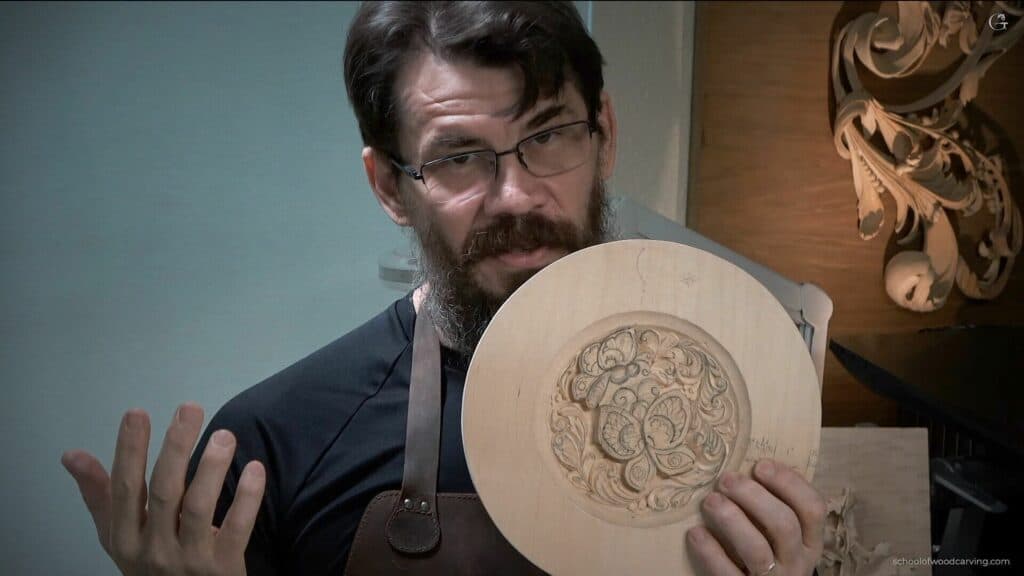
Alexander Grabovetskiy, woodcarver, School of Woodcarving · Published 2022
What does a wood carver mean by "advanced beginner"?
Quick answer: In Plate with Butterflies 7, third video, I call that style of carving advanced beginner because I'm showing a little more difficult techniques. Hazelnuts 8 gets really advanced from me. Beginner 2 gets really good, especially for the beginner, and the Maine class gets more advanced.
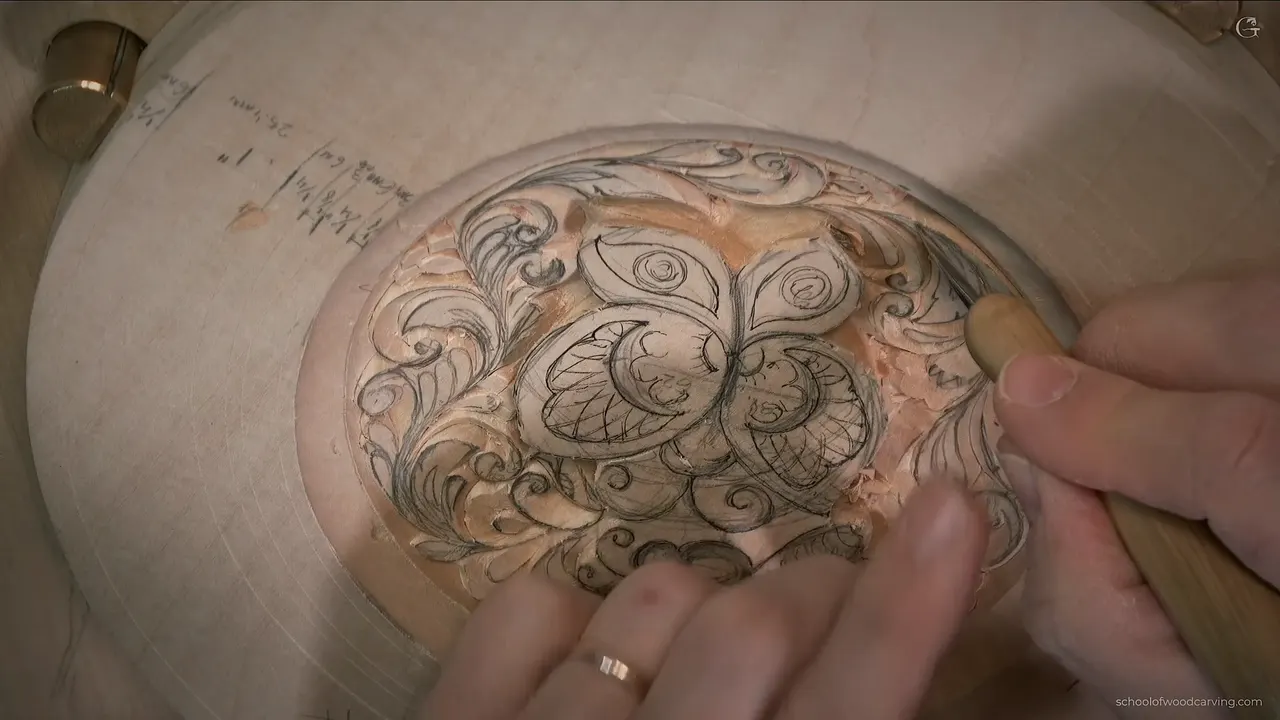

Advanced beginner is what I say about the carving style on the butterfly plate, in video 3 of lesson 7. Other lessons of mine say who a project is for in words like really advanced and somewhat advanced.
Is the plate on your bench a round one with a pencil drawing on it? Do you hold a knife that feels a little new in your hand? Good. This page is for you.
What did I say right before advanced beginner?
A question comes first. "And if you would ask me why I'm not doing my butterfly," I say, and then I give my reason. "I want to make sure I feel my knife." Another line follows. "Every tool you got to use for a little bit before you really feel it."
Next I talk about the style. Anyone who never carved that way gets this. "It takes some practice even if I call it somewhat beginners style." That is where the line for this page sits. "But I would say it's more advanced beginner."

What follows it is "On the way to more advanced because I'm showing you a little more difficult, you know, techniques." The next line is "So whatever I see that detail, I'll just go around."
What was the knife doing in the minutes before that line?
The video opens on shadow. "I'm after really deep shadow," I say. Then the left side. "In this case I've got little too close to the left side." And then "But it's okay. I can just get rid of those chips and it's gonna give me a really good and deep shadow."
"Let me actually excavate slightly," I say, on this side, and a limit comes with it: "Can't get too deep."

Next comes a plan. "In the next probably I'll just separate some of the details." "I still did not separate like, you know, this area needs to be removed." And "With the same knife. I'll just start exactly the same."
"Probably in this case I could do my separation because the knife is so tiny and small." I say "I can probably just a trace. Pretty much my main design" and then comes another thought.
"And you know what? I really like the idea." It is to take the whole thing out "without creating extra deep cut right there." Then "I'm not sure how it's going to look but what I can do I can grab" one of my other knives "and use that and see how it's going to look if I don't like it. I'll recreate that."

"Maybe not this one," I say. Then comes "No, I probably have to do that. Because I think it's gonna look better." Look at the knife from the side, I say, and "this part is a higher." With the normal knife for me, "It's almost impossible."
"But this one I can," I say, "just because of that movement." And "really nice tool." Later comes "And I like I like how it looks just like that."

Another part comes up. "See those leaves," I say. "They have inside some kind of movement also and that is gonna be excavated." Of the leaves I say "it's gonna be like a V cut." "I'm gonna take again my knife," I say, and "there's invisible center line and I'll attack that from the opposite side."
"And let me clean it," I say. "I'm not sure if you see that or not. This is the cut. I'm after." Then a separation could come. "Since I'm here, I can probably do my separation cut."

Other spots are next. "And whatever I have that detail in multiple spots," I say, "just do the same." One more is "right there in this section."
How do I hold a small knife on this plate?
I hold it like a pencil. "And by the way, see how I'm holding my hands," I say. "I'm holding that as a pencil." My other hand guides it. My hand is "placed solidly" and "I'm pinching that."

"That way I can get really really accurate cut." Also "I have a lot of control that way" and "I can do really clean cut that way."
At the end I say "It looks like that's pretty much it" and "the next time we'll work on more details." Last of all comes "I think it's developing more and more and looks nicer."

Who did I say the butterfly plate was for?
Lesson 1, first video, opens with "I would like to do another project." Next, "and that project gonna be somewhat for the beginners." And then "Maybe it's not necessarily for the beginners."
"It could be really good for any wood carver," I say, and I add a limit on the tools. "Limited with the tools you have" and then "you got knife and maybe just a couple gouges."

Lesson 4, video 1, goes back to it. "Like I said before that project," I say, and "not necessarily true for the beginner." Next come "good for any level of wood carving" and "just a different style." I kind of like the simplicity of it, I say, but "still it's gonna be somewhat complex."
Video 3 of lesson 8 has me speaking of "what I used previously on another beginner's class." And I say "So there's a no limitation what you can do it."
Which projects did I call not for a beginner?
Grape Onlay 1, video 1, has grapes in it. "Grapes are not easy," I say, and "to carve grapes, it's not that easy." About that project, "not necessarily for the beginner, although if you wanna challenge yourself, why not?" Later in that video I say "it is somewhat advanced."

Video 2 of Grape Onlay 6 gives you a choice. "You don't have to do it, like I said, if you don't feel comfortable," I say. On that choice I say "gives you extra level if you wish to call it that way." Next comes "This is not the beginner stuff, but challenge yourself."

Back bends are the topic in Grape Onlay 13, video 3. "In my opinion, back bends, it's just must have tools if you are really serious about wood carving," I say. "Not in the beginning, of course, but this project definitely not beginner's project."

The hazelnuts course, lesson 8, has me saying "be really careful." "You probably know what slicing means," I say to anyone working on that project. The reason comes right away. "Because it is not a beginner project."
"It's a pretty much really advanced one because we are not even using layers," I say. "We are carving from a solid block pretty much."

Venetian Flowers Rosette 5, video 1, has it too. A preliminary undercutting is under way, and I say "Anyway, that is not a beginner's project." A line for you follows. "Most of you already understand that and you know the basic techniques of undercutting."

Hashemi Flowers 5, video 2, goes the same way. "I do understand that's not the beginner's project." And "The most of you who is actually challenging yourself to do that type of project already do understand."
Flower Rosette 6, video 5, takes on a view. "If you think that this project is really for the beginner, I'm not 100% sure I agree with you," I say. "It can be really challenging, actually, because the size of it."

The Maine class, lesson 17, has me saying "obviously this piece is more advanced." And "I'm not going to talk to you like I'm talking to the beginner." Yet a welcome follows. "Although you're welcome, if you never carved."
Some people took that class in person, and they "pretty much never carved," I say. "They also pulled really good results."
Venice Room 60, video 9, has a push in it. "I don't have to slice it, I can just push it pretty much, and it's already going to slice it." The reason is "Because the cut goes on an angle." And "So that's more, I would say, advanced topic than beginners, I would say."

How do I talk to beginners when a course is called for them?
Beginner course 1, video 1, starts with "We're going to start this course, which I'm calling the really beginner course." It goes on with "But it's not necessarily just the real beginner course."
"Yes, I called it for the real beginners." The course has a goal. "The goal of this course is to take you from a really beginner all the way to the top," I say. "But it's up to you if you're going to achieve it or not." And "all the wood carvers, all the masters, they started at exactly the same point, almost all of them."
Flower Rosette 5, video 2, tells why I start another beginner course. "Some of you emailed me and asked me if I would be willing to do just a course for the beginners." And "yes, just because of that, I'm going to add some courses for the beginners."
What I will call it comes after that. "Although it would be called the beginner course, I would not place it in that category" and then "in the beginners." And "It's designed for the beginner, but I will try to show you some approaches that is going to be applicable for any level of wood carving."
In Curly Kitchen Cutting Board 4, video 3, I say "I know some of you maybe think it's too simple, and the course called for the beginners." And "You can do so much and so many beautiful things with just pretty much with limited amount of tools."

The same video gives you a task. "Practice, not just watch." What you will see is "it's not that easy to utilize just one knife." And a plan comes after. "But once you master it, and then we're going to move on gouges."
A result gets a word in Beginner course 2, video 6. "I don't think it's bad," I say. It is "really good, especially for the beginner, if you can manage that." And "So you do have your potential inside of you, and you can become a really good wood carver."
A plain line sits in Vase with Grape Leaves 1, video 6. "A really, really nice project for even beginner," I say. And "I'm pretty sure you'll be able to pull it" with one condition: "if you understand the logic."

People who joined the school call themselves beginners in Lily Box 2, video 6. "They call themselves beginners, and they never carved before," I say, "but they already achieved really good results with those projects we're working on."
I name a hard one. "Even with the really complicated ones, like another project is Hashemi flowers." I have pictures from those people. "And oh man, they've done really excellent job," I say.
What did my teacher say about one knife?
Venice Room 50, video 7, tells about my teacher in Russia. "My teacher gave me just one knife at first." I had to master it "before I got my first gouge from him." It took a long time. "I had to carve everything just by using knife."
"And he would say, If you can master knife, gouge is going to be a piece of cake." Now I speak to you. "So for those of you who are just starting carving, I would suggest you watch my beginner's course." I suggest "not just to watch beginner's course."
The April 2020 livestream has me telling the viewers "if you go to my school, I do have a project for the beginner." "So that is a beginner's project." And "this project is done only by knife" with "no other tools except just the border pretty much on the outside." Of that course I say "one of the most downloaded from my School of Wood Carving."
In which videos did I place each project? One table has them.
| Where | What I said about the level |
|---|---|
| Plate course 1 | Somewhat for beginners, and for any wood carver |
| Butterflies 4 | Any level, but somewhat complex |
| Butterflies 7, video 3 | Advanced beginner, on the way to more advanced |
| Grapes 1 | Somewhat advanced, though you can challenge yourself |
| Onlay 6 | Not the beginner stuff, but challenge yourself |
| Onlay 13 | Definitely not beginner's project, with back bends as must have tools |
| Hazelnuts 8 | Not a beginner project, and really advanced |
| Venetian 5 | Not a project for a beginner |
| Rosette 6 | Not 100% sure I agree that it is really for the beginner |
| Maine 17 | More advanced, and you are still welcome |
| Venice 60 | A more advanced topic than for beginners |
| Beginner 1 | A really beginner course, taking you all the way to the top |
| Curly Board 4 | A course called for the beginners |

Which project is on your bench now, and which of these words sounds like yours? The butterfly plate course holds lesson 7 with all three of its videos, and this page shows the tuition plans.
How it's done
- Feel the knife before the butterfly. I say "I want to make sure I feel my knife."
- Practice the style. The line is "It takes some practice even if I call it somewhat beginners style."
- Dig the dark spot. The aim is "really deep shadow," and "Can't get too deep."
- Plan the separation. The plan is "In the next probably I'll just separate some of the details."
- Pinch the blade with a solid hand. I hold the knife "as a pencil," and "I'm pinching that."
- Give the details their turn. Last, "the next time we'll work on more details."
Frequently asked questions
Is the butterfly plate for a beginner?
In lesson 1 I say "somewhat for the beginners," and I add that it is for more than beginners. In lesson 7, third video, I call that style advanced beginner.
How much practice does that style take?
That style needs some practice, I say. I also say a tool has to be used a little before you really feel it.
Which project did I call really advanced?
Hazelnuts in lesson 8. And the grape onlay in lesson 13, where I talk about back bends and being really serious about wood carving.
Is a beginner course only for beginners?
What to carve next
- Plate with Butterflies lesson 7
- Plate with Butterflies course
- Plate with Butterflies lesson 1
- Plate with Butterflies lesson 4
- Plate with Butterflies lesson 8
- Grape Onlay lesson 1
- Grape Onlay lesson 6
- Grape Onlay lesson 13
- Hashemi Flowers lesson 5
- Flower Rosette lesson 5
- Curly Kitchen Cutting Board lesson 4
- Venice Room lesson 50