
Alexander Grabovetskiy, woodcarver, School of Woodcarving · Published 2023
What does a wood carver mean by "bread"?
Quick answer: In Plate with Butterflies 8, video 2, I say I'm doing multiple cuts, walking down, and I name bread for it, then I go on blending. Other lessons use bread for slicing with a knife, and for my work, my bread and butter.

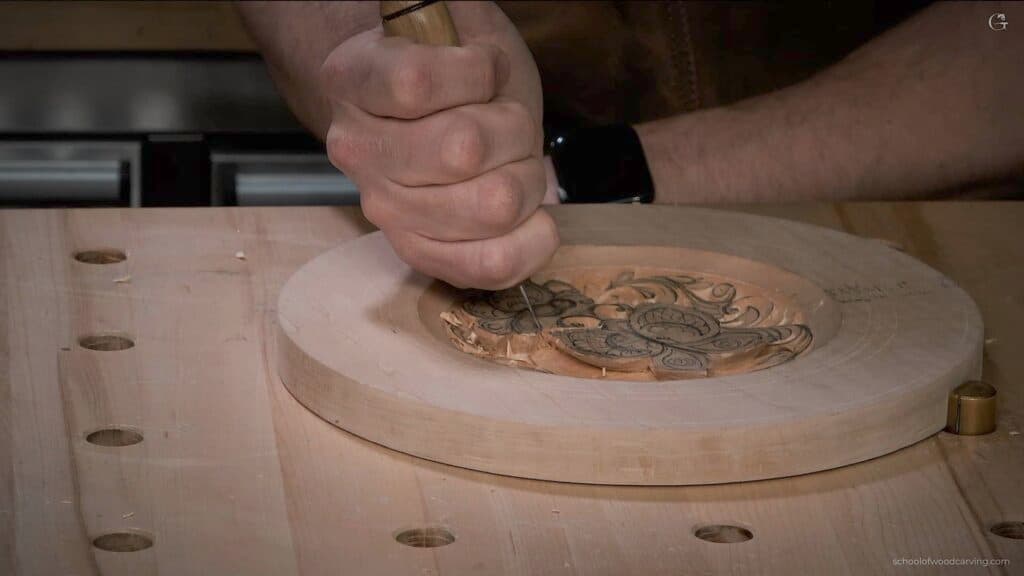
In Plate with Butterflies 8, video 2, I say I'm doing multiple cuts, "walking down" and then: "Almost like cutting bread." Other lessons use bread again, for slicing with a knife and for the work that pays my bills.
Do you slice a loaf of bread at home, back and forth, without pushing the knife down hard? Then your hand already knows the idea.
What am I doing when I say cutting bread?
Right before it comes "I need to cut little deeper around that part." Then, with the pass under way, I say "walking down." Bread follows. After it I say I've got to "blend that in," until everything blends really nicely.

Before the slicing starts, what comes first?
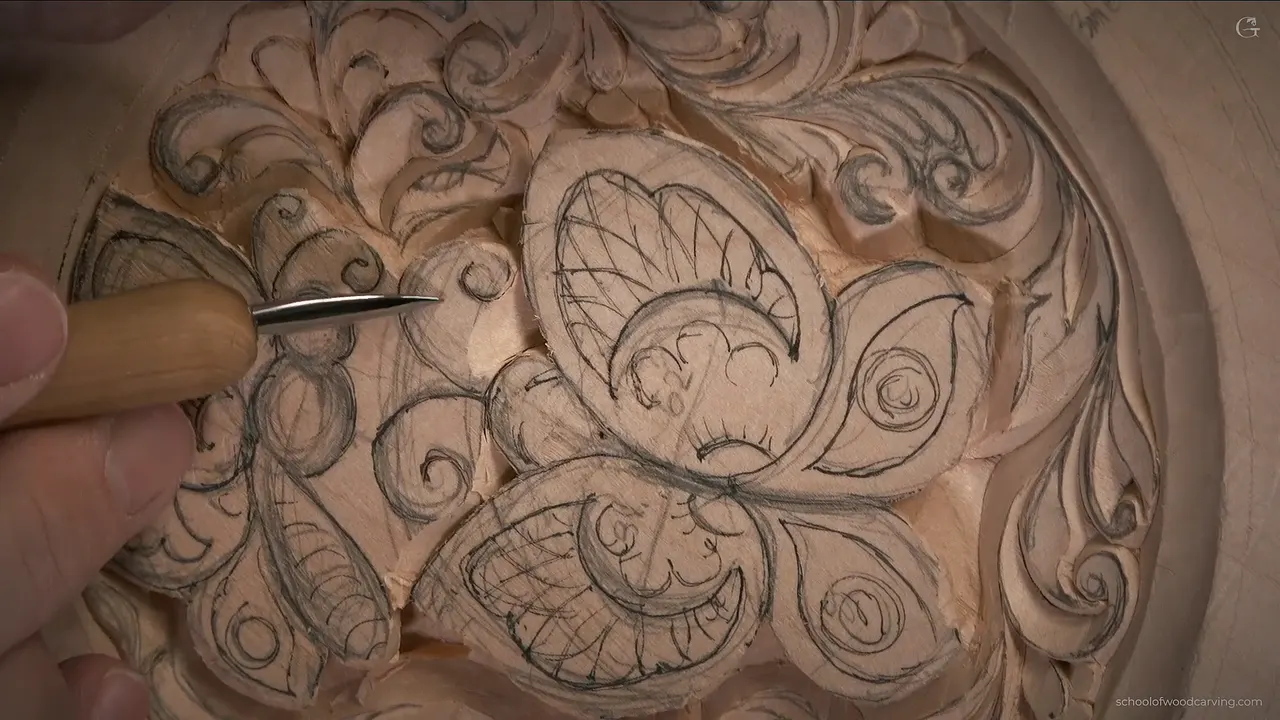
Here is how video 2 goes: "So now I have to continue to excavate this part and the blend to that point." I say "let me grab pencil." I want to make sure I create the right line, and I'm going pretty close. The distance between that line and the edge is "no more than maybe about one millimeter or so" (about 0.04 in).
"Let me do right away in this side," I say. Later on we'll do a little more detail, the swirl a little more, "but for now, it's good." With the same knife, my plan is to start removing a little more.

Why don't I take it all out in one cut?
A gouge would be really nice there, I say. But "it's still possible to create a cut like what we're working on." Then: "Carefully, carefully, carefully without forcing."
Here is the line: "I don't need to create just everything in one cut." Some people like to see "one single cut," but I don't think that is a wise idea in this case.

How do I know the slices have done their job?
When everything blends underneath, "that is what we after." I call it blending "really smoothly and nicely" and you can take your time and blend it even better, I add. "That should be okay."

Next I stop to show how it looks. The light is hitting it straight on, and it looks lighter, but it will be a little darker later on, once we get done.

Where do my hands sit while I slice?
Working on the next side, I say "without rushing." My hands come up next, held low, almost laying on the plate, "just touching the plate itself."
Video 1 of lesson 8 has the same advice. There I ask you to look at my hands, how I'm placing them and how I'm holding my knife. "It's almost flat." The cuts are "small, really small" and it will take me multiple cuts to get to the final result I like.

What do I do when a chip will not fly out?
"And now I need to take care of this area, blend all the way underneath." If the chip is not flying out, "I always have a chance to recreate my cut."
I feel it's loose, I say, so "I can take the chip out." As for the loose chips lying around: "Don't worry about those loose chips."

How do I hold the knife around the body?
Around the body the cut is "somewhat straight like a 90 degree cut," although I say "I don't really have to." An angled cut works with no problem, I think, and I say "let me do a slight angle." Pay attention to the angle, I say, and to the way I hold the knife in a hand, "naturally, naturally, just a slight angle," toward the intersection, and "go from the same spot."

Does the bread line come up again in lesson 8?
Video 3 has it. "Now rotate that plate." Then: "It's gonna be a lot easier to make that cut." After that, bread comes up again with one more word: "sometimes."

Video 3 also has me saying a bigger knife works if you want it to, and there is "no limitation" on what you can do. I point out my angle, and I'm pulling toward myself. I also want you to make sure you don't cut too deep right away, "because it's not going to be good." Taking small cuts, I say, makes it easier to remove the extra material.
"Make sure you work on your angle. That is the most important." Without that you won't train your hand to the right angles, some spots end up much deeper, and "it's not going to look as nice." My words are that this is why it is better to take time and check you're holding your knife at the right angle.

If it looks a little choppy, "that's okay." You can always refine it, and a second pass can "make it look really smooth and nice." Near the end I say "Here you go. That part is done" and that some cleaning needs to be done.
Does video 1 of lesson 8 go the same slow way?
Over in video 1, I say my plan is to place the knife right inside my previous cut, turn it, and try to create the cut right underneath, as deep as I can. Only that one area do I call somewhat difficult. After it I plan to remove a section a bit at a time, and I say it will take me multiple cuts to reach the result I like. I pull toward myself, "but really carefully without forcing it."

Next, about the other side: "I have to keep in mind that I'm not gonna go all the way through. Because remember I do have some carving another side. Not carving, but you know. That's what I mean."
Later I call a stretch good: "It's about the same depth as my main background." My plan for the other side is exactly the same, "little by little." For the next spot: "about the same depth" again.
Where else does the bread picture show up?
In lesson 10 of the butterfly plate, video 3, I say I'm going to do almost like "cutting a bread, like poking little by little." Next: "I don't need to rush anything." And: "If you need to recreate that cut multiple times, take your time."

Later in that video I say "I'm happy how it looks." The head of the butterfly is next, with "Just multiple cuts until you're happy" and "Just blend it nicely."
In Venice Room 73, video 6, I say "And I'm slicing almost like bread. I'm not pushing." I'm "attacking from two sides" and later I say "Without forcing."

Further on I say "I'm slicing, you can see." Then: "Well, you can't see." Showing it is almost impossible, because my hand is covering it. My words are "cutting bread" and if I exaggerate, I say, that is my movement, "or just like using a hand saw, if you wish."
I'm sorry my hand is covering it, I say, and I say maybe I can attack it upside down. It's not really convenient for me, "but at least you can see what is going on."

The care in that video has a reason. I have to be really careful in that area, I say, "because this wall on the inside is going to be visible from below, so I don't want to mess up." It's supposed to be "really clean undercut." And maybe I'll just use number five and hit from above.
The knife livestream from April 2020 has it too: "even on a really complicated under carving, when I'm using knife, I'm not just pushing, because I'm carving actually against the grain. I'm actually slicing like slicing piece of bread." Then: "See those chips? I just cut them pretty much with the knife." The result comes with just a knife, I say, and then comes the limit: "Of course, there's the limit you have to understand."

The saw picture comes up in Venice Room 17, video 10. Early on I say I got to check the backside, because "I don't want to overdo it." I've done it too many times, I say, "especially when I carved flowers." Then comes "I'm using 1 millimeter number 11" (0.04 in), and "I'm going to attack two sides."
Further on I say about the tool I'm using: "It's actually a good tool to get in. I can use it almost like a saw." And then: "I even didn't think about it, but I just got in really deep. Wow. New way of using this tool."
What does bread mean when I talk about my work?
In Lily Box 10, video 11, I talk about the wiggling technique, and I say many wood carvers don't approve of it. "Some of the wood carvers would say it's not professional, but that's not necessarily true." I use wiggling all the time, I say, and it's a technique of the jewelry makers. "You can't say they are not professional."
They work with dense materials, with metals, and sometimes that's the only way to get the material out, I say. Next comes my line: "Wood carving is also my 100% profession, my bread and butter." I believe I am a professional wood carver, and "nobody can say to me it's not professional, because I'm using that in my profession."
In Venice Room 53, video 4, I say I won't do something for free, and I give a reason for the time I dedicate to it: "it has to be paid because it's my work, it's my bread."
Why do I say put the butter on the bread?
In the clay livestream, reason number three is the biggest one, I say. The more you work in this trade, the more you understand that money depends on the time you spend on a project. If you do it for a living, your paycheck depends on the minutes you spend carving. In my case I'm exchanging my ability to carve for money, and I use clay before wood.
It sounds ridiculous, I say, "but yes, I still have to pay my bills" and "yes, I have to feed my children." Some pieces I carved for fun, "yes, absolutely." But the main reason: "It's to get paid and put the butter on the bread. Otherwise, my children would be skinny." And: "I would feed them just with the bread without the butter."

What did the old carvers need bread for?
In Lily Box 12, video 7, I say that even on a farm you pay for supplies and equipment, and for maintenance. "It still cost money. And it's been for a long time like that in history." Next: "It's a good thing or bad thing, it's not for me to say. It is what it is."
My point is that if you're doing it for a living, sometimes you have to underdo, with a stopping point somewhere. Those are the classical carvers in the "19 and 18, 17th century" and some of them "didn't do completely fine, full work." They didn't undercut deeply, and they would stop without finishing.
"And it's not because it was classical idea. It was just because they would get paid exactly the same amount if they would just go to extreme, or if they're going to stop somewhere. They knew they needed bread." Some of the customers they worked for "really didn't understand" what a deep undercut is, I say. My own work in that video is extreme, and I say "But I like the project."
How much is a loaf of bread in my story?
In the money livestream I said what I answer when people tell me they have a budget. "Go to a store and look at the bread." Usually, I said there, bread in the United States cost about $3. You take a bread to the cashier, and he tries to get $3 from you, but you say you've got only 25 cents.
"Can you sell it to me for 25 cents? Absolutely not, okay? You have to charge for your work, and you have to pay for your house."
| Lesson and video | What bread stands for there |
|---|---|
| Butterflies 8-2 | Slices that walk down, then a blend |
| Butterflies 8-3 | A rotated plate, and the bread word again |
| Butterflies 10-3 | A butterfly detail, poked at a bit at a time |
| Venice 73-6 | A tool slicing, not pushing, and a hand saw |
| Knife livestream | A knife slicing against the grain, not pushing |
| Lily Box 10-11 | A technique defended, and my own profession |
| Venice 53-4 | Time I won't give away for free |
| Clay livestream | Getting paid, and butter put on a loaf |
| Lily Box 12-7 | Classical carvers who stopped short for pay |
| Money livestream | A budget answered with a loaf in a store |
Do you have a small knife with a good edge and a scrap of basswood on your bench? Then take thin slices from one small area this week, and check your angle after each one. The full course has every lesson of this plate, with lesson 7 before this one and lesson 9 after it, and all of it sits inside one tuition plan.
How it's done
- Draw the line close. I grab a pencil to make sure I create the right line. The distance from the line to the edge is no more than maybe about one millimeter (about 1/25 in) or so.
- Take thin slices. My cuts go in carefully, with no force, and not everything is created in one cut.
- Keep your hand low. Held low, almost laying on the plate, just touching the plate itself.
- Blend underneath. I go on until everything blends really smoothly and nicely. It can blend even better, I say.
- Watch the angle. A slight angle. It goes toward the intersection, from the same spot, and in video 3 the angle is called the most important.
Frequently asked questions
Do I push the knife when I slice like bread?
Venice Room 73, video 6, has me saying I'm not pushing. The knife livestream says it again with a difference: I'm not just pushing, and there I'm slicing like a piece of bread. Both times it's about slicing.
Why don't I take the waste out in one cut on the butterfly plate?
Creating everything in one cut isn't what I need, I say. Some people like to see one single cut, and I don't think it is a wise idea in this case. Video 3 adds that cutting too deep right away won't be good.
Can you fix a chip that will not fly out?
If a chip is not flying out, I say I always have a chance to recreate my cut. Once I feel it's loose, I take the chip out. And the loose chips lying around? Don't worry about those.
What to carve next