
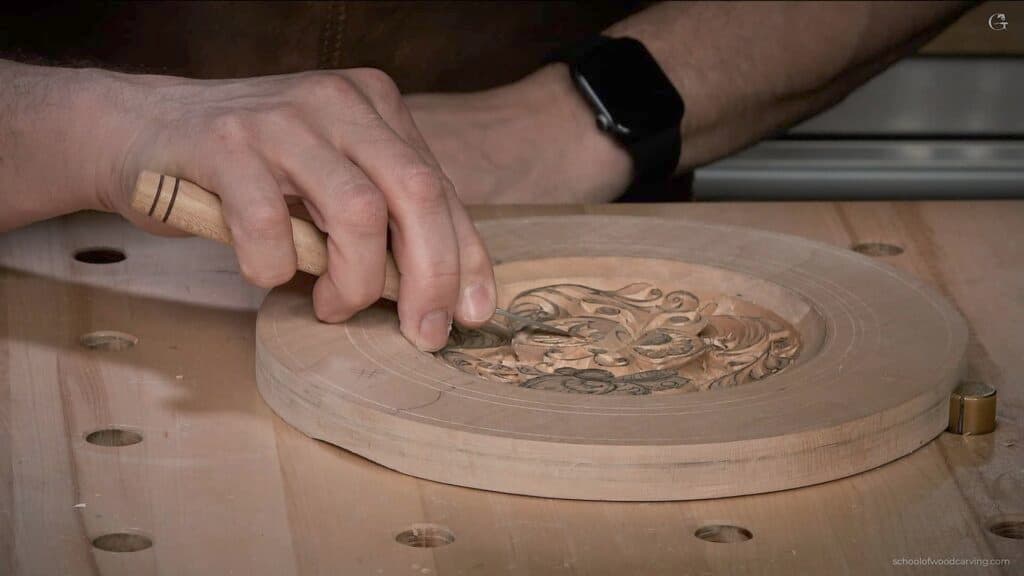
Alexander Grabovetskiy, woodcarver, School of Woodcarving · Published 2023
What does a wood carver mean by a "V cut"?
Quick answer: Video 2 of Plate with Butterflies 9 has me turn the plate over, take lines the other way, one millimeter (0.04 inch) wide at most, and the words that follow are "V cut that's what I'm doing." Other lessons use those words for a leaf line, a border and a stem.
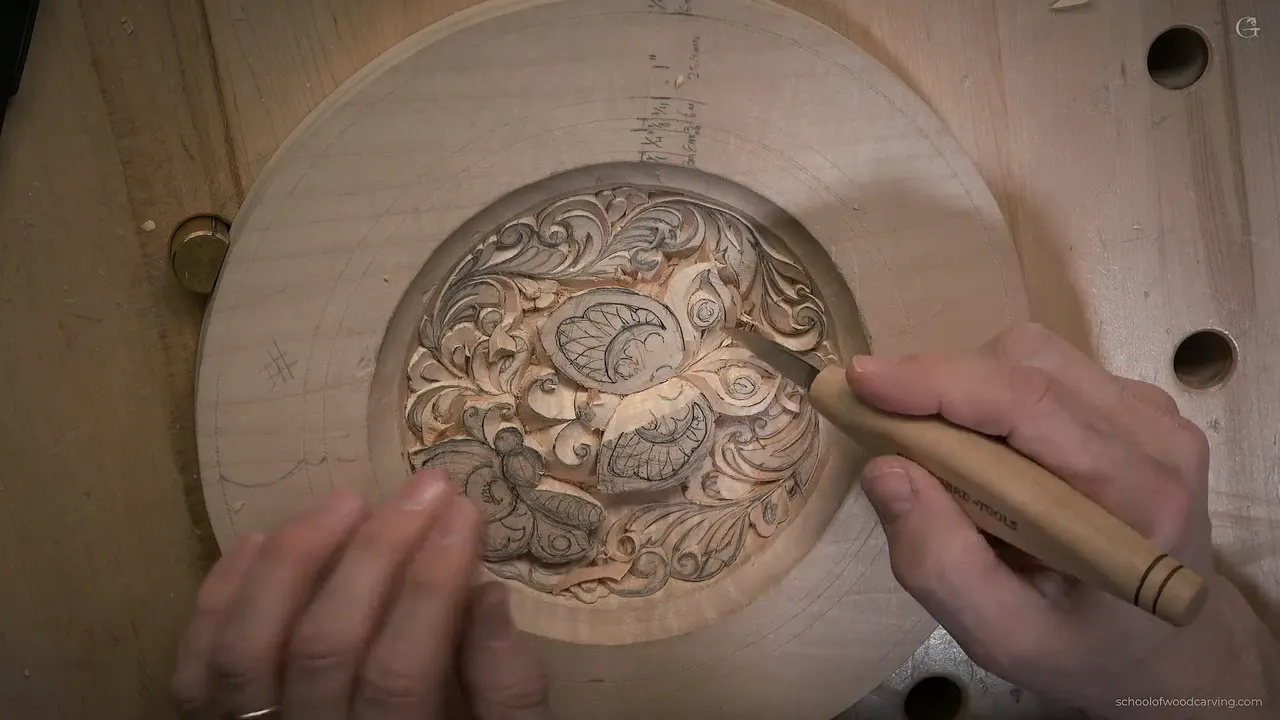

In Plate with Butterflies 9, video 2, I flip the plate, and then comes the line "V cut, that's what I'm doing." Other lessons of mine use the same two words for a leaf, a border and a stem.
Do you press a pencil along a line, then turn the sheet and press a second line from the other side? Then you already know how two small cuts make one groove.
What am I doing when I say V cut?
Right before the plate flips, I say "let's do the grid work. Or whatever you call it." The hand goes down first: "just lay your hand solidly on the board. Hold it like a pencil." Every line goes in one direction at the start, "not really deep," maybe a millimeter deep (0.04 in).

Next the plate flips, and the lines come from the opposite direction. "Again, no more than one millimeter wide," I say, and that is 1/25 in.
Where does the first bevel go on a wing?
The grid work comes later. The next cut I want is a bevel toward the edge of the wing. "The angle is not gonna be that big," I say. I'm not sure you can see it, but "that is approximately the angle."

The cut runs up to the line, but not as deep. A deep cut isn't needed there, I say. Another one gets the same cut after that, and then comes "this side also."
How shallow is a separation inside a wing?
Next I need a "really really shallow cut" with my knife "almost laying flat," held "from just above." Something with a curve to it would probably be better, I say, but I show it anyway, "to prove the point." You can still create "beautiful beautiful movement."

"All I need is just create the separation," I say, between this part and the rest of it. "It's no more than one millimeter deep" (0.039 in). I could go deeper if I wanted to, I say, but I don't think I need it.
What do I call the spot where the grain meets?
After that, I reach a spot where "I need to attack from about two sides." Then comes my name for it: "Marriage line. That's what I call when the grain meets." Change the direction you attack from, I say, and then blend it.

Which side gets the undercut?
At one spot I weigh it out loud: "I could do either undercut under this side." Or "from that side," but "I think it's gonna give me a better Shadow if I gonna remove that part right here." Again, it is about movement, I say, and "it just gives extra Dimension" to the wing.
At that spot my knife is "almost flat," lying "almost like on the surface."
How do I carve the grid work?
First a pencil. "Let me grab a pencil again," I say, and I recreate the grid work. Unless you remember, I say, I said everything is supposed to go kind of to the center. "It doesn't have to be really accurate but still."

Then the knife: "I don't know what knife should I use? I'll just use the big knife." And I add: "before the grid work, I want to attack outside." It is "exactly the same idea what we've done right here."

Some spots can run a little wider than a millimeter, maybe one and a half (0.06 in). "Try not to do too wide. It's not gonna look as nice." Press too hard, and "That becomes little more fragile."
For those of you who live in the United States, I say it's just like 1/32 of an inch (0.8 mm). A reminder comes later: "Gonna remind you that we are doing only one millimeter" (0.04 inch). The pencil marks wait: "We're gonna get rid of them a little later."

Why a knife and not a V tool?
The question is "why I don't use a V tool." My answer is "that's the whole purpose of this lesson, not to use those normal tools." You could use one if you have it, I say, but the tool doesn't have "the sharp, you know Edge right on the bottom." So "it has a small roundness."
The same question is answered in lesson 10. "If you would ask me why I don't use a V tool," I say, "First of all, you're not going to get really sharp V cut with the V tool." Then: "So knife will give you the true, really sharp line on the bottom of the groove I'm talking about."

The V-tool Q&A is about an undercut. "The only way you can do it, if you reshape your V tool," I say. Then comes "mostly, you don't use that tool, but there's cases also."
In the second video of lesson 9, I call this "practice for those of you who would like to carve sunflower." Lesson 10 repeats it: "you'll be able to carve also sunflowers and so on" and "the idea is about the same." About the force there: "Okay, don't press too hard, you can break those details." And: "If you think it's easy, it's actually not that easy. You really have to control pressure of the knife."

Where else does the V cut show on the plate, beyond this video?
In lesson 10, video 2, the grid is "the lattice detail, or whatever." And "Whatever the grid, it's okay." The depth is the same: "And again, it's only one millimeter deep. So I do not do more than that" (0.04 in).

Over in lesson 13, video 2, it goes inside the leaves: "we just V-cut," a "normal V-cut" on the inside. One cut goes in "going opposite direction like that." Then: "or letter V, I should say, just like that." You could leave it like that, I say, and "we can actually introduce some gouging" inside the elements.

In lesson 12, video 3, it is a border. "I've got one cut from outside and another cut from inside, but they are facing inward on this part of the border." They "just are facing almost like a V-cut."
And lesson 7, video 3, has leaves with "movement also and that is gonna be excavated." My words: "it's gonna be like a V cut." The cut will go "toward the center. There's invisible Center Line" and I'll "Attack that from the opposite side."

Does a V cut stay in the middle of a leaf?
Greek Acanthus 5, video 4: inside the leaf. "Historically, Greek acanthus leaf has that V cut on inside," I say, and "So that's what we have to maintain." Any V tool will work, I say, and I plan to take probably just the 45.

The groove is supposed to be right in the middle of the leaf, but "it's not necessarily applies to every detail." On a leaf that goes downhill, my V cut leaves the center: "I'll move it a little to the left" and "make my cut like moving little curvature."
My way of doing it: "just take the V tool and don't force it, but just make a V cut right on the line, and then escape before you hit the edge." Further on in that video: "A lot of times on the Greek acanthus leaf, there is absolutely no ridge, just a pure V cut." A ridge on the inside is allowed too. "It still would be authentic."
First Cuts for Beginners, workshop 2, video 6, has the same cut in leaves with no background: "it was also common to put kind of V cuts in the middle of the leaves to make it look even more beautiful." I add "absolutely no background. Everything is just a V cut." On the tools: "in ancient times they did not use those punches." You would have "only one knife" 2,000 years ago, and still work on a piece of wood "to make it beautiful." If you train your hand "from the first time to cut clean in this type of carving," I say, "you're not going to have any limitations what you can do later on."
What happens when two cuts of a V do not meet?
In Kitchen Cutting Board 10, video 3, the words are "when you're making a V cut, let's say you cut from one side." A second cut, I say, is "not always meeting at the same spot." And: "you do have weird stuff going on right in a point." I ask how you would take care of that spot, and then say "it's not as complicated as it looks."

Further on: "If I'm going to dig that too deep, you can see what happens." The fibers break on another part, and I'm not too happy. "That means I have to make a sharper V cut in this case." The pace is "little by little, without forcing too much."
Workshop 10, video 1, adds "cleaning cut until everything flies out of that V cut." And then: "Although it's not a true V cut. This side is actually straight down cut, and my V cut or beveled cut only from this side."

In Hashemi Flowers 40, video 1, I take number 16, a V tool, "and just establish the border, or a V cut, or V groove, if you wish to say it that way." A normal V cut could go "just straight down like this," I say, "Or I can right away pretty much undercut, semi-undercut, not extremely." My plan is to undercut it from the very first cut.
"Definitely, I cannot create too much pressure. It would be a big mistake." Afterward: "you can see it's already creating the shadow." And with care: "I do have to be really careful because I am working on the end grain."
Can a V cut go around a stem?
In Lily Box 13, video 4, the subject is olives. "I'm going to create some kind of a V cut," I say, "A V groove, just like that." It will go around, for "visual separation between the stem."
Later: "Not really V cut, but some kind of groove cut around." A veiner of half a millimeter (0.02 in) is an option, and "that's going to give a really nice shadow." Then: "I think I have much more control with the knife in this case."
Of the effect: "It's a subtle effect. Just don't be exaggerating too much."
How far from a line does a V cut sit?
In Venice Room 139, video 3, I say "I really have to get approximately one millimeter away and angle it and create a V cut close to all of them." Then: "One millimeter at this point and almost nothing when we get closer to the center" (0.039 in).

"Essentially, it is a V cut." The secondary one will be "exactly the same, one millimeter away" (about 1/25 in), and "the V cut in opposite direction." I could spend a lot longer, but "I really don't need to." Why stop? "I also want to texture it." A magnifier glass would help a lot, I say. Earlier in the video, "the grain changes direction," I say, so I need to be careful.

Which cuts come after the grid work?
Back on the plate, after the grooves, I say "let me do cut around those guys." The bevel is "gonna be toward the edge," "over the edge of the wing" and "Not really deep but still."

"So let me remove first those triangles." And: "Again, almost flat. My knife is laying almost flat." Then I plan to go around and show my hand, "removing Right to the line." Then "rotate with the knife" and "we just created that really nice beautiful effect." And "don't worry if it doesn't look clean right away."

With "those knives," I say, "it's going to be much easier for you," but "you're still able to do it with just a knife." Later, I say, the finish will "look even better."
Video 3 of the same lesson carries on: "We're going to do cut and then blend." Its secondary cut is "somewhat flat" and "supposed to look like a gouge cut."
| Lesson and video | What the V cut does there |
|---|---|
| Butterfly plate 9-2 | Grooves a millimeter wide, plate flipped |
| Butterflies 10-2 | Grid grooves, and why I use a knife |
| Plate lesson 13-2 | A groove cut inside each leaf |
| Twelfth lesson, part 3 | Two cuts facing each other, almost a V |
| The plate again, 7-3 | Leaf insides, dug out as a V cut |
| Greek Acanthus 5-4 | A leaf line, moved off the middle |
| First Cuts 2-6 | Grooves in the middle of leaves |
| Cutting Board 10-3 | Two cuts that do not quite meet |
| Hashemi 40-1 | A V groove that starts as an undercut |
| Lily Box 13-4 | A groove around a stem |
| Venice 139-3 | Grooves a millimeter from a line |
Do you have a small knife and a scrap of basswood on your bench? Then press one groove from each side of a pencil line this week, and look at the bottom of it. The full course has every lesson of this plate, with lesson 8 before lesson 9 and lesson 10 after it, and all of it sits inside one tuition plan.
How it's done
- Draw the grid. A pencil goes down again to recreate the grid work. Everything is supposed to go kind of to the center, and I say it needn't be really accurate.
- Set the hand. My hand lies solidly on the board, and I hold it like a pencil.
- Take one direction. Every line goes one way first, about a millimeter (0.0394 in) deep and no deeper.
- Turn it over. A second set of lines goes the other way, and I call them V cuts.
- Keep it light. Pressing hard makes the wing more fragile, and the lines stay shallow. The pencil marks come off a little later.
Frequently asked questions
Why use a knife for the grooves instead of a V tool?
The whole purpose of the lesson, I say, is not to use those normal tools. A V tool lacks the sharp edge at the very bottom, so it has a small roundness. A knife leaves a really sharp line at the bottom of the groove.
How wide are the grooves of the grid work?
Around a millimeter (0.0394 in), with some spots maybe one and a half (0.06 in). Wider won't look as nice. Press hard and the wing gets more fragile.
Does the V cut sit in the middle of a leaf?
In the Greek acanthus lesson, video 4, the groove can sit in the middle, though that doesn't apply to every detail. On a leaf going downhill, my plan is to move the V cut a little to the left.
What to carve next
- Plate with Butterflies course
- Plate with Butterflies lesson 8
- Plate with Butterflies lesson 9
- Plate with Butterflies lesson 10
- Plate with Butterflies lesson 12
- Plate with Butterflies lesson 7
- Greek Acanthus Leaf lesson 5
- First Cuts for Beginners workshop 2
- Kitchen Cutting Board workshop 10
- Hashemi Flowers lesson 40
- Lily Box lesson 13
- Venice Room workshop 139
- Different shapes of V-tool