
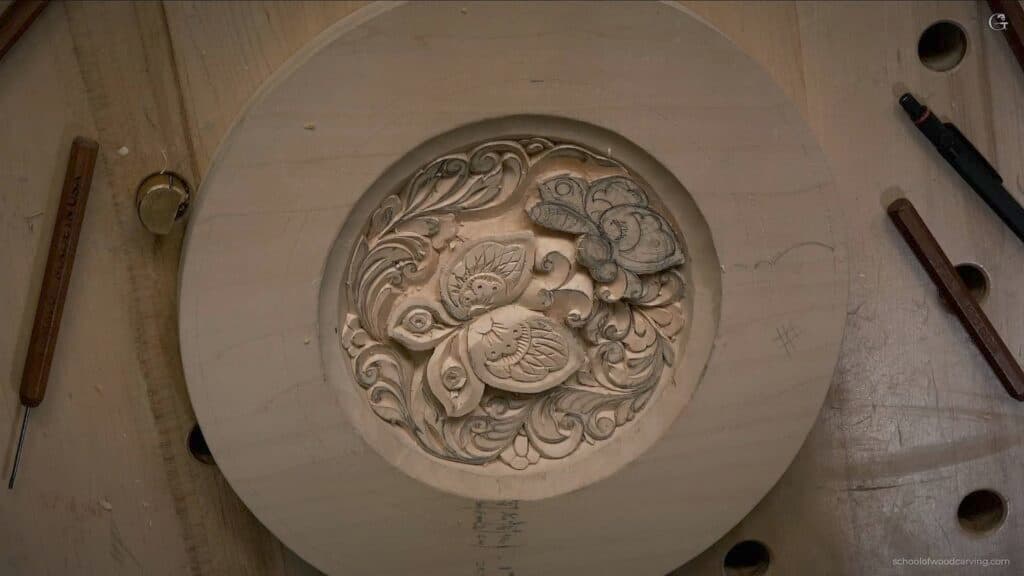
Alexander Grabovetskiy, woodcarver, School of Woodcarving · Published 2023
What does a wood carver mean by "scrape"?
Quick answer: In the third video of lesson 9, I scrape a carved butterfly using a small scraper, a razor blade or the knife itself, and the blade goes the way the grain runs. The pencil marks come off, and I see the roughness. Sandpaper works as well, I say. The same word comes back in other courses.
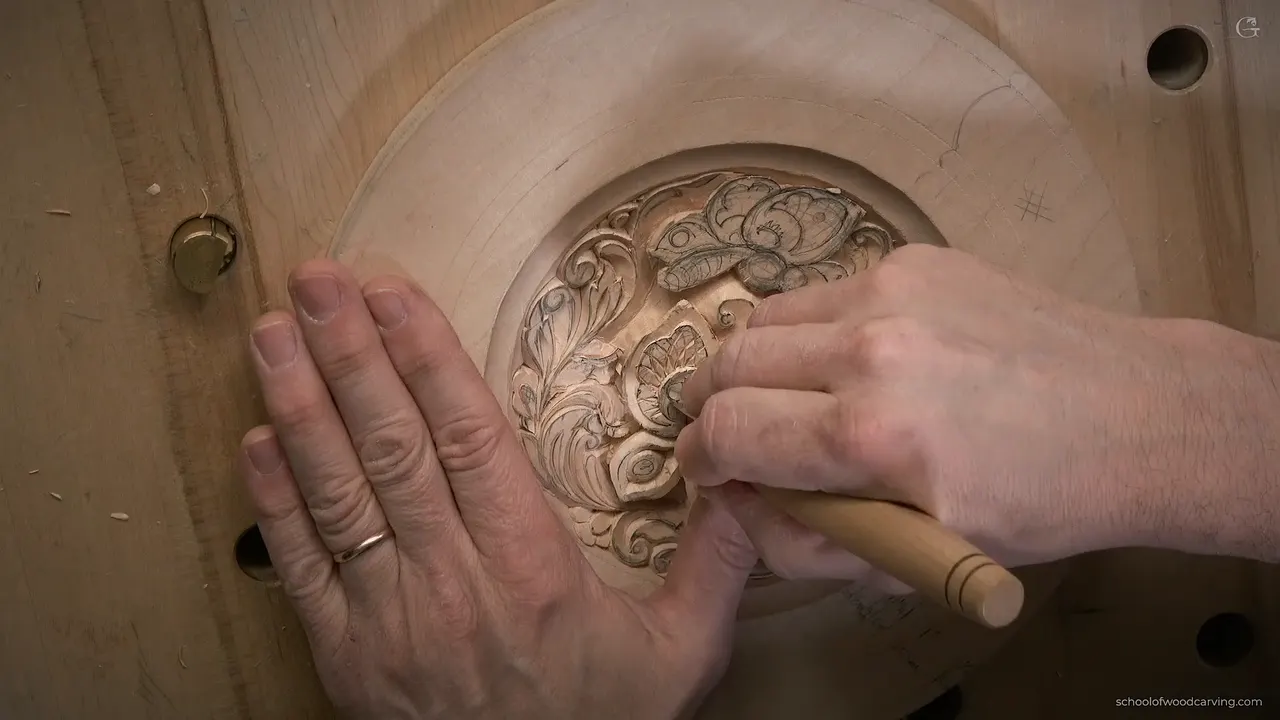

In Plate with Butterflies 9, video 3, I scrape a carved butterfly, name a razor blade, a small scraper or just the knife for the job, and tell you to follow the grain. The same word comes back in other courses, where it takes off glue, marker, paper and router marks.
Ever finished a small shape and found the pencil lines still sitting on it? Does the wood look fine until you hold it close to your eyes? Here is what I do about it.
What do I carve before I scrape in video 3?
The video opens on "I need to do this side exactly the same." I'm going to remove those triangles first, right to the line, as on the other side. It looks like I need to attack from my other side "if I don't want to create the mess." I lower that down. "So that is the marriage line again," I say, and the last area gets exactly the same idea: "We're going to do cut and then blend."

Same angle. The secondary cut is going to be somewhat flat, and it is supposed to look like a gouge cut. "Hope it makes sense," I add. Then comes "One, two, three, go" and I ask you to pay attention again to my hands.

My pinkie is laying there and creating some supporting point. Not pushing too hard, but it gives me really good support. That way I can guide my knife, and I know I'm achieving the control I'm after. Everything is just laying on that pinkie. I don't think about it all the time. It's automatically already in me. "But for those of you who never carved before, just pay attention."
What does scrape mean in video 3?
"That is how it looks as of now," I say after the pinkie. Then comes the scraping idea: "Obviously, what I could do, I could scrape slightly." One choice is a razor blade, and if you do have some small scrapers made for that, that would help also. Even a razor blade will work. "So just whatever the utility knife, razor blade."

The rule follows. Make sure you see the direction of the grain, and scrape with the direction of the grain. "We need to get rid of pencil marks," I say, "and that way you're going to see if we are good or bad." I mean all the roughness.

I scrape it, but see, it's already giving a really good, nice result. A little later: "Make sure you're doing it with the grain, okay?" And again, "Just with the grain." Blending with the scraper works too, I say, and then: "Let's scrape this side also."

"But like I said, you could use just sandpaper. It's going to work also." After that: "I'm not sure how about you, but I like it." Scraping works just the same with the knife, though it will dull it a little bit. Even with the knife, you can carefully scrape that.
The edge gets its turn next: "Just refine the edge because now you can see all the imperfection."
What did I carve after the scraping in video 3?
Since we're just using a knife, I say I will show you what we can do inside. I plan to outline the inner part and create some shadow. There are limitations, because we're using only knife. But if you do have other tools, you can embellish it with some gouges, and I show a small one next.

The gouge goes straight down, 90 degrees. My plan is a small Plug-Cut by creating rotation motion, not really deep, maybe about one millimeter (0.04 in). "But see, it just gave me that dark spot." Do not push too hard. A lot more rotation is better than pushing down. At one spot: "See, I was pressing too much."

I call that type of cut a Plug-Cut "because you're really just removing those plugs out." Next I plan a dot on both sides of the round and a cut toward the center, not a straight cut. I could also create the cut right between those cuts, from the midpoint or maybe about the golden ratio of that point, that point and 60 percent right here. "Boom, just like that."

I could embellish even inside of this cut, I say, with even an 11, really small, tiny cuts, and that gives the butterfly some curliness. I plan to get a bigger gouge next, 4 mm (0.16 in), approximately number 8 or 7, to refine that cut at first. "I try to introduce you ancient way of carving with just a knife." So that is preliminary.

At the end I say we will refine everything, and we will work even on the back side. Not carving, but the shaping. Next time the plan is to continue with the next butterfly, or maybe finish something else.
How does the scraping go in the next butterfly videos?
Lesson 10 of Plate with Butterflies, video 3, shows a spot that doesn't look clean, and "as you remember, you can always scrape it." There's multiple ways. Without a professional scraper, you can use just blade, "just like that utility blade." Just follow the grain, and in my case the grain goes that direction.

A slight scrape takes off those pencil marks, and you can see much better the result. "That's why I don't like to use pencil, by the way." And then: "But for the lesson's sake, it's all right." It can be a little smoother too, I say, just blending all the cuts with the scraping.
Over in lesson 13, video 3, I say the next step for me would be just to scrape everything and make it look really nice and smooth, and maybe I'm going to stain it. "You don't really have to stain it."
Which marks does scrape remove in the Furniture Panel?
In video 1 of Furniture Panel 30, the line is "Now I can remove that paper." After that I scrape slightly, whatever the glue residual I have. With the same scraper I could probably blend the overall movement with no problem. "That's a good scraper by the way." What I call a scraper is a utility knife blade.

In video 3 of Furniture Panel 28 I grab an "18th century scraper, just the razor blade" and my plan is to get rid of that paper. The third video of lesson 30 has me removing paper too, with a fix of my own word: "I mean utility knife blade." With that tool I can blend the whole thing if I need to.

Which way does the blade go on the Furniture Panel?
Over in Furniture Panel 38, video 3, the line is "then let's just scrape it." I add that's how they have done it back then, in the 18th century, and that the glass was already available in the 15th century for sure.

You don't have to use a knife to scrape, I say. A normal card scraper works if you want one, or utility blades, and you can really make it shiny and nice. My tendency is to scrape on an angle, since that way I can hit those small sections. Overall I still go along the grain, and the blade itself is angled. "Except this one I cannot do that."
Lesson 26, video 3, has me saying I can grab some kind of utility blade and scrape slightly, or a scraper if I have a small scraper. I do have some small scrapers, but "knife blades are good." You can use just the side of one, and "This side is a scraper also," or you can use the whole blade. It does the job, as you can see.
A hook works too, if you wish. "If you are in the furniture making, you know what I'm talking about, the hook and the scrapers." I can blend it nicely, really nicely, until you don't really see any transition, maybe changing the position to scrape it this way.
What about router marks in the background?
There are a couple of choices to eliminate those marks, I say in Furniture Panel 19, video 1. "My preferred way, just to take a scraper." Small scrapers are really good, but I really like to use some of my chip carving tools. A number nine one is really thick, and I kind of like it.
I scrape those marks out, and that gives me a perfect look, so I'm not going to see any marks. "But please, also don't overdo it, because even with the scraper, you're not taking too much material. You're still taking some." Small knives scrape inside on the background areas, those router plane marks, so you really don't need to sand anything.
"Again, I'm not against the sanding," I say, "but if you look back on the history, most of the furniture makers, they used scrapers, okay, to scrape and make it even." I add, "Well, like I said, most, not all." Some furniture makers in the 18th and 17th century still used reeds, the plant growing by the river.
Can a knife be a scraper?
In Lily Box 3, video 5, I don't really worry about that marker, "because I can always scrape it if I need to." What I mean by that, I can use a knife as a scraper and kind of shave it a little bit. "I'm using my knife as a scraper."

Back on the panel, lesson 21, video 4, has me thinking about which tool to use for scraping this side, and I'll be able to see the high spots and low spots. "Do I need to scrape it? Oh, no, absolutely not." But I think it's one of the techniques. "I don't use it a lot, but I think I like it."

Then I answer a question about the tool: it's going to dull your tool, "not as much as you think if you've got really good tools." But still, yes, it will dull your tool. Buffing is an option, or a really cheap set, like imported tools, used for scraping.
Is a scraper better than sandpaper?
Later on, I say in Curly Kitchen Cutting Board 15, video 3, maybe just a scraper and clean it, but really carefully. "Yeah, it's better to use a scraper than sandpaper because of the fibers. You're not pressing the fibers in."

In Cutting Board 16, video 4, it's all dirty right now, I say, and that's not good. The old way, we could just use a scraper and scrape it. That's probably my preferred way until everything is just clean. For anyone who doesn't feel comfortable with the scraping, at the beginning especially, it's absolutely okay to take some sandpaper and give it a little sand. "Don't over-sand it because you're going to lose the detail."
What did carvers scrape with long ago?
The lesson Should I use sandpaper in wood carving has me saying they used the skin of the shark. Some of those 15th century guys used glass. They would get a piece of glass and scrape it. "The scraping is one of the techniques they used all over the Europe."

There I scrape the whole surface with pretty much a carving knife, and that gives you really good result. After the scraping, you could burnish it with the same species of wood. That gives you a really shiny surface.
Which scraper do I name for a finished section?
In Greek Acroterion 5, video 6, once we're completely done, I'll take a sandpaper. Or first, maybe I can just take the scraper, cabinet scraper, just scrape the paper out, "but sandpaper will do also."
This section is pretty much done, I say in Venice Room 92, video 2. "So I can just scrape it and make it look nice." A small one isn't required. You could use a normal scraper, a cabinet scraper, and scrape with the big scraper.

In the last Grape Onlay video I say I found scrapers that are really, really good, with multiple shapes. You can just scrape. Obviously, lime wood or basswood is kind of soft, and "it's not too good for scraping, but still you're able to scrape it."
Where do I scrape across my lessons?
| Lesson | What comes off the wood in that video | Blade |
|---|---|---|
| Butterflies 9-3 | The pencil marks, plus any roughness | Razor, scraper, knife |
| Butterflies 10-3 | Pencil marks, then all the cuts blended | Utility blade |
| Furniture Panel 30-1 | Paper first, then the glue residual | Utility blade |
| Panel 28-3 | The paper I am going to remove | Razor blade |
| Furniture Panel 26-3 | A step I blend until no transition shows | Knife blade |
| Panel 19-1 | Router plane marks in the background | Number nine |
| Lily Box 3-5 | The marker I don't really worry about | My knife |
| Cutting Board 16-4 | A carving that looks dirty right now | Any scraper |
| Greek Acroterion 5-6 | The paper, before maybe a sandpaper | Cabinet scraper |
| Venice Room 92-2 | A section I am pretty much done with | Big scraper |
Is there a pencil line on your own piece that no blade has touched yet? Look for the grain first, the way I say it in lesson 9. The second butterfly waits in lesson 10. The butterfly plate course page lists them all, and every video sits inside one tuition plan.
How it's done
- Finish the cuts. A cut and then a blend came first, at the same angle.
- Pick a blade. A razor blade, a small scraper made for the job, or just the knife.
- Read the grain. I make sure I see which way it runs.
- Scrape slightly. Along the grain, I scrape until the pencil marks are gone.
- Check the wing. Now the imperfection shows, so the edge is what I refine.
Frequently asked questions
Which blade scrapes a carving clean?
Razor blades work, I say, and a small scraper made for the job would help too. Even the knife can do it, though it dulls a little.
Which way does the blade go?
The way it runs. I say to make sure you see which way the grain goes, and I repeat it as I scrape. My blade in Furniture Panel 38 sits at an angle to reach small sections.
Does scraping dull the knife?
A little bit, I say. Really good tools dull less than you think, I add in Furniture Panel 21, and you can buff one or get a really cheap set for scraping.
Can sandpaper do the same job?
What to carve next
- Plate with Butterflies course
- Plate with Butterflies lesson 9
- Plate with Butterflies lesson 10
- Plate with Butterflies lesson 13
- Furniture Panel 30
- Furniture Panel 28
- Furniture Panel 38
- Furniture Panel 26
- Furniture Panel 19
- Lily Box 3
- Furniture Panel 21
- Curly Kitchen Cutting Board 15
- Curly Kitchen Cutting Board 16
- Should I use sandpaper in wood carving
- Greek Acroterion 5
- Venice Room 92
- Carving Grape Onlay final assessment