
Alexander Grabovetskiy, woodcarver, School of Woodcarving · Published 2022
What does a wood carver mean by "ancient"?
Quick answer: In Plate with Butterflies 1, video 3, I say this type of wood carving is probably the most ancient one, and that ancient people most likely had only knives and maybe a simple gouge. Other lessons point the word at a knife, a rosette and an acanthus leaf.

In Plate with Butterflies 1, video 3, I say "that type of wood carving is probably the most ancient one." The people I mean most likely did not have many kinds of tools. Other lessons of mine put the word on a knife, on an ornament and on a way of drawing, and in a Lily Box lesson and a Greek Acanthus lesson I mark a date that is not ancient.
Do you have a knife and maybe a couple of gouges? Is there a board on your bench, about 3/4 of an inch thick (19 to 20 mm)? Then you hold close to what I describe for those people. Start with lesson 1 of this course, and after it come the lessons where the word comes back.
What did the plate need before I said the word?
A circle out of the board, and I give two ways to get it. The saw opens video 3. A band saw "would be wonderful," I say, and a scroll saw "also gonna work." Without those I name a coping saw or a fret saw.
The wood is "a soft enough material" and "you can just cut easily." The blade decides how it goes. "Sometimes the blade gonna give you a problem," I say, and with a saw that is not a really good quality "the cut is going to be kind of tougher." Still, "it doesn't take too much to cut through."

What does the number 9 do?
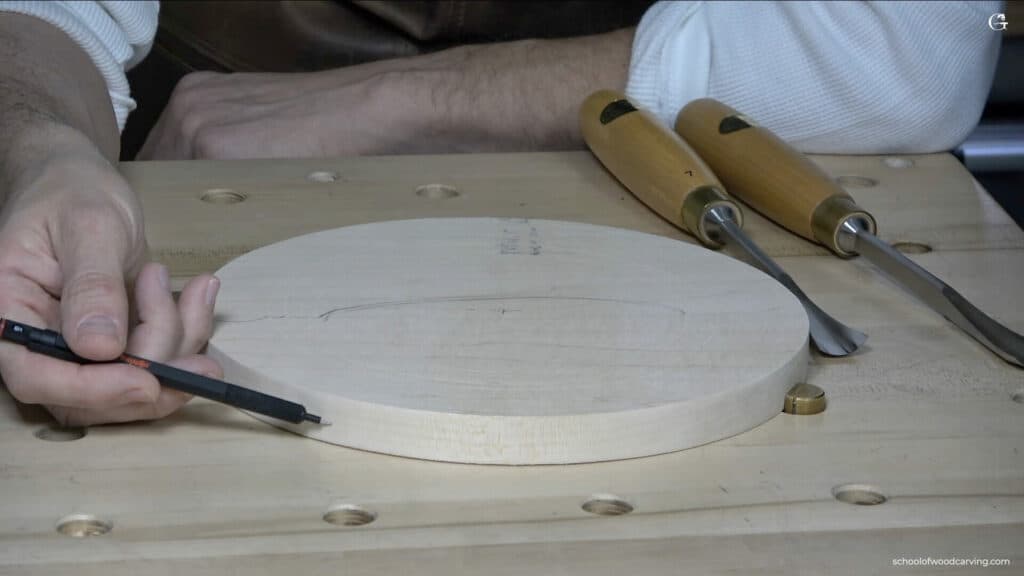
My second way takes a gouge: "some kind of gouge. Let's say like number nine." I explain "relieve it somewhere" as lowering a surface with a "preliminary cut like this." The line stays in view: "Pretty close to the line, but you don't want to lose that line. You really want to see what is going on."
How low is up to you: "whatever the halfway or whatever you want to do like to even to the quarter inch, you know, as low as you wish." A quarter inch is 6.35 mm. Then the fret saw goes around again, and there is "a lot less material you have to cut around."

"Here's the result," I say. The plate is cut out, and "I'm ready to actually start that project," ready to "create that overall shape."

Where does the word come in?
I tell you what I have in mind for the middle: "Maybe butterflies, okay." The line about the carving itself follows. The people I mean lived a thousand years ago or 2,000 years ago, and I say they "most likely didn't have a lots of varieties of tools." My words go on: "all almost all of the wood carving was done with the just the knives and maybe simple gouge."
For this plate I say "Just the knife" and then "It's gonna be a gouge." The plate needs "overall shape" first, and for that, "I will use a number seven."
A bigger number 7 helps: "that's always gonna help." You can "get by with the smaller number seven" and the one I name is 14 mm (0.55 in), "like half an inch." A 20 mm (0.79 in) one "would be even better" and so is a 19 mm (0.75 in) one, a 7/8 inch (22 mm) one or even a one inch (25.4 mm) one. A Swiss made set, I say, "comes with 14 millimeters half an inch" and "it's still gonna be the same operation."

The plan for the shape is "what we have to do we're gonna create overall shape." All around, "it's gonna be a convex" and "those are gonna be raised up." Inside, I plan a concave, "but it has to be smooth. Just like the normal plate."
On depth I say "how deep you can go. It's up to you. But remember we do have only only 19 millimeters deep material." My plan for the first cut is "no more than a quarter inch probably" and then "no more than six millimeters deep." The board is 19 mm (0.75 in), a quarter inch is 6.35 mm, and 6 mm is 0.24 in. "It's always possible to carve inside," I say, and "if you need to carve little deeper, you can always go little deeper."

Which ancient people used the golden ratio?
In video 2 of the same lesson I say Greek people did. I am working out the border there. "You probably know that I am a big fan of Fibonacci Sequence," I say, and "a really big fan of you know golden ratio." Along the way: "please don't overcomplicate stuff" and "I doubt those ancient people at least not all of them." For a carver in Northern Germany or a Slavic country, I say it would be just the visual.
Which tool do I call the oldest?
In Hashemi Flowers 11, video 8, I name the planer, not the gouge, and then I say "Clean it. Knife." I go on: "And the knife, by the way, is a miracle tool. You can do a lot of things with just a knife." "That was actually the first woodcarving tool for the ancient people, just a knife," I say.

My lesson on All About Tools for Wood Carving says "I believe the most ancient wood carvers, they used only knife." In that lesson, "we're talking about the ancient times, but even not too ancient, maybe about 10th century, 9th century, 8th century, like Viking world." And "if you're on a long boat, you can't get all the tools with you, but you can always grab just one knife and carve with that something."
Lesson 6 has me say, in video 2, "tools what people had, they were limited." The design is not limited: "you absolutely not limited with the design choice." On the old carvings, "all the Celtic knots and so on, all weird movements," I say "it's just made with the same technique what I'm doing right now, just one knife technique."
Curly Kitchen Cutting Board 3, video 1, puts the word on a type of carving: "one of the most ancient types, and still, we're going to use only one knife, what was available, thousand years ago, 2,000 years ago."
A reason for the knife comes in lesson 8 of that course: "I really like knife idea, because first of all, it's ancient, so that's what they had back then." And "you don't need to collect the whole tool set like you see right behind me."

How far back does the word go?
Further than the Vikings, I say in First Cuts for Beginners, video 2 of workshop 1. I will start "from the most ancient forms of carving" and the one knife technique is "sometimes called Viking style carving." Then I say "it's not necessarily accurate," because the Viking culture is the 8th, 9th, 10th century, and "history of carving goes way back."
My dates are 2,000, 3,000 and 4,000 years back, "and even before flood, there was wood carvers who used to carve."
Did the old carvers have a straight chisel?
Curly Kitchen Cutting Board 14, video 2, puts a chisel beside it: "In ancient times, the only tool those people had, they either had knife or they had just a straight chisel." "Just the number one carpenter straight chisel," I say, and "you're just using one point of the chisel."

"We are developing the ancient skill," I say of learning the knife, and we take it "progressively toward the modern approach of the wood carving."
Where do I say a date is not ancient?
In Lily Box 2, video 5, I say "I'm not talking about 17th, 16th century. It's not ancient." My number is "3,500 years ago, or to be exact, 3,600 years ago when they did the Ark of the Covenant."

In Lily Box 10, video 9, I say "I'm not talking about ancient, okay? I'm talking about AD wood carvers, like Byzantine wood carvers."
Greek Acanthus 15, video 1, has me stop in the middle of a sentence: "In ancient-- well, I shouldn't say in ancient times, like 300 years ago, for example, one of my favorite wood carvers in the history, Grinling Gibbons." Of him I say "he would use Dutch reed rush" and I have some small dry sections of it.
Venice Room 54, video 11, is about a design I am working on: "I shouldn't say ancient or antique. It is 15th, 16th century design authentic to Venice."
Which ornaments get the word?
Antique Style Rosette, workshop 1 starts with one: "Rosette is one of the most ancient type of ornament." I go on: "Archeologists found the rosettes in Egypt and also in the ancient Babylonian Empire area, in Greece, of course, in Europe."

In Corinthian Acanthus 1, video 2, a leaf gets it: "The most ancient form of acanthus leaf." It has "an incut on the inside, like a concave inside of every leaf." For the drawings, I say "There is some Egyptian drawings found, the ancient drawings, actually, before Corinthian acanthus leaf found."
Video 3 of Roman Acanthus 1 puts it on the volute: "the ancient forms of the volutes." The Greek one is the more ancient: "a Greek-style volute would be straight." Of that style I say "it's kind of angled."
The word goes on a molding in workshop 1 of First Cuts, video 5: "we're going to do a simple ancient style molding," "hand-carved, ancient, really most ancient style of moldings."
Workshop 2 of First Cuts, video 3, has me say "This is the most ancient form of carving, although it would be like a relief, but it's not true relief." In video 6 of that workshop I say "Right here you can see absolutely no background." I add "You can't use any punches on it" and "in ancient times they did not use those punches."
Which finishes and tools get it?
Video 1 of lesson 10 in the cutting board course is about a finish: "I mentioned that ancient people actually did some sanding." They had no sandpaper, "of course" and "I mentioned they used Dutch reed." That is "actually a plant" and "you can find it by the rivers and by the swamps and by the different lakes."

Color comes in lesson 17, video 1. "I would use two ancient ways, actually, how the ancient people would use colors and staining." My date is "at least about 4,000 years," because "woodworkers, even in ancient Egypt, would use some color on the wood." The Babylonian and Assyrian empires "used only natural colors, what they would find around."
Greek Acroterion 1 has a hand plane in video 2: "Somebody would call that cheating, but I don't think so. It's still a hand plane." And "they used hand planes in ancient times," I say, and "they found some Roman hand planes."
Did the ancient carvers know the math?
In lesson 11, video 2, I start with a doubt: "I don't think those ancient people, they thought about philosophy or math." Then I take it back: "In ancient Greece, they did. Okay? That's true. But in ancient Scandinavian countries, they did not."
Of their carvings I say "all over the Europe, in Germany and ancient Poland and ancient Russia, so they still look really organic because you do have that feel inside of you, that feel of flow, all of those lines."
What is the old way to draw an oval?
Venetian Flowers Rosette 5, video 3, answers with my eye: "even to draw that oval, I used just by eye, the old ancient way." My plan after it is "I'm going to use the calipers to make the divisions."

"I can't just calculate. It's going to be really hard to calculate by the inches" for the divisions, I say, and "quite frankly, there's no need." I know "approximately what I want to do" and I plan a spacing of "maybe about an inch," which is 25.4 mm.

In which videos did I say it? One table has them.
| Where I said it | What the word points at in that video |
|---|---|
| Butterflies 1-3 | A simple gouge, maybe, beside the knives |
| First Cuts 1-2 | Forms of carving, and the Viking style |
| Kitchen Board 3-1 | A kind of carving, done with one knife |
| Cutting Board 14-2 | A skill, with a knife or a straight chisel |
| Antique Rosette 1 | An ornament that was found in Egypt and Greece |
| Corinthian 1-2 | A form of the acanthus leaf, with an incut |
| Roman Acanthus 1-3 | A volute, in its more ancient forms |
| Cutting Board 10-1 | Sanding done with Dutch reed, a plant by rivers |
| Curly Board 17-1 | Color on wood, found in Egypt and Babylon |
| Venetian Rosette 5-3 | An oval drawn by eye, the old way |
| Lily Box 2-5 | People from 3,500 or 3,600 years ago |
| Greek Acanthus 15-1 | A date of 300 years ago, which I call not ancient |

Which line would you try on your own board? Every video of this wood carving lesson sits inside one tuition plan. The butterfly plate course page holds every lesson, with lesson 1 on the layout and lesson 2 after it. My sizes come with my own figure first and an inch figure beside it, and the millimeters too.
How it's done
- Cut around the circle. Use a band saw if you have one, and a scroll saw works too.
- Pick a fret saw. Soft enough material, though the blade can give you a problem.
- Relieve with a number nine. Lower a surface with a number nine, pretty close to the line, and keep the line in view.
- Take a number 7. I will use a number seven, and a bigger one helps.
- Plan the shape. All around a convex, and inside a concave that is smooth, like a normal plate.
- Keep the first cut shallow. Six millimeters deep is the most I plan for now.
Frequently asked questions
Which tool did the oldest carvers use?
Almost all of the wood carving was done with just the knives, plus maybe a simple gouge, I say. My tools lesson says the most ancient wood carvers used only a knife, and in lesson 14 of the cutting board lessons I add a straight chisel.
Does a plate blank need a band saw?
Without one I name a fret saw or a coping saw, and I say you can just cut it easily. My second way is a number 9 that lowers a surface and leaves a lot less to saw around.
How deep should the first cut on a plate go?
I plan a quarter inch probably, then six millimeters (0.24 in) for now. There is 3/4 inch (19 mm) of material in all, and I say you can always go a little deeper.
What to carve next