
Alexander Grabovetskiy, woodcarver, School of Woodcarving · Published 2021
How do you carve a leaf tip that twists backward?
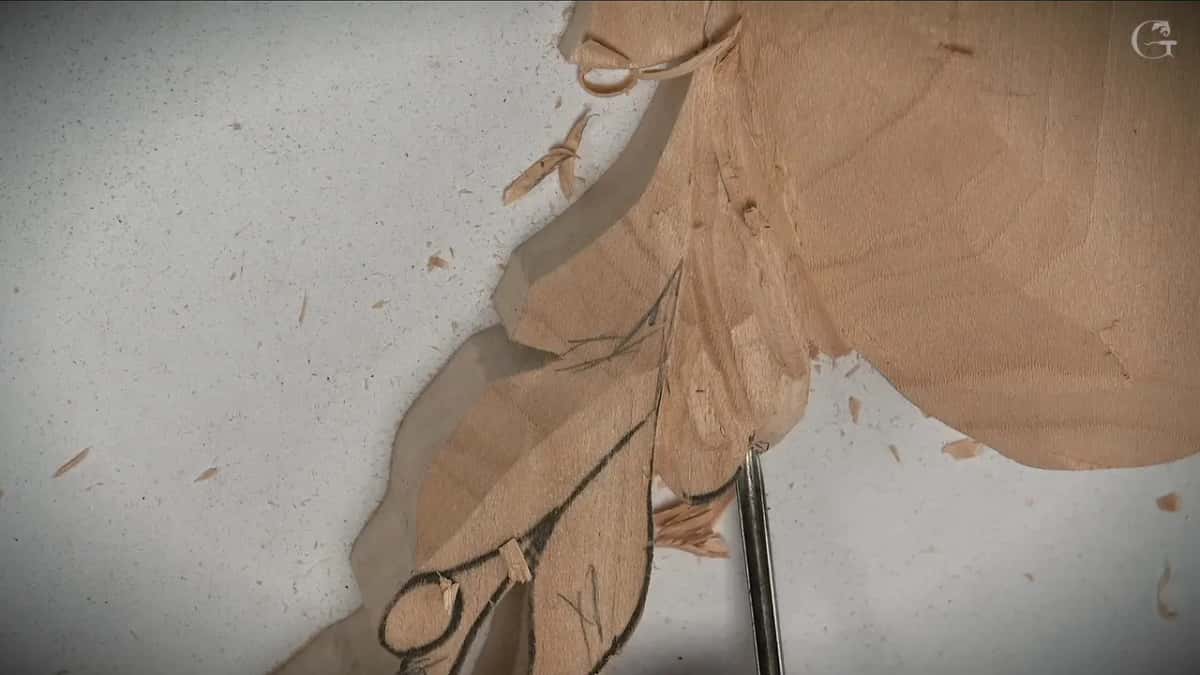
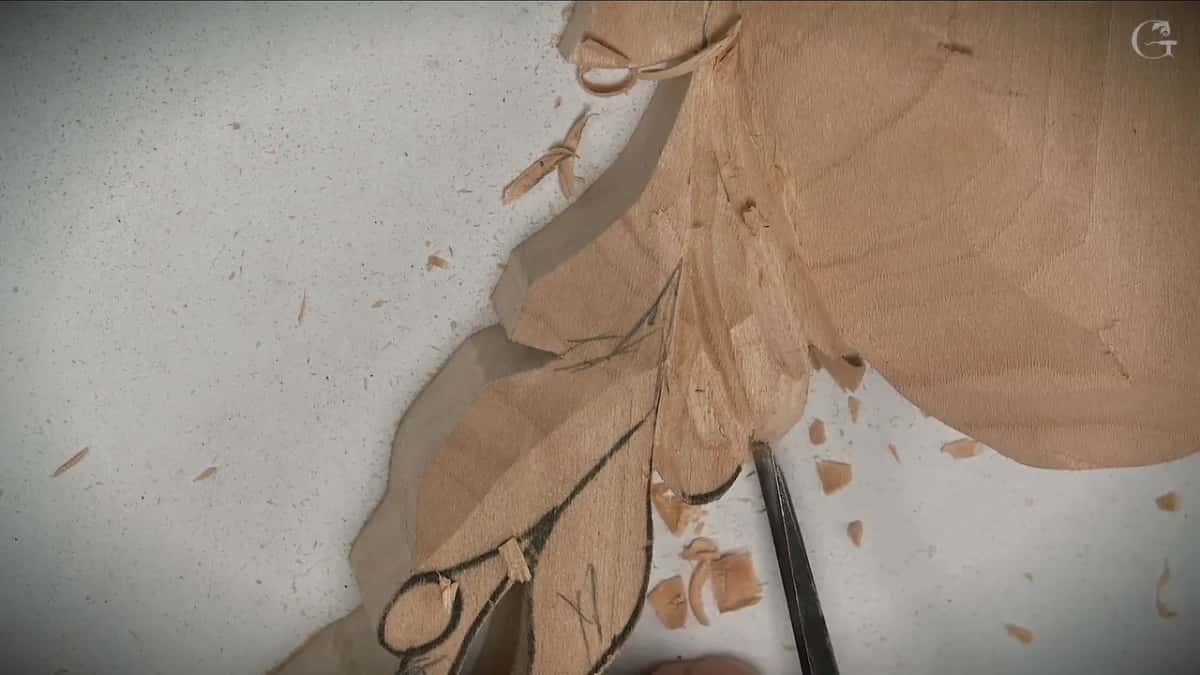
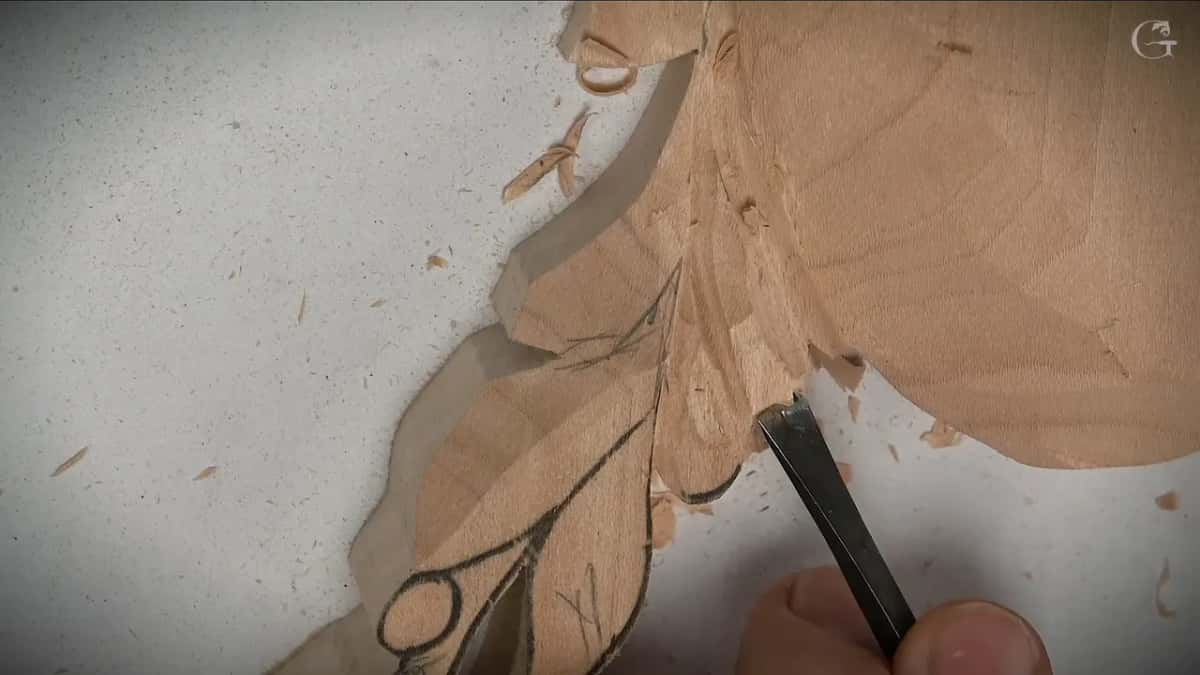
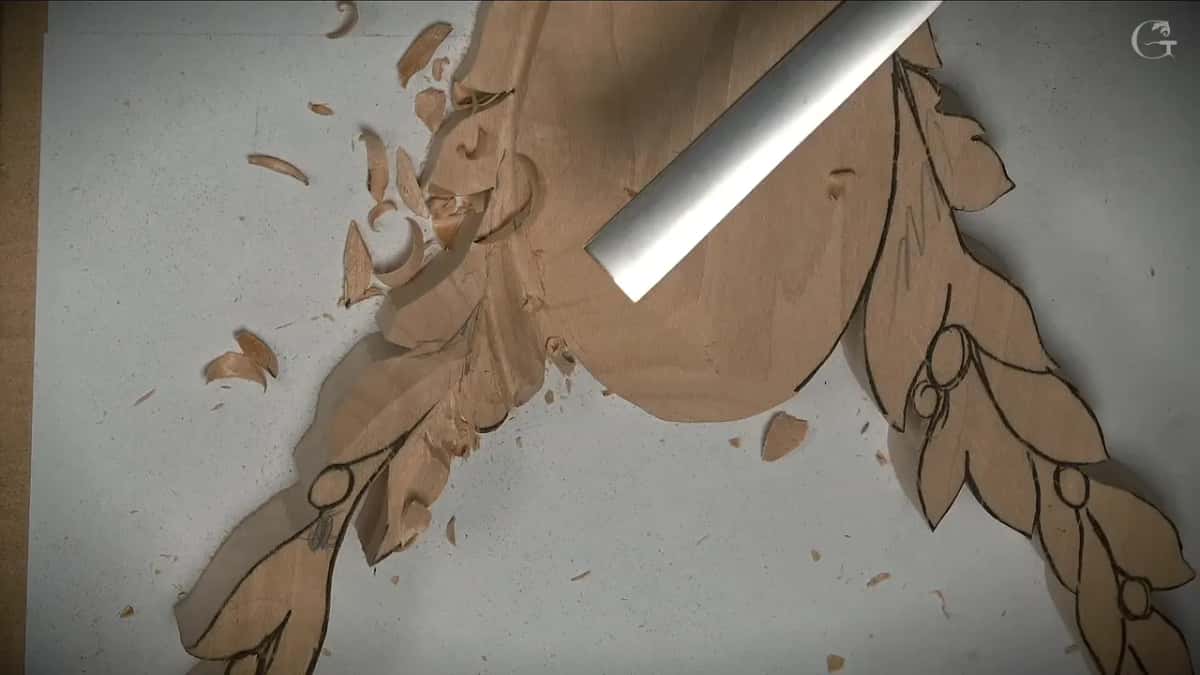
Quick answer: A backward twist on a carved leaf, the way I made one on my chamomile and bow rosette, is a hollow dug on the inside of the leaf with a number 11 of maybe two millimeters, undercut right away. Seen from above it makes sense, and a number 3 then runs the leaf smoothly downhill.
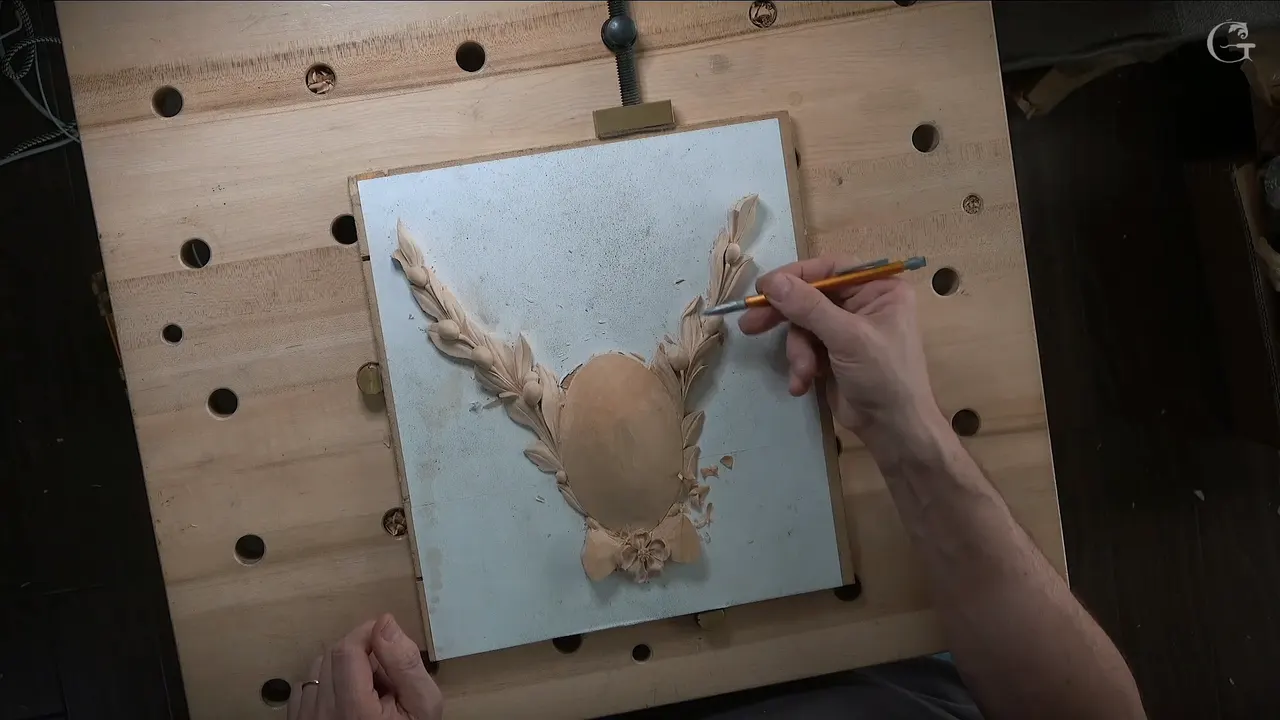
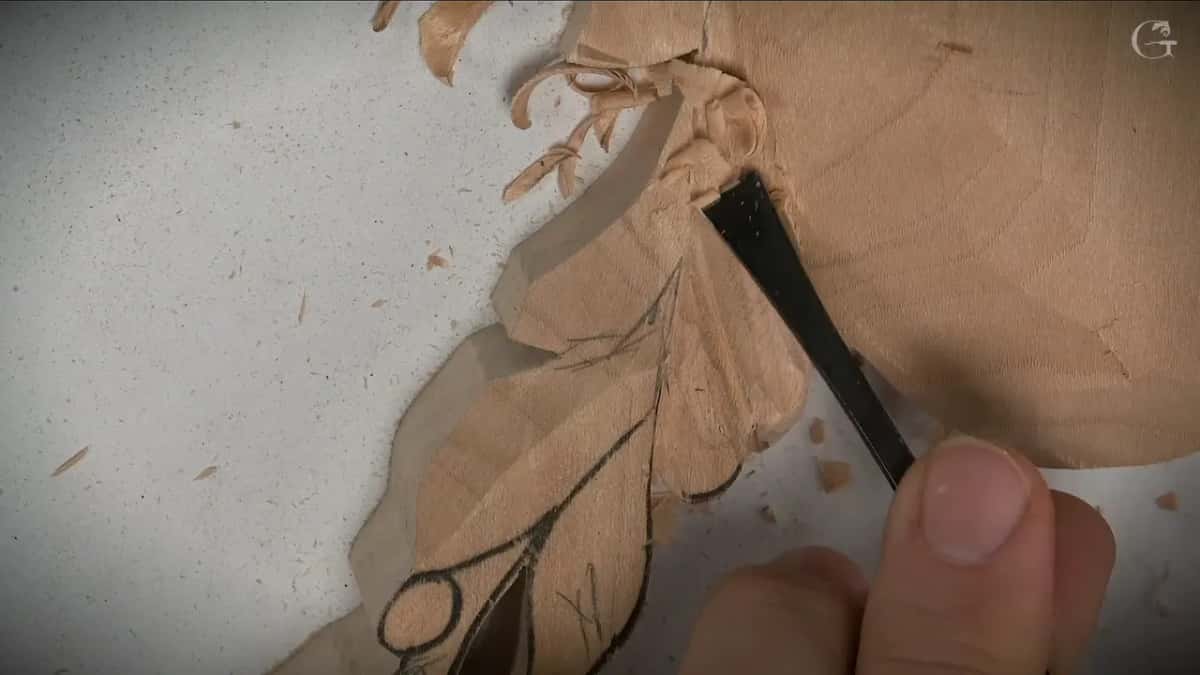
A leaf tip that twists backward is a hollow dug on the inside of the leaf, with the undercut going in right after it. That is how I did it on one spray of my chamomile and bow rosette. I had just dropped one end right down. And even more what I could do, I said, I could actually create some kind of twist. So I picked up a number 11 gouge, about two millimeters (1/16 in), and started digging.
It is one move in leaf carving in wood. Over a grape onlay I said there's a lot of different ways to twist a leaf, and the backward one is only one of them.
Is there a leaf on your board that just lies there, flat and still? A narrow number 11 in your roll? Then you already hold the tool I dug mine with.
The lines below come from what I said over real pieces. A lot of it is that one chamomile leaf, and five other pieces of mine fill in the rest, each one named where it shows up.
The backward twist in six lines
- A small number 11, about 2 mm, dug it on the leaf's inside.
- The undercut started right away.
- Whatever side I turned to the camera, it did not show, and I hoped the phone view from above helped.
- Right after, a number 3 ran it downhill.
- A grape leaf kept its convex through a backward twist.
- Twists went in only a couple of spots on the spray, and the rest stayed simple leaves.
Where on the leaf does a backward twist start?
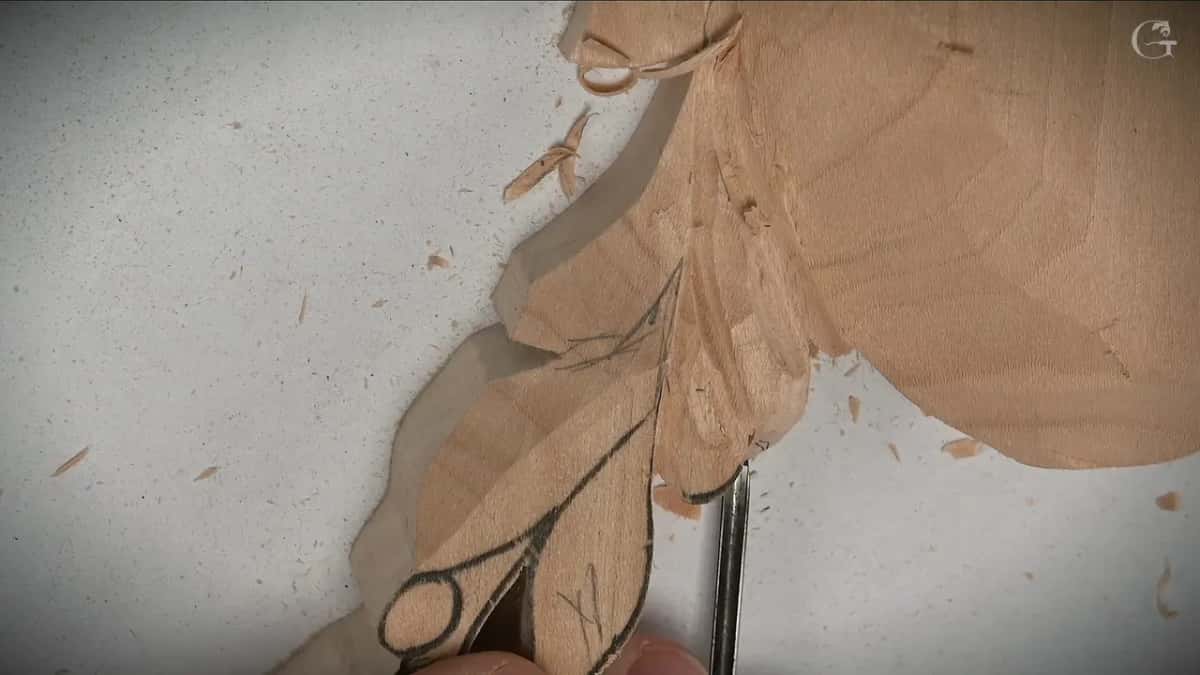
On the inside. Those are my words from the phone view I held up soon after. I know it doesn't look really nice, I said, but what I did, I excavated on inside right here, and I want to create a twist going like this.
Before that, a number 11 a little less than one eighth of an inch, two and a half millimeters, had started excavating there, and I had dropped one end all the way down, so it was kind of wrapping around. That part belongs to the berry, and lesson 2 of this course tells it. The twist came after.
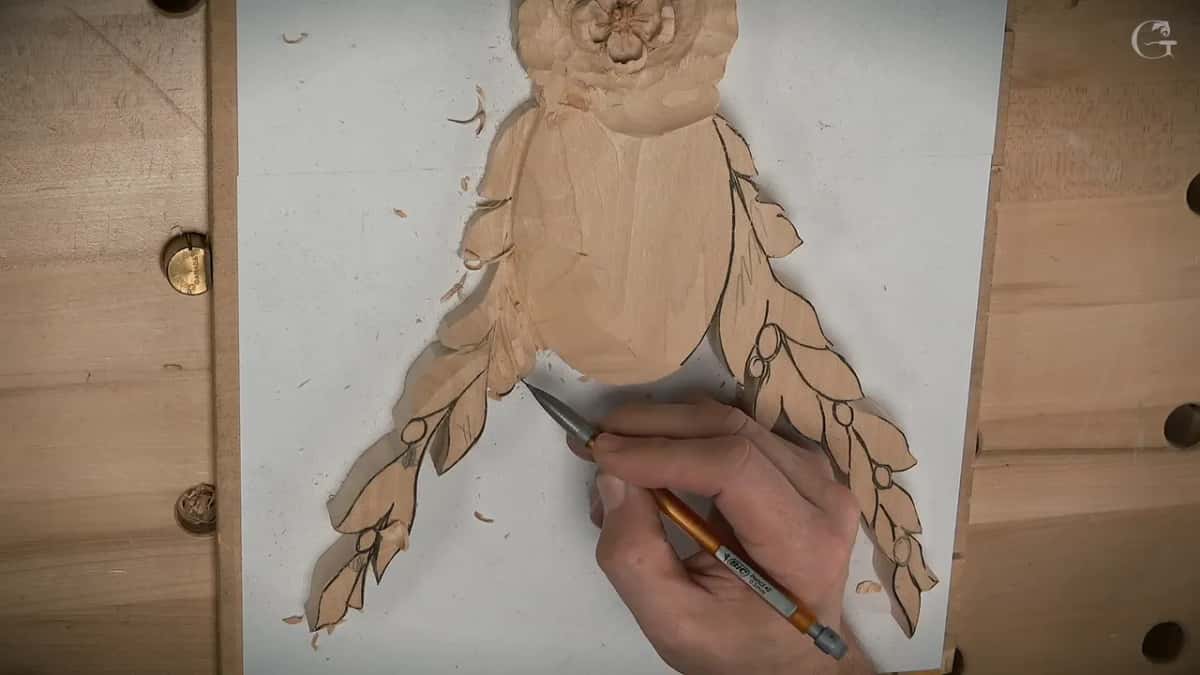
For the twist itself I went down to a number 11 of maybe two millimeters or so. A little later I said, so that is just a twisting backward, and I'm going to start undercutting right away.
Excavate is my word on this leaf. Over a twist in my Venice Room workshop 29 I caught myself on it and said not excavate, I apologize for that word, it's not the right word. Let me just give a shape, I said, like roundness.
The whole rosette is a 7/8 of an inch thick piece of wood, about 22 mm. Mine goes on a panel, in a pair.
Where do you look at a backward twist from?
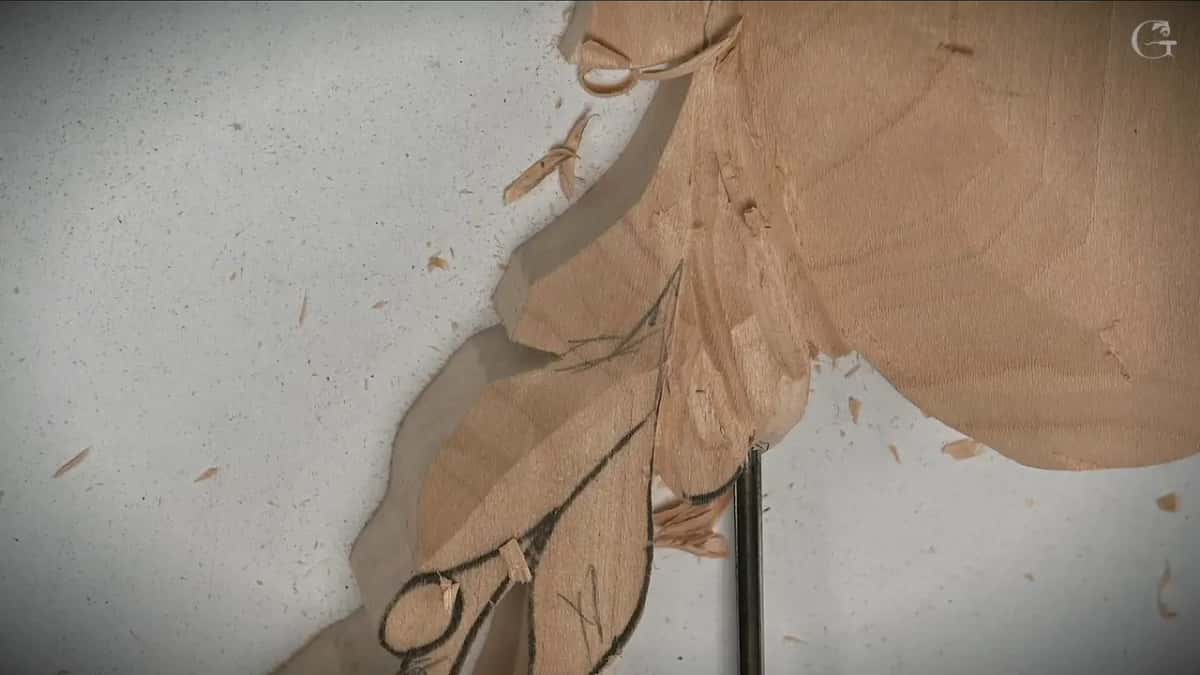
From above. I tried to show it to the camera first, and said I hope you can catch that. Let me try to show that, I said. Well, actually, you're not seeing it, because doesn't matter what side I show, it still doesn't show what I'm doing.
So I picked up my phone and filmed it close. I hope it makes sense if you look from above, of course, I said. That is how it looks. Go this way, and here you go, and in it goes. Hope it helped, I said. A little later, on the next leaf, I apologized in case you couldn't see it and said let me change my camera a little bit.
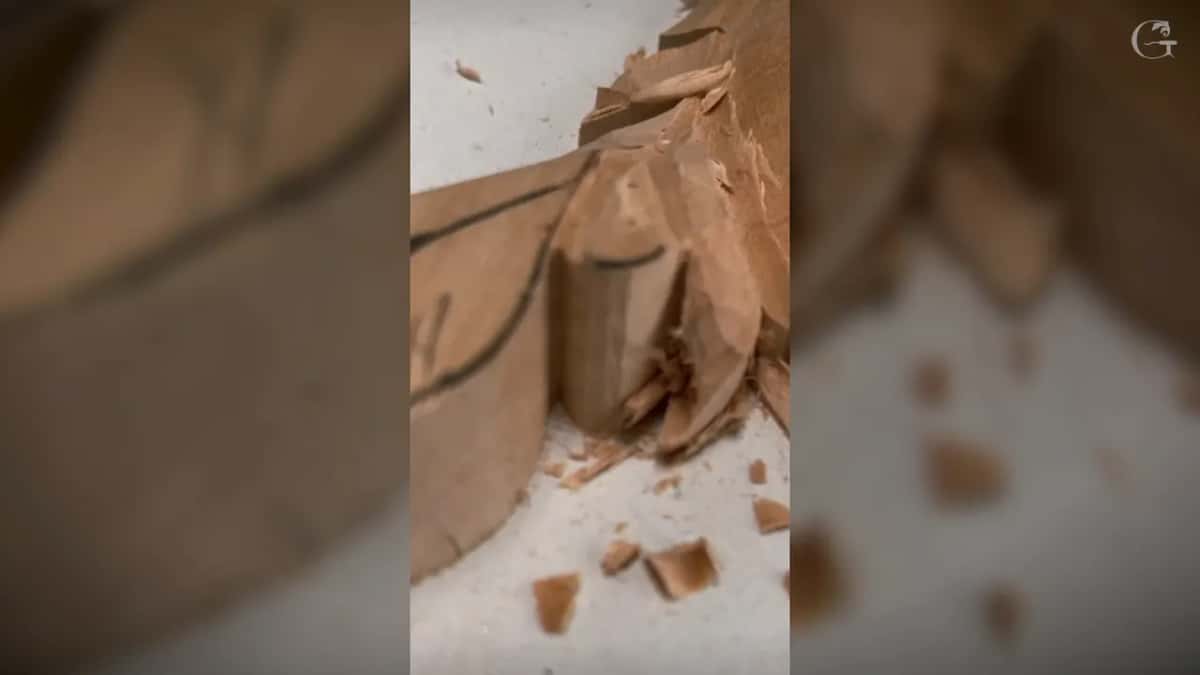
Other twists hid from my camera too. On a furniture panel, in the lesson on the flowers in its upper right corner, I apologized because I was covering it with my fingers, and said that was the best I could do with my camera. The grape onlay was the same, so I turned the piece toward you slightly and said I hoped you could see it. Near the end of this chamomile video I said, if I am covering that with my hands, please accept my apologies, I don't mean to.
What does the undercut under a twist do?
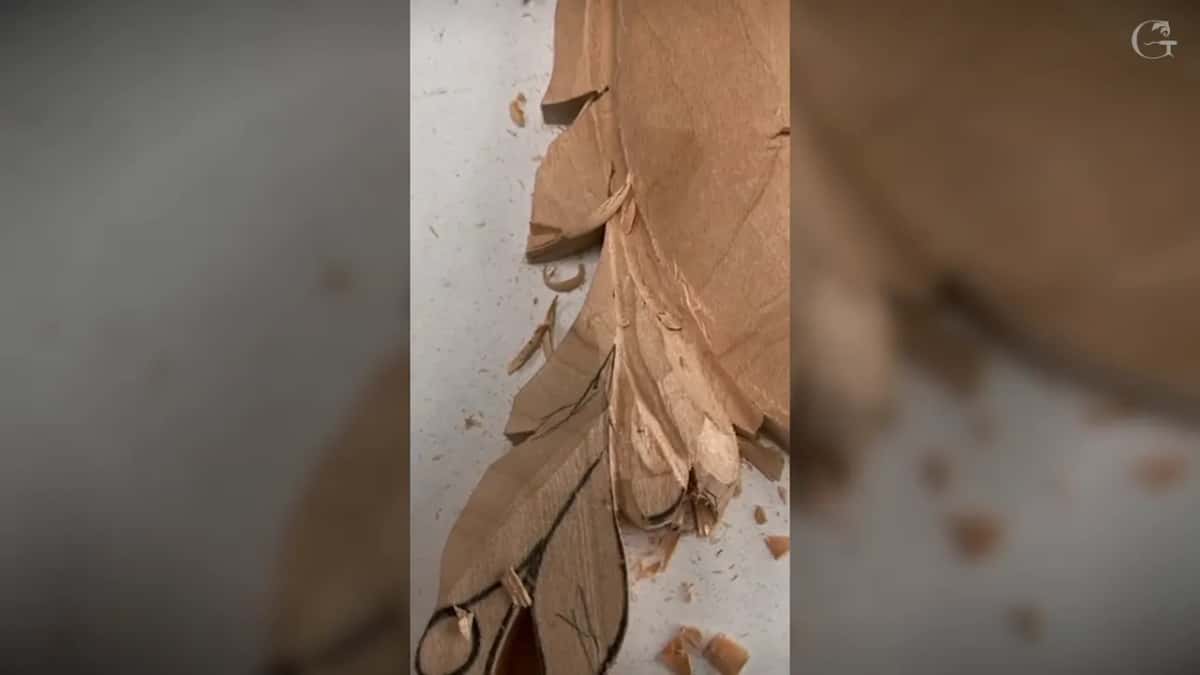
It throws a shadow. With that onlay I said I would like to just undercut right underneath the twist. I still have plenty of material, so I don't worry if I'm going to go on a lower leaf, I said, and I had absolutely no problem with that.
And I asked you about it. Beautiful shadow, can you see that shadow? I doubt you can see, because I've got so much light, but still it's casting.
On my lily box, the first layer, I took a one millimeter number 11 and undercut underneath of a twist really carefully. Again, it's possible to overdo it, I said. I don't want to overdo it. On that box I also made sure of one thing beside the twist. This part has to be lower than my twist, or flipping part, and I moved it down gradually, gradually, to get there. At the start of that part I said let's work this small detail, there's a couple leaves we need to work, and there's also a little twist, and I wanted to make sure it's really visible.
What comes once the twist is dug?
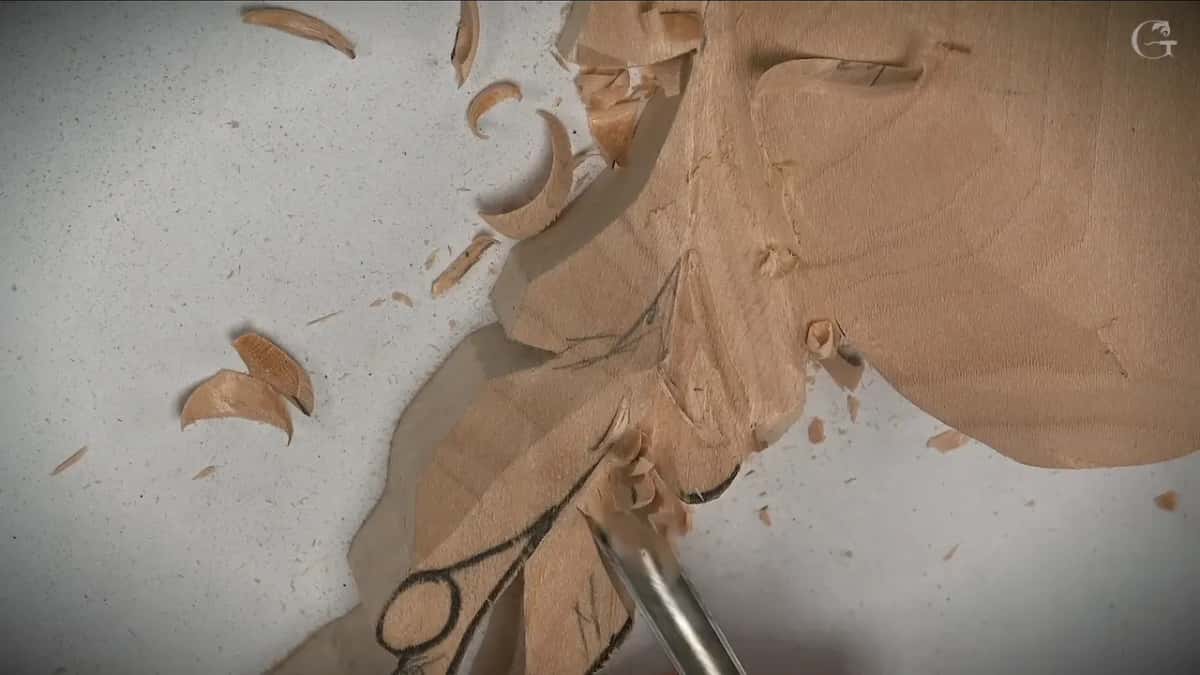
A flatter tool. Over the chamomile leaf my words were plain. And again, different gouges just to try whatever the gouge works. In my case, it's number three.
With that number 3 I wanted to establish the overall movement, and make sure the leaf really transitions smoothly downhill.
The grape leaf went the same way, with bigger tools. There I said it's supposed to blend. I would blend to the left and to the right, into the main convex, which I did not want to lose. The flip there does not run up to the eye, I said. It doesn't make any sense.
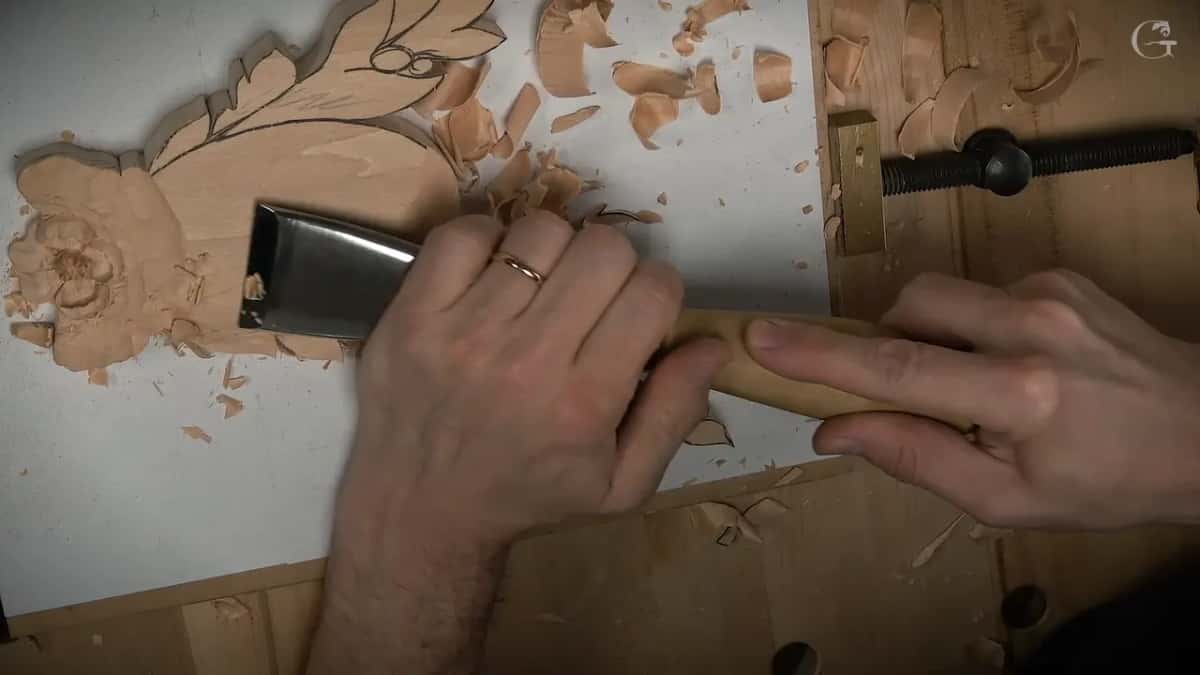
Then a flatter number 7 at 14 mm, about 9/16 in, went in, and I said roll it, roll that pass, just like that. I set the boundary with the same tool, and you could see it already taking shape. It's not a big movement, I said, but still it's kind of really nice.
Which ways can a leaf twist in leaf carving in wood?
More than one. Over that same onlay I pointed at how much meat we had, so we could take advantage of it. In nature, I said, you don't really see just the straight leaves falling like this. You see all kinds of twists.
In the next part of that lesson I said I made that twist, and then a number 11 at 10 mm, three eighths of an inch, went in for a concave. I wanted a small concave there, not big, blended in, but still visible. All I'm after, I said, is that it feels like it is moving that direction.
And I said it plainly. What I showed you is just one of the ways how you can twist the look of the leaf, but there's a lot of different ways. You can do twist downhill, you can do twist uphill.
After that I chose a backward one on another part of that grape leaf, and these were my words. I can probably twist slightly backward, I said. Yes, it's supposed to have a convex, and we're not going to eliminate that, but it still makes a twist. A bigger number 11 did that one, seven millimeters, just over a quarter inch.
The furniture panel went inward instead. I drew a middle line with a pencil and called it a really nice and beautiful flow line. I could twist this way a little bit, I said, see what I mean by flow? See, now it gives me a really nice S shape.
First I carefully grabbed a half millimeter to go around that pencil mark. It doesn't have to be half a millimeter, though, I said, it can be one millimeter too. I stopped there and said I would not do that right away.
I took a number 8 at one eighth of an inch instead and made that part twist a little bit inward. It gives a much more interesting result, I said. That pass went right to the twist. I'm not sure if I'm even correctly saying it, twist, but that is exactly what it is.
Does every leaf in a spray get a twist?
No, and mine did not. Later in this same lesson I said it's up to imagination what you can do with that leaf, and called it simple but beautiful. Then I went back over the spray. In some cases I've got a little twist, I said, but I didn't do that everywhere, just in a couple spots. On this side, I've got a twist upward, and I've got another twist upward. But the rest of them is just the simple leaves.
I stopped myself the same way over the grape leaf and said I didn't want to overdo it there either. For me it looked good. Back in this video, when I planned one leaf to come from under the berry, I said those variations make a big difference, a huge difference.
How deep can you take a twist?
Deeper than the first pass, on one flower of mine. In lesson 45 of my Hashemi flowers I was working against the grain at one spot, and I said that's okay. I made an even deeper concave there, and then said maybe even make an even deeper twist. Here's my number four, I said, and it went in next.
What I could do even more on this one, I said, I can bring that twist even more interesting, inside and out. Just make it really looking wavy, and create more concave. I created the ridge, I said, and I have to blend that ridge nicely, so a number 8 blended it in. Not sure if you're able to see the result, I said, and it was definitely not the end yet.
There is a limit, though. Back in that Venice Room workshop, a number 7 knocked down a little bit of one side. I would not force all the way, I said, because I didn't want to damage the sides.
What did the spray look like before any twist?
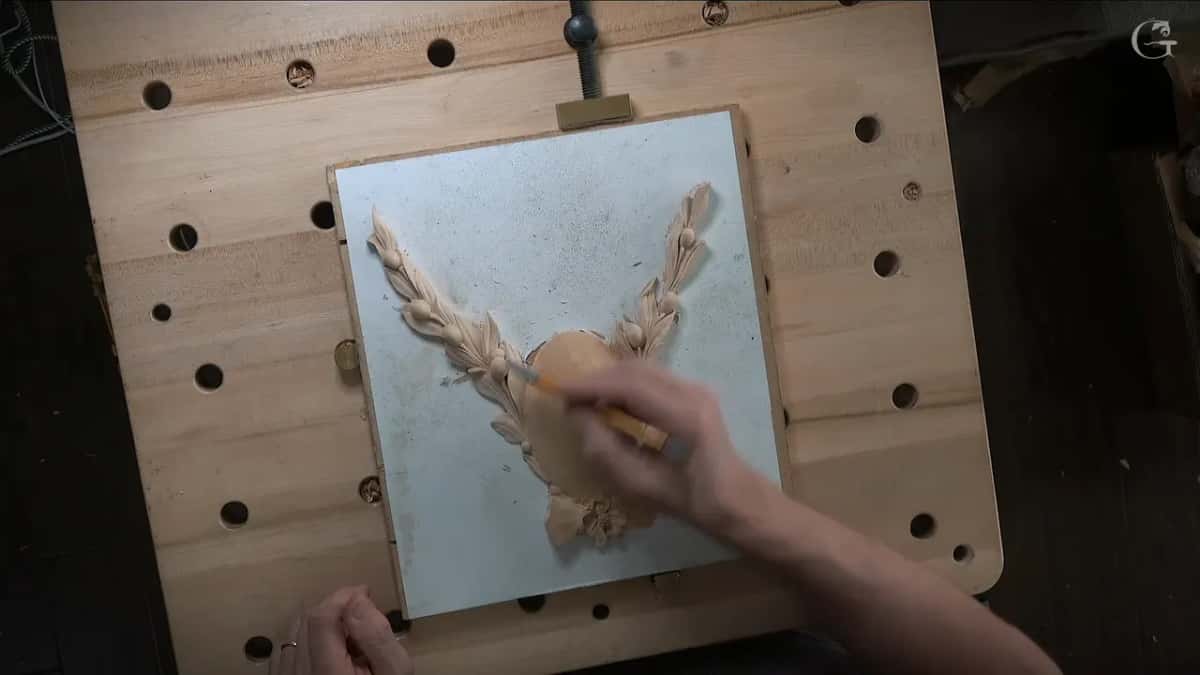
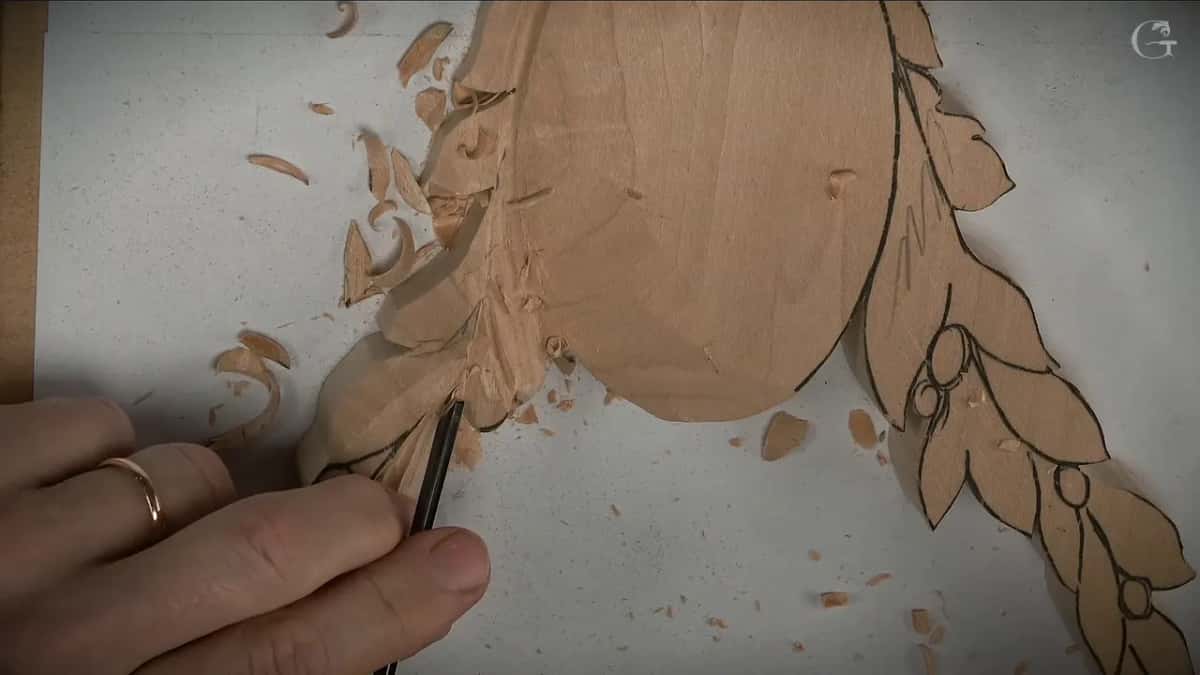
Low, and shaped like a dome. All of it happened in the first eight minutes of the video. I'd work on one side and show you the idea, I said, and you can develop the second side yourself. Whatever I did there, I would do exactly the same on the opposite side. I wanted to keep my high spots pretty high, because some of the parts are going to be really high, so I wouldn't lose the overall picture.
A smaller number 11 went a little deeper all around. This part goes lower, I said, because it's going to be a dome shape. Not the final look yet, I said. A bigger one came next, and I said I could go even lower on this side. And now let's play with that, let's play.
After the twist, another leaf had to go under a line on the relief. Don't want to confuse you, I said, but that's how it's going to look. A smaller number 11 refined the movement of that leaf. The berries and stems on this spray are their own story, and the chamomile flower in the middle gets its dome in lesson 4.
Which tools went into these twists?
Every size here is one I said out loud.
| Piece | Job | Said | Tool |
|---|---|---|---|
| Chamomile rosette leaf | Dug the hollow on the inside first | Twisting backward | About two millimeters, a number 11 |
| Same chamomile leaf | Set the overall movement right after it | Whatever works | In my case, a number 3 |
| Grape onlay leaf | Twisted slightly backward and kept the convex | Slightly backward | Seven millimeters on a bigger 11 |
| Same grape leaf | Rolled the pass after blending each side | Roll it | A flatter 7, fourteen millimeters wide |
| Furniture panel flowers | Made that one part twist slightly inward | Twisting inward | An 8, one eighth inch wide |
| Lily box layer | Undercut underneath of the twist really carefully | Really carefully | One millimeter number 11, used carefully |
The ribbon bow on this rosette twists too, and I modeled that one in clay first.
Where does your own twist start?
With one leaf and one small gouge, the way mine did. You can see where the whole piece starts in lesson 1, and the grape onlay course has twists of its own on its leaves.
Have you got a leaf that lies flat? And a number 11? Then come and carve it with me, and you will find Tuition and Access together on one plan page.
How it's done
- Dig on the inside. A narrow number 11 opened the hollow on the inside, two millimeters or so on mine.
- Undercut right away. The undercut started as soon as the hollow was in, on the chamomile leaf.
- Look from above. Whatever side I showed the camera, the twist did not show. From above, it made sense.
- Run it downhill. Mine was a number 3, whatever gouge works. I used it to run the leaf downhill.
- Keep most leaves simple. Twists went in a couple of spots, and the rest of the spray stayed simple leaves.
Frequently asked questions
What size gouge digs a backward twist?
For the chamomile spray my number 11 was about 2 mm, or 1/16 in. For a grape onlay, a bigger number 11 at seven millimeters went in for a twist slightly backward, then a flatter number 7, 14 mm wide or about 9/16 in, to roll it.
Should you undercut a twist straight away?
I did on the chamomile leaf, starting the undercut as soon as the hollow went in. My lily box got a 1 mm number 11 under a twist on its first layer, and I went really carefully there. Overdoing it is possible, I said.
Can a carved leaf twist upward instead?
In a couple spots on the chamomile spray, one side has a twist upward and then another twist upward. Carving a grape onlay, my words were that a twist can go downhill or uphill, since a backward twist is just one of the ways to twist a leaf.
What to carve next