
October 9, 2024 · Updated August 24, 2026
By Alexander Grabovetskiy — Master Woodcarver · Founder, School of Wood Carving · 23 min read
Why Carving is Honestly One of the Best Ideas That Could Cross Your Mind
Wood carving is the trade of removing wood until the shape shows itself. Ask me why carving instead of something faster, and I answer with my own life. It paid my housing and my food. In a prison cell at 42 below zero, it kept me alive. My grandfather's chisel started it, at six.
Somebody probably told you that this needs a talent you were born with. I do not believe it. Almost every great master who ever lived started at the point you are standing on right now.

Gouge in one hand, mallet in the other, on a moulding that runs off both edges.
So here is the honest reason to begin, and the honest price. No schedule, no promise about your first month. Since I was six I have carved, I believe I made a gouge out of a nail to stay alive, and I teach doctors and professors who had never touched woodworking.
- My grandfather's chisel came to me at six. I should not say he gave it to me, I took it. I killed it on a brick.
- One knife paid my bills for years.
- A machine can carve some things, and it still cannot go underneath a leaf. I owned a shop with a CNC in it, so I am allowed to say that.
- In my in-person classes the room is mostly past fifty.
- Patience cuts both ways here. Carving builds it in you, and without some of it already you will hate every hour.
Why should you pick up a gouge at all?
My best reason is a question somebody asked me years ago, and it has never left me since. What is the richest place on planet Earth? People guess a country. Some say the USA, some say Israel. All wrong.
The richest place on planet Earth is a cemetery. A lot of people are lying right there, talented people who never used the talent God gave them, and every bit of that wealth is buried in the ground with them. I do not want you to be one of those at the end of your life, holding a talent you never opened.

Nine tenths of this panel is still pencil.
Artistic people are all over this planet and they never exercise the talent. I say that in the first hour of my beginner course, before anybody touches a tool. And if you stick with it long enough, you can go all the way to the top.
Now, none of this is easy and I would not pretend otherwise. Other people have written honestly here about whether wood carving is hard, and I have said my piece on whether this is a dying art. Some call it a dying trade. Personally I do not agree, because there are still thousands of people who carve. What is definitely changing is the quality.

Working an oval panel of flowers with a small chisel.
Wood carving ranks among the oldest things a human being does with a sharp piece of steel, and in Britain the Heritage Crafts Red List now tracks which of these trades are running out of people. Its Endangered Crafts Fund puts money behind the ones in trouble. UNESCO keeps the same kind of record in the UNESCO heritage lists. None of that is here to make you sad. Somebody has to be the person who fixes it, and it may as well be you.
Do you have to be born good at this?
Every master who ever lived began where you are. It does not matter whether it was 200 years ago or 1,000 years ago, or even before the flood. They all started at the same point. Almost all of us did.
Master is a title, yes, a royal title in the woodworking world. But everybody can be a master if you understand the process, and even the ability to see in 3D you can develop. The only way is how long you spend on what you do. More you work on it, more you develop. True of anything, not just carving.
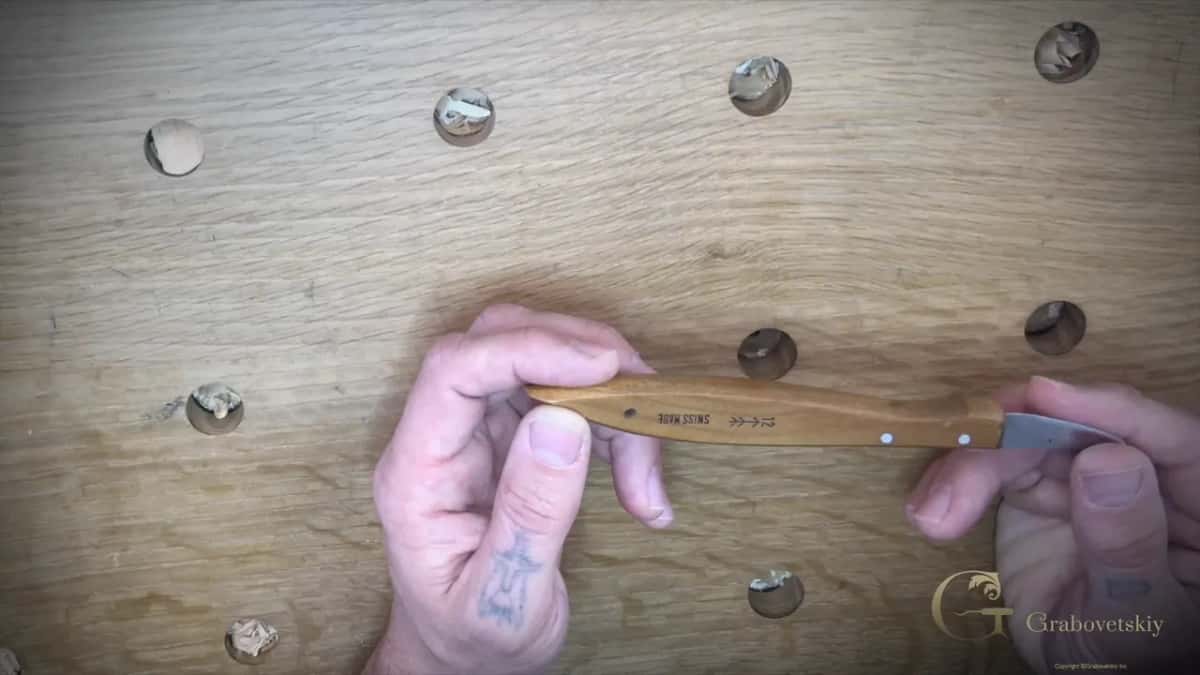
The knife a beginner starts with, held up over the bench.
Think about when you were at school and they taught you cursive writing. You kept the letters between the upper and lower border. Later on you did not need those lines any more, because you feel it naturally. You developed it. Carving works the same way, only slower.
Here is the blunt part. Anybody can poke a chisel into the side of a board, and anybody can learn that in a couple of weeks. The challenge is that you cannot become a master until you learn how to design for relief carving, and for that you have to learn how it was done before you. Even a beautiful designer who draws well on paper does not automatically design for the chisel, because wood is an absolutely different medium. Somebody here wrote about whether you need to be good at drawing.

A beginner course panel, symmetrical acanthus, worked flat.
Johann Wolfgang von Goethe said it better than I can, in a line Robert Greene quotes in his book Mastery:
Everyone holds his fortune in his own hands, like a sculptor the raw material he will fashion into a figure.
An English carver named Thomas W. Wallis began as a humble gilder and ended up a sculptor in wood. His Autobiography records the motto printed in large letters at the end of his schoolroom.
What man has done, man may do again.

Pencil scrollwork on an oak apron, still showing under the carving.
My great-grandfather worked mahogany in the Chippendale style. They called him a redwooder. So I will admit I got some of this in the blood, generational. That still did not carve one leaf for me. The apprenticeship did, and so did the years, which is what the old guilds were built on.
What does carving do to your head?
Working in three dimensions asks something of your brain that flat work never asks. Carving is the ability to think in a three-dimensional world, and to see what two-dimensional people do not see. Do not get me wrong. Every human being is able to develop that ability, because we have the same brains.
When I teach in person, in Florida for example, most of the room is over fifty. I get people in their thirties and forties, sometimes an eighteen year old. Those people know they are in the second part of life, and they know they have to do something with the brains to stir it up, because they do not want to lose memories. Losing the ability to remember frightens them.
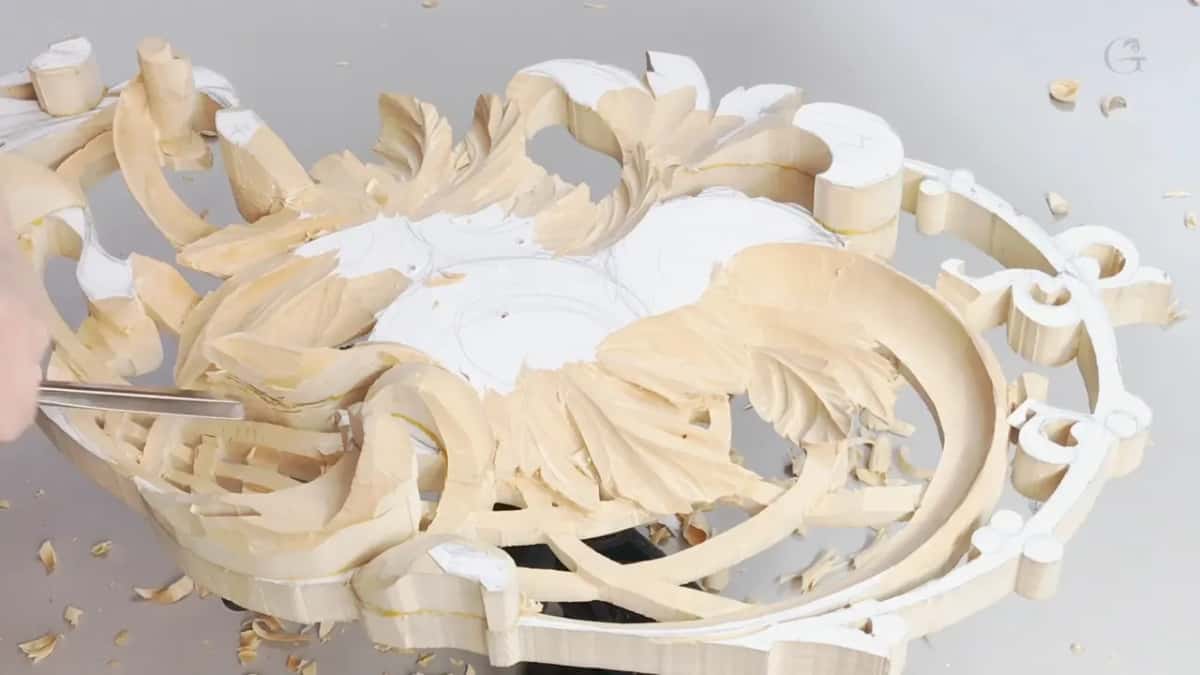
The background is gone and the leaves carry themselves.
Plenty of people are afraid of dementia as they get older, and that is a big problem. When you carve in 3D, or in the round as they say in the UK, you are developing new cells, and you prolong your life pretty much. Maybe your life. I should not say your life. I am not a doctor. But I have talked with doctors and they say, yeah, that is a true fact.
I want that hedge left in, because I meant it. The guy who studied all those neurons, that was never me. For somebody else's reading of the research, our own team went through it in what the science actually found about carving and your brain.

Layout lines still on it, and a knife working the edge.
Robert Greene puts the physical side of it plainly in Mastery, and this part I have felt in my own hands since I was six:
Many of our earliest survival skills depended on elaborate hand-eye coordination. To this day, a large portion of our brain is devoted to this relationship. When we work with our hands and build something, we learn how to sequence our actions and how to organize our thoughts.
Here is a small exercise you can run today, before you own a single tool. Close your eyes and see the ornament upside down in your head. Turn it over. Look at the back. The collection at the Smithsonian American Art Museum is a good place to practice on somebody else's work. That muscle costs nothing to train.
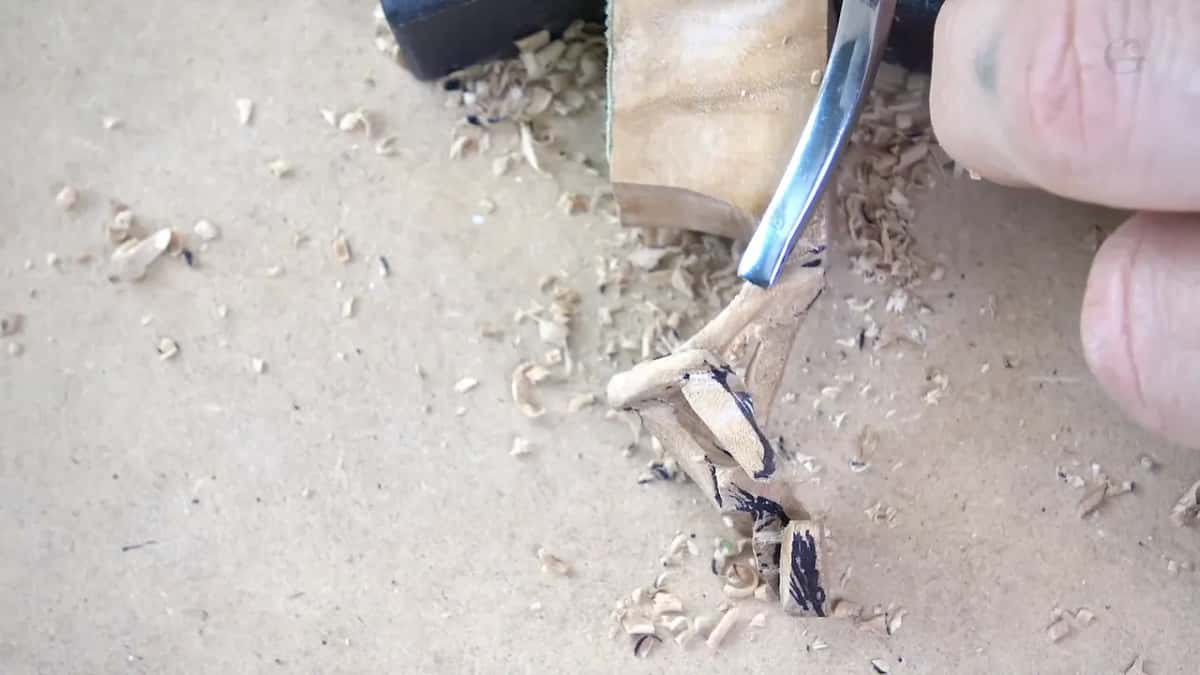
A gouge shaping a stem no wider than a fingernail.
Carving helps you stay busy and stay thinking. In my opinion it beats all of the TV shows put together. How much can you watch of whatever news channel you have on, and worry about what is going on out there? Let us concentrate on the beautiful things instead.
I have also said out loud that carving beats all the depression, and I owe you the other half of that sentence. I grew up not knowing what the word meant. The first time I heard about depression was in the United States, where everybody is depressed and everybody is smiling. So take that line as one man's opinion, not as a doctor's advice.

Reaching in behind a leaf that already floats clear of the board.
Can a machine just carve it for you?
Some carving can be done on a machine, and I know that better than most people arguing about it, because I used to have a shop with a CNC in it. Plenty of stuff can be done on the CNCs. Not all of them. Maybe a 4-axis.
Then you reach the place where it stops. A machine cannot go underneath. Even the armed one cannot undercut inside and go in there. There is no CNC machine on planet Earth that can do the complicated carving. Maybe some microscopic five-axis one gets closer. Yes, there are computerized routers, and they are limited.

Against black, you see how far the scroll stands proud of its ground.
The third thing a machine lacks is the most important part, human touch. Human touch is what makes carving such a unique skill, the marks that a human hand did this and not a machine. When a machine does the carving it comes out more like a plasticky-looking thing. Hand work is hand work. A lot of my own work is relief sculpture carved into a panel, and a lot of it is the acanthus leaf in one shape or another.
| What you want done | A CNC or a router | My hands and a gouge |
|---|---|---|
| Going underneath a leaf | No machine reaches in | Where I live |
| Deep layered ornament | No CNC on planet Earth does it | Same tools as 2,000 years ago |
| A surface somebody will touch | Plasticky | Carries the marks of a human hand |
| Cheap, and done by yesterday | The whole job of a machine | Not the work I sell |

Roses and acanthus running past both edges of the frame.
One guy told me his CNC just runs into the corner, sits down quietly and weeps when it watches a carver work by hand. His joke, not mine, and I laughed at it. I also recommend CNC tape for holding your work down, so please do not turn me into an enemy of machines. My enemy is pretending.
What changed is what people will wait for. They want it done cheap, they want it quick, and it has to be done yesterday. Walk into a furniture store and you can barely find any really good quality furniture. The only good furniture is probably done by hand, by masters. That standard is still on the wall at the V and A sculpture collection, searchable in the V and A online collections, and hanging in the Rijksmuseum in Amsterdam.

My arms reach across about a third of this board.
A carver from the 15th century, the 17th, the 19th, would do a piece exactly the same as what we do. Same tools, same time, almost the same setup. That makes this one of the few skills preserved rather than replaced, which is why the Getty Conservation Institute, the National Trust, the American Institute for Conservation and the National Park Service preservation program still need people who can hold a gouge. Go and look at Grinling Gibbons some time. Nothing in his shop plugged into a wall.

Old grey paint, still sitting down in the hollows of the scrollwork.
Does carving make you patient, or must you arrive with it?
Both, and I hold both at once. Patience is the most important thing in carving, I think. It builds your character, and you become a lot more patient with the carving. Or maybe you just become patient with me.
Now the other side. Somebody without patience is probably going to hate this. And if that patience is missing, carving is not for you at all. It is not a trade for people who want something done quickly.

Blocking in, under heavy black layout lines.
Sometimes it is true, you spend a long time in just one small area. Literally you spend one day, sometimes, on one square inch. I had a piece I worked on for ten years. I could have got it done in one month, but I had other projects. I gave that piece away as a gift and I told them it took me ten years, so at least they would respect how much is in it.
Robert Greene, again in Mastery, describes the trade you are making:
Real pleasure comes from overcoming challenges, feeling confidence in your abilities, gaining fluency in skills, and experiencing the power this brings. You develop patience.

Rough shapes, ink lines, chips.
People also ask me whether carving forgives you when you slip. I break things. I glue them back with a small bottle of glue I keep right there, and yes, that has absolutely happened to me. But mistakes bother me and they always have, so I would never tell you the wood forgives everything. For the specific slips and the way out of them, read the mistakes to avoid in wood carving, and the dangers a beginner runs into is worth ten minutes as well.
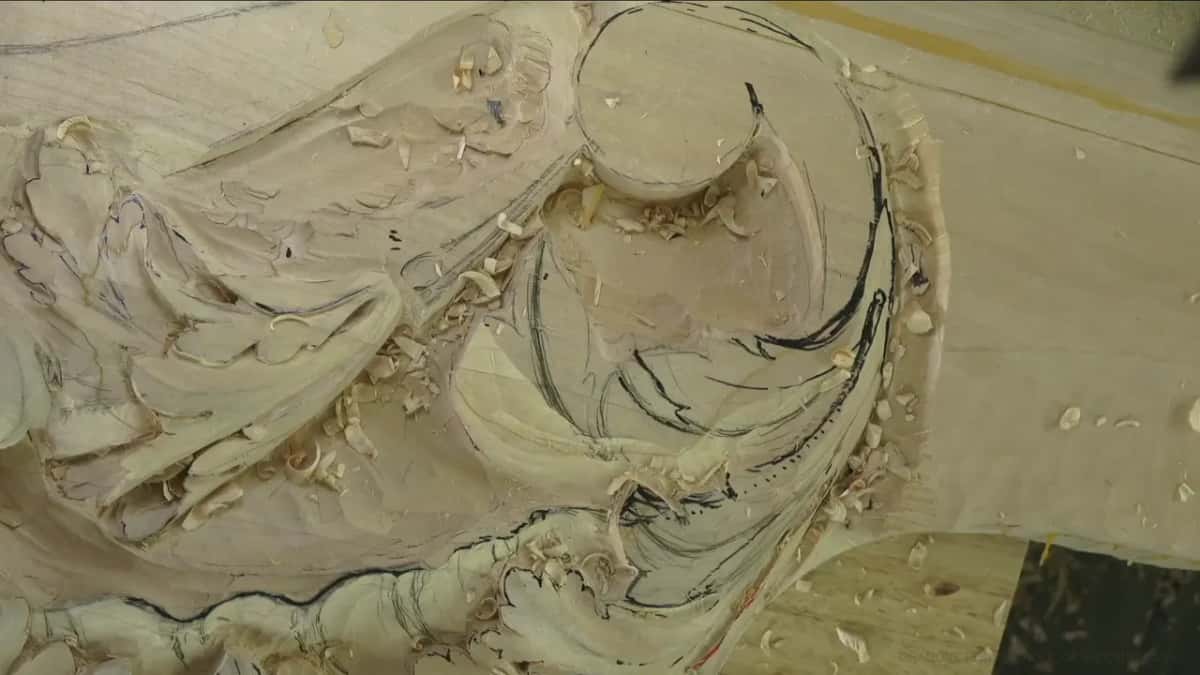
The same panel, empty handed. Look how much wood is still to go.
How long it takes is a question I get, and I refuse to give a number. A man wrote and asked what level he would reach in one month, in two, in a year. Impossible to tell. Young kids come to the gym, pump dumbbells for one day, then walk to the mirror to see what grew on the biceps. Nothing grows in one day. Do not be like a child. You can read Fine Woodworking cover to cover and the hours are still yours to put in. A fuller answer sits in how long it takes to learn to carve wood.
What does a whole day of carving feel like?
Peaceful, and a lot busier inside your head than you would guess. I am carving all day long and every day, and it is so peaceful. One of the most peaceful professions, I would say. You concentrate on your work and your hands become like a machine, doing everything automatically.
And that is exactly where the surprise is. Your hands go into auto mode, but your brains stay free, and you can use them for pretty much anything. I really do not like to be in quiet. I listen to audiobooks while I carve, and I have taken university courses that way. When it is too quiet in the background, it is just boring to me.

One shaving curling off the blade.
There are gaps, though. Moments come when I am really quiet, really quiet, and all I hear is my gouge slicing through the fibers. They say that sound triggers hormones, endorphins, a kind of euphoria, a tingling. So they tell me. What I know is that I once made a whole video with no music and no talking, just the gouge and the wood.
Time disappears in there. You start at six in the morning and you finish at two in the morning and you did not even see how much time passed. It just flies. Honestly, I can get lost in time when I am doing it.
The livestream below is the other kind of session, where I talk the whole way through and answer whatever comes in.
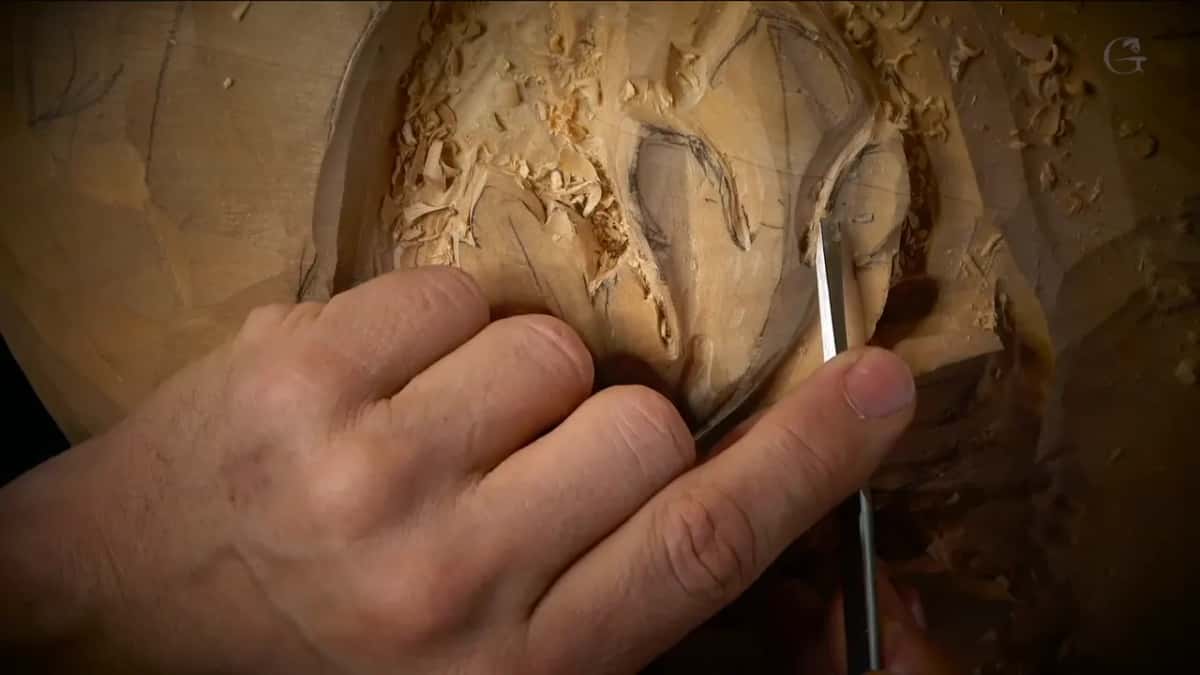
Side light across a half shaped leaf.
The rewards are small and they are constant. A clean chip comes off the petal and I can see it is really nice and clean, and I know it is a small thing, but it makes me happy. Some people really like to see the details, and it gives me joy to put that detail in even when nobody is ever going to see it.

Half carved, half still drawn, in one picture.
There was a German carver in the 15th and 16th centuries, Riemenschneider. I really like what he would say. He always made it look nice from the backside, and when people asked why he bothered in a spot no human eye would ever see, he answered that a human is not going to see it, but God will see it. We wrote more about him in why Riemenschneider left his limewood unpainted.
And that is true. But I live in a different century, and people expect everything done pretty quick, so that luxury they had in the 15th century is not mine. I still put the detail in the back. Just faster than he did.
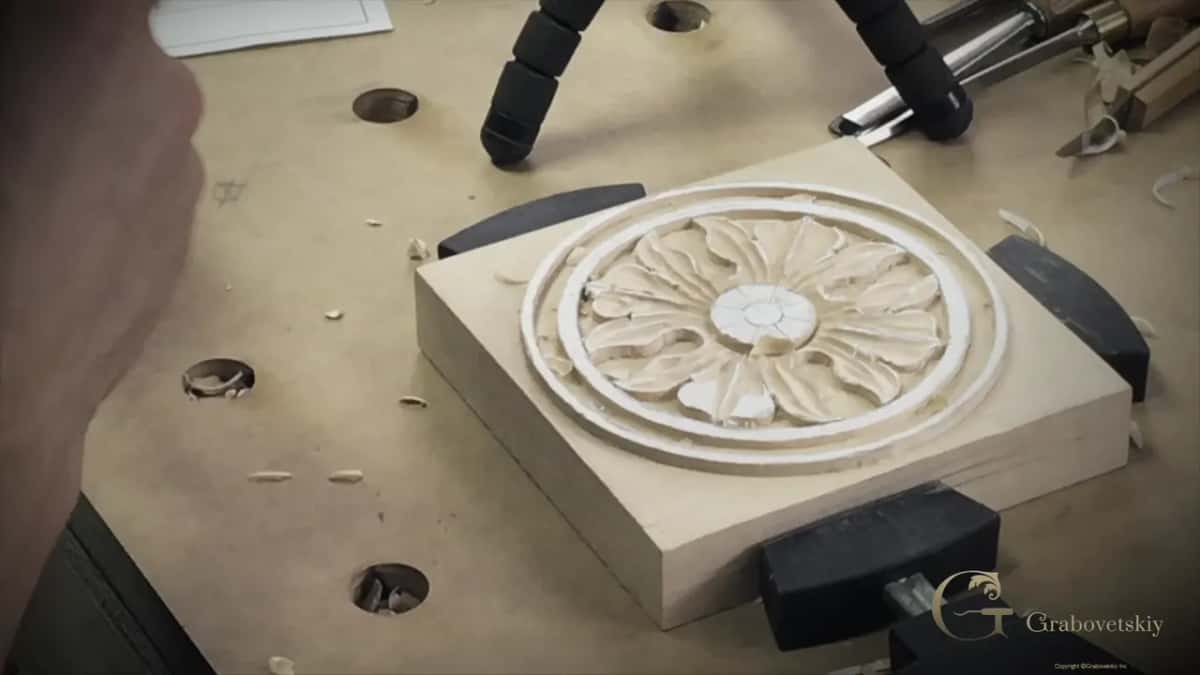
Dog holes, chips and clamp pads, on a real bench.
The material changes the day too. Olive wood has dark streaks running right through the leaves you are shaping. Where a species comes from matters as well, and the International Tropical Timber Organization tracks that trade while the USDA National Agricultural Library holds the dry technical reading. Which wood you pick is its own decision, and it has its own article, what kind of wood you should use for carving. Our wood database has the species pages when you want to go deeper, and what the gravity of wood means explains why one board eats twice the effort of another at the edge.

Olive wood, with the dark streaks running through the leaves.
How do you start when you have never carved anything?
Start the way my own master started me, with paper, a pencil and one knife. He gave me only one knife, and a gouge much later. Until I could handle the knife properly, he would not hand me a gouge at all.
Step 1, draw the design before you touch wood
My master would put a piece of paper in front of me and say one word. Think. Think how you are going to carve it. Boom, think. A piece of paper is not a piece of wood. What tools are you going to use? How many tools do you even have? Then he taught me the laws underneath any ornament, the law of space, the law of rhythm, the law of repetition. More on that in planning and sketching a carving design.
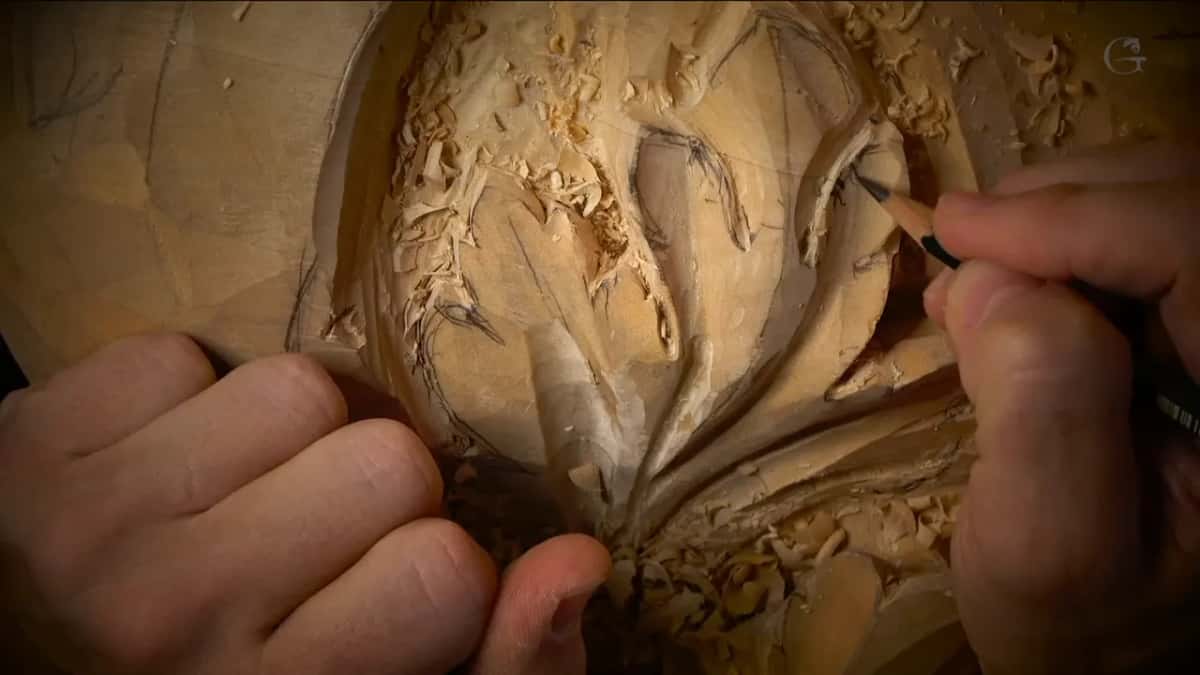
Drawing straight onto the work to fix a line.
Step 2, get one knife and stay with it a long time
My favorite knife is a number 12, Swiss made. Somewhat expensive, but worth it. That knife has sat on my shelf for twenty years and I still use it daily, so it was a one-time payment for a lifetime friend. It paid a lot of bills. My housing came out of that knife, and food, and clothes, and I am not talking about twenty dollars. Old carvers used one knife for all the beautiful things they made. For the shopping order, read the best materials for beginners in wood carving.
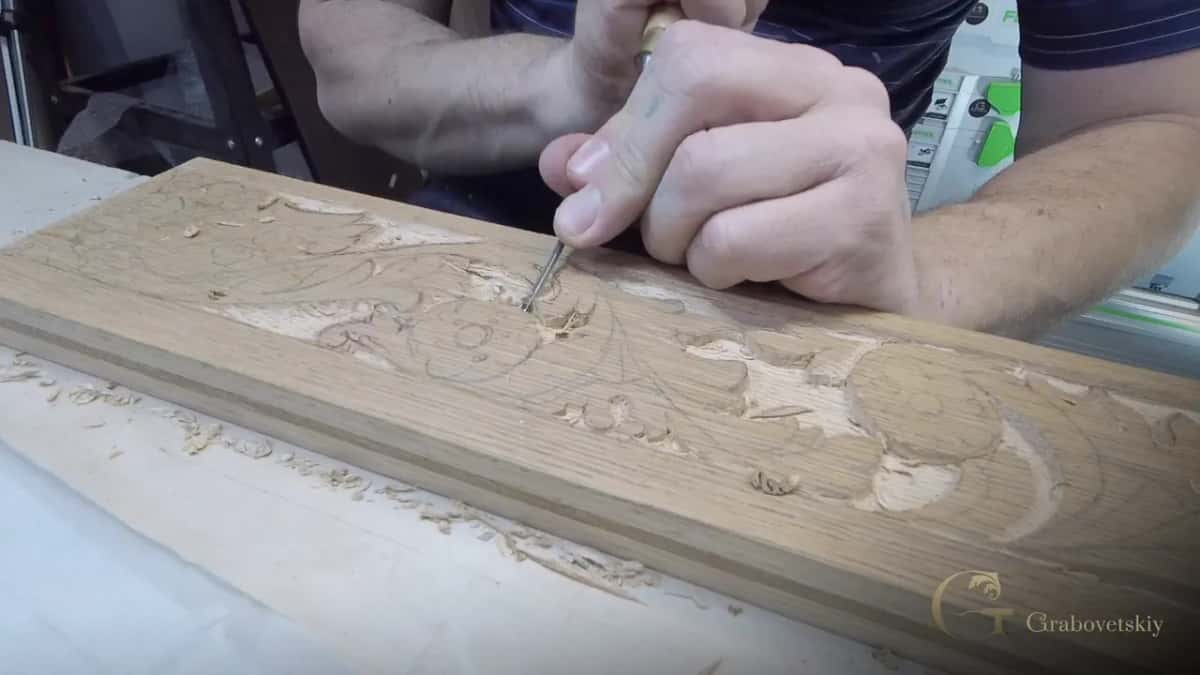
Both hands on one small chisel, pushing into the scroll.
Step 3, learn to sharpen, because bad wood does not exist
I came to my master one day and complained that he gave me a bad piece of wood. He said there is no such thing as bad wood. It is dull tools. That is the only problem, dull tools. Sharp tools can do beautiful stuff even on the worst of the worst pieces of wood. That lesson was hard to believe and easy to hear. Everything I know about it sits in sharpening and in the full carving tool sharpening course.
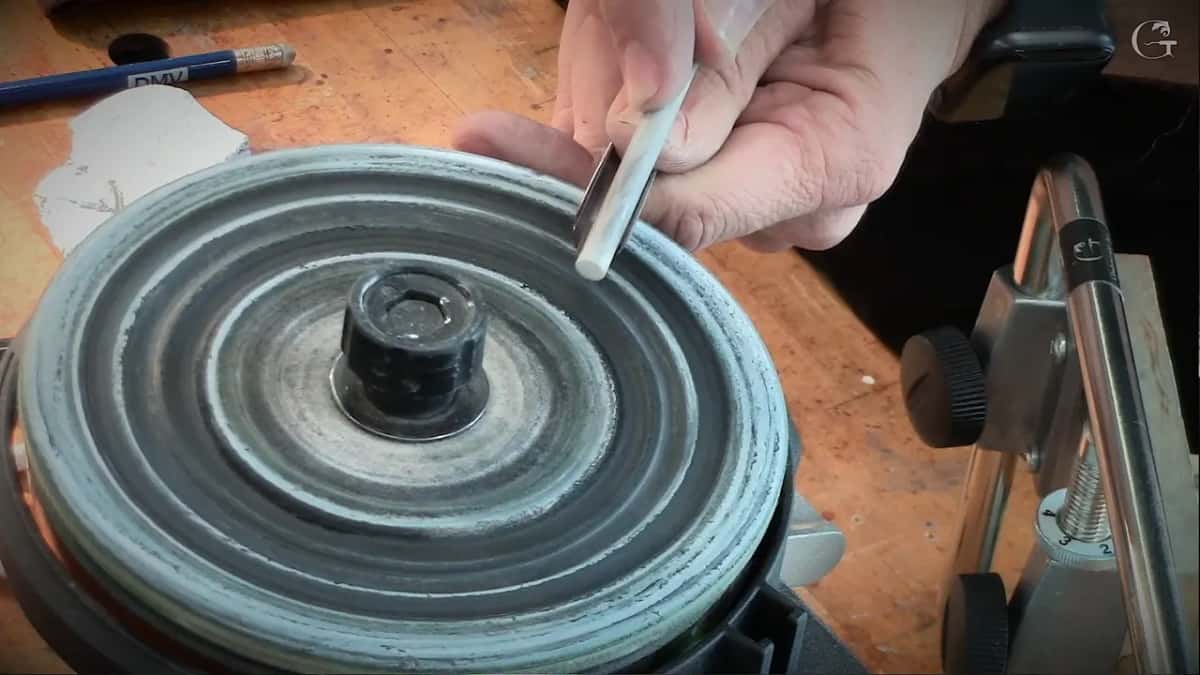
A gouge against the honing wheel.
Step 4, shape it in clay first so your head learns 3D
Before you grab a board, work with clay. You are going to involve some parts of the brain you never used before. Clay adds, wood takes away, and doing both teaches your hands what a form actually is. It costs little and it saves a board.
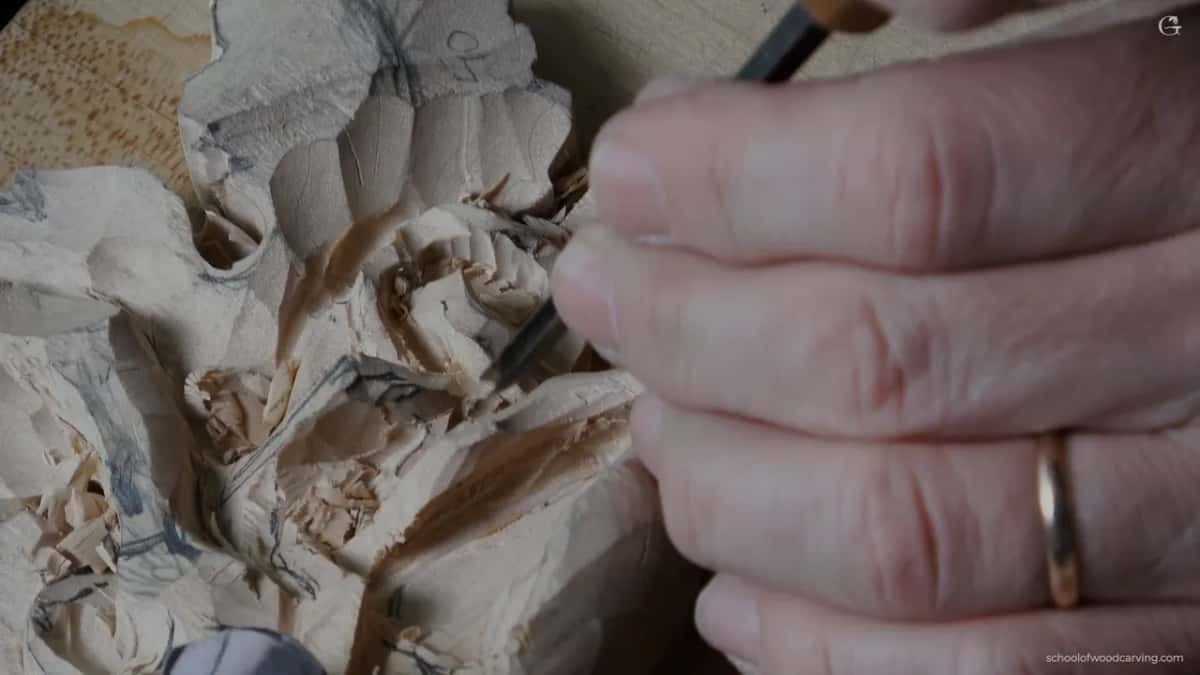
Grapes still flat discs at this stage.
Step 5, jump in and carve badly for a while
When I was young I spent almost every day on the river, and the way we learned to swim was simple. We jumped in the water and started doing the stuff. Sometimes it is a good idea to push somebody in the water and let him swim, and explain the technique later. Learning to think in 3D works exactly the same way. You just start working on that. Simplicity is a rule. If you want a route map, somebody wrote out how to start learning wood carving, and the first step in wood carving covers the same ground.
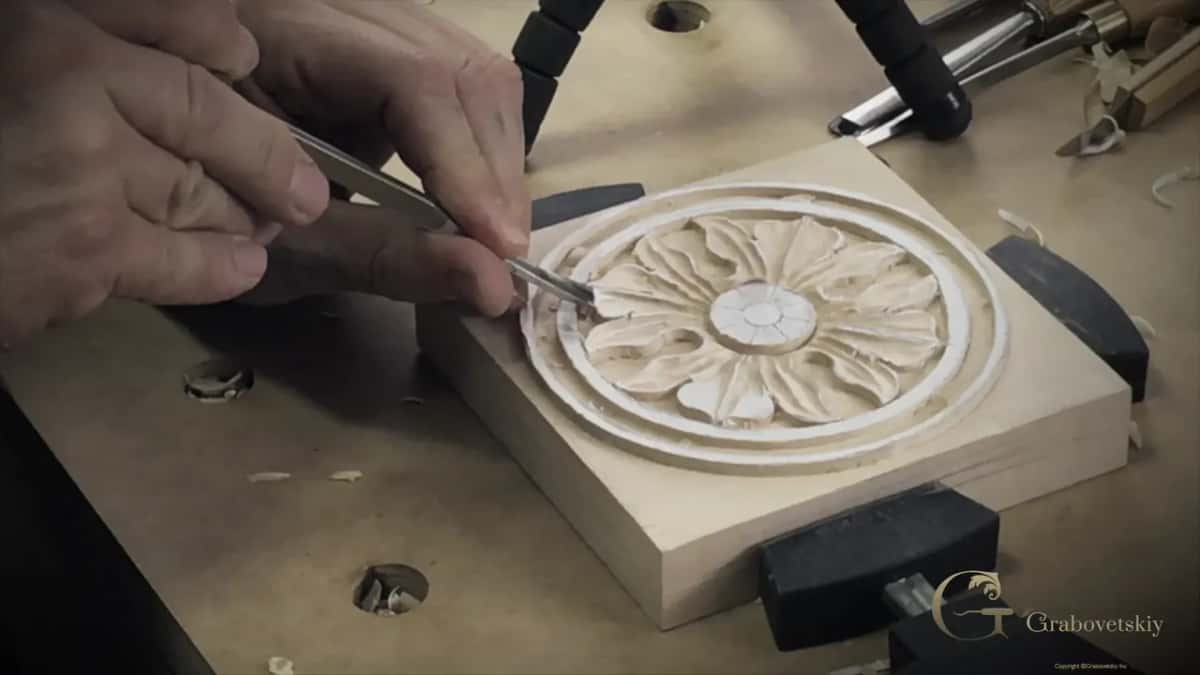
Held in bench dogs, both hands driving toward the center.
After those five, it is on you. It all depends on you and only you, and on the progress you make. I show what to do. Skip the practice and no result comes. Arithmetic, not a threat. Two more honest answers live in carving without a lot of space and what the first year costs.
Who actually shows up to learn this?
People with no woodworking behind them at all, and most of them are not young. Many people in my school work in completely different professions. Some of my students are doctors. Lawyers too, and professors from universities, not just one but multiple professors.
They are already seniors, and they really love carving. That group surprised me at first and does not surprise me now.

Carving into the eye of a volute.
Something else I notice, and it bothers me. I live in the United States, and when you walk into a famous Walmart store there are older people greeting and helping. At the beginning I did not know why they still work. They do not have much time left, they are not enjoying what they love to do, and they are seniors. That is what I want to save you from.
Online the room is bigger than I can count. We have students from Australia, New Zealand, Argentina, Holland, Belgium, Denmark, Sweden, Finland, Canada. I even do not know how many countries I have right now. One year my site was almost crashed because 5,000 people logged in and watched almost the same video. Other trades keep their own houses, like the American Association of Woodturners and the Association of Woodworking and Furnishing Suppliers, and public money for the arts here runs through the National Endowment for the Arts.

A flat hand gives you the scale.
The in-person seats are the thing I cannot make more of. My class was sold out pretty quickly the second year I taught it. A student of mine, Mark, could not get into the first Indianapolis class at all, because it was sold out really quickly, and he had to wait another whole year for a seat. Since then he has not missed a single one. He signs up for all of them.
One May class at the Marc Adams School of Woodworking sold right away, just on the fly. To meet me in person, register before time, because the last time there was a waiting list. Our in-person workshops page carries the dates.

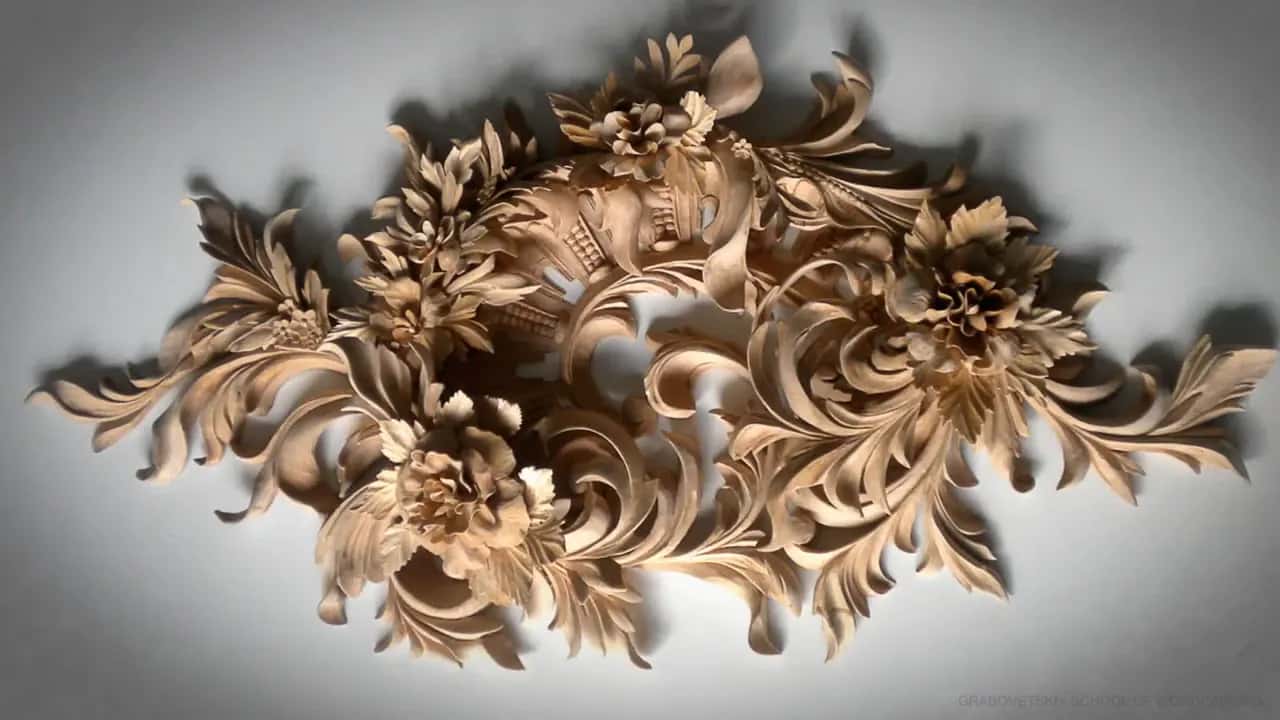
An oval rosette of full flowers, seen from straight above.
One last honest thing. For me it is not a hobby. Yes, it is. I love it with all of my heart as a hobby, and my hobby became my main business. Both halves are true and I will not tidy them up. The whole story is in my own biography and in my Russia to America story, and what people made of the teaching is in the student reviews.
If you want to see how I teach this, the beginner course First Cuts for Beginners is where I take a person from the very start. The school is a non-profit and where the tuition goes is written out plainly. Or start here and look around first.
Frequently asked questions
Is fifty too late to begin carving?
The people in my Florida classes have mostly passed fifty already. I get people in their thirties and forties, and once in a while an eighteen year old walks in. Age is not the thing I would worry about. The part I watch is whether you are still at the bench after a month.
Can somebody with no art training learn this?
Anybody can poke a chisel into the side of a board, and anybody can pick that up in a couple of weeks. The wall arrives later, when you have to design for the chisel. A person who draws beautifully on paper does not automatically design for wood, since it behaves like an entirely different medium.
How many tools do I have to buy before I begin?
One. My own teacher handed me a single knife and held the gouge back until I could use it properly. Other carvers will tell you ten, maybe twenty at the most, and that depends completely on the kind of work you do. My favorite knife has sat on my shelf for twenty years.
Will I ever get fast at it?
Faster than your first month, certainly. Fast the way a machine is fast, that will never happen. You cannot speed this up when you want a piece made by hand. Some days go entirely on one square inch of background, and I have been at this since the age of six.
What happens the day I break the piece?
You glue it back together. I keep a small bottle right on the bench and I reach for it when I need to. Has that happened to me? Many times over. I have broken plenty and glued it back, and I still dislike making mistakes, whatever anybody tells you about the wood forgiving you.
Do you carve in silence?
Rarely. Quiet bothers me, so audiobooks run while my hands work, and I have taken whole university courses at the bench that way. When the background goes too quiet the day turns boring. There are gaps where all I hear is the gouge, and I like those too, in small doses.
Filed under
- Basic wood carving techniques
- beginner-friendly wood types
- beginner wood carving projects
- best wood for carving
- creative wood carving ideas
- easy wood carving ideas
- enjoyable wood carving tips
- fixing mistakes in wood carving
- how to carve wood
- how to start wood carving
- improving focus with carving
- learn wood carving online
- mental health benefits of carving
- patience through wood carving
- simple wood carving projects
- starting a wood carving hobby
- step-by-step wood carving guide
- therapeutic benefits of wood carving
- Tools needed for wood carving
- Wood Carving Basics
- wood carving benefits