September 8, 2024 · Updated August 26, 2026
By Alexander Grabovetskiy — Master Woodcarver · Founder, School of Wood Carving · 19 min read
What are the best types of wood in Barbados for beginners to practice carving?
Choosing the best types of wood in Barbados for a beginner is mostly a question of grain, not of price. I have never carved a board grown on that island, so I will not pretend I did. The one wood I can speak for is mahogany. It runs harder than basswood, and beautiful work comes off it.
Most of what you will read about carving wood in Barbados was written by somebody who has never held a gouge. I read those pages too. Softwood lists copied off a chart, species that do not grow anywhere near the Caribbean, and not one word about what a board does when a sharp edge goes into it.
Here is the opposite. You get what the wood must do under the tool, in the words my own students hear. Then I mark plainly which half of the Barbados answer comes off my bench and which half comes out of a reference book.
One fact on this page you will not find anywhere else. My gouges go dull faster on basswood than they do on oak. Forty years at the bench, a teacher who tried to explain it, and the reason still escapes me.
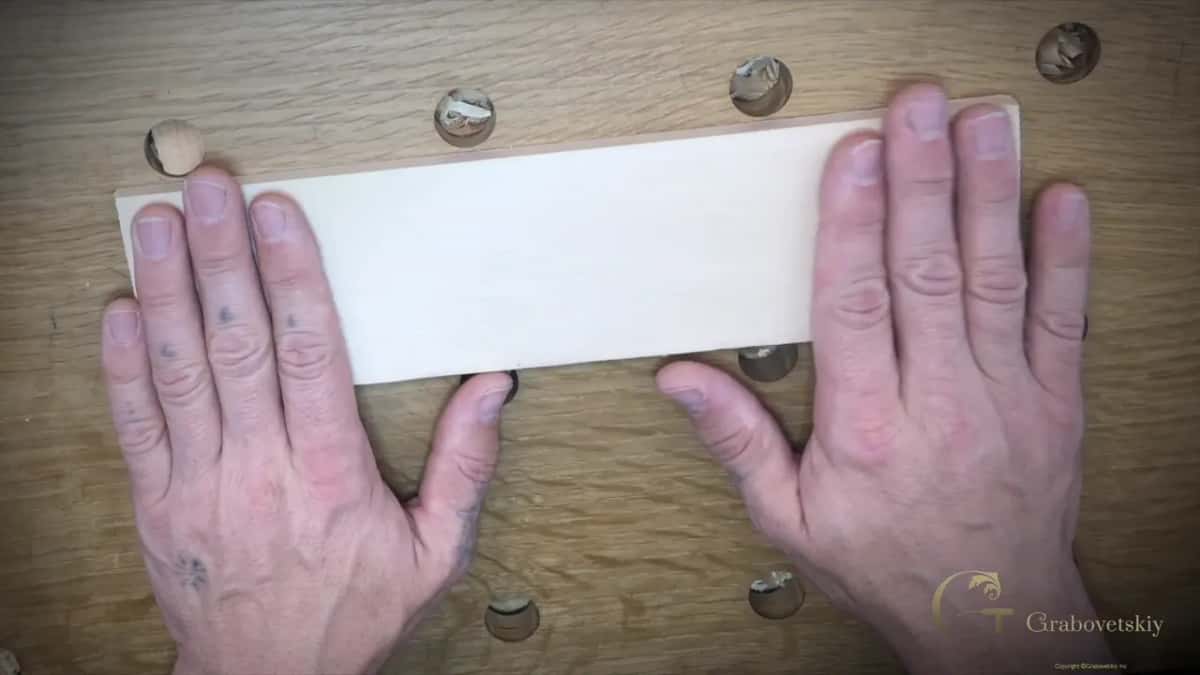
The very board I put in a beginner's hands. He names it basswood on screen a moment later.
- Grain comes first and hardness comes second, because loud figure hides the carving you just made
- Basswood is my first answer on every continent, and in Europe you buy the same tree as lime or linden
- Mahogany is the Barbados wood I can speak for from my own bench
- My edge dulls quicker on basswood than it does on hard oak, and basswood is not an abrasive wood, which still makes no sense to me
- Ask the yard whether a board was air dried or kiln dried before you ask the price
What does a beginner's board have to do under the gouge?
A beginner's board has to move under a sharp edge without fighting back, and it has to keep the detail after you carve it. That is the whole test. Everything else is decoration.
The first lesson of my beginner carving course says the same thing. A plank must give under the tool, and stay stable enough that a thin edge does not crumble. And it must be quiet. When a big figure runs through, your eye follows the figure instead of the leaf.
Quiet is doing real work there. A pale face gives the carving all of the light, so every shadow reads from across the room. Loud wood eats those shadows. My longer answer sits in why wood grain matters for carving, and the Wikipedia entry on wood grain covers the anatomy under it.
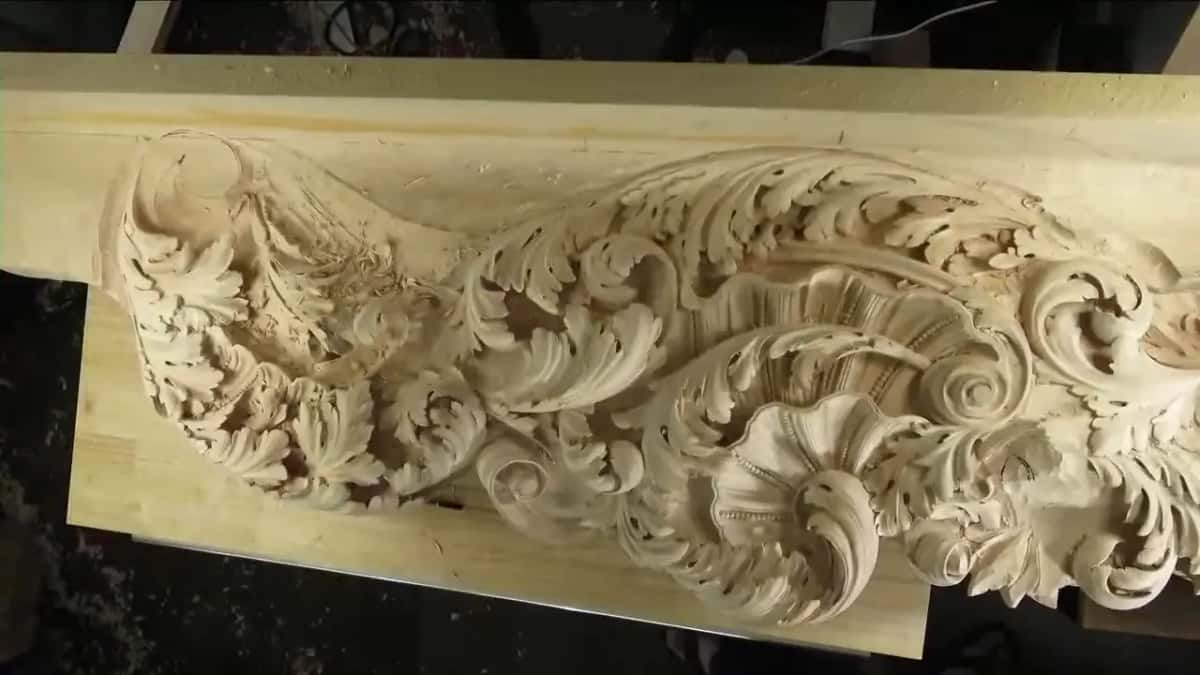
Study the uncarved margin. Grain is in there, but you have to hunt for it.
Now set that beside coarse open grain. Stripes arrive whether you want them or not, and a small leaf on top of them competes for attention.
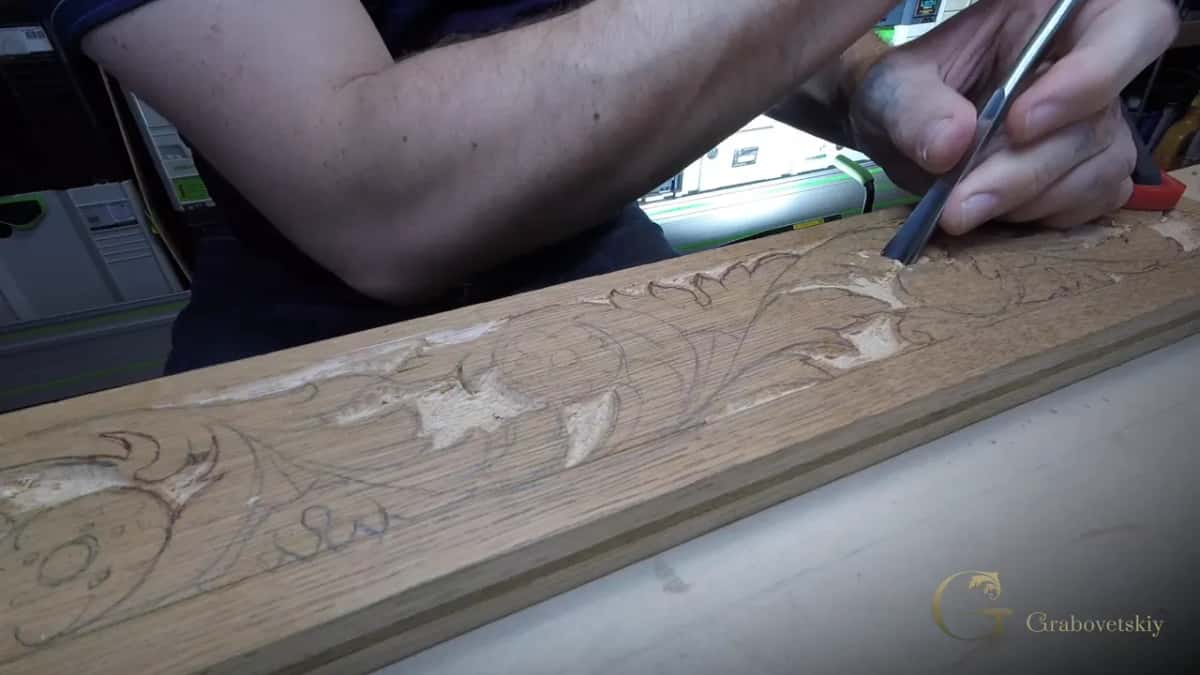
Grain this coarse pulls your eye off the carving.
Why is basswood my first answer on every continent?
Basswood carves easy and shows almost no grain, so nothing on the board competes with the shape you have just carved. In Europe the same tree is lime wood. Germans call it linden. Back home in Russia we say lipa.
Soft enough to move, and it still holds the detail. Those two qualities almost never travel together in one plank, which is why I keep repeating the name. Old European shops filed lime as a hardwood, with pine as the soft one, cheap carvings in pine and the expensive work in oak until the seventeenth century moved it to lime.
There is no limit to what you can do with it. Almost no limit. I should not put it that way, and yet four decades in, the wall has not turned up. Reference data sits on the Wood Database basswood entry and the Tilia genus page.
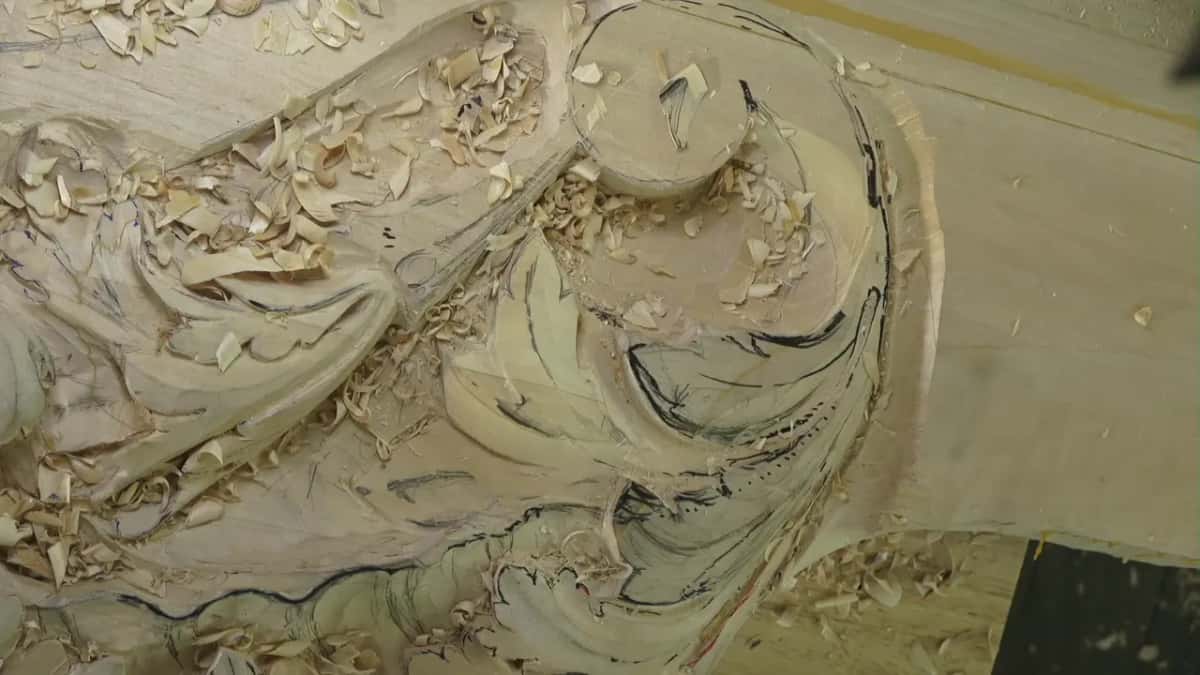
Soft curled chips heaped in the hollows, the kind of waste that never left a splinter in my hand.
My preference runs deeper than the species. Canadian basswood over American, because more forest and less pollution shows in the lumber. Some boards have waited in my shop over ten years, a few of them twenty-five, including rift cut French limewood you could fairly call tiger limewood.
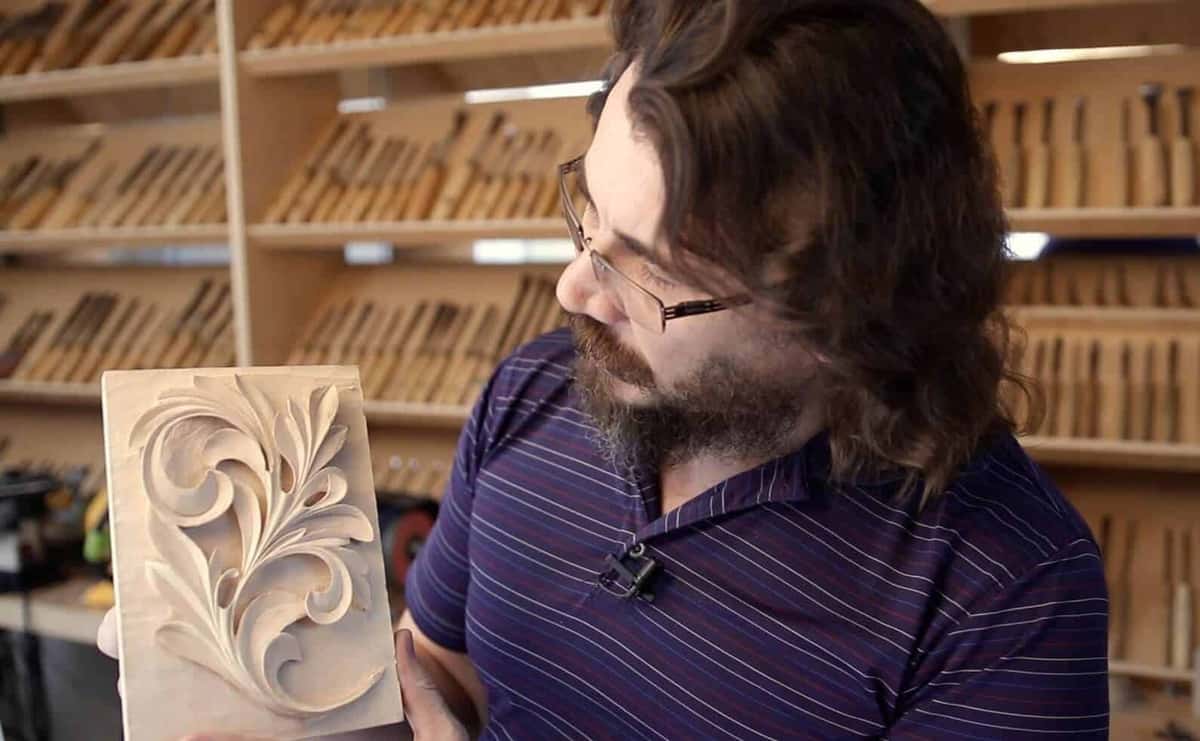
The board's full thickness, and how far the acanthus goes into it.
Fine work survives on it too, so long as you behave. Do not press. And never add a pass you did not plan, because micro detail stays crisp only while you leave it alone. Set basswood against the softwoods a beginner is usually offered and my reason for one name gets obvious.
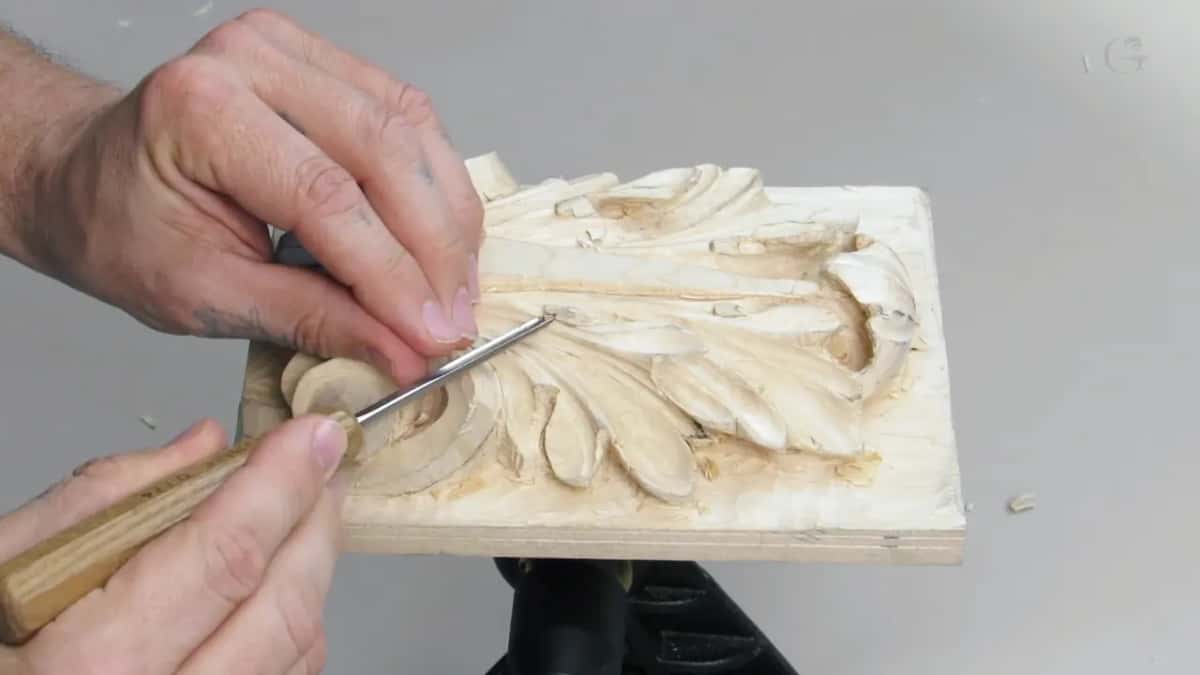
Micro detail on a pale board, one fold at a time.
Can you actually buy basswood in Barbados?
I do not know, and inventing an answer about somebody else's island is not something I will do. What you can have is the way I handle this question when it arrives from the other side of the world.
Students of mine in Australia and New Zealand cannot get basswood at all. They order from European shops and wait on the shipping. But there is another carving wood I name for them, jelutong, and I hope that name is coming out right. Find what your local furniture makers buy, then judge it by grain and by feel beneath a sharp edge.
Do the same in Barbados. Skip the construction lumberyard, because builders rarely buy carving stock. You want the yard that supplies furniture makers, and Google finds those under hardwood lumberyard. On what moves through the region, start at the Government of Barbados portal and the International Tropical Timber Organization, with the country page for Barbados for geography. All of that is reference data, not my bench.
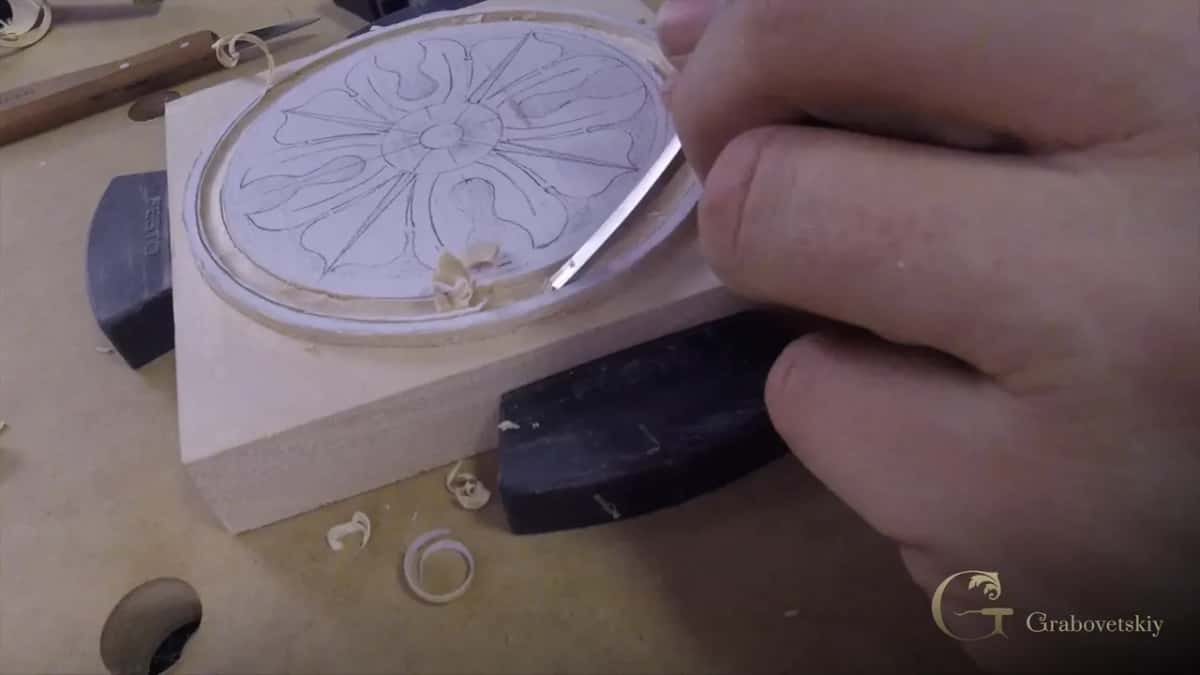
A whole rosette in pencil, a skew starting the outline.
Now the money warning. A real hardwood yard often will not sell one board. At a yard in the States the minimum used to sit near three hundred dollars and now runs closer to five hundred, so ask your own yard before you fall in love with a plank. My students in Australia hit the same wall.
Is mahogany a good wood for carving?
Mahogany is really nice for carving, and it is not bad at all, so you can make beautiful pieces from it. That sentence comes off my own bench rather than out of a book. Of every wood a person in Barbados is likely to reach for, mahogany is the one I can defend.
Hundreds of species wear that name and they look nothing like each other. Sapele is one. Honduras mahogany is another. Indian mahogany happens to be my favourite of the family, though not my favourite wood overall. My great-grandfather was a redwooder who worked mahogany in the Chippendale style, so red-coloured timber was a family subject long before I held a gouge.
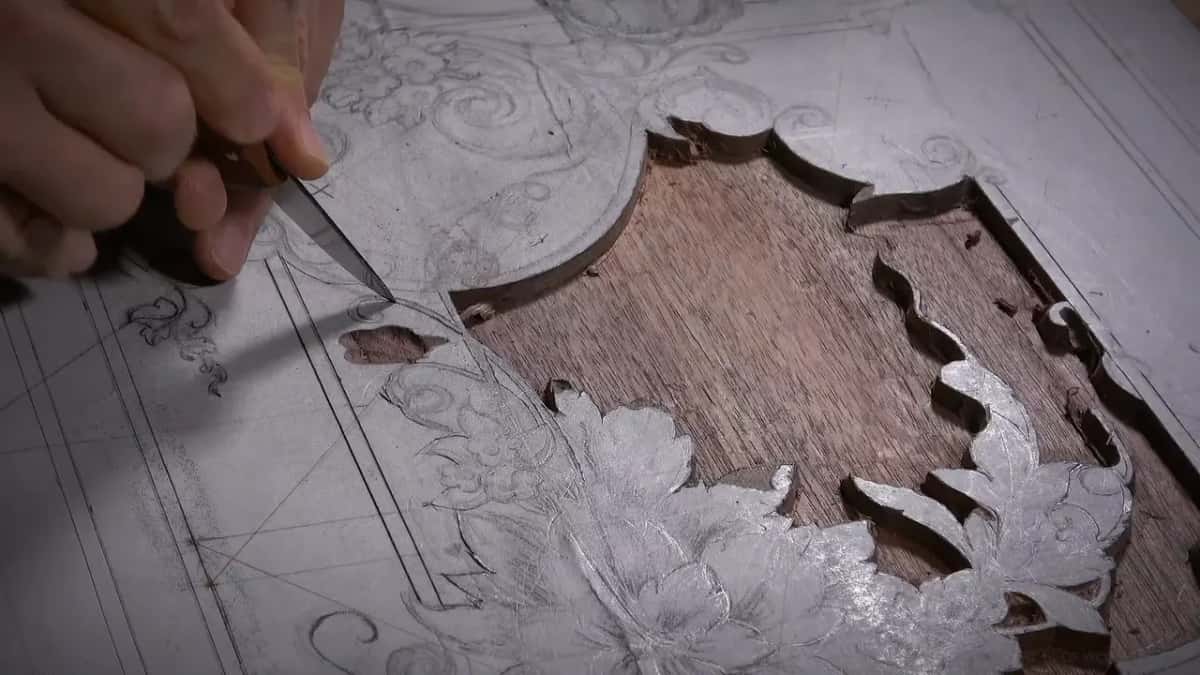
Dark hardwood with straight quiet grain, and naming its species off a picture is beyond me.
On hardness I group mahogany with the harder woods, alongside oak and walnut and birch. Keep a mallet within reach, and your design shifts. Start with the Honduran mahogany data sheet, then the numbers for sapele, the general overview of the mahoganies, and the page for Swietenia mahagoni, the West Indian mahogany. Books place that one in the Caribbean. Reference data, nothing more.
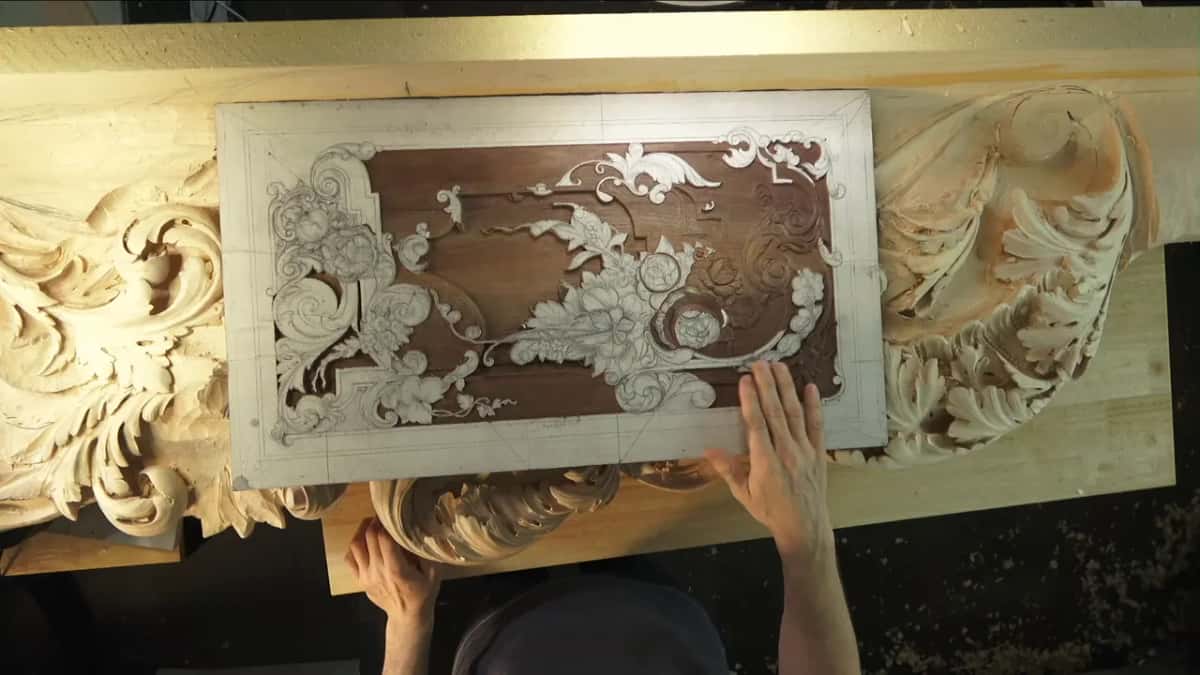
Two woods in one frame, and that relief runs under a millimetre deep.
My honest summary for a first mahogany project is short. Buy the quietest piece you can find, keep the design bold, and go slower than feels necessary. More on species choice waits in the four woods I keep in the shop.
Which island trees should I ask the yard about?
Ask about mahogany first, then read the reference pages yourself instead of believing anybody about the rest. Me included. Honesty costs me something here.
Teak, purpleheart, iroko, greenheart. Never had one of them on my bench. Not a single hour with a gouge in any of those four. Describing how they feel is beyond me, and a guess printed in first person turns into a lie the moment somebody buys a board on the strength of it.
Pointing you at real reference pages I can do. Three tropical trees worth reading cold: Casuarina equisetifolia, Cordia alliodora and Artocarpus altilis, the breadfruit. For measured properties, the Forest Products Laboratory chapter on physical properties and the whole Wood Handbook cost nothing. Keep hearing about teak? The teak data sheet beats my opinion, since I have none.
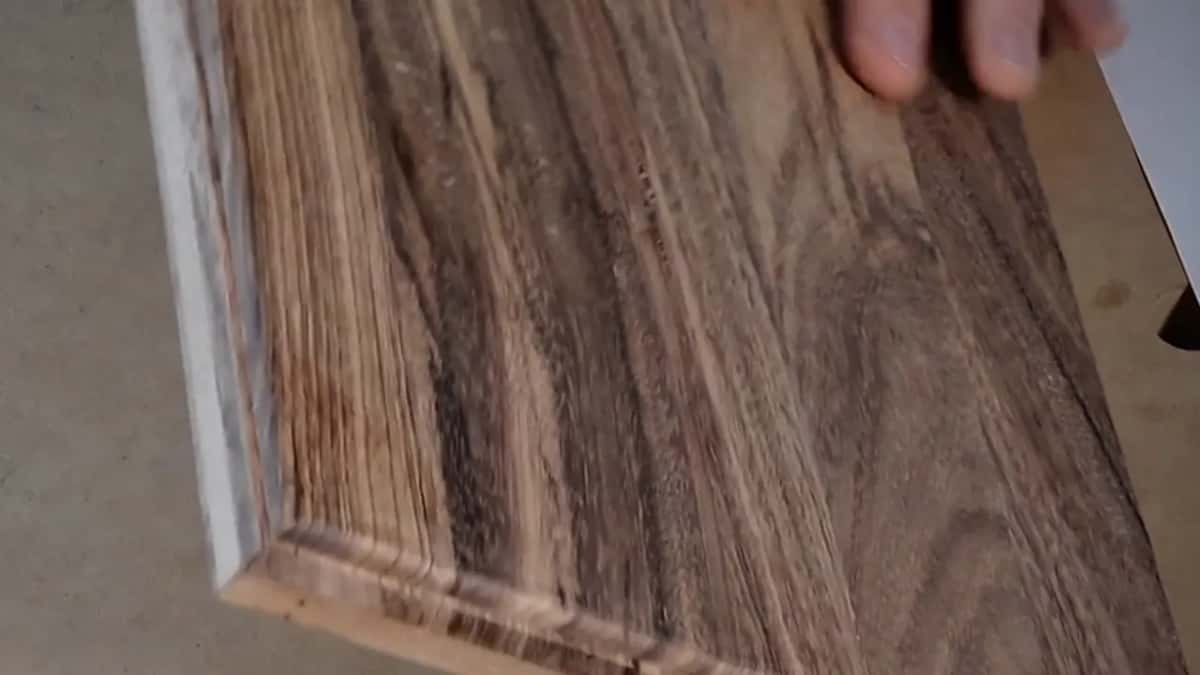
Gold and dark brown streaks running the whole length of a small lid board.
Take a simpler test with you. Set the board down and back up a few feet. If the figure is shouting from there, save it for a plain surface and buy something quieter.
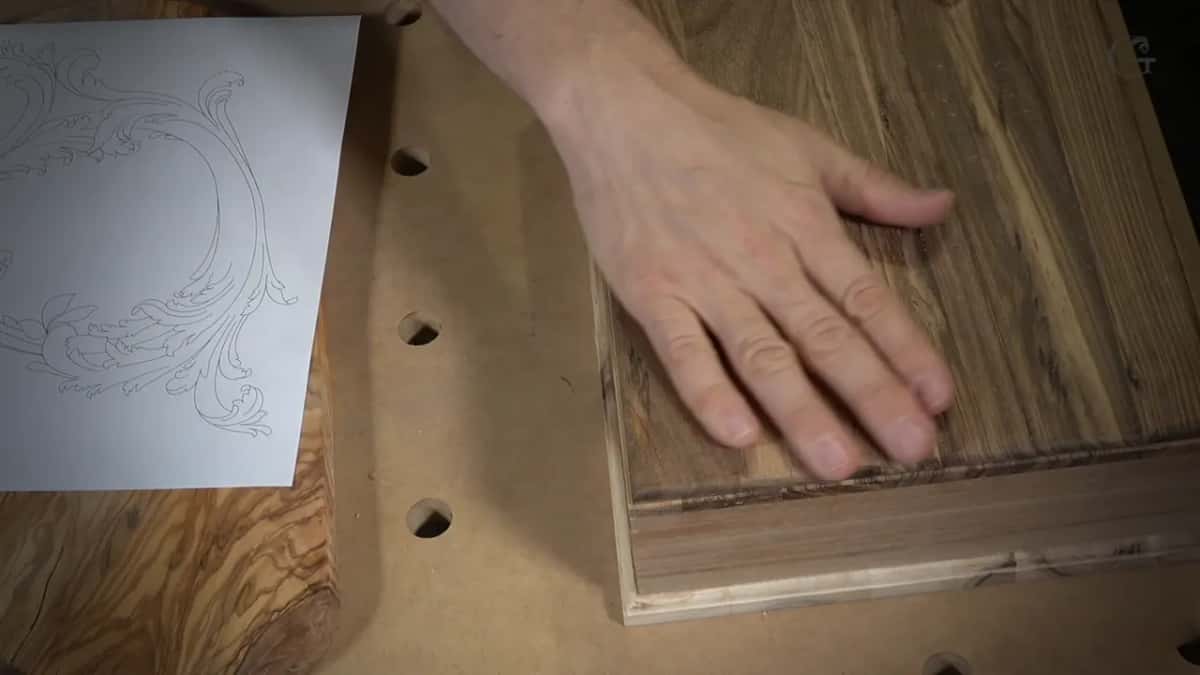
A glued-up panel of heavily streaked wood, a wilder board beside it.
Why do my tools go dull faster on basswood than on oak?
My tools go dull a lot quicker on basswood than on oak, and after four decades the reason still eludes me. A paradox, and I say so out loud in my lessons. Basswood is much the softer wood.
Watch me carve an oak apron and something odd shows up. I walk to the sharpening station less often than on a soft pale board. Backwards, completely backwards. Every hardness chart insists the harder wood should be eating my edge.
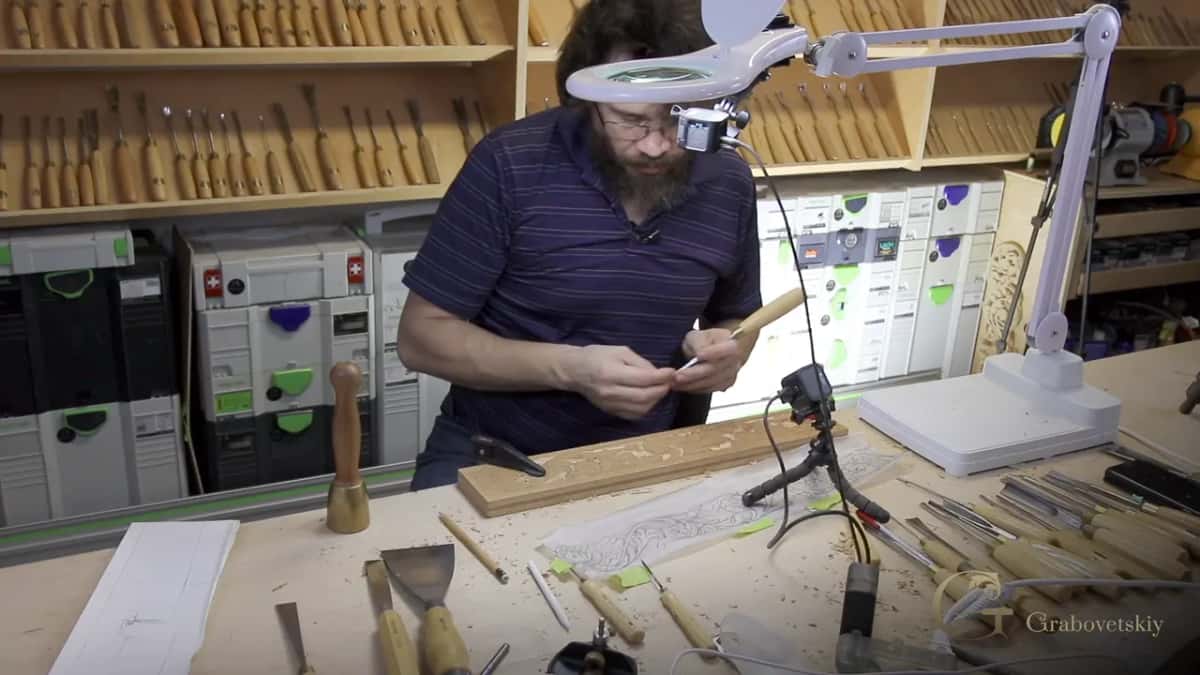
The bench where I carved the dining table apron, sharpening station behind me.
My teacher tried to explain it. Still did not get it, and a tidy theory invented to look clever would be dishonest. Basswood does not even look abrasive. Some woods really are, and you feel that almost at once, but nothing like it happens here.
That video carries the title Basswood is like MDF for woodworker, sixteen minutes on the wood I recommend the most.
Take the practical half and leave the mystery alone. Budget sharpening time into every project, whatever board sits in front of you. My free lesson on sharpening a gouge is the place to begin if your edge is beating you, and the full sharpening course goes deeper.
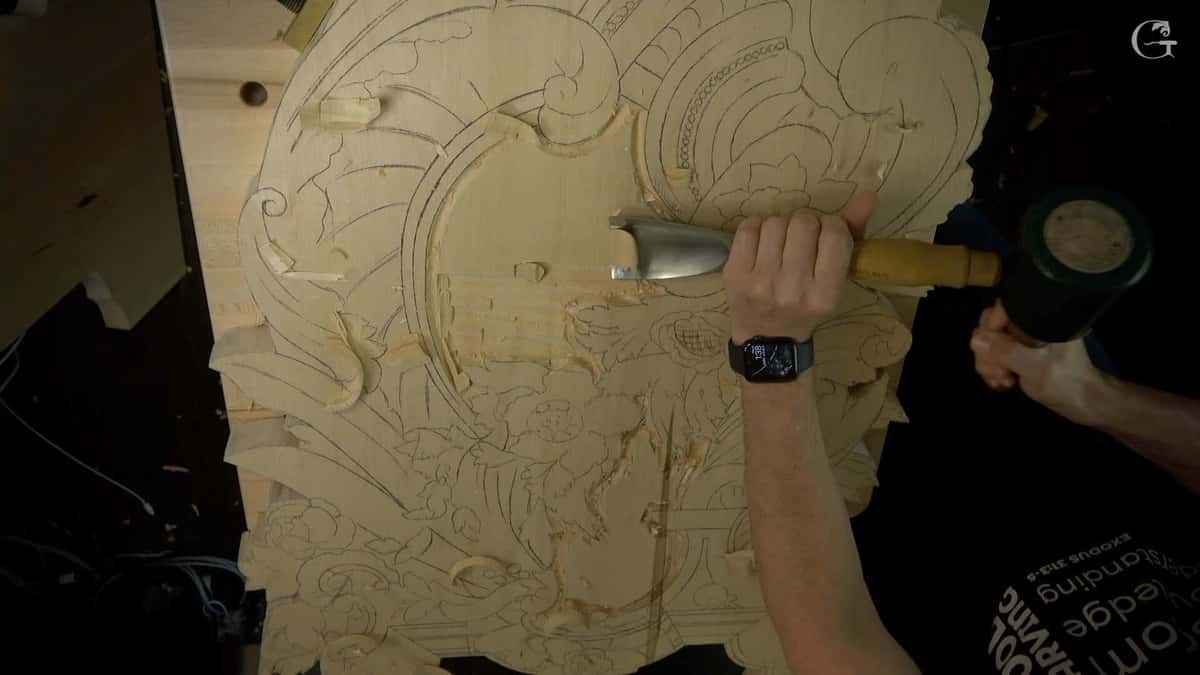
A mallet in mid-blow. Even soft pale wood wants a push behind a wide gouge.
One more reason to stop trusting the chart. A hardness number is a steel ball pressed into a block, and no ball ever told anybody how a fibre tears under a slicing bevel. Put what Janka hardness means for a hand carver beside the description of the Janka test and the gap opens up. My ranking of which woods are hard to carve does not match the chart order either.
How do these woods compare under a gouge?
Every wood in this table comes from my own recorded lessons, and the last column is my advice to you. No hardness figures here, on purpose. Numbers have never carved anything for me.
| Wood | What it does under a gouge | The other thing I noticed | For a beginner |
|---|---|---|---|
| Basswood, lime, linden, lipa | soft enough to move and still holds the detail | I never got a splinter out of it | start here |
| Mahogany | not bad at all, and beautiful pieces come from it | hundreds of species wearing one name, and they look nothing alike | yes, with a mallet in reach |
| American black walnut | a little harder than lime, and it holds detail nicely | pressed fibers pop back at you later | later, not first |
| Cherry | a hardwood that keeps fine detail really nicely | I love to carve it | later |
| English brown oak | softer than white American oak, and it carves beautifully | the one oak I actually love | yes, once you own a mallet |
| White oak | harder, and I do not like it | white oak can hand you a splinter | no |
| Red oak | really hard wood, and oak wants a mallet | one of the three oaks I name | skip it |
| Butternut | a great wood when the design is not full of detail | hard to get in the States now | yes, if you find any |
| Birch | not that hard, still it works a little different | I name it with the harder woods | maybe |
| Maple | carvable, and it will be difficult | I would not recommend it to you | no |
| Poplar | carvable, and I keep steering new carvers away from it | difficult is the word I use | no |
| Pine | a soft wood, and all of the grain is visible | the cheap old carvings were done in pine | no, and it distracts me |
| Hard pine | so dry that I broke quite a few gouges | you cannot even drive a nail in it | never |
| Yellow cedar | great wood, and the wrong grain for small detail | the grain pulls your eye off the carving | for big shapes only |
| Olive | harder than limewood, so I can leave a thinner detail | really dense, and the heart of the slab barely carves | not for a first piece |
| Acacia, gopher wood | crunchy, and it hands you splinters | crunchier than oak, and the grain is gorgeous | no |
| Ebony | dense, and almost impossible, though it still carves | the only one I have called that | no, please do not |
| Jelutong | another wood for wood carving, as I put it | the name I give where basswood cannot be bought | worth asking your yard about |
Crunchy is my own word and I know it is not standard. A crunchy board throws short dry waste and hands you splinters, and one afternoon of it teaches you the word.
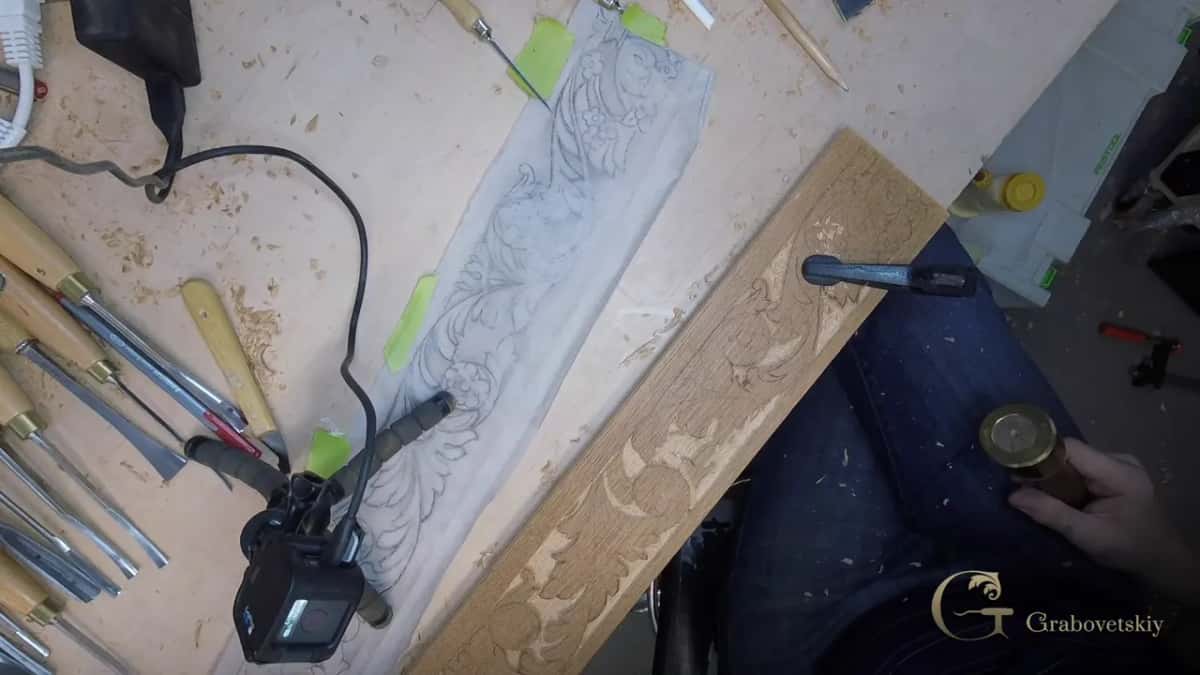
Gouges lined up in the order I want them, brass mallet in hand.
Scan the table sideways too. Cherry and walnut keep a detail beautifully, and basswood matches them so long as you do not press. Longer versions live in my notes on carving walnut and in the short answer on walnut, plus measured figures on the black walnut data sheet, the cherry page and the butternut page.
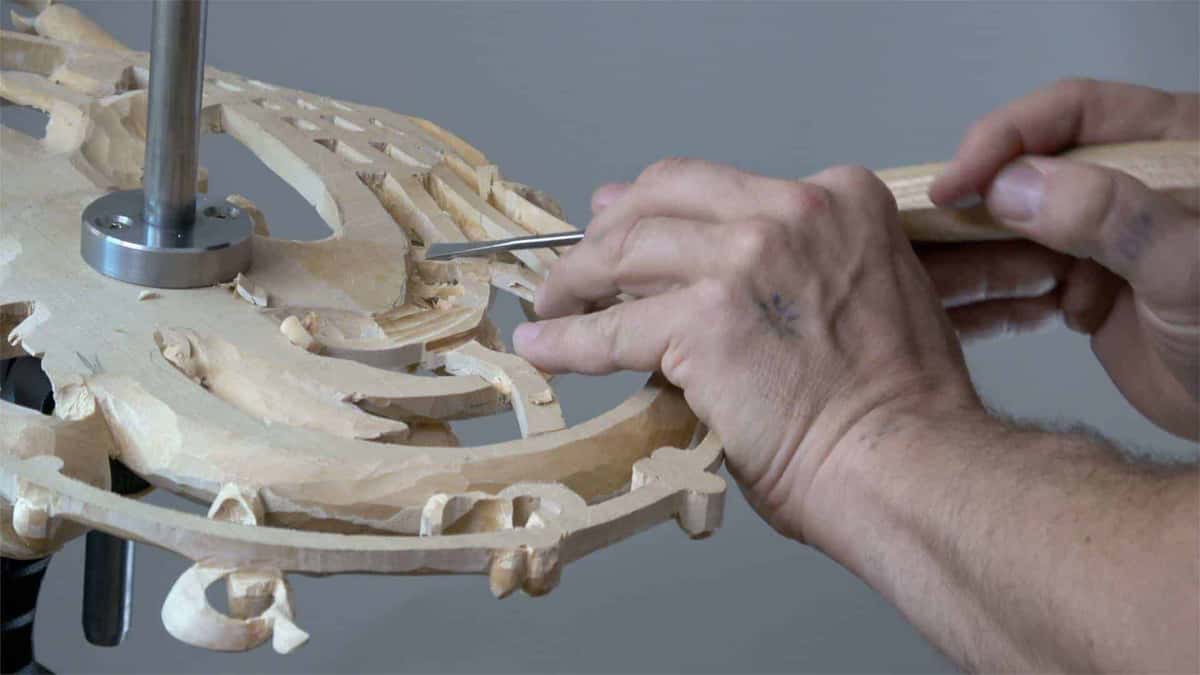
Pierced work, sawn right through so daylight comes past it.
The oaks deserve their own line, because it depends which oak you have got. White oak I dislike, and it can hand you a splinter. English brown oak carves beautifully and runs softer than the white American one. Sheets for the white oak and the red oak sit a click away, and the ones I warn beginners off appear in my general answer on beginner woods. The hard maple sheet and the eastern white pine sheet carry the measured side.
How do I pick a carving board at the yard?
Read the end of the board before you look at its pretty face, because the ring pattern there tells you how much a plank will move. Five checks. Four of them read the board, and the fifth saves your money.
Step 1, look at the edge of the board, not at its face
The edge comes first, every single time. Rings should never sit close to the heart of the tree. Closer to the bark side is what I want. A dead straight run across the rings is dangerous, because that plank will cup.
Step 2, ask for quarter sawn or rift cut
Quarter sawn or rift cut is my preference. Both hold their shape. Rings arcing across the end are my signal to walk away, since a board like that moves a lot, and work that moves after you finish breaks your heart. Details sit in how I prepare raw wood for carving.
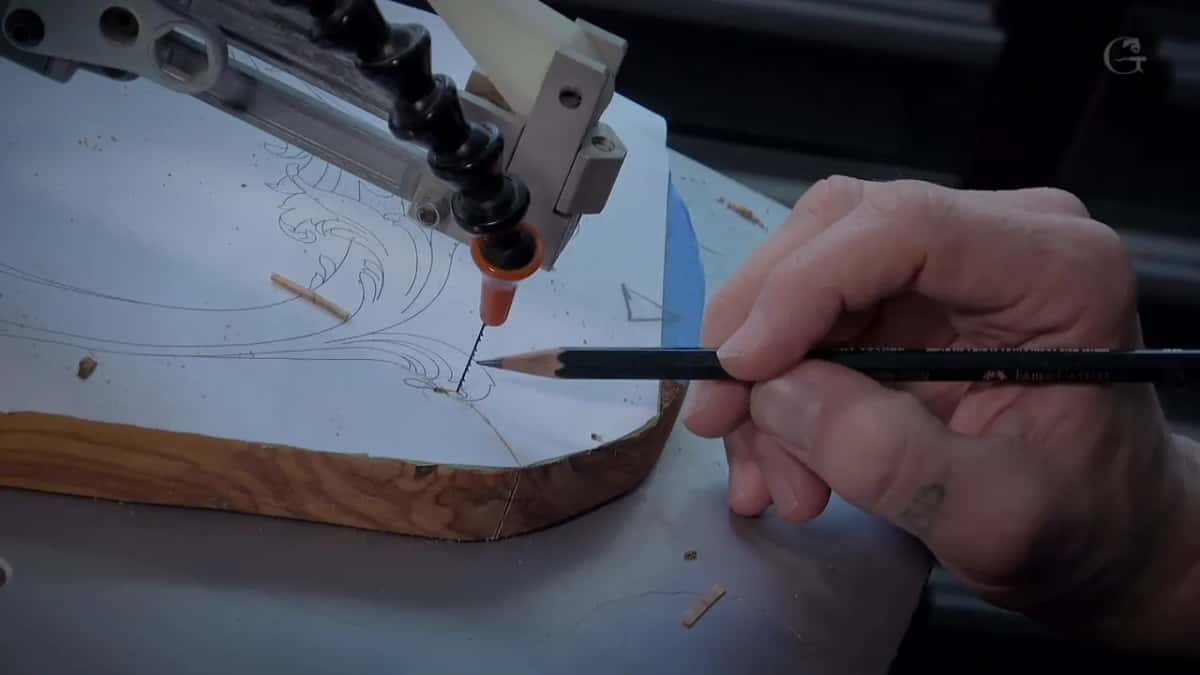
The face is still papered, so the sawn edge is the only wood to read.
Step 3, skip the construction yard and find the hardwood one
A construction lumberyard is the wrong door. Carving stock is unusual wood and nobody keeps it for builders. Search for hardwood lumberyard instead, or track down the place selling to furniture makers. At a big box store, ask at the pro desk. Found a board on Amazon? Write to the actual seller.
Step 4, ask whether the board was air dried or kiln dried
Two drying methods, and they are not equal. Kiln drying is what manufacturers use, in a very large stove, and they fry those boards so the stock sells fast. Air drying is slow, and always my preference. Ask which one you hold.
Step 5, ask what the smallest order really is
Money last, because that part surprises people. A real hardwood yard usually sets a minimum order, once around three hundred dollars and now nearer five hundred. If the number stings, read what carving actually costs in the first year. Trade forums like WoodWeb and the archives at Fine Woodworking can point you at suppliers.
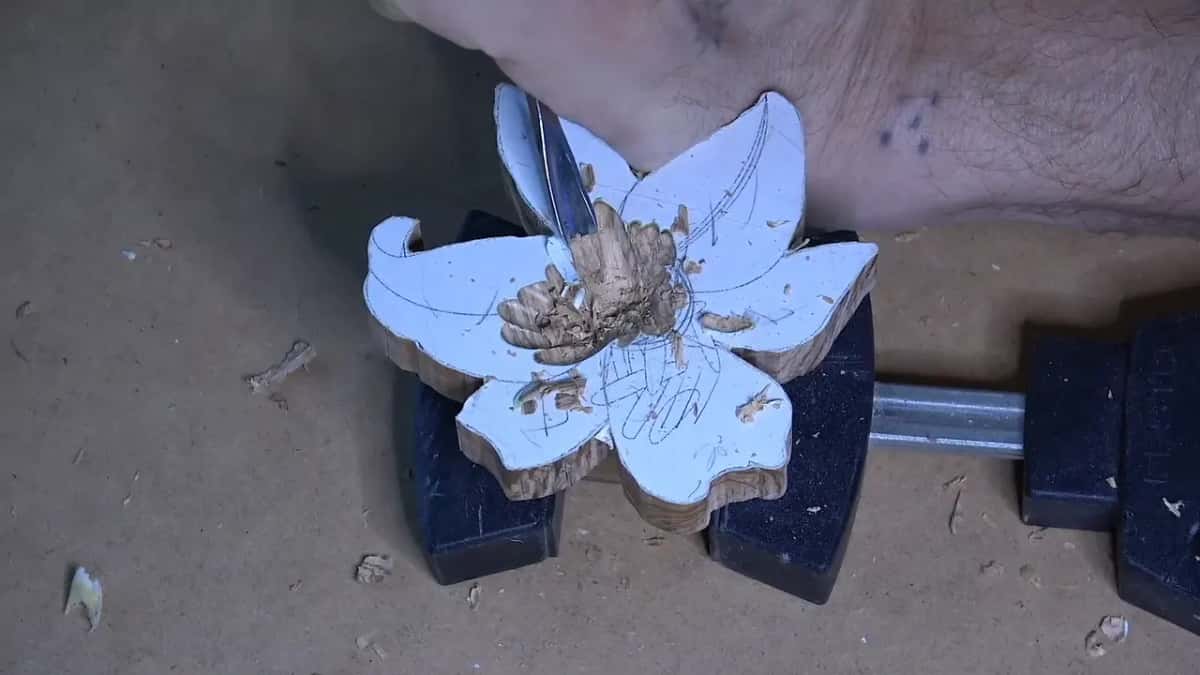
Every sawn petal edge shows wavy figure.
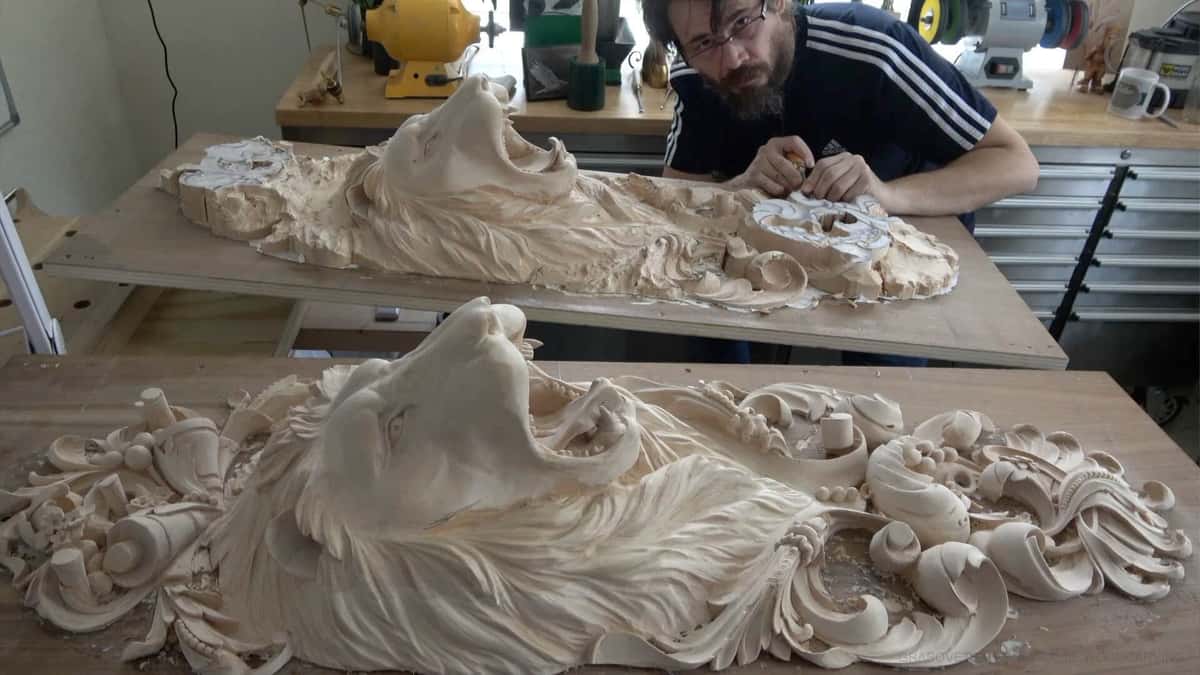
One panel nearly done, the other still blocked out.
Does air-dried wood really carve better?
Air-dried boards move less than kiln-dried ones, and that finding is mine, from the bench, not a line off a chart. Movement is what ruins a finished carving months after you put the tools away. So I buy for stability first.
Here is the mechanism as I understand it. Fell a tree and those fibres are still alive, and while they live they suck water much quicker. Dry a board slowly and naturally and all of that settles. Fry it instead and you get stock to sell this month, which suits a lumberyard and not a carver.
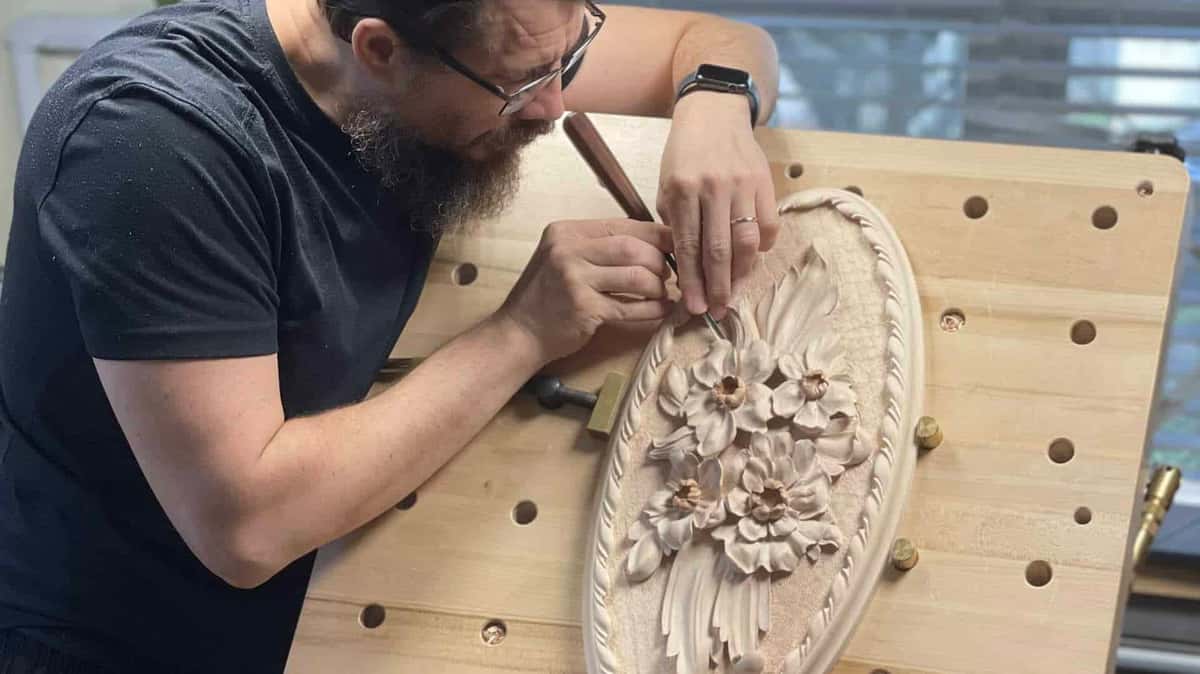
An oval rosette under one bench clamp, and nothing special in this shop.
Kiln-dried stock moves a lot more, and I found that out the slow way. Air dried, most of the movement goes away. Time is the only price, and boards of mine have waited patiently for twenty-five years. For the timeline read how long wood takes to dry for carving, then whether you have to dry wood at all, and finally what causes warping and cupping.
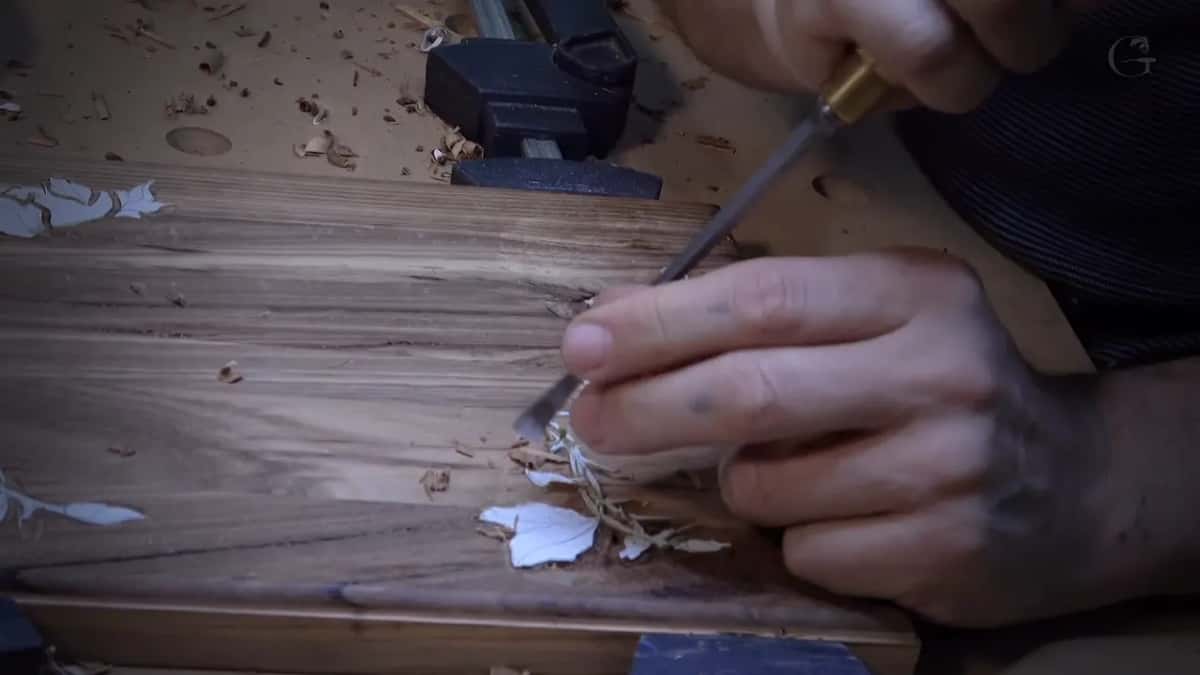
Short crumbly waste rather than curled shavings.
What if the only wood you can get is harder than basswood?
Then you change the design before you change the wood, because a harder board carries a thinner detail than a soft one will. Not a compromise. How the old work got done.
Understanding the property of whatever lies on my bench is part of the job. Lime does not behave like oak or walnut or mahogany, and birch differs again even though birch is not that hard. On a soft pale board I can design nearly anything. A hard board makes me design for the wood.
An example off a lily box. That piece was olive, a harder wood, so one corner of the design ran down to a sixteenth of an inch and I felt safe. In lime I would never leave anything so thin. Same tools, same hands, different drawing. That balance turns up in how to stop thin carvings breaking and in whether thicker wood is better.
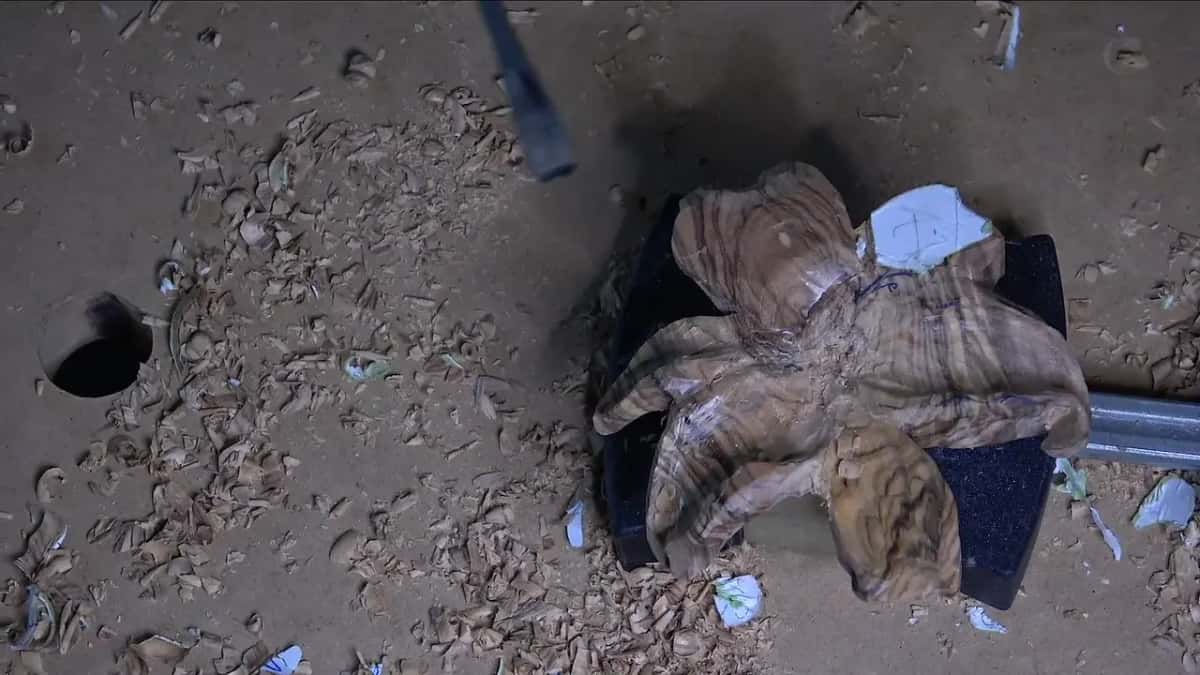
Petals shaped, paper gone, and a harder board let those edges survive.
Two last things. Start with a mallet. Oak is a harder wood, and carving oak most likely means you have to use a mallet, so plan for one rather than fight the board by hand. My notes on whether you need a mallet cover the rest.
Second, and people skip this part. Everything also depends on your tools. Sharp gouges make grain direction almost irrelevant, so you can go along it or against it without splitting anything. Cannot sharpen whenever you want to? Then you have to be mindful of the grain every minute. Sharpening comes second in the order I teach, right behind design, and grain direction stops frightening anybody once the edge is right.
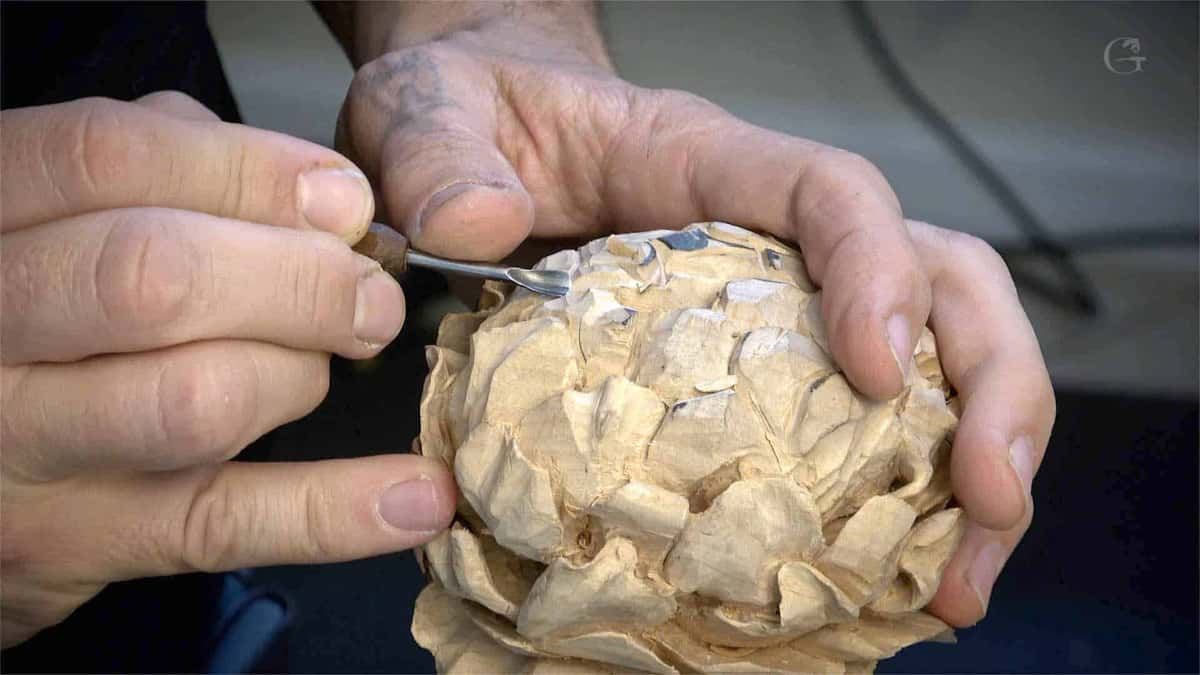
Held in two hands rather than clamped down, one petal of many.
God gave you a pair of hands and some patience for a reason, and a hard board is no reason to quit. It is a reason to draw better before you start carving.
If you can get one clean board on that island and you want somebody standing beside you while you learn to read it, come and Join School of Wood Carving.
Frequently asked questions
Is mahogany too hard for a first carving?
Not too hard, in my view. I call it really nice for carving, and that opinion is on tape. Keep a mallet nearby, pick a bold first design instead of fine work, and go slowly. A quiet piece with little figure in its face will treat you best.
Do I have to use basswood to learn?
You do not. Almost any wood can be carved, though some make the lesson harder than it needs to be. Where lime cannot be bought I name jelutong for my students overseas. Judge whatever you can get by two things, how quiet its face is and how it feels beneath a fresh edge.
Will a hardness chart tell me how a board carves?
Only partly. A hardness number comes from a steel ball pressed into a block, which is nothing like a bevel slicing across live fibre at an angle. My edge dulls quicker on soft pale wood than on a hard oak plank, and no chart predicts that. Use charts for weight and strength.
What does quarter sawn mean at the lumber yard?
It describes how a plank was sliced out of the log, so the growth rings meet its face nearly upright rather than arcing across. Quarter sawn and rift cut boards hold their shape. Rings arcing across the end warn you that a plank will cup, and I walk away from those.
Why do you talk about grain more than hardness?
Your eye decides whether a carving works, long before your arm does. A board with loud figure swallows every shadow you carve, so the shape stops reading from a distance. Hardness only changes how you hold a gouge and how hard you push. Figure changes whether anybody sees your work.
How big should a first practice blank be?
Small. In my beginner workshop the first blank runs about 20 millimetres across, which is three quarters of an inch, and roughly 10 millimetres thick. Something that size sits in a clamp, finishes in an evening, and costs almost nothing when you ruin it. You will ruin one. Everybody does.
Filed under
- affordable wood options for carving
- beginner-friendly wood types in Barbados
- beginner's guide to wood carving
- beginner wood carving projects
- best local woods for carving
- best wood for beginners carving
- best woodworking tools for beginners
- carving tips for beginners
- carving workshops in Barbados
- common carving woods in the Caribbean
- easy woods to carve for newbies
- factors affecting carving wood choice
- how to choose wood for carving
- ideal wood types for novice carvers
- importance of wood softness in carving
- popular carving woods in Barbados
- softwood availability in Barbados
- soft woods for carving in Barbados
- tips for selecting carving wood
- Understanding Wood for Carving
- wooden carving supplies for beginners