September 6, 2024 · Updated August 25, 2026
By Alexander Grabovetskiy — Master Woodcarver · Founder, School of Wood Carving · 20 min read
What are the best types of wood in South Africa for beginners to practice carving?
The best types of wood in South Africa for a beginner are the ones a yard actually stocks: plantation pine and plantation gum. On the local species I am reporting, not ruling. What I can teach you is how to read a board before you hand over money for it.
You went looking for a wood list, and every page gave you one. Yellowwood, stinkwood, kiaat. Then you walk into a yard in your own town, ask for a board of it, and watch the man behind the counter shake his head.
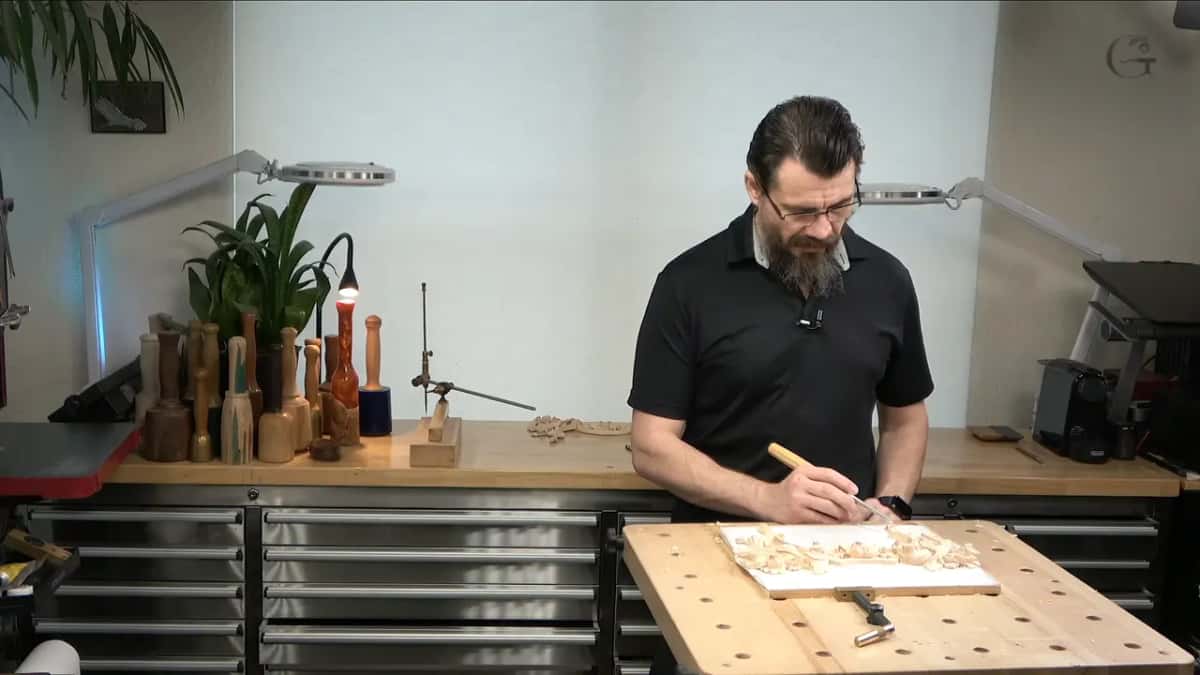
My bench, and the row of turned mallets behind it.
So let me say the awkward part before you work it out on your own. On South African species I am not the authority, and I will not act like one. Some of my students live in Africa and I am glad they do, but the wood on my own bench came off a truck in Florida, so for local timber the government and the botanists get to speak here instead of me.
What I do know is a board. I know what one has to do under a knife, how a dense one pushes back, and how to check a plank in a yard before the money leaves my hand. That part travels.
So here is how this page works. Every fact about your timber is attributed out loud, with the link on the name of whoever said it. The law is in here too, because four of the beautiful ones need a licence and two of those are caught twice. The knife and the board are mine.
- One wood is my answer everywhere, and it wears a different name in every country: basswood, lime, linden, lipa.
- Forestry South Africa says the plantation resource is pine, eucalyptus and wattle.
- Yellowwood, stinkwood and kiaat sit on the protected list under the National Forests Act, so a licence stands between you and the board.
- Kiaat is caught twice, and yellowwood was never on CITES at all.
- A jacaranda that fell on your street is an invasive, not a protected tree, so carve it.
What wood do I put in a beginner's hands, anywhere in the world?
Basswood, and that has been my answer in the beginner course and on the livestreams where the question came up. In European culture the same tree is called lime wood or linden wood. In Russia, where I grew up, we call it lipa. Four names, one wood.
Here is what I tell a first timer. You will need some type of wood. I suggest basswood. It is one of the best. There is no grain in it, almost no grain visible. Of course there is a grain, but no visible grain. And you can achieve great results. It is soft enough, and it still holds the detail.
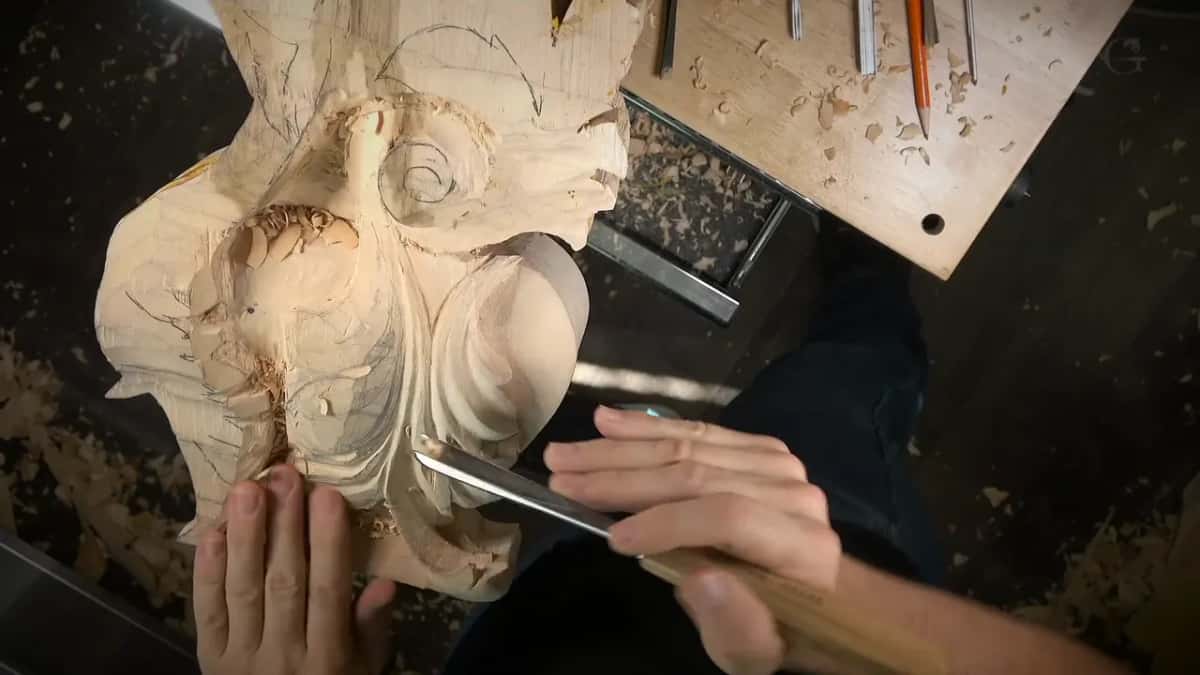
One long gouge into the edge of a pale roughed leaf.
Then comes the part that matters to you. If you do not know where to get the basswood, those planks you can probably get in some craft store in your town. Over here in the United States there is a store called Michaels. You can go to Woodcraft and get basswood planks also. And if you are in a different part of the world, I am pretty sure you can find some suppliers who would supply you.
Look at that last sentence, because it does real work. I name the shops I know, and I stop naming them the moment I leave ground I know. You will find the same shape on my page for carvers in the UK.
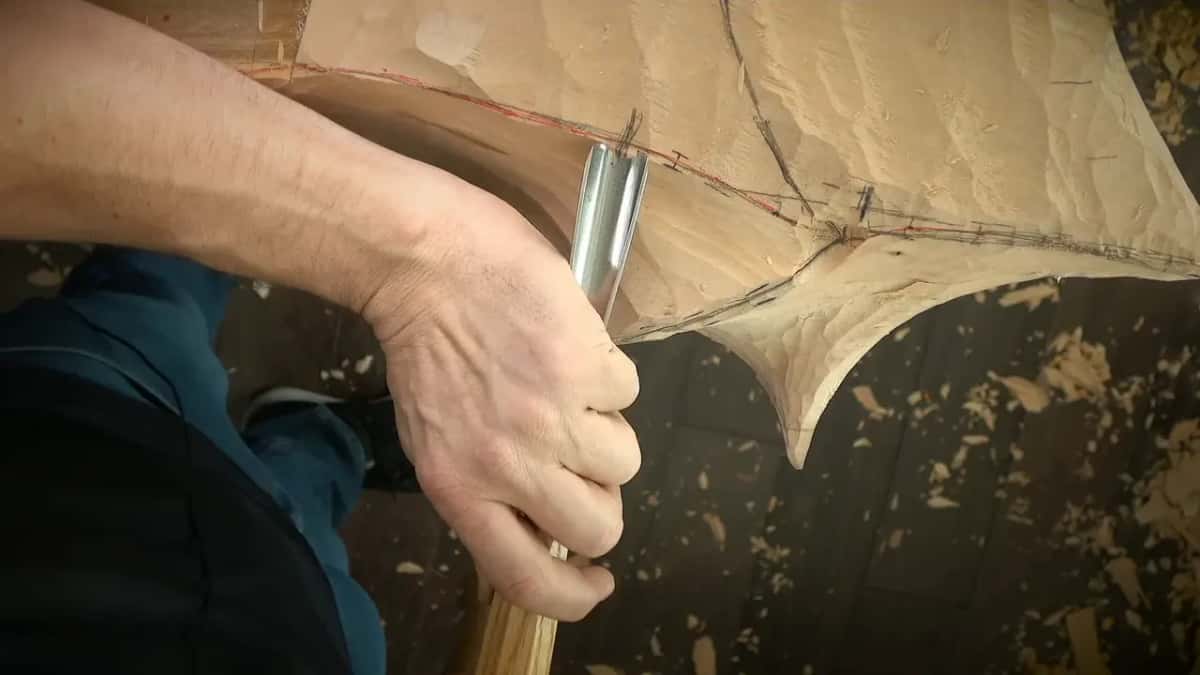
My fist on a long gouge, bevel planted in a pale blank.
I should also own up to a contradiction, because I say this wood both ways myself. In the sharpening lessons I call basswood a soft wood, plain and simple. Over in the acanthus and rosette lessons I say they call it soft wood, but it is not really soft, and I go further: in old European culture it was not considered a soft wood at all. It was considered a hardwood, and the soft wood would be a pine. Both of those come out of my mouth. The phrase I keep coming back to, over and over, is soft enough.
So what do I do if nobody near me sells basswood?
You find out what your own yard actually keeps, and you start from there. I answered this on camera about carving wood in Australia. My students there cannot get basswood, so they order it out of Europe and pay the freight.
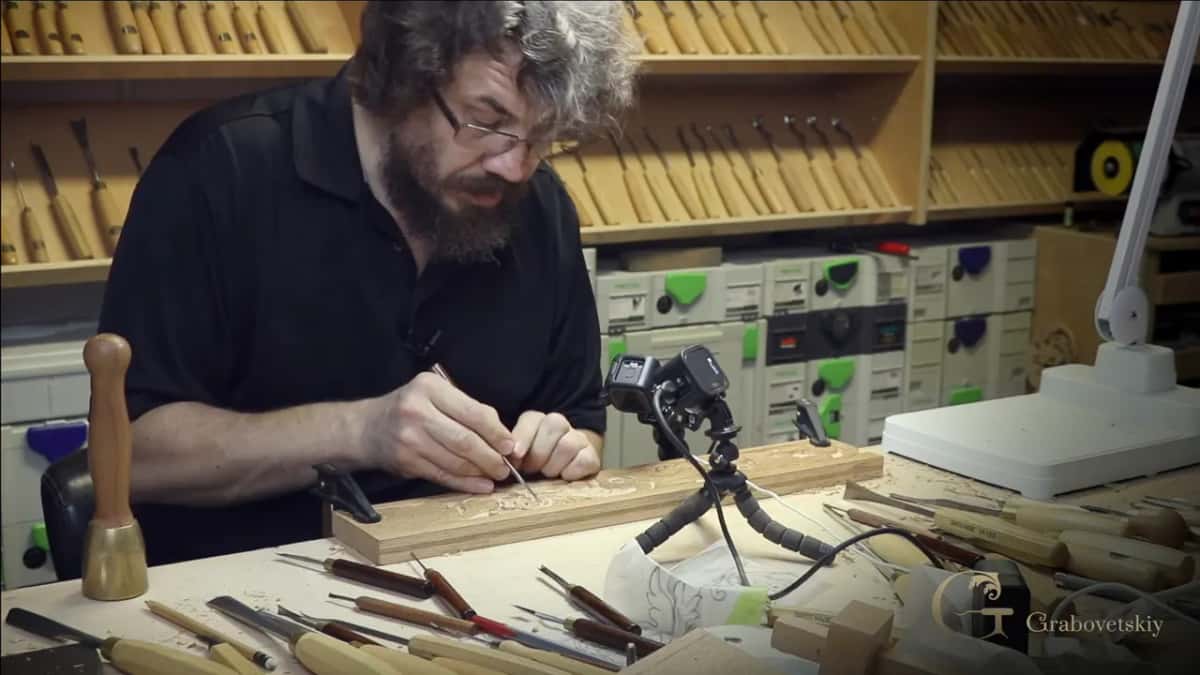
A long tan open-grained board, brass mallet among the gouges.
On that livestream I named the one substitute I had heard of, jelutong, and admitted out loud that I might be saying it wrong.
A whole lesson on my site came out of a man on Instagram asking me for a good supplier of basswood blanks. I said yes, absolutely I do. Then I asked him where he was located. Not to stall him. Where you live is most of the answer.
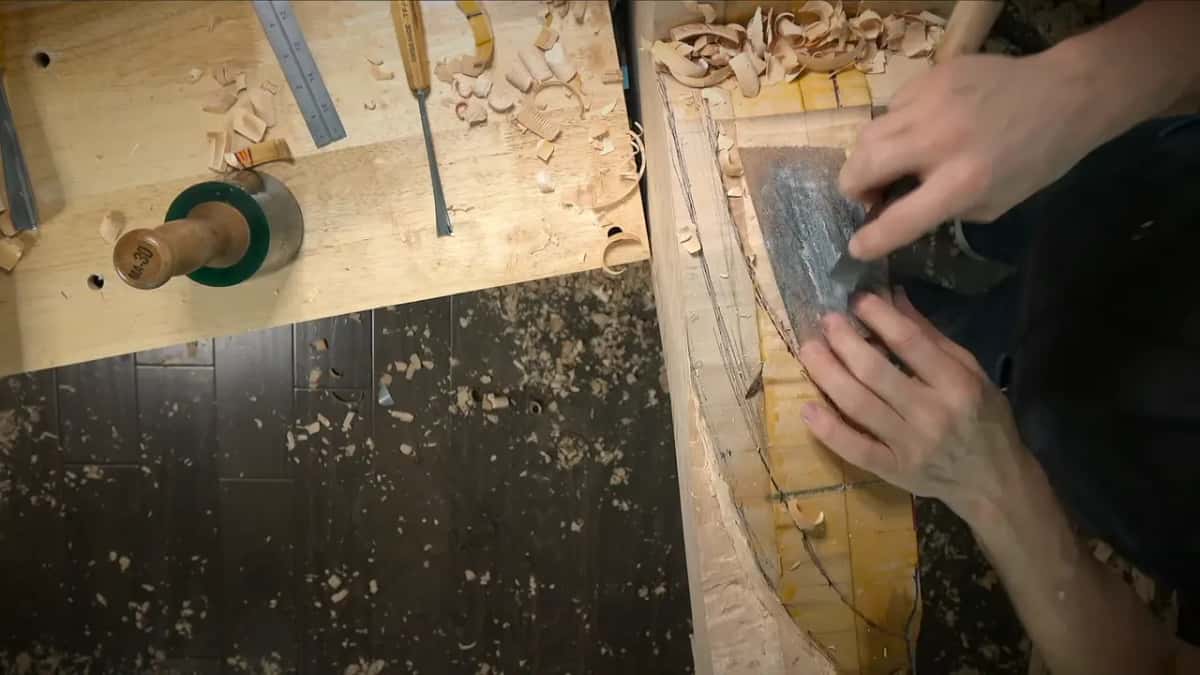
A wide steel blade on a curved blank.
Then I gave him the part that works anywhere on earth. Go to a local lumberyard, and not just any lumberyard. A construction lumberyard will not have it, because that wood is not construction stock. You want the yard that sells to the furniture makers. So you Google hardwood lumberyard, and you start calling.
I say the same thing a shorter way when somebody asks me about thick stock. Check on your location where furniture makers shopping, and get with them. Broken English, and still the best advice here.
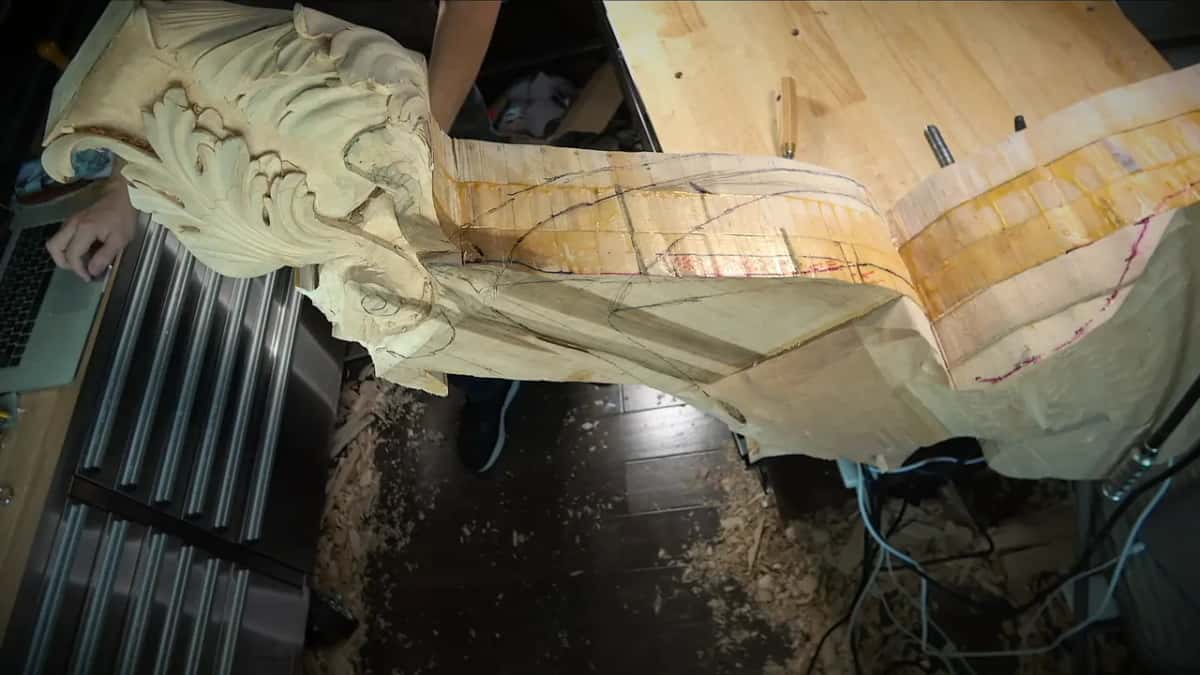
One end carved, the rest still pencil.
Now the part I had to read rather than live. Forestry South Africa, in its own industry statistics, puts the country's plantation resource at roughly 1.2 million hectares and says plainly what that resource is: pine, eucalyptus and wattle, not indigenous forest. So the wood a beginner can walk in and buy off the shelf is plantation softwood and plantation gum.
The gum in a yard is usually sold as saligna, a label that covers more than one Eucalyptus, and the nearest published account of how a plantation gum of that group cuts is The Wood Database entry for rose gum, Eucalyptus grandis. Camphor is the other one you will trip over, planted far outside its native range. Camphor turns up on The Wood Database page for camphor as a scented timber of moderate density that can irritate skin and lungs.
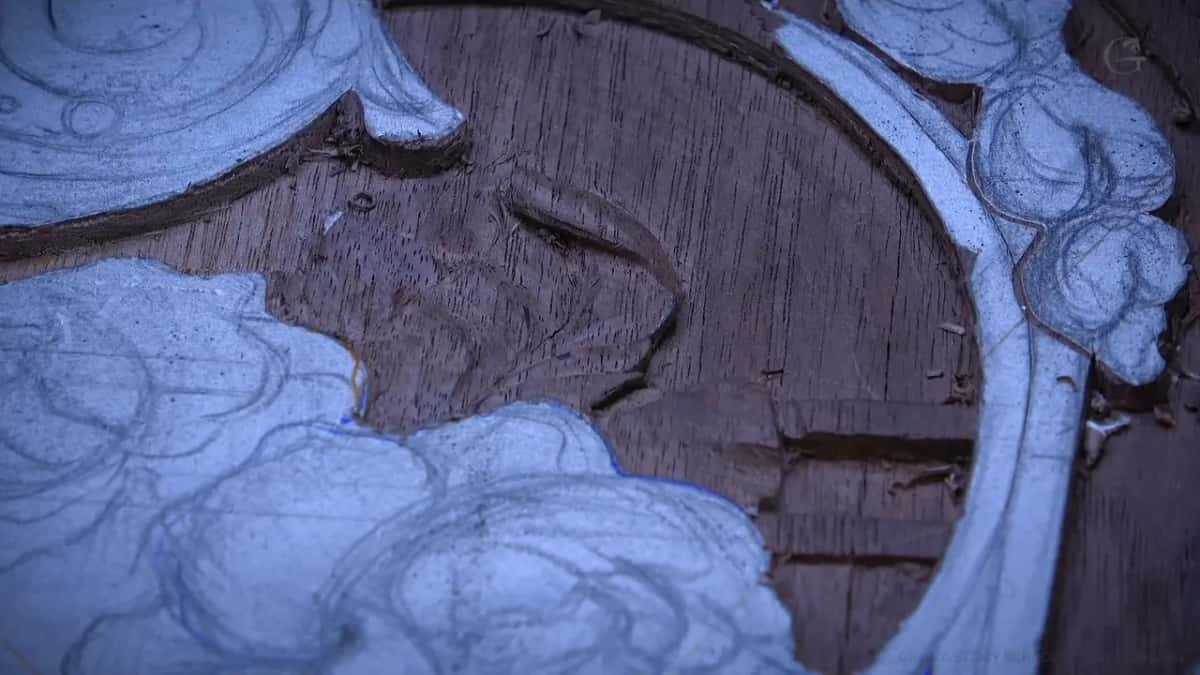
A dark open-grained panel, its raised design still pale.
Wild olive deserves a line of its own. The SANBI PlantZAfrica page on wild olive describes a dense, fine grained indigenous wood, and it is not among the protected trees in Gazette 42887, so you may simply buy it. Dense and fine grained is a hard start, whatever the species.
Which South African woods can a beginner legally buy?
Plantation pine, saligna gum, camphor and wild olive are all yours to buy. The famous indigenous carving timbers are a different story, and the difference is a piece of paper.
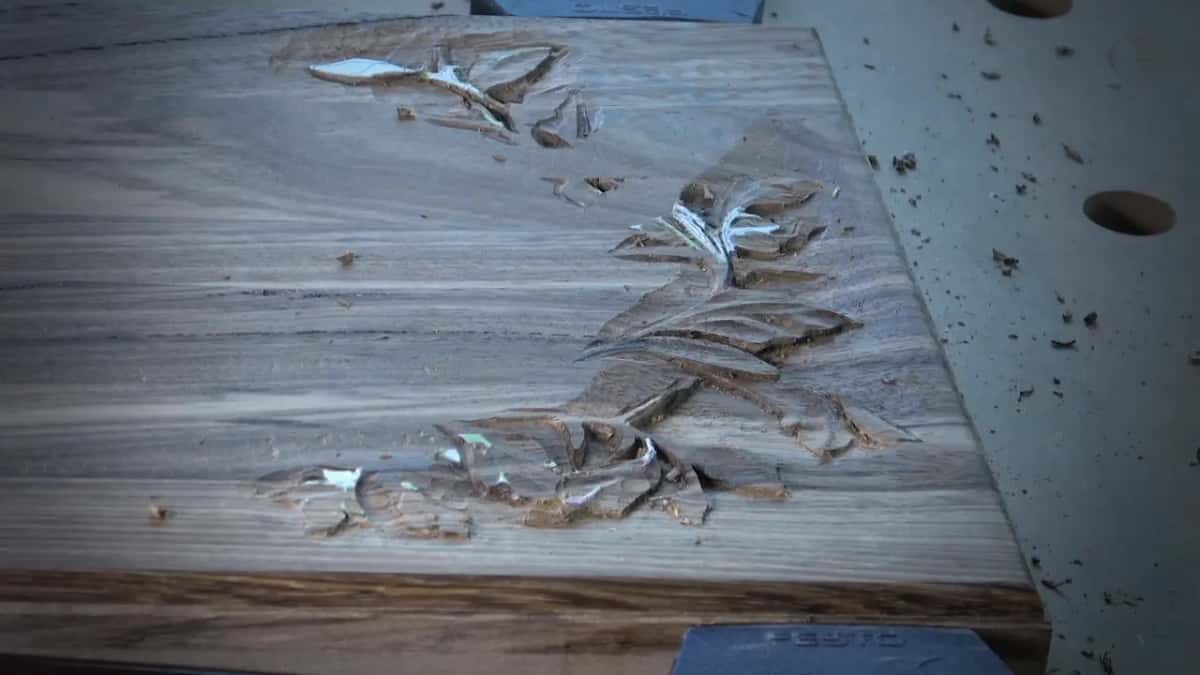
White layout paint sitting in the hollows of a dark streaked board.
SANBI hosts a copy of the protected tree notice, and it spells out the rule under the National Forests Act. No person may cut, damage, transport, buy or sell a protected tree, or any forest product that came off one, without a licence from the Minister. A board is a forest product. So is a bowl.
Government Gazette 42887 is the primary text, and it names them. Ocotea bullata, which is stinkwood. Pterocarpus angolensis, which is kiaat or wild teak. And the yellowwoods: Podocarpus latifolius, Podocarpus henkelii, Podocarpus falcatus and Podocarpus elongatus. The 2024 annual list from the Department of Forestry, Fisheries and the Environment still carries every one of them, and Prunus africana, already there in 2019.
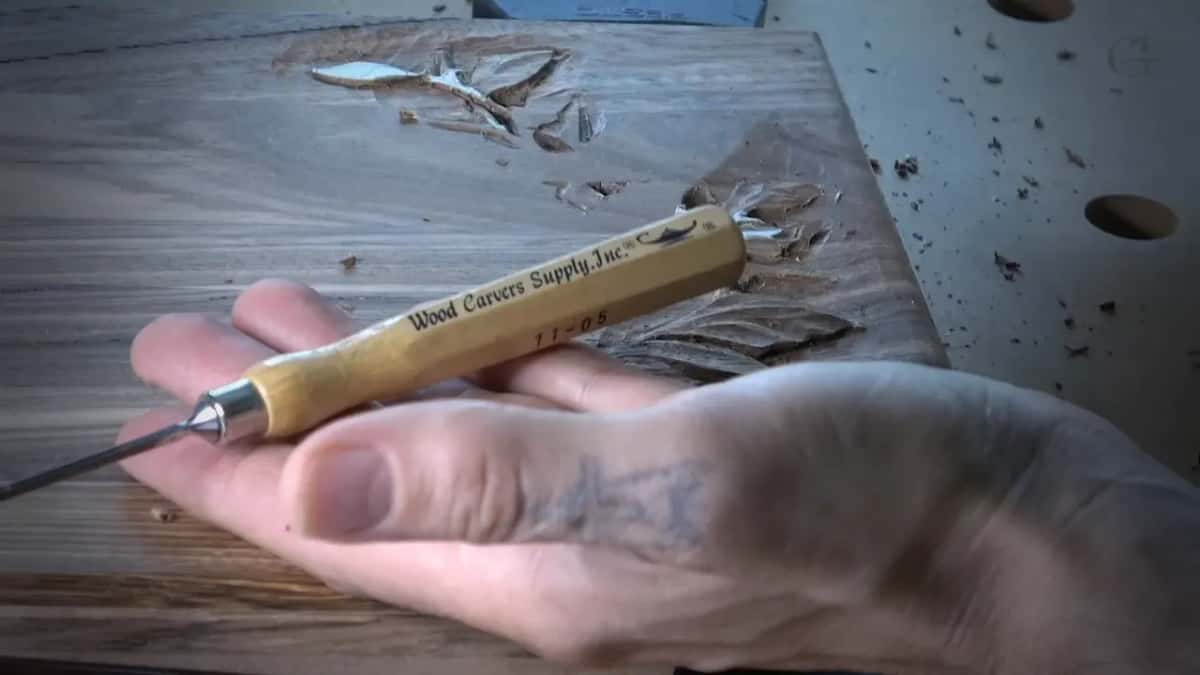
The maker's name burned into the handle.
That list also grows. A news release from the same Department announced red and pink ivory, jackal berry, manketti and umtiza going on. So never treat the list as fixed. Look it up the week you buy.
| Wood | Can a beginner just buy a board | Where that comes from |
|---|---|---|
| Plantation pine | Yes | Forestry South Africa |
| Saligna gum, the plantation eucalyptus | Yes | Forestry South Africa |
| Camphor | Yes, with a dust mask on | The Wood Database |
| Wild olive | Yes | SANBI |
| Real yellowwood, Podocarpus latifolius | Not without a licence from the Minister | Gazette 42887 |
| Stinkwood, Ocotea bullata | No | Gazette 42887 |
| Kiaat, Pterocarpus angolensis | No, and export needs CITES paperwork too | Gazette 42887 and Forest Trends |
| Red stinkwood, Prunus africana | No, on CITES as well | Gazette 42887 and The Wood Database |
One more label to distrust in the shop. Imbuia furniture turns up all over South Africa, and the name sounds local because it shares the Ocotea genus with stinkwood. The Wood Database note on imbuia puts it straight: imbuia is Ocotea porosa, out of Brazil.
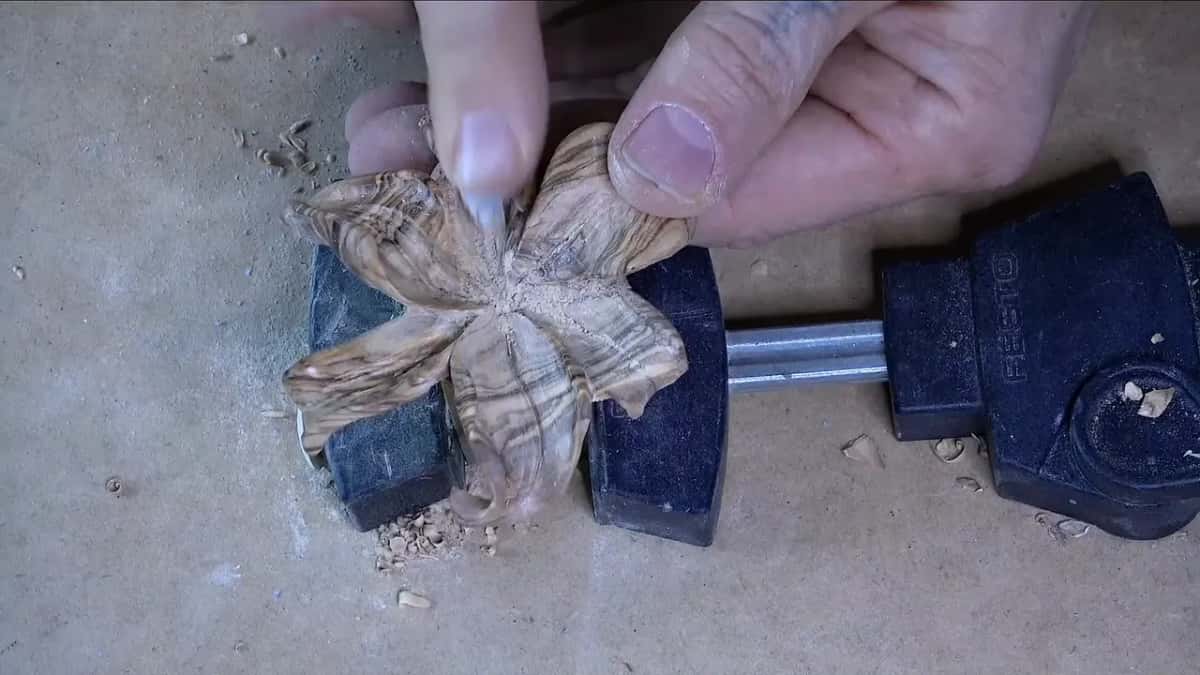
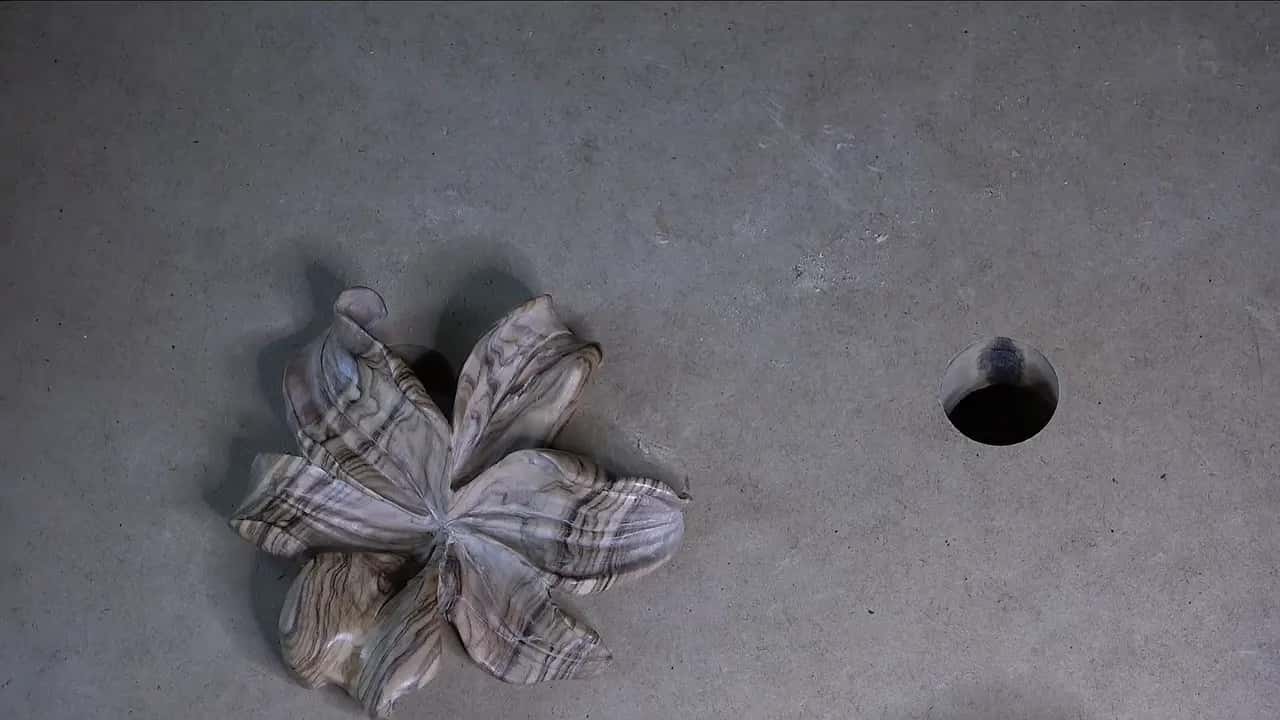
A small flower in figured wood, clamped between black jaws.
Is yellowwood banned by CITES?
Yellowwood is not a CITES species at all. What restricts it is South African national law and nothing else. Careful writers get this one backwards all the time.
CITES governs crossing a border. National law governs cutting the tree. A species can be caught by one, both, or neither, and collapsing them into one sentence is how an article ends up lying to a reader who loses a shipment.
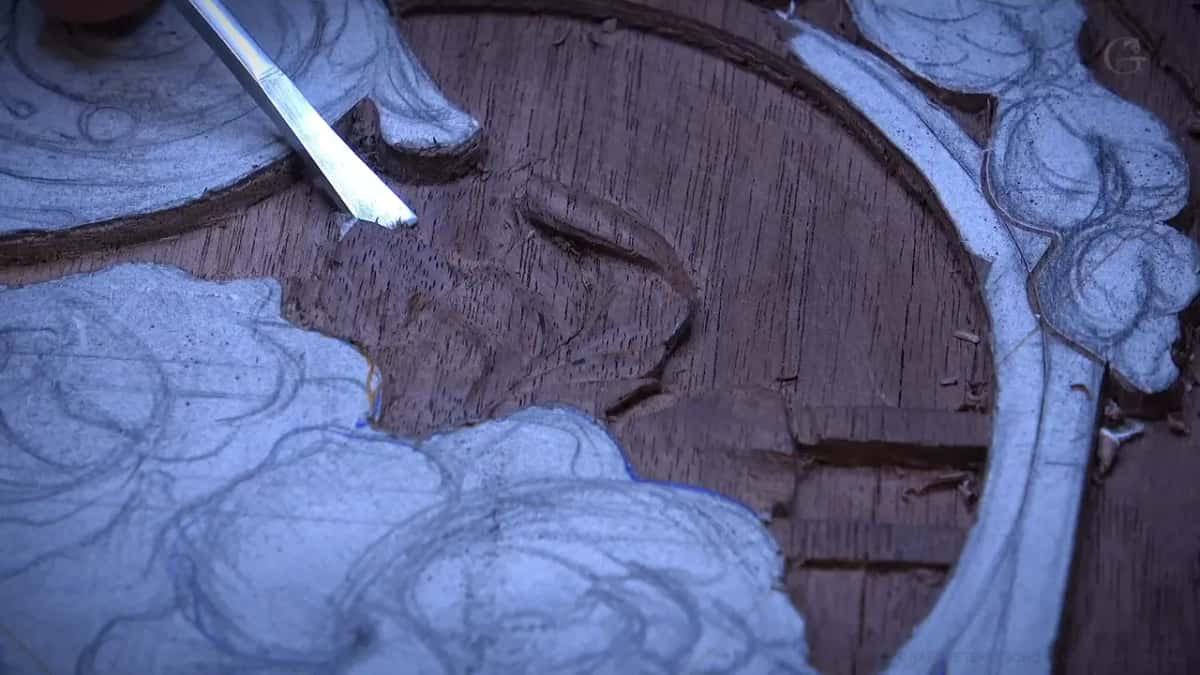
A bright chisel lowering the background of a dark panel.
Only two Podocarpus entries appear in The Wood Database table of restricted and endangered species: Podocarpus parlatorei on Appendix I, and Podocarpus neriifolius on Appendix III for Nepalese wood. Neither one is your yellowwood. South African national law is what stands between you and that board, and it stands there firmly.
Kiaat is the opposite case, and it is caught twice. It sits on the South African protected list, and it went onto CITES Appendix II on 23 February 2023, when CoP19 listed every African Pterocarpus species. The Forest Trends brief on those listings is the clearest account I found. Lawfully felled kiaat still needs paperwork to leave the country. What stings is that the SANBI profile of Pterocarpus angolensis puts the tree in the northern bushveld and calls it the classic local carving and furniture timber.
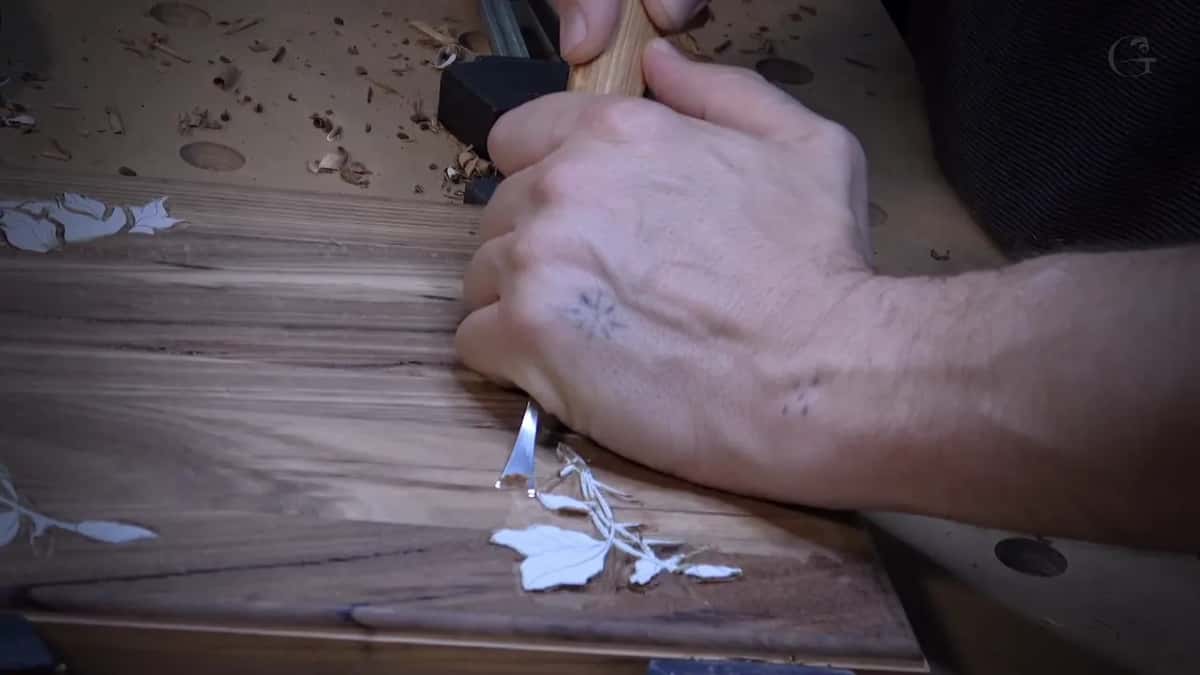
A mallet raised over a gouge on a dark figured lid.
Red stinkwood, Prunus africana, is the other double. Protected at home, and on Appendix II since 1995, with the listing reaching finished wood products. To check a species yourself, Species+, run by UNEP-WCMC with the CITES Secretariat, is the official lookup. SANBI on real yellowwood is worth a read anyway: the national tree, slow growing, every Podocarpus there protected after historic over-logging. The stinkwood page in the same archive is shorter. Good trees are now scarce.
What about the jacaranda that came down on my street?
Carve it. Jacaranda is not protected. It runs the other way, it is a listed invasive, and the listing skips the city streets where most of them stand.
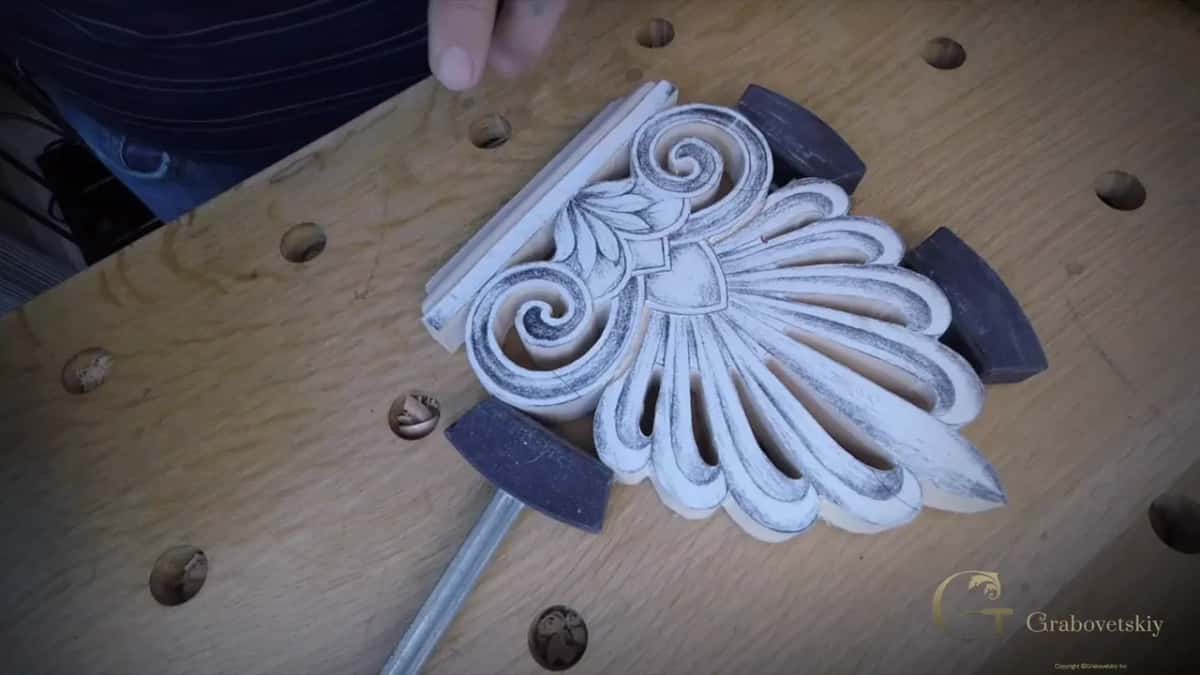
A chalked palmette ringed by three rubber-faced mallets.
The NEMBA alien and invasive species list in Gazette 43726 carries Jacaranda mimosifolia as entry 180, Category 1b in Gauteng, KwaZulu-Natal, Limpopo, Mpumalanga and North-West. The same notice does not list it for urban areas inside those provinces, and it does not list it anywhere else in the country.
The Agricultural Research Council sets out what those categories require of a landowner, and the practical reading is plain. A jacaranda the city already felled in the street is yours to take home and carve. Planting one, selling one, or letting one spread inside a listed area is the part the law is aimed at.
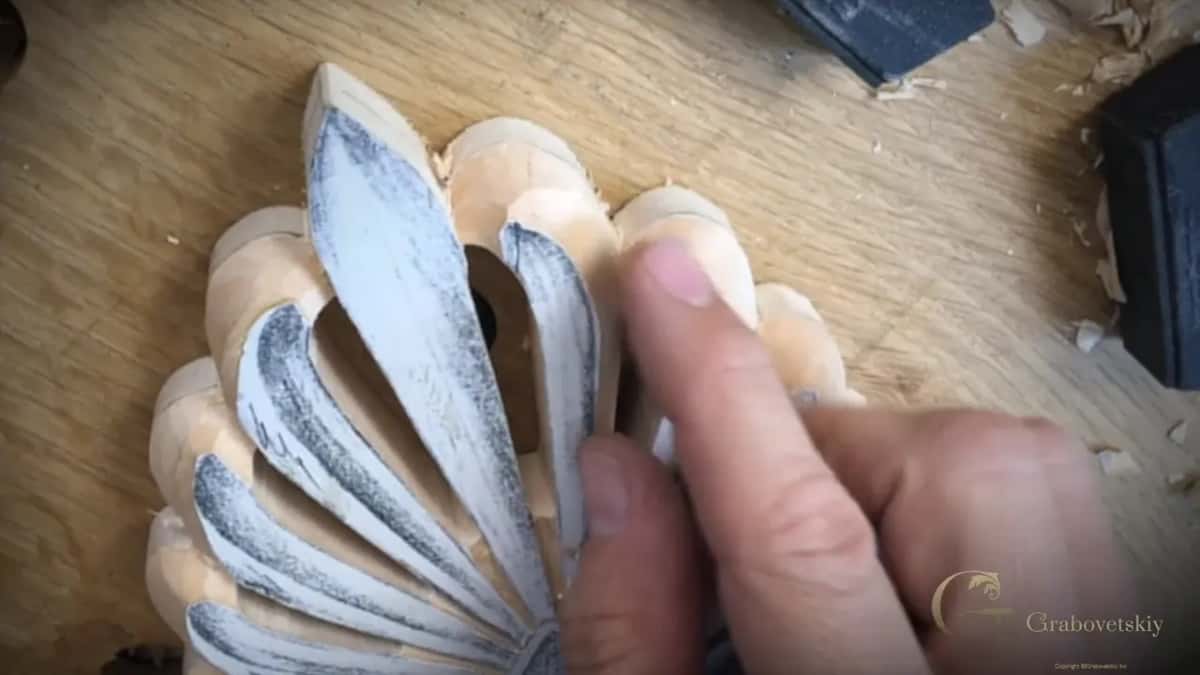
My fingertip where one bead has broken away.
On jacaranda I am reporting what the gazette says and nothing further. So I will not tell you how it cuts. I will tell you that free timber off a felled street tree is the cheapest practice wood a beginner ever gets. A tree felled last month is still wet, though, which raises the separate question of drying wood before you carve it. A wood you are free to ruin is worth more to a learner than a wood you are frightened of, which is also the whole argument of my ranking of softwoods for beginners.
How do I test a board in the yard before I buy the stack?
Five checks, and every one of them works in any country on any species. This is what my hands do.
Step 1, look at the end grain and find the rings
When I buy wood I look at the edge first. I want a quarter sawn or a rift cut board, and I want the face closer to the bark side than to the heart. If it is a straight slice through the log, I try not to buy it, because it is going to move a lot and it is going to cup.
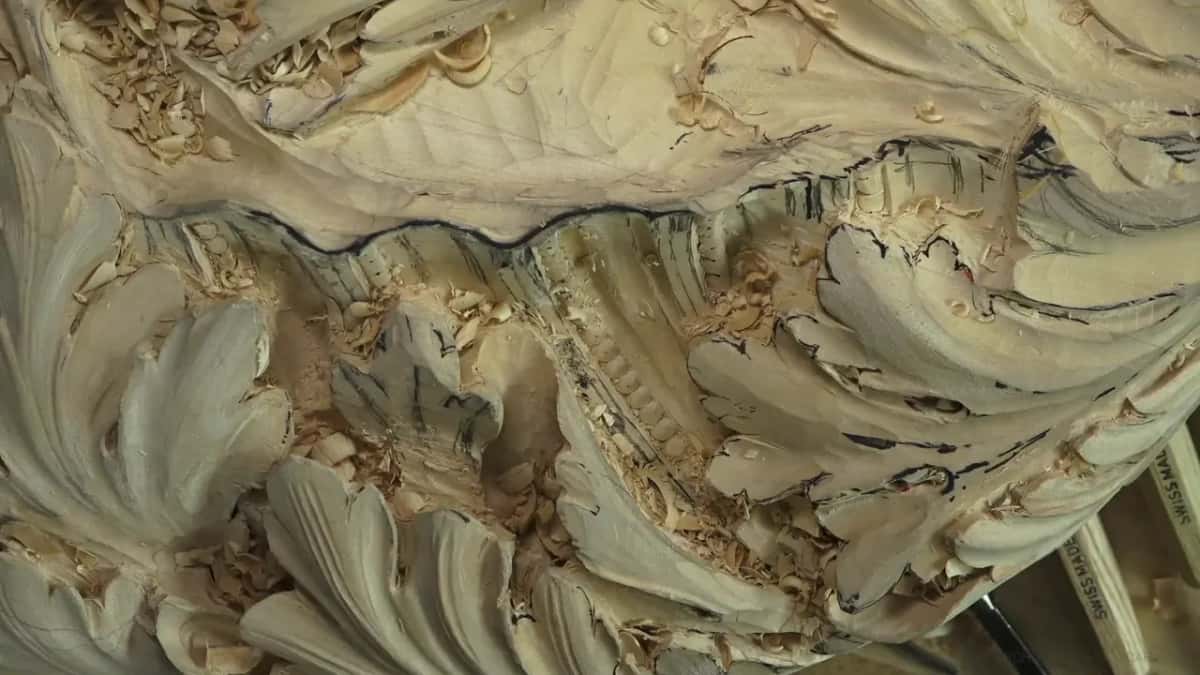
Charcoal lines still crossing acanthus leaves buried in chips.
Step 2, turn the board over and count the stripes you can see
This one is an eye test, not a hand test. I do not like to carve pine, and the reason is not hardness. What bothers me is that all of the grain is really visible, and it distracts. On the wood I love you can barely see the grain, so your eye stays on the shape you are cutting instead of on the stripes underneath it. A loud face fights your drawing first.
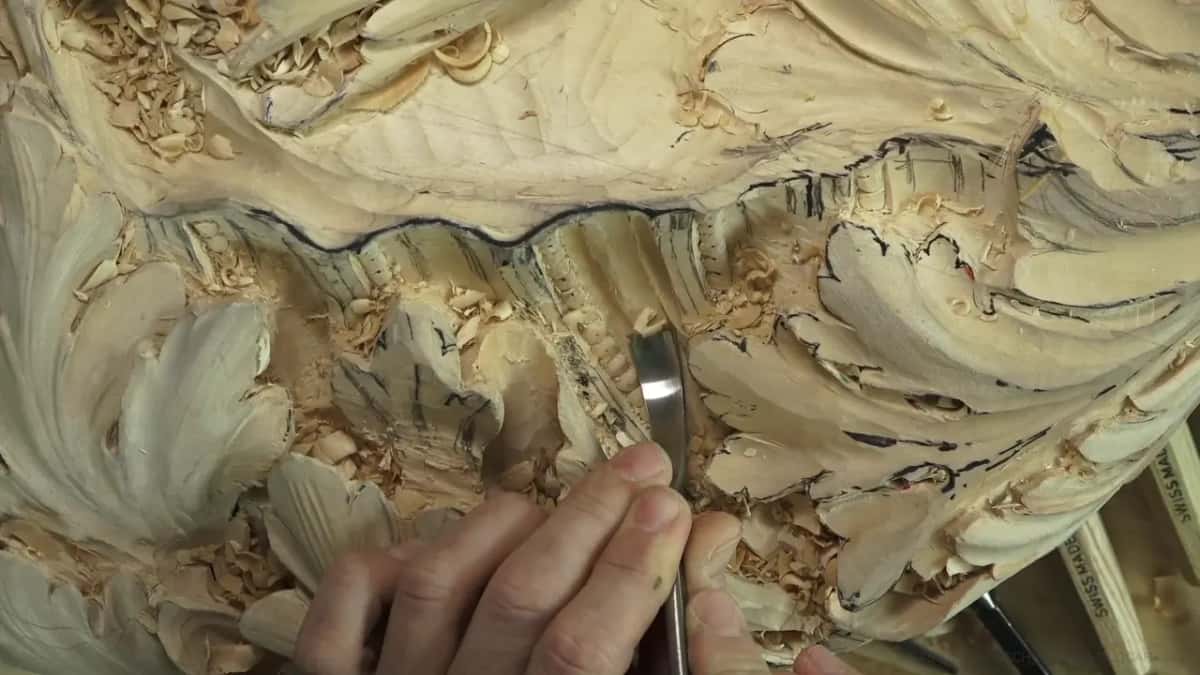
A gouge slicing a fluted channel, chips piling in the hollow.
Step 3, ask the yard whether the stack was air dried or kiln dried
When you get wood from a lumberyard, most of the time it is kiln dried. They use that big stove and cook the water out. I found that it moves a lot more. My own wood is all air dried, and some of it has sat in my shop untouched for over ten years, a little of it for twenty. Air dried stock is hard to find now, so ask the question, then take what you can get. The USDA Forest Products Laboratory Wood Handbook holds the moisture and shrinkage numbers, and I have a longer piece on how long wood takes to dry.
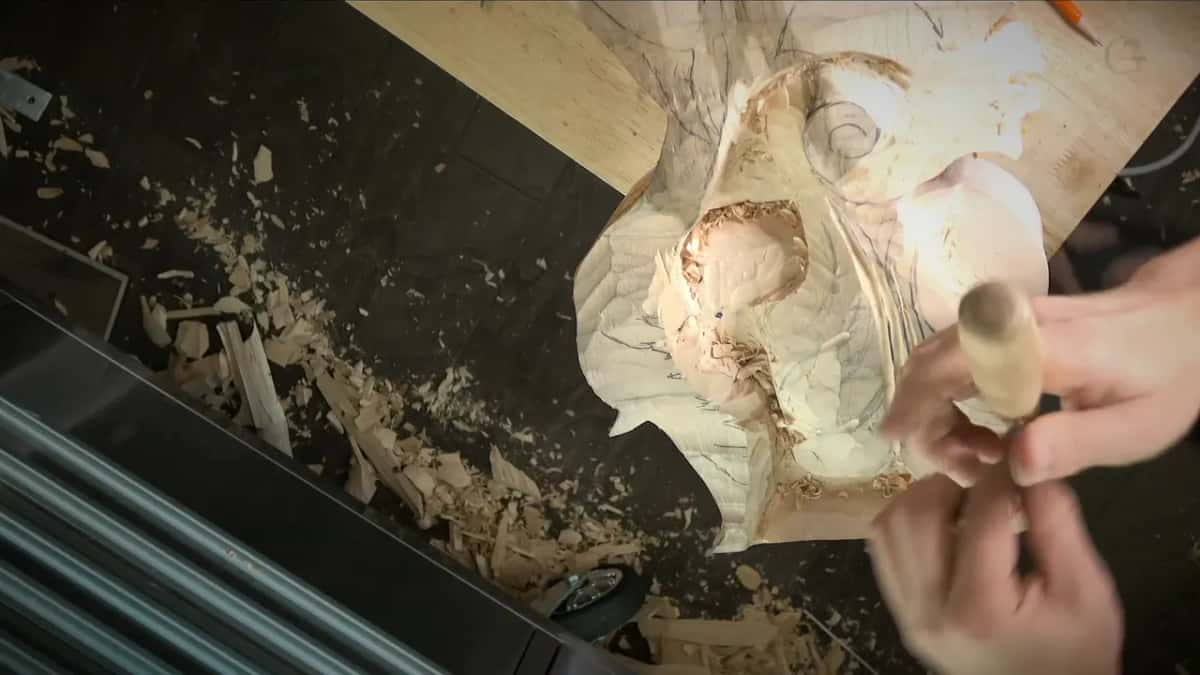
Both hands on a gouge above a pale leaf panel.
Step 4, buy the thin board and glue up instead of paying for thick stock
You do not really have to buy thick stuff. Just get the four quarters material, which is three quarters of an inch, and laminate it together, and there you go, you have a thicker board. The smaller the piece you buy, the more expensive it gets. You spend less money and you pay more per inch, which is worth knowing before you order a handful of little blanks.
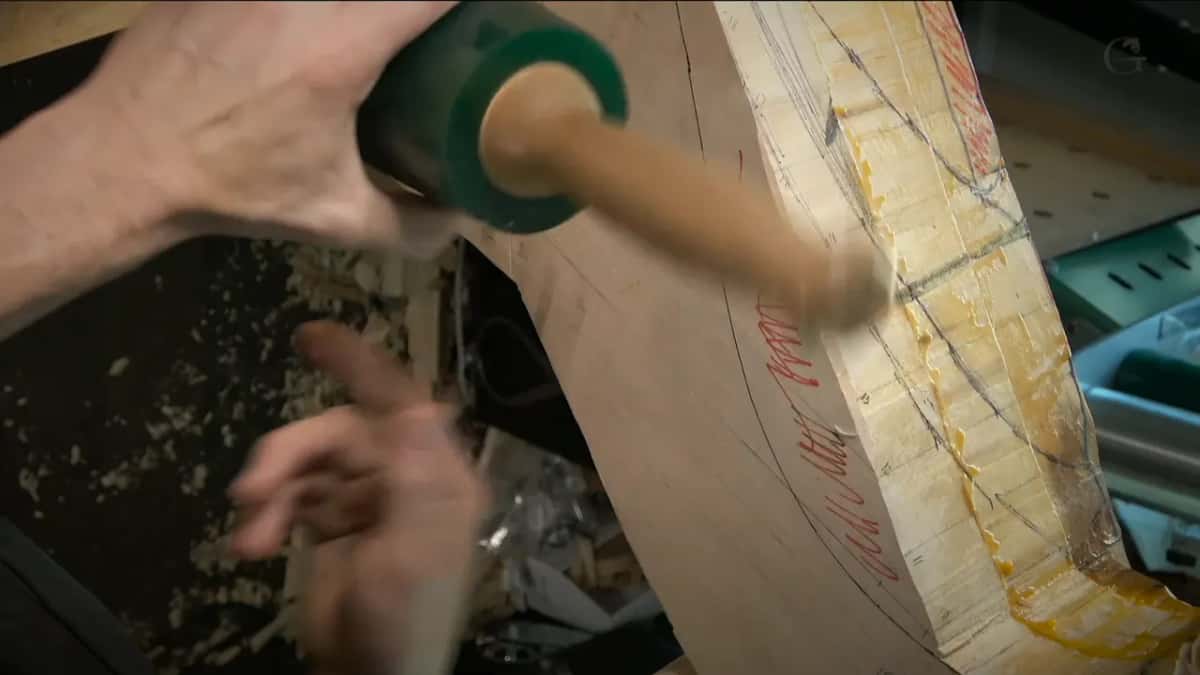
A green mallet over a laminated blank, red waste hatching showing.
Step 5, take one cut with a sharp tool before you buy the pile
Buy a single board first. Sharpen properly, take one slice with the grain and one against it, and watch what the wood does to your edge. Some people say the best wood is a soft wood and your tools should not get dull. That is not necessarily truth. Basswood is soft wood, and your tools still get dull, and really quickly sometimes.
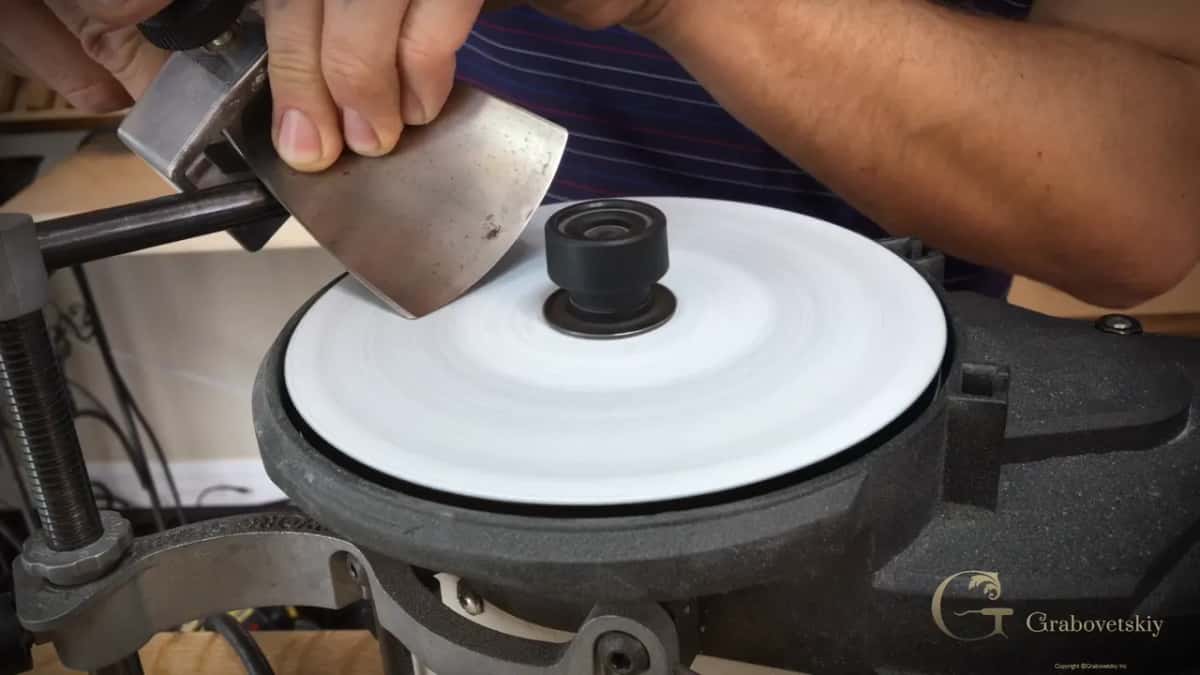
A wide fan-shaped blade meeting the spinning honing wheel.
Why does a dense board fight you?
The fibers under your blade have nothing holding them up. I usually wait until day three of an in person class before I explain it, because nobody understands it until they have felt it.
Think of the grain as a bundle of drinking straws, where the ones underneath hold up the ones on top. Carve from the supported side and the wood slices. Come at it from the other side and the straws have nothing beneath them, so they rise up and they fight. Pet a dog against the grain and you have the whole lesson in your hand.
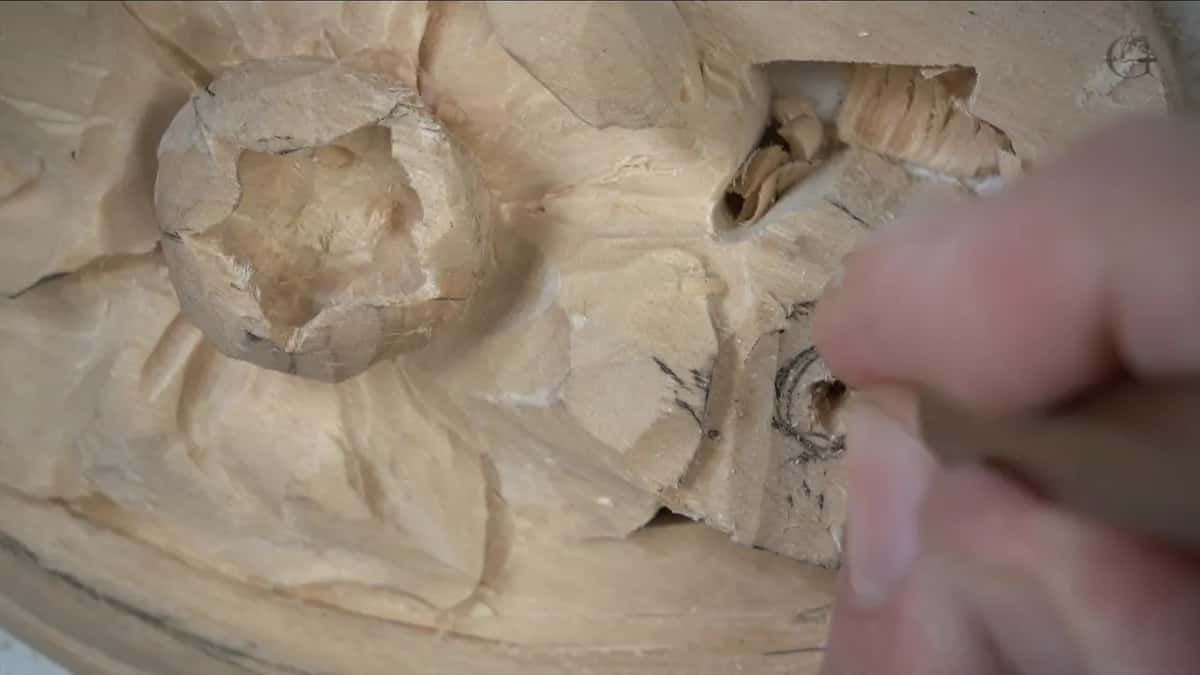
Ragged fibers standing up in the pocket beside the bud.
Now take one channel with two sides. One side runs with the grain and the other runs against it. So this cut is going to be a clean cut, and that cut is going to be a really rough cut, and it splits, and that creates the problem. You can attack one side and then attack from the other, if the space is wide enough. On a tiny spot you cannot, and you have doubled your time for nothing. More on two grain directions in one cut.
A student beat me to it. He said sharp tools, and I added the second half. Sharp tools break the rules. If your tools are really sharp it honestly does not matter much, you can go against the grain or along it, and you are not going to split, you are not going to make a big mistake. Which is why I point beginners at carving in the direction of the grain, then tell them the rule bends.
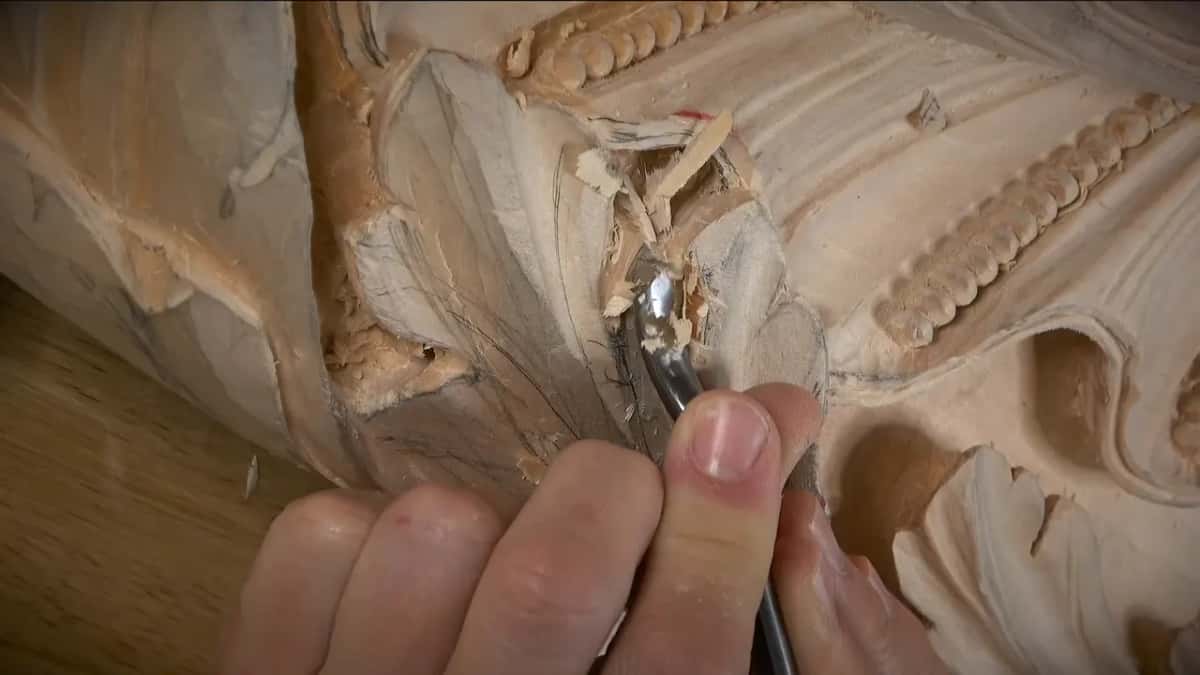
One sliver of fiber lifting at the blade.
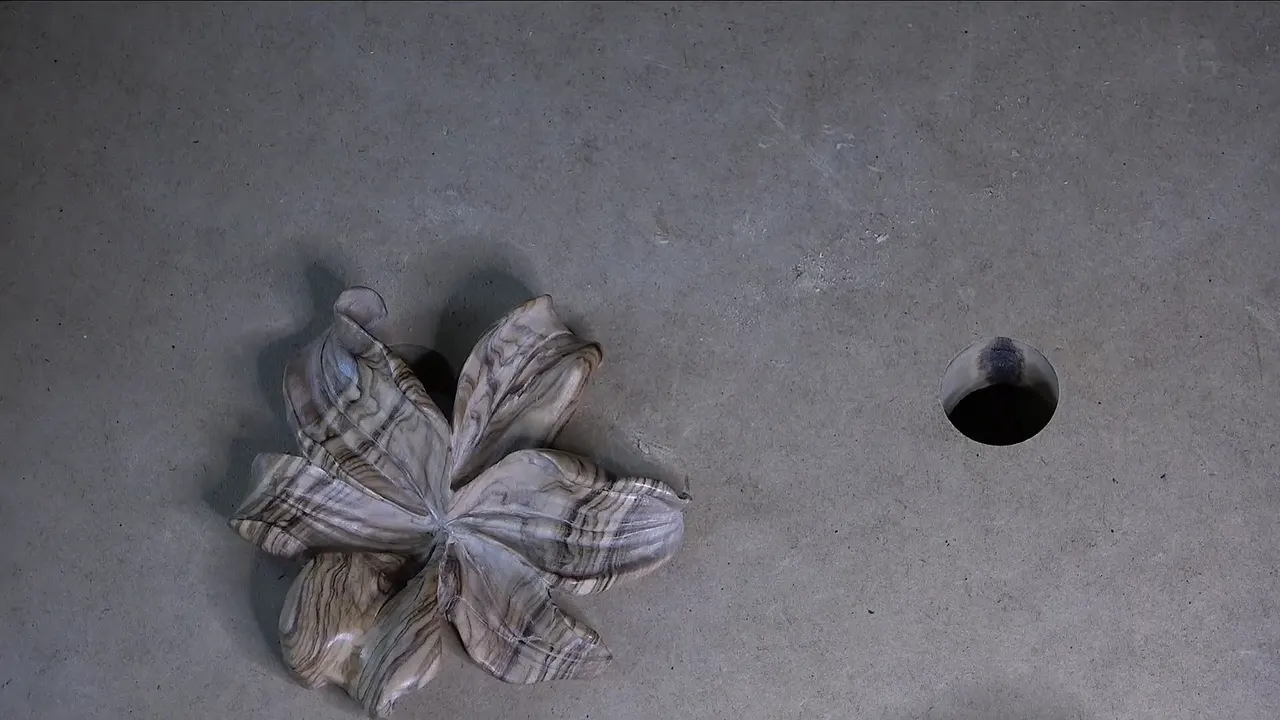
That exercise above is part 2.3 of my beginner course. Nine minutes of following a pencilled line at a low knife angle, and in the middle I stop to show which way the grain runs.
When the wood does fight you, the fix is not a different species. I take the cut back and take a smaller chunk. I reach for a smaller tool for the same reason: I can control it, remove smaller pieces, and stop worrying about fighting the wood.
Dense is not automatically bad either. I carved an olive wood box and the material was really dense as far as how it carves, and that was fine. Still much better than hard pine. I had to carve hard pine once, harvested in the 19th century and dried for a long time. You cannot even drive a nail in it. I broke quite a few gouges.
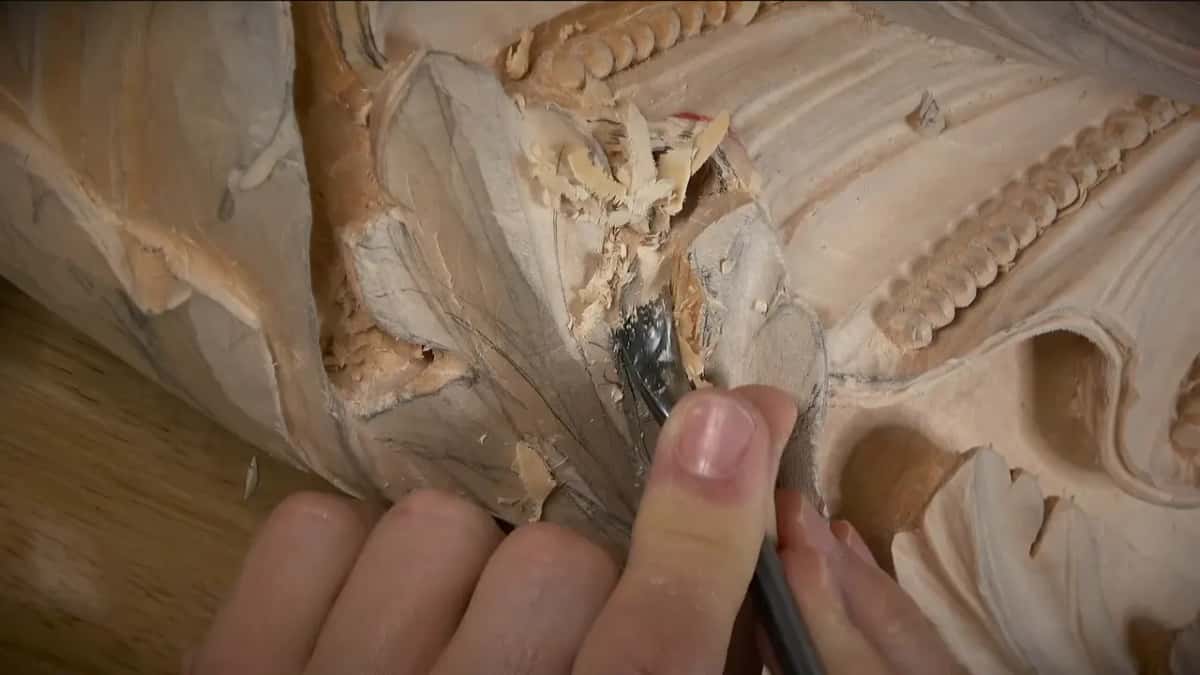
Torn fibers heaped around the blade in a deep carving.
Does a harder board need a different edge on my gouge?
A shorter bevel on the gouge, and a lot more patience with the strop. Short bevel, I use harder woods, like oak. A long thin bevel goes weak the moment the wood pushes back at it.
Oak is a little harder on tools, and I say that as a man who loves English brown oak. Both things are true at once. A wood can be a pleasure and still eat your edges. So on the harder boards I regrind shorter, I strop more often, and I take less wood per pass.
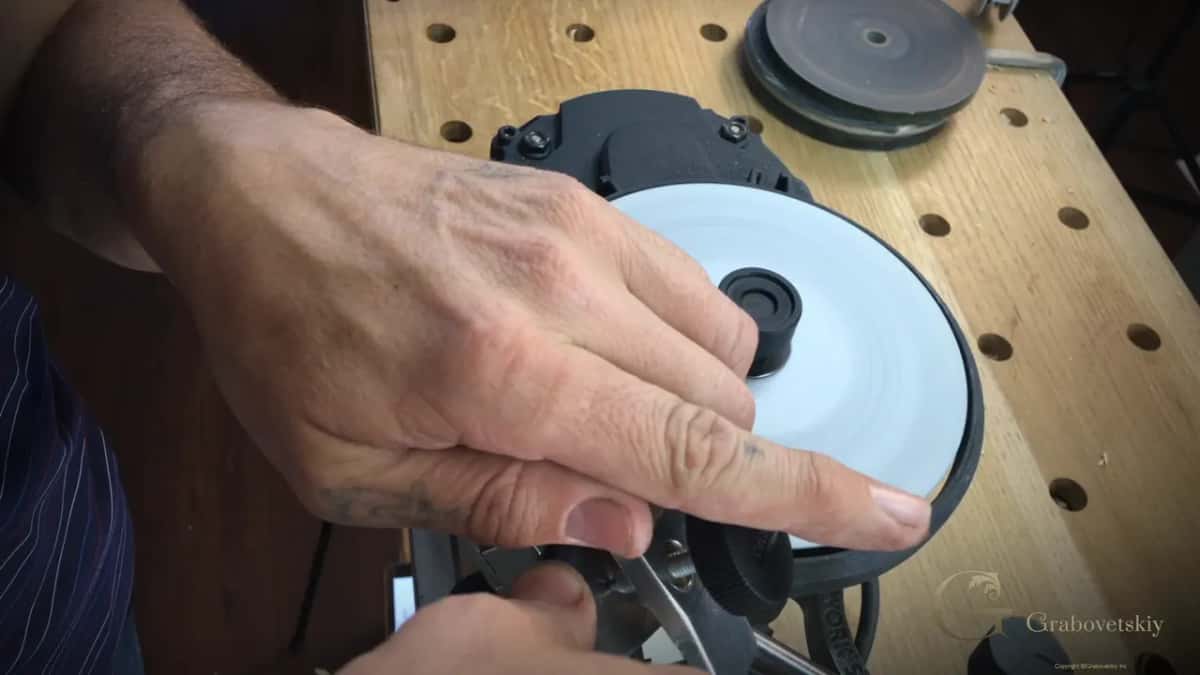
A hand steadying the honing wheel, a gouge in the jig.
Which brings me to the two woods on this page that carry a warning. The Wood Database file on muninga, which is the trade name for kiaat, says muninga works easily and has outstanding stability, and in the same breath that it blunts cutters moderately, tears out where the grain interlocks, and can irritate skin and lungs. Camphor comes with the same footnote about its dust and its oil. Wear the mask. I do not like stone carving because of the dust, and wood dust is not innocent either.
For a number behind any of this, the USDA Forest Service Wood Handbook is the standard reference. I will not hand you a hardness figure. My whole vocabulary for hardness is harder, softer, crunchy, dense, and whether the wood is fighting me, and a chart cannot tell you that a board is fighting you. I wrote out why the Janka number misses so much for a hand carver.
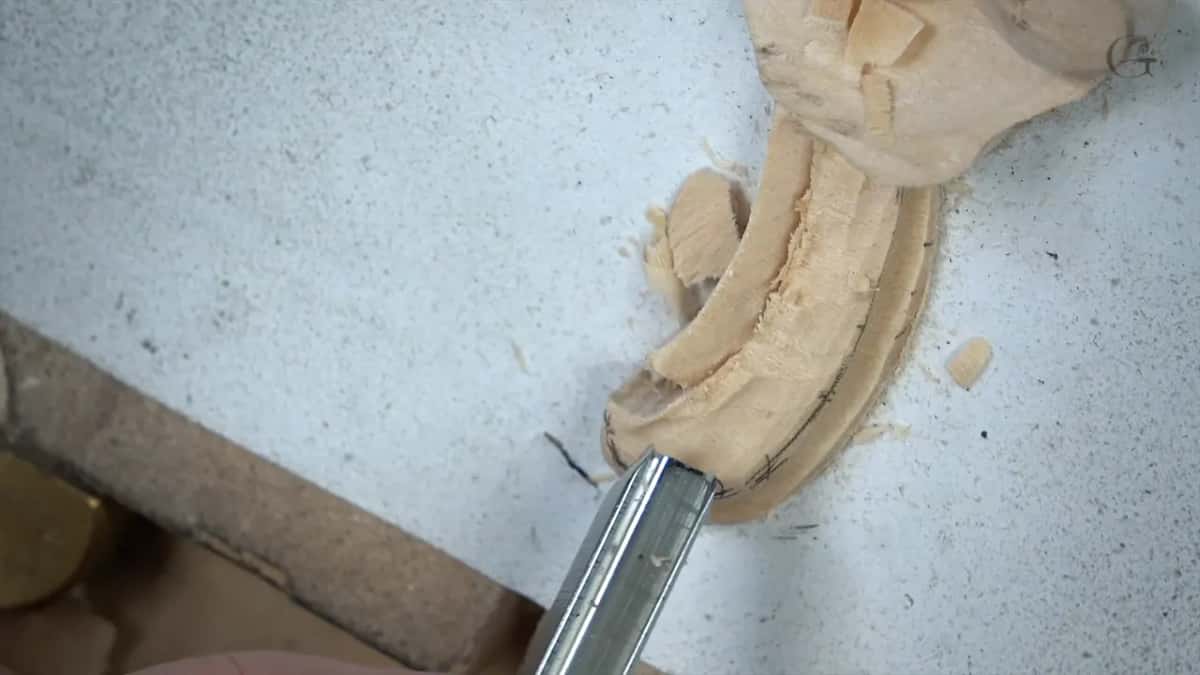
A gouge running along a raised leaf, the surface still rough.
Who has already carved these woods well?
Venda carvers, generations before any of us had a website. I raise it because a beginner who thinks the tradition starts with him works differently from one who knows better.
The Africa South Art Initiative archive carries Meshack Raphalalani, born 1950 in Venda, a sculptor working in the Venda tradition and a founder of the VhaVenda Arts Foundation.
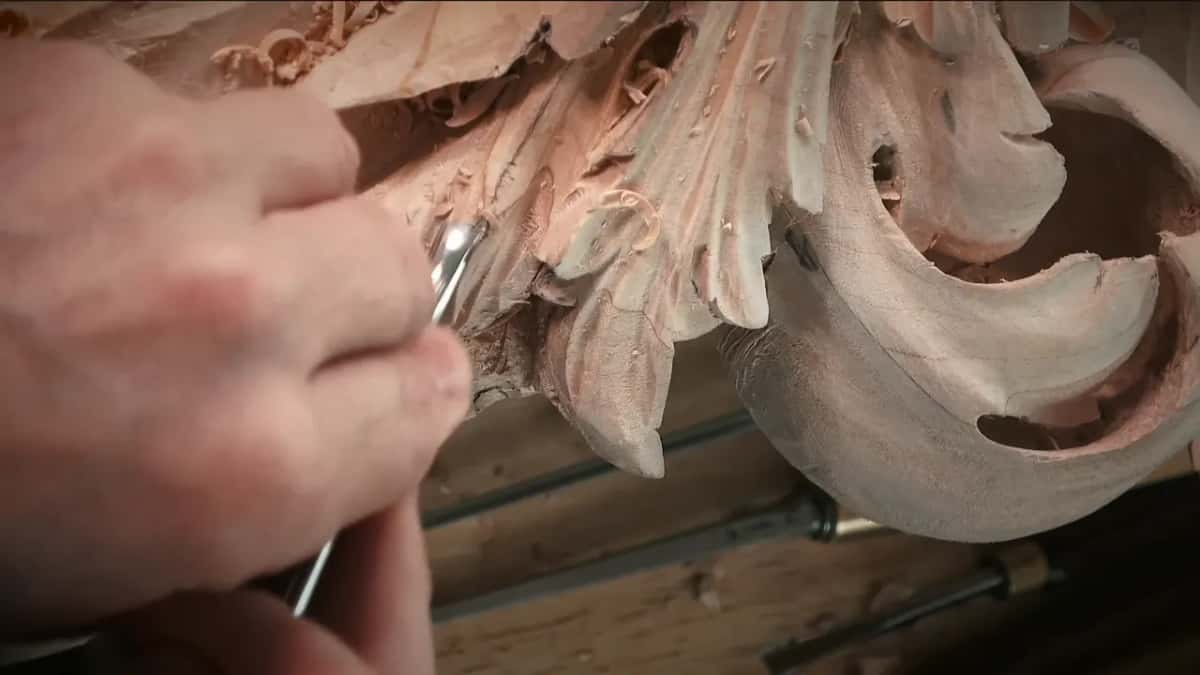
A small gouge at a deeply undercut scroll.
Students of mine live in Africa. Also Japan, Vietnam, Israel, Brazil, Argentina and Mexico, and I am not even counting the European countries. It tells me the itch to carve a shape into wood does not care where you were born. Same reason I bothered with the Cameroon version of this page, the Iceland one, and a short one for Botswana next door to you.
Keep all your offcut pieces, by the way. Absolutely nothing here is waste. Scraps teach you what a species does to an edge and they cost you nothing, which matters when you look at what a first year of carving costs. Half of the mistakes beginners make come from fear of the board in front of them, and a free offcut cures that faster than any lesson I can film. My guide to choosing wood for hand carving is the version with no country attached.
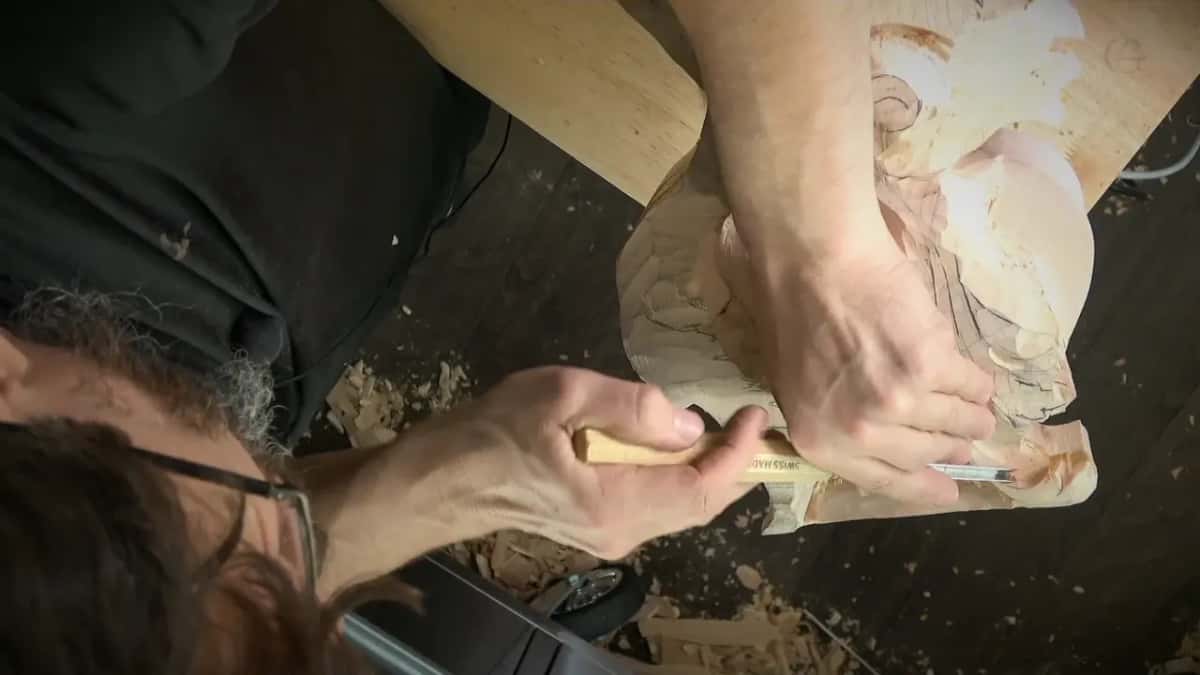
Both hands driving a Swiss gouge along a pale relief edge.
If you want the first cuts taught in order, with the wood question settled before you spend a rand on timber, that is what my First Cuts course for beginners is for. Join School of Wood Carving.
Frequently asked questions
Can I buy a yellowwood board without breaking the law?
Only with a licence behind it. The protected tree notice covers buying and selling, and not just the felling, and it reaches any forest product off the tree. Ask the seller for the paperwork. If the yard cannot produce it, put your money on plantation gum.
Does kiaat need paperwork if I post a carving overseas?
Yes, on two counts. The tree itself is on the South African protected list, and CoP19 put every African Pterocarpus onto CITES Appendix II on 23 February 2023. So a lawful log at home still becomes a permit problem at the border. Check the species on Species+ first.
Where do I start if my town has no hardwood yard?
Ask a furniture maker where he buys his stock. The yard that supplies furniture makers is the one that carries carving wood, and it rarely advertises. Failing that, find whoever sells timber online near you and phone the seller instead of clicking the button. Business people are open to it.
Is a softer board really easier on my gouges?
Not as much as you hope. Soft wood still dulls steel, sometimes very fast, and a dull edge tears fibers no matter how mild the species is. Sharpen before you carve, strop while you carve, and judge a wood by what it does to your edge.
Should I practise on the offcuts?
Always. An offcut owes you nothing, so you will try the cut you keep avoiding on the good board. Carve the same shape three times on scrap, watch where it tears, then move to the piece you care about. Nothing here costs less.
Filed under
- affordable wood types for carving
- beginner-friendly wood available in South Africa
- beginner wood carving guide South Africa
- best affordable wood for carving
- characteristics of good carving wood
- finding soft wood for carving projects
- how to choose wood for carving
- popular wood choices for carving
- qualities of beginner-friendly wood
- Safety tips for wood carving
- soft wood options for beginners in SA
- stable wood for beginners in SA
- tips for selecting wood for carving
- top beginner woods for carving in SA
- types of easy wood for carving South Africa
- Understanding Wood for Carving
- where to find carving wood in South Africa
- wood carving for beginners in South Africa
- wood that's easy to carve for newbies
- wood types that don't split easily
- wood with a pleasant smell for carving